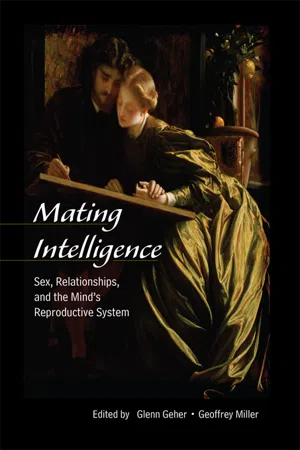
eBook - ePub
Mating Intelligence
Sex, Relationships, and the Mind's Reproductive System
- 480 pages
- English
- ePUB (mobile friendly)
- Available on iOS & Android
eBook - ePub
Mating Intelligence
Sex, Relationships, and the Mind's Reproductive System
About this book
Human intelligence is sexually attractive, and strongly predicts the success of sexual relationships, but the behavioral sciences have usually ignored the interface between intelligence and mating. This is the first serious scholarly effort to explore that interface, by examining both universal and individual differences in human mating intelligenc
Information
Publisher
Psychology PressYear
2007Print ISBN
9780805857498
9780805857481
Edition
1eBook ISBN
9781136678868
I
Introduction
Chapter 1
Mating Intelligence: Toward an Evolutionarily Informed Construct
This book introduces a new construct called ‘Mating Intelligence’ (MI) which concerns cognitive processes that uniquely apply to the domain of human mating, sexuality, and intimate relationships. This MI construct encompasses both species-typical psychological adaptations (such as the perceptual, cognitive, and decision-making processes for evaluating an individual's potential as a long-term mate), and a set of individual differences in the efficiencies, parameters, and design details of those traits. Although we all have some ability to assess who is attractive (a species-typical adaptation), some of us are better at this than are others (i.e., we show individual differences in adaptive functioning).
We propose the construct with some trepidation, because most new constructs in psychology are a waste of time. They may succeed in getting a new technical term associated with the name of a tenure-seeking researcher, but rarely lead to cumulative, consilient scientific progress (McGrath, 2005). Technically, new constructs rarely show good discriminant validity (predicting behavior differently from existing constructs) or good incremental validity (predicting behavior better than existing constructs) (see, e.g., Gottfredson, 2003; Judge, Erez, Bono & Thoresen, 2002). The burden of proof should rightly be against researchers trying to introduce a new way of parsing human nature or a new individual-differences variable.
This is especially true in intelligence and personality research, where most new constructs turn out to be little more than the good old-fashioned g factor (general intelligence, IQ), and/or one or more of the ‘Big Five’ personality traits (openness, conscientiousness, extroversion, agreeableness, emotional stability). For example, some evidence suggests that ‘political authoritarianism’ corresponds empirically to low intelligence plus low openness (i.e., conservatism), high conscientiousness (i.e., sense of duty), and low agreeableness (i.e., aggressiveness) (Heaven & Bucci, 2001; Jost, Glaser, Kruglanski, & Sulloway, 2003; Schultz & Searleman, 2002). Many other newly introduced constructs turn out to be little more than statistical sub-factors of general intelligence. For example, Howard Gardner's ‘multiple intelligences’ (Gardner, 1983) all correlate positively with general intelligence, but often can't be measured with as much reliability and validity, so they look more attractively elusive and mystical (see Gordon, 1997; Hunt, 2001; Klein, 2003; Pyryt, 2000). Similar problems afflict Robert Sternberg's construct of ‘practical intelligence’ (Gottfredson, 2003).
On the other hand, there are a few constructs—notably ‘social intelligence’ (Cantor & Kihlstrom, 1987) and ‘emotional intelligence’ (Salovey & Mayer, 1990)—that have provoked progressive research traditions in the last several decades. Research on social intelligence (including Theory of Mind, Machiavellian intelligence, autism, and face perception) has arguably been the most important innovation in developmental psychology and comparative psychology in the last 30 years (e.g., Reader & Laland, 2002). It has yielded thousands of papers on the ‘mind-reading’ skills of apes, children, and adults. Research on emotional intelligence has had a similar impact in business management, organizational behavior, clinical psychology, and relationship research (e.g., George, 2000). Both constructs are also informing the emerging fields of social neuroscience and affective neuroscience (e.g., Bar-On, Tranel, Denburg, & Bechara, 2003).
For both social and emotional intelligence, though, the development of reliable, valid individual-differences measures of the constructs has proven somewhat frustrating and elusive (e.g., Davies, Stankov, & Roberts, 1998; Geher, 2004; cf. Mayer, Caruso, & Salovey, 1999)—especially in finding measures that show good discriminant validity beyond well-established measures of general intelligence and personality (De Raad, 2005). Some evidence for discriminant validity has been published for some emotional intelligence scales (e.g., Livingstone & Day, 2005; Petrides & Furnham, 2001, 2003; Tett, Fox, & Wang, 2005). However, skeptics suggest that social intelligence is just general intelligence plus extroversion, or that emotional intelligence is just general intelligence plus agreeableness and emotional stability (see, e.g., De Raad, 2005; Matthews, Zeidner, & Roberts, 2004; Schulte, Ree, & Carretta, 2004).
Although such criticisms are important, they often miss the crucial tension that makes these constructs scientifically productive—these constructs bridge the gap between research on human universals and research on individual differences. They unify the experimental psychology tradition of Wilhelm Wundt and the correlational psychology tradition of Francis Galton. They identify not just a distinctive part of human nature, but a cluster of human differences that are socially salient and important. The human-universal aspect of these constructs helps researchers identify key adaptive problems, social functions, and cognitive mechanisms. The individual-differences aspect helps researchers develop valid ability tests that can drive comparative research across species, sexes, ages, populations, families, individuals, and psychopathologies.
For instance, emotional intelligence is a set of mental abilities (to read facial expressions, identify emotions in self and other, and control one's own emotions under trying situations), but it is also a partly-heritable, partly-trainable dimension of variation that is helpful to appreciate in school, work, and family life (Ciarrochi, Forgas, & Mayer, 2006). We all have emotional intelligence in some form, to a far higher degree than most other species. But we differ in how well it works, and even small individual differences in emotional intelligence can yield huge differences in life-outcomes—getting promoted versus fired, driving to a second honeymoon versus a divorce hearing. We suspect that Mating Intelligence will also turn out to have two faces—a set of universal mechanisms, and a dimension of individual differences—as a psychological construct.
A HISTORY OF MUTUAL NEGLECT BETWEEN MATING RESEARCH AND INTELLIGENCE RESEARCH
We aim for ‘mating intelligence’ to serve a research-motivating function like the ‘social intelligence’ and ‘emotional intelligence’ constructs did. Specifically, we hope it will build bridges between mating research (including evolutionary psychology, human sexuality, and relationship research) and intelligence research (including psychometrics and behavior genetics). These two fields have neglected each other for over a century.
Human intelligence research has neglected the central adaptive challenge in the life of any sexually reproducing species—finding mates and having offspring. To quantify this neglect, we examined all volumes of the premier international journal Intelligence since its inception in 1977. We searched in SciSearch for Intelligence articles that included all keywords we could list related to mating (e.g., mating, mate, marriage, sex) in the title or abstract. We then read the abstracts to see if they genuinely concerned mating issues. As of November 2005, only 3 of 811 articles (0.8 percent) in Intelligence have dealt directly with human mating (Benbow, Zonderman, & Stanley, 1983; Kanazawa & Kovar, 2004; Rushton, 2004). Another 43 articles concern sex differences unrelated to the context of mating behavior (e.g., Deary, Thorpe, Wilson, Starr, & Whalley, 2003).
Equally, mating research has neglected intelligence—the most reliably measurable, predictive, heritable construct in the history of psychology (Jensen, 1998). Evolutionary psychology has been at the forefront of human mating research since about 1990, and its premier journal is Evolution and Human Behavior. Since changing its name from Ethology and Sociobiology in 1997, only 1 of its 311 research articles (Flinn, Geary, & Ward, 2005), as of November 2005, has dealt directly with intelligence (according to a similar keyword search in SciSearch). Another 6 concern sex differences in specific cognitive abilities (e.g., Silverman, Choi, Mackewn, Fisher, Moro & Olshansky, 2000), but do not directly relate intelligence to mating behavior. Similarly, the premier journal in relationship research, the Journal of Social and Personal Relationships, contains only 2 of 939 articles directly concerning intelligence since its inception in 1985 (Rowatt, Cunningham, & Druen, 1999; Sprecher & Regan, 2002).
More generally, although SciSearch returns 44,111 results for ‘mating’ and 27,974 results for ‘intelligence’ in all journals since 1950 (out of 51,477,995 total records), the combination of ‘mating’ and ‘intelligence’ appear in only 40 relevant articles. (In descending order of citation impact, the top 10 were: Crow, 1993, 1995; Feingold, 1992; Lykken & Tellegen, 1993; Miller & Todd, 1998; Furlow, Gangestad, & Armijo-Prewitt, 1998; Eaves, 1973; Hatfield & Sprecher, 1995; Li, Bailey, Kenrick, & Linsenmeier, 2002; Rushton & Nicholson, 1988). Most of these concerned assortative mating for intelligence. (Another 60-odd articles concerned different ‘mating’ strategies in genetic algorithms, an artificial ‘intelligence’ optimization method, based on early work by Todd & Miller, 1991). Those 40 relevant mating/intelligence articles are only twice as many as would be expected by chance (24), given the base-rate frequency of ‘mating’ (.000857) and ‘intelligence’ (.000543) in the whole scientific literature of 51 million papers since 1950. In fact, ‘mating’ is less likely to be associated with ‘intelligence’ (121 total papers) than with ‘cockroach’ (168 papers), ‘Norway’ (178), or ‘steel’ (182). Thus, ‘mating’ and ‘intelligence’ do not seem very closely connected in the minds of scientists.
Indeed, we could find only three areas of overlap between mating research and intelligence research.
First, as mentioned above, there is the literature of assortative mating for intelligence, which is important to ascertain mostly for technical reasons in behavior genetics (overlooked assortative mating can bias estimates of heritability from twin and adoption studies).
Second, there are sporadic references to mate preferences for intelligence, creativity, adaptability, and other aspects of general intelligence in the evolutionary psychology literature on human mate choice—including research on cross-cultural preferences, personal ads, and sperm-donor preferences (e.g., Buss, 1989; Dunbar, Marriott, & Duncan, 1997; Haselton & Miller, 2006; Kenrick et al., 1990; Li et al., 2002; Scheib, 1994).
Third, there is the clinical psychology literature on mental illnesses that undermine mating intelligence in particular ways that are not entirely explained by reduced general intelligence. These mating-intelligence disorders include the following: Borderline personality disorder includes highly unstable evaluations of the commitment level and mate value of a potential mate, and of one's own mate value (Skodol, Gunderson, Pfohl, Widiger, Livesley, & Siever, 2002). Anorexia—severe, sometimes fatal under-eating—often includes misconceptions that the other sex is attracted to a much thinner body form than they actually prefer, and such misconceptions are often driven by media stereotypes and adolescent peer-group gossip (Groesz, Levine, & Murnen, 2002; Paxton, Schutz, Wertheim, & Muir, 1999). Asperger's syndrome and autism are characterized by deficits in social understanding and communication abilities that result in pervasive, consistent problems in attracting, retaining, and understanding sexual partners (Ashton, 2002; Baron-Cohen, Wheelwright, Skinner, Martin, & Cubley, 2001; Baron-Cohen, Richler, Bisarya, Gurunathan, & Wheelwright, 2003). Narcissistic personality disorder—extreme arrogance, grandiosity, self-involvement, and showing off—can be construed as obsessive over-investing in conspicuous, public fitness-displays to attract multiple short-term mates (Buss & Shackelford, 1997; Gabriel, Critelli, & Ee, 1994; Robins & Beer, 2001). Antisocial personality disorder (psychopathy)—a pervasive pattern of callous, exploitative, impulsive, violent, and promiscuous behavior—can be construed as over-reliance on deceptive, coercive, and short-term mating tactics (see Dunsieth, Nelson, Bursman-Lovins, Holcomb, Bechman, Welge, Roby, Taylor, Soutullo, & McElroy, 2004; Krueger, Hicks, Patrick, Carlson, Iacono, & McGue, 2002). All these personality disorders seriously reduce long-term mating success, relationship satisfaction, and marital stability (Grant, Hasin, Stinson, Dawson, Chou, Ruan, & Pickering, 2004; Skodol, Gunderson, McGlashan, Dyck, Stout, Bender, Grilo, Shea, Zanatini, Morey, Sanislow, & Oldham, 2002), so can be viewed partly as disorders of Mating Intelligence. However, antisocial personality disorder in males often increases short-term reproductive success (Moffitt, Caspi, Harrington, & Milne, 2002)—insofar as this represents a successful ‘alternative strategy’ in male mating behavior, this emphasizes the point that Mating Intelligence can have a very dark side indeed.
Clearly, none of these research areas has developed an integrated view of Mating Intelligence as a major adaptive domain of human cognitive functioning. We think this century of mutual neglect between mating research and intelligence research has been harmful in many ways. It led mating researchers to neglect the romantic attractiveness of intelligence in its diverse manifestations. It led relationship researchers to neglect intelligence as an explanatory variable in predicting relationship formation, satisfaction, conflict, and dissolution. It led intelligence researchers to focus on the predictive validity of general intelligence in the public domains of education and employment rather than the private domains of relationships and family life, making it easier for critics to portray the ‘general intelligence’ construct as exclusively concerned with modern book-learning. It led sex-differences researchers to spend decades on sterile debates about cognitive differences between men and women, without any sexual-selection theory from mating research to drive sex-differences predictions, or sophisticated psychometrics from intelligence research to clarify the nature of the cognitive differences.
Each of these scientific problems led to lost opportunities in applied psychology—decades of delay in understanding the real-world effects of intelligence differ...
Table of contents
- Front Cover
- Half Title
- Title Page
- Copyright
- Contents
- Foreword
- Preface
- Part I INTRODUCTION
- Part II MATE SEARCH AND MATING INTELLIGENCE
- Part III STRATEGIC FLEXIBILITY IN MATING INTELLIGENCE
- Part IV MENTAL FITNESS INDICATORS AND MATING INTELLIGENCE
- Part V MATING INTELLIGENCE AND OTHER INDIVIDUAL DIFFERENCES
- Part VI THE ECOLOGICAL CONTEXT OF MATING INTELLIGENCE
- Part VII CONCLUSIONS
- Author Index
- Subject Index
Trusted by 375,005 students
Access to over 1.5 million titles for a fair monthly price.
Study more efficiently using our study tools.
Frequently asked questions
Yes, you can cancel anytime from the Subscription tab in your account settings on the Perlego website. Your subscription will stay active until the end of your current billing period. Learn how to cancel your subscription
No, books cannot be downloaded as external files, such as PDFs, for use outside of Perlego. However, you can download books within the Perlego app for offline reading on mobile or tablet. Learn how to download books offline
Perlego offers two plans: Essential and Complete
- Essential is ideal for learners and professionals who enjoy exploring a wide range of subjects. Access the Essential Library with 800,000+ trusted titles and best-sellers across business, personal growth, and the humanities. Includes unlimited reading time and Standard Read Aloud voice.
- Complete: Perfect for advanced learners and researchers needing full, unrestricted access. Unlock 1.5M+ books across hundreds of subjects, including academic and specialized titles. The Complete Plan also includes advanced features like Premium Read Aloud and Research Assistant.
We are an online textbook subscription service, where you can get access to an entire online library for less than the price of a single book per month. With over 1.5 million books across 990+ topics, we’ve got you covered! Learn about our mission
Look out for the read-aloud symbol on your next book to see if you can listen to it. The read-aloud tool reads text aloud for you, highlighting the text as it is being read. You can pause it, speed it up and slow it down. Learn more about Read Aloud
Yes! You can use the Perlego app on both iOS and Android devices to read anytime, anywhere — even offline. Perfect for commutes or when you’re on the go.
Please note we cannot support devices running on iOS 13 and Android 7 or earlier. Learn more about using the app
Please note we cannot support devices running on iOS 13 and Android 7 or earlier. Learn more about using the app
Yes, you can access Mating Intelligence by Glenn Geher, Geoffrey Miller, Glenn Geher,Geoffrey Miller in PDF and/or ePUB format, as well as other popular books in Psychology & History & Theory in Psychology. We have over 1.5 million books available in our catalogue for you to explore.