- 316 pages
- English
- ePUB (mobile friendly)
- Available on iOS & Android
eBook - ePub
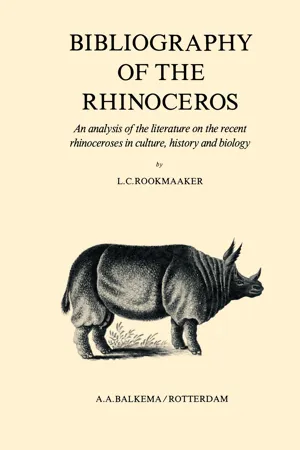
Bibliography of the Rhinoceros
About this book
A listing and analysis of 3106 references to the rhinoceros in books and articles.
Information
PART 1
HISTORY
CHAPTER 1
ANCIENT GREECE AND ROME
1.1 REVIEW
Gowers 1950 (review of most sources). Günther 1967: 14 (summary). Keller 1909: 383–388. Killermann 1908: 581. Lach 1970: 158 (summary). Lenz 1856: 198 (sources cited). M. Ryhiner 1952. Steier 1895 (good succinct review). Stricker 1881.
Toynbee 1973: 125–127, 368.
1.2 APPEARANCE
Aelianus, XVII.44 (horn sharp and hard; thick skin). Agatharchides, 71 (size, thick skin, colour, one horn). Aristoteles, Hist. Anim. 499b-19 (‘Indian ass’, one-horned and one-hoofed), Part. Anim. 663a (‘Indian ass’, one-horned, solid hoof). Dio Cassius, LI.22 (like elephant, with horn). Diodorus, III. 35 (size, thick skin, colour, one horn). Martialis, XXII (double horn). Oppianus, II. Plinius, VIII. xxix (size, colour, one horn). Strabo, XVI. 4, 15 (size, colour, one horn).
1.3 DISTRIBUTION
1.3.1 Reports from Africa
Agatharchides, 71 (around Red Sea). Herodotus, IV. 191 (horned asses in Scythia). Pausanias, IX. xxi (Ethiopia). Periplus, IV, VI (1980:20, 22) (interior, occasionally around Adouli). Solinus, 43 (Ethiopia). Strabo, XVI.4, 15 (N.E. Africa).
1.3.2 Reports from India
Ctesias, 25 (‘wild asses’ in India: appearance, colour, virtues of horn; presence of ankle-bone and gall). Curtius, VIII. ix. 16 (India), IX. i. 5 (Persia). Diodorus, III.35 (India). Megasthenis, XV (one-horned horse in India). Philostratus, III. 2 (1883: 109) (India, only hunted by king; virtue of horn). Pseudo-Callisthenes, III. 16–17 (1969: 126) (after victory against Darius, king of Persians, ‘great rhinoceroses came forth from the forest of reeds’).
1.3.3 Remarks
On Aelian: Benveniste 1929 (Aelian’s unicorn passage influenced by Indian rhinoceros).
On Ctesias: Ettinghausen 1950: 99 (first statement on antipoisonous virtue). Godbey 1939: 268. Heeren 1805: 965–969 (unicorn of Ctesias is Asiatic rhinoceros). Keller 1887: 186 (rhinoceros confused with ‘Antilope picta’). Lassen 1852: 646 (wild ass is rhinoceros). Laufer 1914: 90 n. 1, 97 n.2, 154 n.2. Steier 1895: 1781 (wild ass is rhinoceros with touches of other species; germ of unicorn legend). Wilson 1836: 48–55 (rhinoceros plus gorkhar).
1.4 HABITS AND LEGENDS
1.4.1 Copulation
Solinus, 30 (copulates backwards).
1.4.2 Emnity with elephant
Aelianus, XVII.44. Agatharchides, 71. Diodorus, III. 35 (fight for pasture). Plinius, VIII. xxix. Solinus, 43. Strabo, XVI.4, 15 (fight for pasture, horn as weapon).
1.4.3 Horn sharpening
Aelianus, XVI1.44. Agatharchides, 71. Diodorus, III.35. Plinius, VIII. xxix. Solinus, 43.
1.4.4 Tossing of bear
Martialis, XXII.
1.4.5 Remarks
Ettinghausen 1950: 76–90 (legends of movable horn, horn sharpening, emnity with elephant of Indian, not African, origin). Laufer 1914: 84 n. 1 (horn sharpening). Scullard 1974: 227 (Aelianus on emnity with elephant).
1.5 EXHIBITION IN ROMAN CIRCUS
Athenaeus, V.201c (Alexandria, Ethiopian rhinoceros in procession for Ptolemaeus Philadelphus, 279/8 B.C.). Capitolinus, Ant. Pius, X.8–9 (‘rhinoceroses’ in Rome, 148–9). Capitolinus, Gord. III, xxxiii (one shown, April 248). Dio Cassius, LI.22 (one slain by Caesar, 29 B.C.). Lampridius, XXVIII.3 (one in Rome, described as ‘Egyptian’). Martialis, IX, XXII (games of Titus, 80 A.D.). Plinius, VIII. xxix (one in games of Pompey the Great, 55 B.C.; it has ‘often been seen’; ‘another bred here to fight...’). Solinus, 43 (first rhinoceros in Rome during Gn. Pompejus). Suetonius, 11.43, 3 (one at Saepta during reign of Augustus).
Remarks: Colesso 1701. Cuvier 1806: 26. Fitzinger 1836. Freytag 1747: 34. Godbey 1939: 266, 267. Gowers 1950. Hediger 1938: 1873 (Titus, 80). Houttuyn 1761: 330. Jennison 1937: 30, 54, 66, 72, 84, 86, 87, 90, 92. Keller 1887: 149 (Alexandria). Ladvocat 1749: 20. Laurie 1978b: 2. Loisel 1912, I:92, 103–108. Oken 1838: 1189. Reynolds 1963a: 99 (black rhinoceros), 1971: 13. Toynbee 1973: 126.
1.6 TRADE
Iuvenalis, VII. 130 (horn used as oil-flask in Roman baths). Periplus, VI, XVII (1980: 22, 31) (export from Africa).
Godbey 1939: 263–265 (trade with Africa and China). Herrmann 1913: 556 (trade between China and Africa, or Huang-tschi). Warmington 1974: 162 (horn imported into Rome from India and Africa; also taken to China).
1.7 ART
1.7.1 Review
Sperlich 1961
1.7.2 Piazza Armerina, Sicily (mosaic, N.W. of Syracuse)
Gentili 1957: 221 (‘hunters drag a rhino from an African swamp’). Sperlich 1961: 138 (Indian rhino). Toynbee 1973: 127, fig. 1 (African mosaicists, ca. 305 A.D.).
1.7.3 Cameos
Furtwängler 1896: 305, 311 (two cameos). Imhoof-Blumer & Keller 1889: 121, pl. XIX 46 (Berlin, 1 cameo).
1.7.4 Coins
Augustin 1587, pl. 63 (Domitian, two-horned rhinoceros). Camper 1782: 140 (Domitian). Gowers 1950: 69 (Domitian and Hadrian). Imhoof-Blumer & Keller 1889, PL IV 8 (Domitian). Lach 1970: 160 (Caracalla, one-horned rhinoceros). Mattingly 1976: 411, pl. 81. 16–17 (Domitian). Rookmaaker 1978b: 20 (Domitian). Sloane 1749: 124, figs. 6–7 (Domitian). Spanheim 1671: 137 (Domitian, with one-horned rhinoceros). Toynbee 1973: 126, pl. 52 (Domitian).
1.7.5 Labicum, Thonlampe
Keller 1887: 118, fig. 28. Laufer 1914: 85 n.l.
1.7.6 Palestrina mosaic, Praeneste
Barthelemy 1761: 592 (‘l’arrivée de l’empereur Hadrian dans un canton de la haute Egypte’). Camper 1782: 141. Gowers 1950: 68. de Montfaucon 1757: 151, 159 (by Sylla). Shaw 1746: 91. Toynbee 1973: 126 (triomph in Fortuna temple, by Sulla). Volkman 1779: 336 (time of Hadrian).
1.7.7 Perugia mosaic
Gowers 1950: 68 (white rhinoceros from time of Augustus).
1.7.8 Salmanassar II obelisk
Benveniste 1909. Brentjes 1978: 151 (ox). Hilzheimer 1926: 166. Keller 1909: 386, fig. 133 (rhinoceros). Laufer 1914: 87 (rhinoceros). M. Ryhiner 1952: 66 (is rhinoceros).
1.7.9 Tesserae
Gowers 1950: 68 (rhinoceros is not Indian). Rostovtsev 1903 (some figured).
1.8 OTHER STATEMENTS
Horatius, I.5 (Sarmentus compares Meurius with a ‘wild horse’ with a horn). Lucilius, III. 135 (mentions ‘rhinoceros’).
1.9 SPECIES KNOWN TO ROMANS
Gowers 1950 (most specimens shown in Rome were Ceratotherium simum cottoni). Jennison 1937: 34, 54, 74 (often Indian, sometimes African species). Loisel 1912, 1: 136 (both one and two-horned species known). Rookmaaker 1978b: 20 (Rhinoceros unicornis and Ceratotherium simum). Toynbee 1973: 125–127 (both one and two-horned species known). Warmington 1974: 150 (both one and two-horned species known).
CHAPTER 2
MIDDLE PERIOD (400–1500)
2.1 REVIEW
d’ Alès 1936 (on Tertullian and Justin, symbolism). Einhorn 1976 (on unicorn, occasional information on or parallels with rhinoceros study). Godbey 1939: 286–290. Sainéan 1921: 39 (names).
2.2 GENERAL SOURCES
Abelaerdus, col. 1806 (poem). Cosmas, XI, col. 441 (India and Ethiopia). Eucherius, p. 820 (double-horned rhinoceros distinct from monoceros). Eustathius, cols. 743, 955 (mentions monoceros). Gossouin 1913: 114 (a ‘monoheros’ among Indian animals–cf. Langlois 1911: 83). Isidorus, XII. ii. 12, 13 (rhinoceros is monoceron, captured by virgin). Jordanus 1863: 18 (rhinoceros of India is not unicorn). Langlois 1911: 35 (Bestiaire by Philippe de Taon, 12th century, describes monosceros). Photius, col. 477, cap. 36 (describes rhinoceros). Polo 1958: 188, 253 (unicorn in S.E. Asia). Tertullianus 1927: 144 (monoceros differs from one-horned rhinoceros; symbolism of unicorn). Timotheus of Gaza 1949: 44 (chapter on rhinoceros, partly from Oppian).
2.3 TRANSLATION OF JOB 39 VERSE 9
Alanus, col. 927 (translates rhinoceros = unicornis). Augustinus, col. 881, cap. 39 (monoceros is unicornis). Bruno, col. 679, cap. 39 (translates rhinoceros). Gregorius, col. 571, cap. 31.2 (translates rhinoceros, with symbolism). Hieronymus, col. 1462, cap. 39 (translates rhinoceros = unicornis). Odonis, col. 461 (translates rhinoceros = monoceros). Ruper...
Table of contents
- Cover
- Half Title
- Title Page
- Copyright Page
- Table of Contents
- Introduction
- Acknowledgements
- Abbreviations
- Analysis of the Literature
- Part 1. History
- Part 2. Biology
- Part 3. Culture
- Bibliography
- Index
Trusted by 375,005 students
Access to over 1.5 million titles for a fair monthly price.
Study more efficiently using our study tools.
Frequently asked questions
Yes, you can cancel anytime from the Subscription tab in your account settings on the Perlego website. Your subscription will stay active until the end of your current billing period. Learn how to cancel your subscription
No, books cannot be downloaded as external files, such as PDFs, for use outside of Perlego. However, you can download books within the Perlego app for offline reading on mobile or tablet. Learn how to download books offline
Perlego offers two plans: Essential and Complete
- Essential is ideal for learners and professionals who enjoy exploring a wide range of subjects. Access the Essential Library with 800,000+ trusted titles and best-sellers across business, personal growth, and the humanities. Includes unlimited reading time and Standard Read Aloud voice.
- Complete: Perfect for advanced learners and researchers needing full, unrestricted access. Unlock 1.5M+ books across hundreds of subjects, including academic and specialized titles. The Complete Plan also includes advanced features like Premium Read Aloud and Research Assistant.
We are an online textbook subscription service, where you can get access to an entire online library for less than the price of a single book per month. With over 1.5 million books across 990+ topics, we’ve got you covered! Learn about our mission
Look out for the read-aloud symbol on your next book to see if you can listen to it. The read-aloud tool reads text aloud for you, highlighting the text as it is being read. You can pause it, speed it up and slow it down. Learn more about Read Aloud
Yes! You can use the Perlego app on both iOS and Android devices to read anytime, anywhere — even offline. Perfect for commutes or when you’re on the go.
Please note we cannot support devices running on iOS 13 and Android 7 or earlier. Learn more about using the app
Please note we cannot support devices running on iOS 13 and Android 7 or earlier. Learn more about using the app
Yes, you can access Bibliography of the Rhinoceros by L.C. Rookmaaker in PDF and/or ePUB format, as well as other popular books in Biological Sciences & Biology. We have over 1.5 million books available in our catalogue for you to explore.