- 232 pages
- English
- ePUB (mobile friendly)
- Available on iOS & Android
eBook - ePub
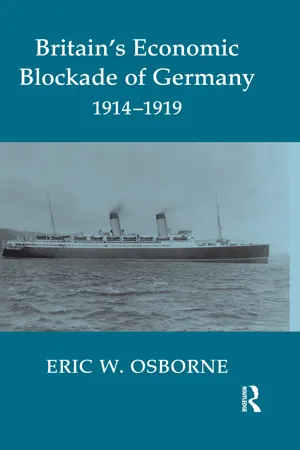
Britain's Economic Blockade of Germany, 1914-1919
About this book
Great Britain's economic blockade of Germany in World War I was one of the key elements to the victory of the Entente. Though Britain had been the leading exponent of blockades for two centuries, the World War I blockade was not effective at the outbreak of hostilities.
1
Foreign Policy, Naval Commitments, and the Changes to Blockade, 1756–1904
Three interconnected factors ensured that Britain was the world’s leading economic power at the turn of the twentieth century. The first of these was its industrial might, which owed a large debt to its empire. The country was an entrepôt for raw materials from it and a workshop for turning them into finished goods for re-export around the globe. By 1880, Britain accounted for 26 per cent of the world’s industry and was the leader in the production of pig-iron, coal, and steel.1Coupled with this was a second factor, that of the nation’s maritime fleet, which served as the commercial carrier for much of the world. The value of this carrying trade in 1894 exceeded £1,000,000,000, a truly tremendous sum in the late nineteenth century.2 Underpinning the economic strength afforded by these two factors was a third: the nation’s naval superiority. This was administered through the combined direction of the Admiralty and the Foreign Office. The military and civil branches of government worked reasonably well together as the Foreign Office rarely interfered in naval affairs. This situation, however, had altered completely by 1914. Numerous economic, diplomatic, and military changes during the nineteenth and early twentieth centuries had forced a shift in the relationship between these two branches of government. Increasingly, the Foreign Office exercised greater influence over military policy, replacing the security provided by the Royal Navy with guarantees garnered from international agreements. This would have profound effects on Britain’s use of blockade by 1914.
British politicians and civilians alike were well aware of the contribution of the Royal Navy to their prosperity and security. It acted as the policing force of the Pax Britannica and was the dominant naval force in the world throughout the nineteenth century. This circumstance was largely the result of no other power wishing to bear the expense of building a navy to challenge it.Formerly great maritime powers such as France and Spain did not have significantly large navies for decades following their defeat in the 1805 Battle of Trafalgar during the Napoleonic Wars, although France mounted a challenge in this regard in the 1840s and 1850s. Germany was not unified until 1871 and did not embark on a significant naval construction plan until the mid-1890s. The United States and Japan were only beginning the process of building large, blue-water navies in the last quarter of the nineteenth century. Given this situation, the Royal Navy easily maintained the lines of communication and trade routes between Britain and the empire, ensuring the flow of materials and finished products that were so vital to British prosperity.
The British were secure in the defensive capabilities of their navy, but they also appreciated its importance as a potential threat to other nations in the event of war, through both direct military action and the imposition of blockade. By the early nineteenth century Britain was the uncontested master of the naval blockade, a weapon that contributed much to its victories in war and its subsequent position in the peacetime world. It consisted of using warships to patrol off the shores of an enemy power in order to bottle up its battle fleet within its harbors. Such an action forced the warships of an enemy to sortie and do battle with the Royal Navy where its superiority would carry the day. The practice of blockade was certainly not new. The first recorded instance of a blockade was during the Peloponnesian War in the fifth century BC. Britain, however, was the first naval power to implement a systematic blockade during the 1756–63 Seven Years War. Vessels of the Royal Navy sealed off major French ports, such as Brest and Toulon, from the outside world, thus damaging French commerce and bottling up the French Navy with the ultimate goal of forcing its fleet to fight the blockading force. The Royal Navy also employed the blockade with great success during the Napoleonic Wars.3 It had become a much more important weapon by this period because it assumed a military and economic role. The ensuing distress that it caused to Europe was a decisive factor in the defeat of Napoleon and clearly showed its importance as an economic weapon.The pressure of blockade forced Russia to withdraw from France’s Continental System, which was a trade embargo against Britain, because that country needed British goods. The result was the invasion of Russia by Napoleon that resulted in the destruction of his army and a shift in the tide of war against him.
In the early nineteenth century, Britain owed the success it enjoyed in the Napoleonic Wars not only to its military and economic power, but also to the ambiguous definition of maritime law on its greatest weapon of blockade. International law concerning the proper usage of sea power by a belligerent nation was in its infancy. Most rules governing sea power came from commerce agreements between Great Britain and other maritime nations and were an extension of rules from British prize courts, the naval judiciary bodies that ruled on the fate of vessels seized in wartime.4 These conventions did not represent a unified international opinion as they were solely a collection of independent documents with separate nations. There were attempts at a more united body of opinion, the most significant being the League of Armed Neutrality of 1780 in which Russia, Denmark, and Sweden agreed on a set of rules on blockade and neutral rights. There was, however, no truly universal rule accepted by all major nations, except that an enemy’s property could be captured wherever it was found. Attempts at establishing a universal set of maritime laws for all nations, such as the League of Armed Neutrality, failed because many powers like Britain refused to consider a codification of laws that might threaten their rights as a belligerent. This situation led Catherine the Great of Russia to call the League of Armed Neutrality the ‘Armed Nullity’.5
Most rules governing the use of blockade remained those of individual nations concerning their view of neutral rights. This situation was exactly what Britain desired. It left the authority of neutrals over the rights of a belligerent sea power weak and produced little encumbrance to the Royal Navy. In this situation the duties of the navy and the Foreign Office were well defined, separate, and mutually beneficial for the interests of the state. The Royal Navy had free reign while the Foreign Office confined itself largely to the issue of Orders in Council, which were declarations of blockade and any changes to one in place. It also dealt with the weak protestations of neutrals, particularly the United States during the Napoleonic Wars. The British believed they could act with virtual impunity as a consequence of their naval superiority and self-sustaining economy that existed in the early nineteenth century. This is evidenced in the Order in Council of 7 January 1807, which stated that ‘the Commanders of His Majesty’s Ships of War … are hereby instructed to warn every Neutral Vessel coming from any such [French] Port, and destined to another such [French] Port, to discontinue her voyage, and not proceed to any such Port’.6 This order in council virtually proclaimed an end to the trade of neutral nations with France, obviously a grievous commercial injury. Neutrals, such as the United States, could do little to stop Britain from implementing this policy; a good example was the failure of the US embargo of trade with Britain in 1807. It was an attempt to force Britain to stop interfering with US trade to the European Continent. President Thomas Jefferson’s action did not damage the British economy. It damaged that of the United States because Britain was a major market for American merchants.7
The luxury of using blockades with virtual impunity vanished in the decades following the Napoleonic Wars. This situation was the product of domestic changes and an alteration of Britain’s position on the world stage. Until the mid-nineteenth century, the British did not seriously consider any codification of neutral rights as it ran counter to their interests. As historian Maurice Parmalee noted, ‘belligerents, especially when powerful nations, have always been prone to ignore neutral rights upon the sea’.8 Parmalee’s statement, however, does not hold when one examines Great Britain’s diplomacy by the mid-nineteenth century. By 1856, Britain had begun to move away from its reliance on naval supremacy to reliance on international law in order to safeguard its interests.
On 25 February 1856, the Congress of Paris opened to bring an end to the 1853–56 Crimean War. The victorious powers of Britain and France had defeated Russia’s attempts to extend its power in the Near East at the expense of the Ottoman Empire. One of the most notable achievements of the congress was the advancement of international maritime law concerning blockades that resulted from actions taken during the war. In March 1854 Britain had announced the surrender of some of its belligerent rights at sea, the most important being the right to capture enemy property in neutral ships. This move by London was an effort to placate one of the great neutrals, the United States. As in the Napoleonic Wars, the United States championed neutral rights through its call for freedom of the seas, meaning the ability to trade with any country in peace or war without interference. The British had hoped that their action would obviate any diplomatic problems over a blockade of Russia that might cause war with the United States.9 This situation had already occurred once in the War of 1812 between the United States and Britain.
The new laws at the peace conferences resulted from agitation by the United States over the immunity of enemy property if carried in neutral ships and was embodied in the 1856 Declaration of Paris. This document marked the beginning of a trend where the British Foreign Office took the leading role in deciding naval policy. The declaration decreed the permanent abolition of privateering, whereby a privately owned vessel captured enemy commerce in the name of a belligerent country in war; that a neutral flag covered all enemy goods except contraband of war; that neutral goods, excepting contraband of war, were no longer liable to capture under an enemy’s flag; and that blockades had to consist of a force strong enough to prevent access to the ports or coast of an enemy in order to be considered legally binding.10 All but one of the seven nations represented at the conference signed the declaration. The governments of both France and Russia supported the declaration because they had both suffered under British blockades in wartime. This legislation, in their view, helped alleviate future damage to their trade. The United States, although it advocated the advancement of neutral rights, did not support the declaration because of the stipulation that abolished privateering. The Americans had only a small navy and depended on its use in time of war.
The 1856 Declaration of Paris was the target of severe criticism at the time and later. Contemporaries viewed it as an unnecessary surrender of Britain’s belligerent rights. Thomas Gibson Bowles, in his 1900 work on the declaration, believed that it destroyed all hope for an effective blockade.11 He maintained that the agreement made blockades virtually useless because an enemy could carry on its commerce through neutral merchant ships that called at neutral ports. Their cargo could then be transported overland to the enemy. Even so, Marion Siney points out in her work on Britain’s World War I blockade that Bowles did not consider the application of the doctrine of continuous voyage developed in the eighteenth century. This held that goods destined for an enemy but consigned to a neutral port were open to seizure.12
Siney concluded that the declaration stemmed from commercial interests, but it was much more important than simply an agreement based on economic considerations. It was the turning point where neutral rights became more important than belligerent ones. There were two motivating factors behind Whitehall’s support of the declaration. The first was from the standpoint of improving Britain’s position when a belligerent. British politicians viewed the surrender of the right to capture enemy property in neutral ships as beneficial, to avoid any entanglements with neutrals when Britain was at war. Whitehall reasoned that Britain’s naval preponderance would allow a blockade to be effective without this right through the destruction of the enemy’s merchant fleet. The Royal Navy was also still free to seize contraband whenever found on neutral vessels.13 A blockade under these stipulations would attain the object of damaging an enemy’s economy.
The second factor is far more important to this study than the first. The Declaration of Paris was an attempt to codify the laws concerning neutral rights in time of war in an age where Britain increasingly played the role of neutral power more often than that of belligerent. It was an attempt by Whitehall to find a middle ground between the country’s rights as a belligerent and as a neutral. British politicians believed that the stipulations that abolished privateering and set conditions for the legality of a blockade were a boon for Britain.14 In their view, they would protect the country’s overseas trade and consequently its industrial economy. By 1860 British merchant marine tonnage amounted to 5.7 million tons, the largest in the world.15 Coupled with this huge maritime fleet was the economic policy of free trade, which the British also endeavored to protect around the world. The 1846 abolition of the Corn Laws that subsidized British grain against cheaper grain from abroad symbolized Britain’s shift away from trade protectionism. Following this measure, free trade quickly became a basic tenet of Victorian Britain; it would remain sacrosanct for the remainder of the century. The stipulations in the Declaration of Paris helped...
Table of contents
- Cover Page
- Title Page
- Copyright Page
- Series Editor’s Preface
- Acknowledgements
- Introduction
- 1 Foreign Policy, Naval Commitments, and the Changes to Blockade, 1756–1904
- 2 The Culmination of Faith in International Law: The Second Hague Conference and the Declaration of London, 1905–11
- 3 Blockade Preparations in the Final Years of Peace, 1911–14
- 4 Britain at War: The First Steps for Blockade in 1914
- 5 The Year of Frustration, Stalemate, and Doubt, 1915
- 6 The Blockade Strengthens, 1916
- 7 The Critical Year, 1917
- 8 The Last Year of War and the Final Legacy of the Blockade in the Peace, 1918–July 1919
- Conclusion
- Bibliography
Trusted by 375,005 students
Access to over 1.5 million titles for a fair monthly price.
Study more efficiently using our study tools.
Frequently asked questions
Yes, you can cancel anytime from the Subscription tab in your account settings on the Perlego website. Your subscription will stay active until the end of your current billing period. Learn how to cancel your subscription
No, books cannot be downloaded as external files, such as PDFs, for use outside of Perlego. However, you can download books within the Perlego app for offline reading on mobile or tablet. Learn how to download books offline
Perlego offers two plans: Essential and Complete
- Essential is ideal for learners and professionals who enjoy exploring a wide range of subjects. Access the Essential Library with 800,000+ trusted titles and best-sellers across business, personal growth, and the humanities. Includes unlimited reading time and Standard Read Aloud voice.
- Complete: Perfect for advanced learners and researchers needing full, unrestricted access. Unlock 1.5M+ books across hundreds of subjects, including academic and specialized titles. The Complete Plan also includes advanced features like Premium Read Aloud and Research Assistant.
We are an online textbook subscription service, where you can get access to an entire online library for less than the price of a single book per month. With over 1.5 million books across 990+ topics, we’ve got you covered! Learn about our mission
Look out for the read-aloud symbol on your next book to see if you can listen to it. The read-aloud tool reads text aloud for you, highlighting the text as it is being read. You can pause it, speed it up and slow it down. Learn more about Read Aloud
Yes! You can use the Perlego app on both iOS and Android devices to read anytime, anywhere — even offline. Perfect for commutes or when you’re on the go.
Please note we cannot support devices running on iOS 13 and Android 7 or earlier. Learn more about using the app
Please note we cannot support devices running on iOS 13 and Android 7 or earlier. Learn more about using the app
Yes, you can access Britain's Economic Blockade of Germany, 1914-1919 by Eric W. Osborne in PDF and/or ePUB format, as well as other popular books in History & Military & Maritime History. We have over 1.5 million books available in our catalogue for you to explore.