- 464 pages
- English
- ePUB (mobile friendly)
- Available on iOS & Android
eBook - ePub
About this book
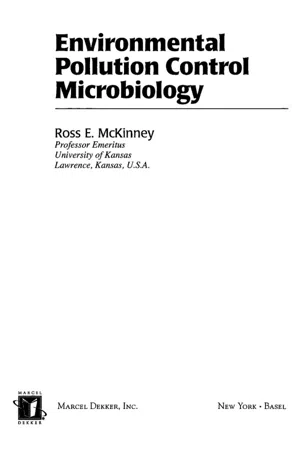
Compiling knowledge gained through more than 50 years of experience in environmental engineering technology, this book illustrates the application of fundamental concepts in microbiology to provide a sound basis for the design and operation of various biological systems used in solving environmental challenges in the air, water, and soil. Environme
Information
Chapter 1
INTRODUCTION
Environmental pollution control microbiology is currently an exciting and challenging area of science and engineering. Environmental pollution control microbiology is concerned with solving a broad spectrum of environmental pollution problems that affect people around the world from a microbiological point of view. On one hand, environmental pollution control microbiology is concerned with protecting people from pathogenic microorganisms; and on the other hand, it is concerned with the application of microbiology to solve a wide range of environmental pollution problems. Emphasis is placed on the environment rather than on individuals. Both science and engineering are involved in environmental pollution control. Scientists determine the environmental problems and evaluate different solutions. Engineers utilize the information supplied by scientists to design the most efficient systems to solve the environmental problems. By working together as a team, scientists and engineers are meeting the challenges of environmental pollution control in our modern world.
The concepts of Environmental Pollution Control Microbiology have their roots in conventional microbiology with its concerns for pathogenic microorganisms and public health. The roots are even deeper in chemistry, which forms the basis of all reactions between the chemical compounds that make up our world, and in biochemistry, which focuses on the chemistry of biological systems. The deepest roots are in civil engineering, which provides the basis for all the other areas of engineering contributing to the design and construction of pollution control facilities. Chemical engineering is one of the newest areas of engineering to become involved in solving environmental problems. It joins mechanical engineering and electrical engineering in contributing their special expertise. Environmental Pollution Control Microbiology was developed to show how microbiology, chemistry, and engineering are combined to provide real solutions to environmental pollution problems.
MICROBIOLOGY
Microbiology forms one of the cornerstones for environmental pollution control microbiology. Microbiology also has its roots in many different scientific areas. Microbiology is a combination of bacteriology, virology, mycology, phycology, protozoology, zoology, biochemistry, and mathematics. With such a widespread field, microbiology is made up of diverse groups of scientists rather than a single, coherent group. It will take microbiology many more years before it becomes a unified science, if it ever does. Microorganisms form the unifying theme for microbiology. Viruses, bacteria, fungi, algae, protozoa, rotifers, crustaceans and various worms make up the major groups of microorganisms that exist in the environment. Viruses are the most difficult group of organisms to study because they exist in the area between chemistry and microbiology. Viruses have the characteristics of pure chemical compounds and living microorganisms. Their small size and difficulty in culturing makes viruses hard to study; but their negative impact on plants and animals makes them a very important part of microbiology. In recent years environmental microbiologists have found that viruses are having a greater impact on environmental health than in the years past. As bacteria pathogens have been reduced, viruses have moved into the vacancy that has been created. Viruses are all parasitic pathogens without measurable respiration. They are also host specific. The uniqueness of viruses has created a special aura that greatly affects how the public deals with viruses.
Bacteria have attracted the greatest attention in microbiology because they are easy to cultivate and study in pure cultures and because they have had a major influence on the health of people. Most of the early bacteriological studies were directed at medical bacteriology to understand the causes of common diseases affecting people. As progress was made in controlling disease-producing bacteria, bacteriological studies shifted to understanding the biochemistry of bacteria and the quantitative relationships in bacterial growth. The transmission of pathogenic bacteria through food and water has long been the focus of environmental microbiologists. In recent years efforts have shifted from pathogenic bacteria to helpful bacteria, such as those involved in the treatment of municipal wastewater and industrial wastewater. The simplicity of the bacteria biochemistry has proven to be of major importance in pollution control microbiology. Understanding how bacteria metabolize different organic compounds provides the basis for designing and operating new biological wastewater treatment systems. New techniques and new media for growing bacteria have yielded new bacteria to work with. In spite of all the knowledge we have on bacteria, it has been indicated that the majority of bacteria have yet to be found and examined in pure culture. New media and new techniques will be required to find and study these unknown bacteria that currently inhabit our environment.
Although bacteria are related to fungi, mycology, the study of fungi, grew as a separate field. The problems with fungi lie in their complexities when compared with bacteria. Fungi undergo several phases in their life cycle, making them difficult to study. Most of the efforts in mycology have been directed towards taxonomy than towards the biochemistry of fungi. Because of the economic impact of fungi in agriculture, mycology has been oriented primarily towards plants. The discovery of antibiotics and their application in the control of disease producing bacteria helped to stimulate interest in the biochemistry of fungi. Fungi are also important in environmental pollution control microbiology in the treatment of some industrial wastewaters and in composting of solid wastes. Recently, mycologists have been interested in fungi for the mass production of proteins to be used in animal feed. One group of fungi, the yeast, has developed into a separate area of mycology, the same as bacteria. Yeast cells are used in the production of specific foods and beverages. Yeast cells have also been used in some industrial wastewater treatment systems. Because of the economic value of yeast, considerable effort has been made to study and understand the biochemistry of yeast. More is known about the biochemistry of yeast than the other fungi.
Algae are photosynthetic microorganisms that have unique growth characteristics. Since algae depend on light for their source of energy, they are found primarily in water and on moist surfaces exposed to light. The large number of diverse algae in the environment stimulated phycologists, scientists who study algae, to focus their primary attention on taxonomy. A few phycologists were intrigued by the various mechanisms involved in photosynthesis. These phycologists began to examine the biochemistry of algae. Most recently, space research and the future potential of space exploration created renewed interest in algae biochemistry. The fact that algae utilize carbon dioxide and produce oxygen as a metabolic end product indicated that algae might have value in space travel where people will need oxygen and will produce carbon dioxide as one of their major waste products. Algae have also been studied as a potential source of protein for feed supplements. Algae have a special role to play for environmental pollution control microbiologists. Algae can conserve nitrogen and phosphorus in their protoplasm. Adding algae to the soil can help improve soil characteristics and increase fertility for higher plants. Growth of algae in ponds has proven useful in stimulating fish farming. Since algae and bacteria do not compete against each other, they can be grown together to take advantage of the best characteristics of both groups of microorganisms. The potential for algae in environmental pollution control is just beginning to be recognized.
Microscopic animals are larger and more complex than the microscopic plants. They are easy to see and recognize at relatively low power magnification under the microscope. It is not surprising that the protozoologists are also concerned about taxonomy and the distribution of protozoa in the environment. The difficulty in isolating and growing protozoa in pure culture slowed studies on their biochemistry. Eventually, techniques were developed that permitted the separation and growth of protozoa, free of bacterial contamination. Even then, most of the productive protozoa studies dealt with the interaction of protozoa and bacteria, since protozoa use bacteria as their primary source of nutrients. Like bacteriology, a portion of protozoology has been concerned with pathogenic protozoa. Recently, concerns over Giardia, Cryptosporidium, and Pfisteria have focused attention on these pathogenic protozoa and their place in environmental concerns. Part of the problem lies in the fact that these pathogenic protozoa are most dangerous to the very young, the elderly, and those individuals with damaged immune systems. The pathogenic protozoa are parasitic pathogens, living off host animals. Fortunately, most protozoa are non-pathogenic and assist in the reduction of pathogenic bacteria in the environment. Protozoa are also major partners in the microbiology of biological wastewater treatment systems.
Higher animals such as rotifers, crustaceans, and worms have come under the scrutiny of zoologists, scientists who study animals. These microscopic animals live on bacteria, algae, and small protozoa and are not grown in sterile environments. They are quite large with some being macroscopic rather than microscopic in size. The higher animals have complex digestive systems and are much more sensitive to toxic materials than the other microorganisms. Since these organisms form an important link in the aquatic food chain, many studies have been made on the environmental conditions that adversely affect their growth. Concern for water pollution has become a major issue for many aquatic zoologists. A number of field studies have been made, using organism counts and species diversity to indicate environmental damage to streams and lakes. Recently, the EPA proposed using Ceridaphnia as an indicator of wastewater effluent toxicity. There is no doubt that zoologists will have an increasing role in water pollution control studies.
The very breadth of microbiology poses a challenge to anyone with a major interest in pollution control microbiology. It is not possible for everyone to be an expert in all areas of microbiology. Yet, it is important to have a good understanding of the different areas to provide communication with the technical specialists in the different areas of microbiology. There is nothing wrong in developing a special interest in one area of microbiology, as long as you keep your focus on the total picture and not on the details. It is important to realize that while pure cultures are critical in the study of microbiology, it is equally important to understand the competition that exists between the different organisms. The fastest growing pure culture organism may not be the predominant organism in the real environment. Laboratory conditions often fail to simulate the natural environment and allow entirely different growth patterns to occur. The keys to pollution control microbiology are in examining the different organisms in their natural environment and in understanding the how and why of their growth characteristics in that environment.
CHEMISTRY
Chemistry has a very special place in environmental pollution control microbiology, the same as in the other branches of microbiology. Chemistry is a basic science concerned with the composition of all matter. Chemistry helps to explain how materials react with each other. Experience, experiments, and faith form the basis for chemistry. Experience came first and produced as many wrong answers as right answers. Experience soon produced experiments to find correct answers and to provide a reproducible basis for chemical reactions. Faith is the glue that holds chemistry together. No one sees the atoms that make up matter; but we have faith that the atoms are all there. Experience shows us that the same materials react the same way every time we bring them together for a reaction. Experiments help us learn new reactions and to show others how old reactions occur. The accumulation of knowledge in the literature helps us bridge the gaps between experience and experiments. While parts of chemistry are qualitative, ultimately it must become quantitative. Mathematics is an integral part of chemistry. Mathematics helps us understand how much of chemical A reacts with chemical B to produce chemical C. Mathematics helps us explain how fast chemical reactions occur. We accept the fact atoms are in motion until the temperature reaches absolute zero. Like chemistry, much of mathematics is based on faith.
Chemistry has its specialties: qualitative and quantitative analyses, organic chemistry, inorganic chemistry, physical chemistry, colloidal chemistry, nuclear chemistry, and biochemistry, plus lots of subspecialties. Each specialty is important to the field of chemistry and to environmental pollution control microbiology. Qualitative analysis and quantitative analysis are essential in environmental pollution. They permit the measurement of different pollutants found in the environment and their magnitude. Organic chemistry is important since all living creatures are composed of a multiplicity of organic compounds. Again we have lots of faith to accept how organic compounds are constructed and how they react. Technology is slowly providing new answers about the structure of complex chemical compounds; but even here faith is important. The same is true of inorganic chemistry. Fortunately, there are not as many different inorganic compounds as there are different organic compounds. The ability of the chemist to create new organic chemicals has led to the production of new products that have greatly changed the world. Not all of the changes have been for the better. Inorganic chemicals form an important part of trace elements that are critical to all biological life. Physical chemistry teaches us about gases, rates of reactions, and energetics of reactions. Colloidal chemistry teaches us about very tiny particles and how those particles react and interact. Bacteria are larger than true colloids; but they react similar to large colloids. Nuclear chemistry is concerned with radioactive elements and compounds and how they react with the rest of the world. Biochemistry is important since it focuses chemistry on biological systems. It is not surprising that biochemistry covers all areas of chemistry, creating as much confusion as light. Although much knowledge has been gained over the years in all areas of chemistry, much is still to be learned. As new knowledge in chemistry is uncovered, that knowledge will be quickly applied to environmental pollution control microbiology.
Environmental chemistry has grown up in recent years as chemists began to recognize that the environment is an important part of applied chemistry. With emphasis on environmental pollution, environmental chemistry has a strong base in chemical analysis and biochemistry, as it affects the air, water and land environments. Environmental chemistry helps make the bridge between environmental pollution control microbiology and all of the major areas of chemistry. As with microbiology, it is not necessary to be a specialist in all areas of chemistry; but one must have knowledge of the major areas of chemistry that affect microbiological systems in the environment.
ENGINEERING
Engineering is the third cornerstone in the foundation for environmental pollution control microbiology. Engineering is concerned with the various structures and systems employed in solving environmental pollution problems. Because of the diversity of environmental problems and the large number of different solutions, there are many different types of engineers involved. Civil engineers were the first group of engineers to recognize environmental pollution problems. Stormwater runoff resulted in civil engineers designing and constructing storm sewers to remove the excess water from city streets and to discharge it in nearby rivers and streams. Domestic sewage was not a problem for civil engineers initially, since sewage was collected in cesspools adjacent to each house. Periodically, the cesspools were cleaned out by being pumped into a tank on the back of a wagon and hauled out into the country for disposal on land as fertilizer. As cities grew, the demand for more fresh water became a serious issue. The number of water wells increased and the water table dropped. The need for a permanent water supply that could meet the current demands, as well as future demands, became one of the primary tasks for civil engineers. As new water supplies were developed, it was possible to pipe water to every customer willing to pay for a connection and the water. The improved municipal water supplies led to the increased use of water closets, bathtubs, and kitchen sinks. An unexpected consequence of the improved water supplies was a corresponding increase in wastewater production. The increased flow of wastewater to the cesspools caused them to overflow into the storm sewers, creating water pollution in the adjacent streets and in the receiving streams. Civil engineers soon had to design sewers to collect both sanitary wastewater and stormwater. It is not surprising that differences of opinion arose as to whether to use separate sewers or to combine both wastewaters into a single sewer. The initial concerns stemmed from the fact that scientists and engineers believed that diseases could be transmitted by air from decomposing sewage. Hydraulic traps were constructed in the house connections to prevent sewage odors from entering the connected houses. It soon became apparent that combined sewers were more economical than separate sewers since both wastewaters were discharged to the same rivers. It was not readily recognized that the discharge of wastewaters into natural waterways would create serious environmental pollution problems for downstream water users as the communities increased in population. It did not take long before water pollution became serious for the large cities in the United States.
Concerns over polluting public water supplies soon led to research on various methods for treating polluted streams. Intermittent sand filters were developed at the Lawrence, Massachusetts, Experiment Station for treating polluted river water to be used for drinking water. It was shown that intermittent sand filters removed the pathogenic bacteria causing typhoid fever that was endemic in the United States. Intermittent sand filters soon gave way to rapid sand filters that could process more water at a faster rate. The application of chlorine to filtered water insured the safety of the water from rapid sand filters by killing the pathogenic bacteria that were not removed in the water treatment plants. The success of intermittent sand filters for treating polluted river water led to their use for treating domestic wastewater prior to discharge in streams and rivers. Since England had greater water pollution problems than the United States in the 1890s, British engineers modified the intermittent sand filter and produced the first rock media trickling filter. The success of trickling filters in reducing pollution from domestic wastewater prior to discharge into streams and rivers led to its use in England, Europe, and the United States. British research on improving wastewater treatment led to the development of the activated sludge process in 1914. Activated sludge proved to be the most efficient wastewater treatment process and is still widely used throughout the world. The success of activated sludge is a primary example of pollution control microbiology at its best. While wastewater treatment removed contaminants from the water, large quantities of sludge remained to be returned to the environment. Since time began, wastewater sludges were always returned back to the environment as fertilizer. Unfortunately, pathogenic microorganisms were transmitted through the wastewater sludge to some crops used for human consumption. Research found that anaerobic treatment could reduce the survival of pathogenic microorganisms in the wastewater sludges; but it was Karl Imhoffs development of a practical design to treat wastewater sludges that resulted in large-scale treatment systems for wastewater sludges. Anaerobic treatment of wastewater sludges developed slowly over the years until researchers became interested in a more detailed examination of the anaerobic microorganisms responsible for sludge digestion. This is one of the more interesting areas of environmental pollution control microbiology that is still evolving. It is not surprising that water treatment plants increased more rapidly than wastewater treatment plants. Clean water was essential for cities to grow and prosper. Wastewater treatment was largely ignored until environmental pollution threatened to stop industrial development. Today, municipal water supplies and municipal wastewater treatment plants are part of the total water environment necessary to sustain future populations.
Cities also produced considerable amounts of solid wastes, which had to be collected and removed at regular intervals. Most city administrators considered solid wastes as a nuisance and did little more than collect the solid wastes. The solid wastes were carried outside the city limits and dumped onto low value land, where less fortunate people scavenged anything of value that remained. Because of limited coal resources for industrial operations, British engineers developed incinerators that burned solid wastes and recovered energy for industrial plants. Since the United States had ample coal for industrial plants, American engineers showed little interest in energy recovery incinerators. Eventually, civil engineers developed sanitary landfills to replace the open dumps for solid wastes. Conversion from open dumps to sanitary landfills progressed slowly since local politicians were reluctant to spend tax money on things that the public could not see and use directly. Ultimately, the environmental movement in the United States raised public concern over sanitary landfills and incinerators for handling solid wastes. Emphasis on solid waste recycling and minimization produced new engineering systems for collecting and separating the various components of solid wastes. A major effort has been directed towards large scale composting operations for yard wastes. It required environmental regulations to force local government to face these important problems. Engineers favored the new environmental regulations since the regulations resulted in new engineering projects.
As America’s industries began to grow, they produced more wastes. Industrial plants were just like small cities, producing liquid, gaseous, and solid wastes. It is not surprising that industries followed the lead of cities and dumped their liquid wastes into nearby streams. The solid wastes were dumped on the land; and the gaseous wastes were sent up tall smokestacks into the atmosphere. When cities began to face their environmental pollution problems, a few of the larger industries followed suite. Civil engineers tried to use the same technology for industrial wastes as for municipal wastes. It quickly became apparent that civil engineers designing waste treatment facilities for industries needed more chemistry to understand how to properly process the various industrial wastes. As civil engineers changed their education to handle both municipal and industrial wastes, they evolved into sanitary engineers. The expanding industrial market for sanitary engineers caused chemical engineers to recognize that industrial waste treatment was as much in their area of expertise as it was in the sanitary engineer’s area of expertise. Chemical engineers used their knowledge of chemical processes to design efficient industrial wastewater treatment processes, while using the civil engineers to design and construct the industrial treatment plants. The development of more complex mechanical equipment for solid waste collection and incineration brought the mechanical engineers into the environmental picture. The mechanical engineers also became involved in the design of various pieces of mechanical equipment used in water and wastewater treatment plants. The need for improved controls and better instrumentation to o...
Table of contents
- Cover Page
- Title Page
- Copyright Page
- Preface
- Chapter 1 Introduction
- Chapter 2 Bacteria
- Chapter 3 Bacteria Growth
- Chapter 4 Fungi and Yeasts
- Chapter 5 Algae
- Chapter 6 Protozoa and Other Animals
- Chapter 7 Soil Microbes
- Chapter 8 Water Microbiology
- Chapter 9 Water Supply and Treatment
- Chapter 10 Wastewater Characteristics and Collection
- Chapter 11 Wastewater Treatment
- Chapter 12 Air Microbiology
- Chapter 13 Solid Wastes
- Chapter 14 Hazardous Wastes
Trusted by 375,005 students
Access to over 1.5 million titles for a fair monthly price.
Study more efficiently using our study tools.
Frequently asked questions
Yes, you can cancel anytime from the Subscription tab in your account settings on the Perlego website. Your subscription will stay active until the end of your current billing period. Learn how to cancel your subscription
No, books cannot be downloaded as external files, such as PDFs, for use outside of Perlego. However, you can download books within the Perlego app for offline reading on mobile or tablet. Learn how to download books offline
Perlego offers two plans: Essential and Complete
- Essential is ideal for learners and professionals who enjoy exploring a wide range of subjects. Access the Essential Library with 800,000+ trusted titles and best-sellers across business, personal growth, and the humanities. Includes unlimited reading time and Standard Read Aloud voice.
- Complete: Perfect for advanced learners and researchers needing full, unrestricted access. Unlock 1.5M+ books across hundreds of subjects, including academic and specialized titles. The Complete Plan also includes advanced features like Premium Read Aloud and Research Assistant.
We are an online textbook subscription service, where you can get access to an entire online library for less than the price of a single book per month. With over 1.5 million books across 990+ topics, we’ve got you covered! Learn about our mission
Look out for the read-aloud symbol on your next book to see if you can listen to it. The read-aloud tool reads text aloud for you, highlighting the text as it is being read. You can pause it, speed it up and slow it down. Learn more about Read Aloud
Yes! You can use the Perlego app on both iOS and Android devices to read anytime, anywhere — even offline. Perfect for commutes or when you’re on the go.
Please note we cannot support devices running on iOS 13 and Android 7 or earlier. Learn more about using the app
Please note we cannot support devices running on iOS 13 and Android 7 or earlier. Learn more about using the app
Yes, you can access Environmental Pollution Control Microbiology by Ross E. McKinney in PDF and/or ePUB format, as well as other popular books in Technology & Engineering & Environmental Science. We have over 1.5 million books available in our catalogue for you to explore.