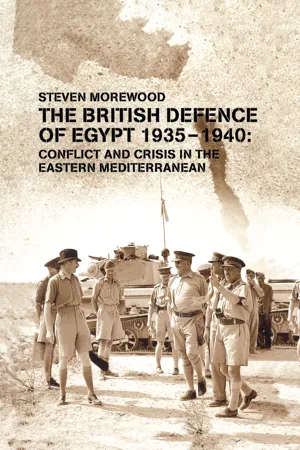
eBook - ePub
The British Defence of Egypt, 1935-40
Conflict and Crisis in the Eastern Mediterranean
- 294 pages
- English
- ePUB (mobile friendly)
- Available on iOS & Android
eBook - ePub
The British Defence of Egypt, 1935-40
Conflict and Crisis in the Eastern Mediterranean
About this book
A comprehensive and challenging analysis of the British defence of Egypt, primarily against fascist Italy, in the critical lead-up period to the Second World War. Culminating in the decisive defeat of the Italian military threat at Sidi Barrani in December 1940, this is a fascinating new contribution to the field.
1 The British defence of Egypt in the interwar period
Strategic imperatives and rationale
In December 1929 Sir Austen Chamberlain, the recently departed Conservative foreign secretary, spoke in the parliamentary debate on the latest attempt to legitimise the longstanding British military presence in Egypt.
The relationship between Egypt and ourselves has not been a matter of choice but the result of the geographical position occupied by Egypt as one of the high roads and arteries of imperial communications. It is to that fact that the intervention in Egypt originated. It is to that fact that the occupation of Egypt by British forces is due, and it is, first and foremost, to protect those interests that British forces have continued in Cairo, Alexandria and elsewhere, as our guarantee for the security of those vital interests.1
British involvement in Egypt occurred over a protracted period. Britain was drawn in by her evolving strategic, political and economic interests in the eastern Mediterranean, the protection of which rendered it impossible for her to vacate Egypt once British forces were established there. Although the motives for the 1882 occupation still arouse controversy,2 the primacy of the security of the Suez short cut to India and the Far East is readily apparent. In essence, the division between economic and military factors is a false one: they are not mutually exclusive, with the Canal serving both as a highway for trade with the lucrative eastern part of empire and as a reinforcement route for warships, troop transports and supplies in either direction. The overriding significance of strategic considerations is nevertheless inherent in the fact that, even after the Egyptian public debt problem was resolved, the British remained steadfastly in occupation. Egypt was too valuable a prize and too vulnerable to a hostile foreign occupation for British decision-makers to ever seriously consider leaving, notwithstanding periodic evacuation promises, confirming French cynicism that the temporary arrangements lasted longest. In fact the ‘temporary occupation’ would endure for seventy-four years. Egypt became a jugular vein of imperial communications through which ran land, maritime, telegraph and later air routes to near and distant parts of the far-flung British Empire. In line with the accretion of Egypt’s strategic significance over the years, the market value of the British Treasury’s investment in Canal shares, dating from 1875, had mushroomed from £24 million in 1898 to £93 million by 1935. Notwithstanding the retrenchment of the 1920s and early 1930s, Britain remained determined to retain her empire and when fascist Italy threatened her vital interests in the eastern Mediterranean in mid-1935 she responded by amassing the largest concentration of forces seen since 1918.
No surrender
The close of the Great War marked a watershed in the history of the military base in Egypt. Established in 1882 to guarantee the security of imperial lines of communication with the most richly endowed parts of the empire located east of Suez, the garrison remained firmly entrenched. By 1918 two contradictory developments were apparent: first, the rise of Arab nationalism, partly ignited by the British themselves to help topple the Ottoman Empire but not extinguished by its demise, which infected Egyptians; second, the deepening of the existing military establishment in Egypt which served as a wartime base for operations in the eastern Mediterranean. The one was about to challenge the other and demonstrate, once again, Britain’s determination to protect its critical geo-strategic position in Egypt.
Britain harboured no intention of scuttling from Egypt at the end of the Great War. To the contrary, Ottoman collapse created a unique opportunity to expand the British Empire to its greatest extent. Britain eagerly filled the resulting power vacuum in the Middle East and at the Paris Peace Conference successfully argued that it had assumed the Ottoman role of Suez guardian while Egypt was incapable. Moreover, most of Britain’s allies, barring obstreperous Italy, obligingly recognised the British protectorate with even the United States, supposedly committed to self-determination for all nations, great and small, conferring approval in April 1919. ‘There is no doubt’, Lord Derby wrote jubilantly from Paris, ‘that the Egyptian Nationalist deputation had a real douche of icy cold water with President Wilson’s letter accepting our control of Egypt’. General Sir Edmund Allenby, following his appointment as Special High Commissioner to Egypt to restore order, cannily published the American communiqué hoping it would ‘have a calming effect on public opinion, as it was hoped and expected that Wilson w[oul]d. support nationalists’. When an Egyptian delegation was finally allowed to Paris, seeking support for independence, it found itself cold-shouldered by all the Great Powers except Italy. Indeed, the British protectorate and the transfer to Britain of Turkish rights, under the 1888 Suez Canal Convention, were recognised in the Paris treaties of Versailles, St Germain, Trianon and Sèvres, demonstrating Britain’s determination that its tenure of Egypt should form an integral part of the peace settlement.3
The position was not entirely satisfactory. The end of hostilities crystallised two problems for imperial defence: the containment of nationalism balanced against the realisation that Britain, financially and psychologically exhausted by a world war, could not afford to maintain large garrisons outside India. In November 1914 the British General Officer Commanding in Egypt, General Sir John Maxwell, had declared martial law while sweetening the pill with a promise that his government assumed ‘the sole burden of the present war without calling upon the Egyptian people for aid therein’. However, within three days of the announcement, Egyptian artillery units were committed to help defend Suez and by August 1915 a labour corps was established which eventually exceeded 100,000 members, who served not only in Egypt but also Palestine and France. The fellaheen, who constituted the majority of the population, resented being drafted into the corps, the requisition of one-fifth of their camels and British control over the pricing and distribution of cotton. Their seething anger provided a mass base for the political elite to exploit to further the cause of Egyptian nationalism. Widespread rioting erupted in March 1919. The Residency’s abrupt dismissal of a delegation (Wafd) of local politicians, led by Sa’ad Zaghlul Pasha, provided the occasion. It boldly sought immediate independence and in return promised to guarantee the neutrality of Suez and to place Egypt under the protection of the new League of Nations. Denied a hearing in Paris, when the members persisted in their demands, they were taken into military custody and deported to Malta. Upon his arrest Zaghlul was found to possess a newspaper clipping, in English, of Wilson’s Fourteen Points with ‘the rights of small nations’ underlined in red. The British police soon turned the escalating situation over to the military, which was embarrassed with demobilisation in full swing. The revolt was vigorously suppressed with the British, Indian and Dominion troops awaiting embarkation. Their emasculating tactics included driving lorries at rampant mobs, firing into crowds and the vigorous employment of armoured cars, aircraft and mounted troops for dispersal operations. Over a thousand Egyptians were killed, fifty-seven executed and fifteen hundred convicted and imprisoned for the loss of only seventy-five British killed or wounded. Although disorders decreased after the summer, the underlying current of revolt led to the deployment of two warships at Alexandria, four in the Canal and a naval flotilla up the Nile by the end of 1921.4
The bill for suppressing the revolt ran to almost £6 million. To maintain a large military presence would be prohibitively expensive. Seeking a political solution, Lloyd George’s government sent a fact-finding mission to Egypt under Lord Milner, secretary of state for the colonies and foremost government expert on Egyptian affairs. Arriving in December 1919, the mission travelled from Port Said to Cairo in a heavily armed train with protective aircraft hovering overhead. Four years earlier, Milner had con-fidently asserted that Egypt would in future ‘be as much a part of the British Empire as India or Nigeria’.5 Once on the spot, however, his mission was confronted by a widespread boycott. ‘We have never honestly faced the Egyptian question’, Milner declared, ‘and our neglect to do so is in a measure responsible for the present situation.’ Following meetings with moderate politicians, his mission concluded that Egypt might be granted independence in exchange for an alliance protecting British interests, a concept that became public in the Milner–Zaghlul Agreement of August 1920.6
Up to this point, Milner had been entrusted with negotiations outside of Cabinet jurisdiction. The service departments therefore greeted the proposals with shock, not least the sympathy accorded to native aspirations to confine forces to the Canal Zone. Winston Churchill, Secretary of State for War, considered that the protectorate should be maintained, more especially as Britain had assiduously cultivated its recognition by the Great Powers and found support from another arch imperialist, the Chief of the Imperial General Staff, Field Marshal Sir Henry Wilson. Air Marshal Sir Hugh Trenchard, the Chief of Air Staff, emphasised Egypt’s critical importance to imperial communications, with plans afoot to extend the Royal Air Force presence in Egypt.7 During the war, air training schools, maintenance stations and aerodromes were established west of Suez and the final Middle East campaigns all involved aircraft in a salient role. The Air Staff underlined that Egypt was now ‘the keynote of the Royal Air Force scheme’: its cloudless blue skies presented ideal training conditions, providing on average 40 per cent more flying hours than at home; Egypt formed a semi-mobile reserve for the Middle East; and expenses incurred in providing existing workshops and depots would be lost in transferring to the Canal Zone. In short, Egypt could not be replaced; it was ‘the most important junction in the world from an imperial air route point of view’.8
Admiral Beatty, Chief of Naval Staff, further fuelled the debate on Egypt’s future status when he emphasised that the shorter Suez route to the eastern empire was essential to the Royal Navy now that Britain faced two major naval rivals, Japan and the United States, in separate theatres.9 ‘The vital importance of the Suez Canal to the sea communications of the British Empire is an axiom’, proclaimed an Admiralty memorandum; ‘its peculiar danger lies in the fact that it is the narrowest and most easily-blocked portion of our only short route to the East’.10 Australia, New Zealand and South Africa were also anxious that Suez remained firmly under British control. The South African Prime Minister contended that Britain ‘must hold on as grimly as possible’ to the Middle East and that ‘no surrender should be made to present or future political enemies’. At the 1921 Imperial Conference the Australian leader, Billy Hughes, asserted that any menace to Suez affected ‘the whole of the empire vitally’ and denigrated any confinement of forces to the Canal Zone. Already worried by potential future Japanese aggression, Hughes spoke of a three-week period for a rescuing fleet to reach Singapore via the Suez route. In similar vein, William Massey, his New Zealand counterpart, considered Egypt the most important country in the empire after Britain itself.11
The forceful intervention of the services had its effect and in five months of talks in London (July – November 1921) an Egyptian delegation, led by Premier Adly Yeghen Pasha, could not move their hosts on the military question. Lloyd George spoke of dealing with the Egyptian nationalists with ‘fire and sword’ but the reality was that, with imperial overstretch apparent from Ireland to India, such a solution was too problematic. The Egyptian delegation rejected the proposal that ‘British forces should have free passage through Egypt and be maintained at such places and for such periods as shall from time to time be determined’ as tantamount to ‘occupation, pure and simple’. After the talks broke down, Lord Curzon, Foreign Secretary, addressed a note to the Sultan suggesting that his people should not ‘indulge their national aspirations, however sound and legitimate in themselves, without sufficient regard to the facts which govern international life’. Disenchanted, Adly’s Cabinet resigned on 8 December 1921 leaving Egypt once more without a government. As political agitation rose anew, inflamed by the Curzon note, Zaghlul was deported for a second time and stern military measures ensured there was no repeat of 1919. Seeking to break the deadlock, Allenby met more moderate Egyptian politicians in secret to thrash out a compromise formula. He conveyed the gist of this to the Chief of the Imperial General Staff: ‘drop the word “protectorate”, give them a constitution, retain all necessary safeguards, including British troops here, and make further concessions depend on circumstances’. Curzon procrastinated over the proposals, finding ministers wanted a firm treaty commitment before relinquishing the protectorate. Summonsed to London, Allenby threatened to resign along with his leading advisers if his proposals were rejected. Fearing that Allenby would attack his shaky coalition government from the House of Lords, Lloyd George waved aside opposition led by Churchill. In the event, the Allenby Declaration proved acceptable, with a few modifications, because the end of the protectorate and martial law was to be balanced by four reserved points. There was never any question of granting unfettered independence and then trusting the native government to discuss imperial interests sympathetically, as Allenby suggested.12
The House of Commons endorsed the new policy by 202 votes to 70 (the latter figure reflected Labour and Liberal criticisms). As Allenby hoped, the formula proved sufficiently enticing to persuade a moderate nationalist, Sarwat Pasha, to form a cabinet on 1 March 1922. With British forces still conspicuous, Egypt was ironically declared an ‘independent sovereign state’ on 15 March and the Italian-educated Sultan, Ahmed Fuad I, became the first monarch. To mark the change of title, the following day a 101-gun salute was staged in Cairo, Alexandria and Port Said. ‘God has graciously permitted the independence of Egypt to be attained by our hands’, Fuad announced. ‘We are grateful to God and hereby announce to the world that from today Egypt enjoys independence and sovereignty.’ During 19 April 1923 a new constitution, modelled on Belgium’s, was promulgated, thwarting Fuad’s autocratic designs. The intelligentsia hoped that the western model would advance Egyptian membership of the League of Nations. Martial law was finally ended on 5 July 1923, despite the misgivings of the British and European communities, and the exiled Zaghlul was allowed to return and play an active political role.13
These events established the triangular relationship between the Palace, the Wafd and the British Residency which came to dominate the Egyptian political scene. This was later succinctly analysed by Lampson:
What was the position? On the throne King Fuad, an astute and unscrupulous Monarch, but a Monarch who in the last resort knew full well on which side his bread was buttered. He might gird at the British and frequently did: but he was fully conscious that the security of his throne depended in the last resort upon British support. Against him – and against us – was the Wafd, the popular nationalist party pledged to secure the independence of the country. It was a three-legged stool – King Fuad, the British and Wafd. When things became difficult we could always rely on King Fuad to beard – and if necessary scotch – the Wafd in their more violent anti-British, i.e. pro-independence, attitude.14
Although Egypt was now a constitutional monarchy, the dynasty resented the constraints placed upon it and whenever possible ruled through a regime sympathetic to palace interests. Under the constitution, the monarch could appoint and dismiss governments, suspend Parliament and his agreement was required to approve legislation. As the most popular and nationalistic party, the Wafd represented the natural party of government, but a broad base rendered it vulnerable to splits, leading recalcitrant members to form splinter parties, while its radicalism often led the British to concert with the opposition to manoeuvre it from power. Until 1936 the Wafd posed by far the biggest threat to the sustenance of British interests in Egypt. Of all native parties, it proved the most reluctant to accept Britain’s unilateral declaration of Egyptian ‘independence’ as anything other than a self-serving sham. Under Zaghlul the party lost no opportunity to indulge in anti-British rhetoric, even taking its case for fetter-free independence to the Lausanne Conference in November 1922. Its memorandum suggested that the reserved points ‘were unjustified by the real conditions of things and attacked Egypt’s sovereignty, both internally and externally . . . [and] were actuated by the desire to keep Egypt under British tutelage’.15 There was much in this. The British High Commission, buttressed by the Cairo garrison, represented a state within a state and its civilian tentacles extended into critical domains of the Egyptian administration, such as policing and financial matters. Indeed, if anything, Britain’s grip on the country remained as tight as ever. In 1921 the European Department in the Ministry of the Interior was created, charged with protecting foreign communities; its activities stretched far and wide as it created personal files on suspect individuals. Again, British police officers occupied the major posts in the cities under the direction of Sir Thomas Russell, Chief of the Cairo Police. Britain also continued to provide the Inspector General of the Egyptian Army. And although Egypt now had a Ministry of Foreign Affairs, its scope for acting contrary to British wishes was very limited.16
On no less than four occasions before 1939 a populi...
Table of contents
- Cover Page
- Title Page
- Copyright Page
- List of maps
- Foreword
- Acknowledgements
- Abbreviations
- Introduction
- 1 The British defence of Egypt in the interwar period
- 2 The defence of Egypt and the onset of the Italo-Abyssinian Emergency
- 3 Defending Egypt during the Italo-Abyssinian Emergency
- 4 Defending Egypt during the Italo-Abyssinian Emergency
- 5 The making of the 1936 Anglo-Egyptian Treaty of Friendship and Alliance
- 6 Securing an exposed flank
- 7 ‘Bloodless war’
- 8 The approach of war in the Mediterranean
- 9 Implementing the Treaty of Friendship and Alliance
- 10 The Suez Canal and the defence of the Far East, 1919–1940
- 11 Conclusion
- Notes and references
- Select bibliography
Trusted by 375,005 students
Access to over 1.5 million titles for a fair monthly price.
Study more efficiently using our study tools.
Frequently asked questions
Yes, you can cancel anytime from the Subscription tab in your account settings on the Perlego website. Your subscription will stay active until the end of your current billing period. Learn how to cancel your subscription
No, books cannot be downloaded as external files, such as PDFs, for use outside of Perlego. However, you can download books within the Perlego app for offline reading on mobile or tablet. Learn how to download books offline
Perlego offers two plans: Essential and Complete
- Essential is ideal for learners and professionals who enjoy exploring a wide range of subjects. Access the Essential Library with 800,000+ trusted titles and best-sellers across business, personal growth, and the humanities. Includes unlimited reading time and Standard Read Aloud voice.
- Complete: Perfect for advanced learners and researchers needing full, unrestricted access. Unlock 1.5M+ books across hundreds of subjects, including academic and specialized titles. The Complete Plan also includes advanced features like Premium Read Aloud and Research Assistant.
We are an online textbook subscription service, where you can get access to an entire online library for less than the price of a single book per month. With over 1.5 million books across 990+ topics, we’ve got you covered! Learn about our mission
Look out for the read-aloud symbol on your next book to see if you can listen to it. The read-aloud tool reads text aloud for you, highlighting the text as it is being read. You can pause it, speed it up and slow it down. Learn more about Read Aloud
Yes! You can use the Perlego app on both iOS and Android devices to read anytime, anywhere — even offline. Perfect for commutes or when you’re on the go.
Please note we cannot support devices running on iOS 13 and Android 7 or earlier. Learn more about using the app
Please note we cannot support devices running on iOS 13 and Android 7 or earlier. Learn more about using the app
Yes, you can access The British Defence of Egypt, 1935-40 by Steve Morewood in PDF and/or ePUB format, as well as other popular books in History & Military & Maritime History. We have over 1.5 million books available in our catalogue for you to explore.