- 312 pages
- English
- ePUB (mobile friendly)
- Available on iOS & Android
eBook - ePub
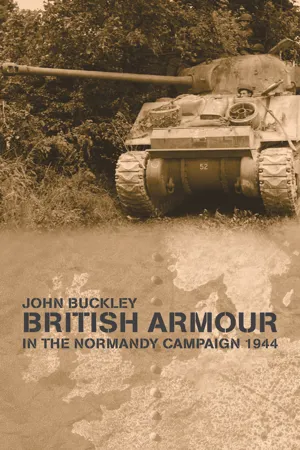
British Armour in the Normandy Campaign
About this book
The popular perception of the performance of British armour in the Normandy campaign of 1944 is one of failure and frustration. Despite overwhelming superiority in numbers, Montgomery's repeated efforts to employ his armour in an offensive manner ended in a disappointing stalemate.
1 INTRODUCTION
‘The scandal of the European campaign was the inability of Western democracies to produce armor and, perhaps doctrine, that was at least on a par with that of their opponents.’
Roman Jarymowycz, Tank Tactics:
From Normandy to Lorraine.
From Normandy to Lorraine.
On 6 June 1944 Allied armies stormed ashore on the beaches of Normandy to open the campaign that would for the Allies be the defining phase of the Second World War. Months of careful preparation and planning came to fruition during the crucial early hours of D-Day to ensure overall success and, despite some reverses, by the end of the first day over 150,000 Allied troops were firmly established in Normandy.1 Behind the soldiers, as they waded and fought their way on to mainland Europe, lay the vast armada assembled by the Allied nations, consisting of 1,213 naval fighting ships supported by over 5,500 landing, ancillary and merchant vessels. Within 24 hours 6,000 vehicles and 10,000 tons of stores had been put ashore.2 Overhead the sky was filled with aircraft of the RAF and USAAF, who dominated the western theatre of operations to such an extent that they had achieved not just air superiority, but total air supremacy. On D-Day the Allies could call upon in excess of 12,000 aircraft, while the Luftwaffe in northwest Europe could muster fewer than 200 serviceable aeroplanes to contest the landings.3
Undoubtedly, Operation Overlord was an overwhelming achievement, quite beyond the capabilities of any other individual or group of military powers. Furthermore, any hope the Germans had of defeating the Allied invasion came to nought within the next few days, and by late June the Heer and the SS were desperately attempting to the stem the inland advance of the Allies. For a time they appeared to be succeeding, but it was at a heavy price as their forces haemorrhaged to destruction over the ensuing weeks. In contrast, the Allies grew stronger, improving both qualitatively and quantitatively to such a degree that in early August they delivered for the West a crushing victory, almost entirely wiping out the German 7th Army and the 5th Panzer Army. In the wake of the disastrous Mortain counter-offensive and the flight from the Falaise Pocket, out of seven armoured divisions, perhaps as few as 24 tanks and 1,300 men escaped across the Seine to fight on in defence of the Third Reich in September.4
The scale of the Allied victory was stunning. In less than 80 days the Allied humiliation of 1940 had been reversed and the Wehrmacht’s greatest achievement overturned. Indeed, in the pursuit from Normandy to Belgium in August and September 1944, the rate of the Allied armour spearheaded advance even outstripped that of the much-vaunted blitzkrieg to the English Channel in May 1940. More German troops and units may have been written off as a result of the Soviet Bagration offensive in the summer of 1944, but the loss of France was a much more important psychological blow to the Third Reich, and one from which it could not recover. Although the war was far from over by September 1944, its outcome was clear. The Western Allies’ contribution to the defeat of Nazi Germany had been emphatically made and their influence on the post-war map of Europe assured.
However, in spite of the tremendous achievements in the summer of 1944, the Allied victory was not unqualified. The failure to close the neck of the Falaise Pocket as early as possible has been the source of some debate, with heavy criticism levelled at the Allies, particularly Montgomery and to a lesser degree Bradley, for not co-operating more effectively to bag as many German soldiers as possible. The stout defence of the German border later in 1944 was partly a result of this mistake, it is contended. The inability of the Allies to win as conclusively as they might in August may seem in retrospect to be churlish considering the overwhelming nature of the victory and the level of the achievement, but the censure of the Allied high command is not without substance.5
Unquestionably, this debate has in part fuelled the ongoing differences between British, Canadian and American analysts and historians of the campaign in the ensuing years. Correspondence in the respected Journal of Military History in 2002 illustrated some of the opinions clearly, when the British military historian Robin Neillands refuted what he saw as the persisting allegations from the United States of over-caution, timidity and excessive tea drinking on the part of the British forces in northwest Europe in 1944–45.6 In his most recent popular work, The Battle for Normandy 1944, Neillands has worked hard to impress upon the critics of the British that there was little to choose between the battlefield effectiveness of the respective Allied armies, though he concedes that in tactical ability the Germans were superior.7 Others however, continue to support the view that a hierarchy of operational and tactical effectiveness can be established with the Germans at the head followed, in order, by the Americans, the British and finally the Canadians.8
The view that the Allies won by massive application of resources and that this compensated for weak battlefield craft, particularly on the part of the Anglo-Canadians, has become the orthodoxy since 1945. John Ellis especially developed this argument in his work of 1990, Brute Force: Allied Strategy and Tactics in the Second World War.9 More recently still, the eminent international and military historian, John Gooch, demonstrated how much this view has become common currency when he wrote that in comparison with the Germans, between 1944 and 1945, the British Army was ‘found to be wanting in almost every respect’ and was saved only by its artillery and supporting air power.10 If one wanted to seek out the exponents of the high arts of operational technique in the Second World War, it seemed, it was the Germans one turned to. It was contended that against the odds they had won spectacular victories in 1940 and 1941 and had held off overwhelming numbers with great skill from 1943 onwards.
In the post-war era, as NATO military planners and analysts sought answers to the difficulties of preventing much larger Warsaw Pact forces from swarming into western Europe, they seemed to have a fair blueprint in the techniques of the Germans in the closing years of the Second World War. Despite being heavily outnumbered the Germans had stymied vast enemy armies for periods of time, both in the east and the west, supposedly by employing cunning and resourceful battlefield craft. Lt-Gen Giffard Le Quesne Martel claimed in 1951 that in order to stop the Russians the West would have to learn from the Germans and employ mobile armoured tactics. He stated that ‘linear defence is fifteen years out of date for European warfare, and we must do the same as the Germans did with their mobile forces’. The Allies might have won the war, but their success was based upon sheer weight of numbers and resources, not operational and tactical acumen, it was claimed by senior officers. That the Germans had employed a static rather than a mobile defence in the summer of 1944 was carefully ignored, as was the obvious point that they had found little success in stopping either the Soviets or the Western armies no matter what tactics they had used.11 Furthermore, as Terry Copp has argued, this interpretation also put aside the harsh and brutal methods the German army employed as a means of instilling fear of recrimination for retreat or failure, and focused instead purely on the tactical and operational methods utilised, especially against Allied and Soviet armour.12
This developing assessment by senior officers such as Martel was in part predicated upon the analysis of historians such as Basil Liddell Hart, intent on proving that the Germans had been influenced by his pre-war works and had developed their techniques from his ideas of dynamic, mobile armoured war-fare.13 The efficacy of this was demonstrated not only in the so-called blitzkrieg period but also in the manner in which the superior tactics of the Germans confounded the Allies in Normandy for so long, and against all the odds. Although the Allies held considerable resource advantages in artillery, air power and armour, they were unable to bring their tanks to bear as effectively as they should because they ignored the lessons they might have learnt from Liddell Hart or from the success of the Germans in the early phase of the war.14
This reading of the war’s events compounded with predominating postwar American views that the root of German effectiveness against superior weight of numbers and equipment lay in the effective delegation of command and decision-making to leaders at the frontline, not those miles behind. The over-control of a commander such as Montgomery and his desire to grip his subordinates resulted in the suffocation of commanders’ initiative and squandered opportunities for exploitation on the battlefield. By embracing the mission tactics approach of the Germans, rather than the orders-based tactics employed by the Allies in the Second World War, it was posited that NATO forces would greatly enhance their likelihood of halting a Soviet invasion.15 A German-style mission-based doctrine, or auftragstaktik, would free commanders to deal with the enemy in a flexible and dynamic manner, in contrast to the sluggish, predictable and ponderous befehlstaktik, or order-directed methods employed by the Allies in Normandy in 1944.16 The criticism of the Allied approach, that they got stuck for two months when holding all the advantages, and their clear inability to conduct high-tempo armoured operations appeared to be supported by the events of 1944. It was a perception further reinforced in the post-war years when the British Army of the Rhine conducted tours of the Normandy battlefields, employing British, Canadian and German veterans, including members of the SS, to comment on the events. When serving officers were told the stories of such operations as Totalise, Bluecoat and most infamously of all Goodwood, it seemed perfectly clear and obvious that the Allies had performed poorly, whilst their wily opponents had demonstrated tactical superiority.17 The Goodwood battle of 18–20 July encapsulated everything that was wrong with British armoured forces in the Second World War. Despite huge firepower support, including the use of the Allied strategic air fleet, three armoured divisions had been repulsed with heavy losses by much smaller enemy forces, and over 400 British tanks knocked out of action in just one battle. It seemed that little more needed to be said about the inefficiency of British and Canadian tank formations.
Historical criticism of Allied armour and its impact on the Normandy campaign has been obvious and overt. Liddell Hart may have been instrumental in the formulation of this orthodoxy in the 1950s, but the more recent historiography also supports the contention. In 1990, John Ellis was roundly critical of the armoured divisions in 21st Army Group, while in 1991 John English claimed: ‘Without question, the tank arm remained the weakest link in the Anglo-Canadian order of battle.’18 Russell Hart in 2001 even went so far as to state: ‘British armour made little contribution to Allied victory in Normandy.’19
The supposed failure of the Anglo-Canadian armoured forces to stage a strategic breakout and exploitation prior to mid-August, and only then achieved because of the American successes in the west, has been attributed in post-war literature to three key factors. First, it has been asserted that the techniques employed by Montgomery and his senior staff were deeply flawed and reduced each operation to an attritional, slogging battle, in which the initiative was too often squandered. The stalemate was therefore self-imposed and could have been broken if alternative techniques had been employed. To a significant degree the weakness of Anglo-Canadian armour was a critical failing as, when hurled upon the German lines, it was palpably unable to break the deadlock and was repeatedly thrown back. In 1983, in his famous work Decision in Normandy, Carlo D’Este took the Allies, in particular Montgomery, to task for their overly deliberate and predictable tactics and operational techniques. More recently, Roman Jarymowycz has been critical of the Allied approach in Normandy, and he compared their style unfavourably with the capabilities of the Soviets’ deep battle methods, used with great, if costly success against the Germans on the Eastern Front.20 The campaign also supposedly exposed the tactical weakness of British armoured units. Liddell Hart was the most significant critic of the tactical techniques and methods employed by the armoured arm of 21st Army Group. He argued that the British had demonstrated a poor grasp of armoured doctrine in Normandy, a view supported by some senior veterans of the fighting, such as the future Field Marshal Michael Carver.21
However, the employment of armour in Normandy requires deeper analysis, and it is not enough merely to attribute Allied victory to the blunt employment of mass. Others had relied on superior numbers but failed, notably the French in 1940 and the Soviets in 1941. Greater numbers and resources do not guarantee success – strength and force have to be brought to bear effectively at critical points in a campaign and the battle in order to prevail, and to this end the Allies appear to have been successful. Overall casualties in Normandy were within predicted limits, and the approach adopted by Montgomery and 21st Army Group delivered an overwhelming victory against a highly experienced and recalcitrant foe. Stephen Hart has recently re-evaluated the operational techniques of 21st Army Group and found them to be much more effective and appropriate than previously believed. Moreover, he contends that Montgomery’s curious and largely disagreeable personality has been allowed to confuse and cloud the issues.22
In addition, it is clear that the denigration of the armoured forces on a tactical level fails to acknowledge the context of the campaign, nor take account of the innovation and flexibility of British brigades and divisions, particularly obvious in the mid-to-later stages of the fighting. It is certainly the case that much criticism of the employment and conduct of armoured operations in Normandy is founded upon a misconception that the Allies should have fought a different style of campaign to the highly successful one they did prosecute. Consequently, the operational and tactical conduct of British armour in Normandy requires a fuller and more appropriate analysis, one in which the starting point is not that, because their techniques did not mirror those of the Germans, ergo they were misguided and flawed. Too much previous analysis has assumed failure on the part of Anglo-Canadian armour simply because it did not follow the pattern set by the Germans in 1939–42, the one so much admired, and arguably misunderstood, in the post-1945 world.
The second, and to many most important reason why Allied armoured forces failed to come to terms with the requirements of the campaign in Normandy was the inferior equipment with which they were forced to fight. The technology-oriented explanation for the difficulties encountered by Allied armoured forces in Normandy focuses on the relative weakness of the Shermans and Cromwells fielded by the British, Canadians and Americans when compared with their German counterparts, the Tigers and Panthers. Famously, during the war and shortly afterwards, the MP for Ipswich, Richard Rapier Stokes, among others, repeatedly attempted to take the government to task over the deficiencies in British tanks. He was particularly critical in a secret session of the House of Commons on 24 March 1944, when he challenged James Grigg, Secretary of State for War, to a tank duel in which Stokes would command a Tiger and Grigg a Cromwell.23 In a speech to the House in August 1944, Stokes claimed that he had been informed by a ‘responsible general’ that in tank design, ‘Relatively speaking, to-day, we are just as far behind the Germans as we were in 1940.’ Following a contradictory interruption, Stokes continued:
If he [Rear-Admiral Beamish] took the trouble to read my speeches he would be aware that all along my criticisms have been based on irrefutable facts. [laughter] It is all very well for hon. Members to laugh, but these men are dying.24
Stokes certainly captured the sense of frustration felt by some tank crews and commanders in Normandy. He pointed out that in one unit, he was regarded as the patron saint of the regiment, for protesting against the inadequacies of British tanks. In 1945 he published Some Amazing Tank Facts, a pamphlet in which he outlined the ‘scandal’ and the crucial tank gap that had bedevilled the efforts of British armoured units in the Second World War, even in the closing phase from 6 June 1944 onwards. Emotively he stated:
Thousands of the boys who went out to fight for us are not coming home again because our Ministry of Defence failed, through stupidity and weakness in the department of weapons.25
A simple comparison of the firepower and armour protection afforded to the respective British and German types of tanks seemed to demonstrate the main reason behind the inability of the Allied armoured formations to impose themselves on the campaign. In short, it was, and is, argued that Allied tanks were technically inferior and thus could not engage effectively with enemy armour.
Historians and writers such as Roman Jarymowycz, Peter Beale, Russell Hart, Kenneth Macksey and many others have all placed great emphasis on the failings of the tanks themselves as an explanation for the poor showing of Allied armour in Normandy. Max Hastings in particular argued this case in 1984 in Overlord, in which he claimed that the most fundamental failing of the Allies in Normandy was their inability to deploy a tank to rival those of the Germans. In addition, one of the key factors behind this deficiency was the weakness of British tank design and production in the years leading up to Operation Overlord. Jarymowycz argues that the British were simply unable to build a reliable and functional tank during the war and thus switched to the flawed but dependable Sherman, while Beale is vitriolic in his condemnation of the whole British design and procurement process.26 Most recently of all Tim Ripley has claimed:
The V...
Table of contents
- COVER PAGE
- BRITISH ARMOUR IN THE NORMANDY CAMPAIGN 1944
- CASS SERIES: MILITARY HISTORY AND POLICY
- TITLE PAGE
- COPYRIGHT PAGE
- SERIES EDITOR’S PREFACE
- ILLUSTRATIONS
- FIGURES, MAP AND TABLES
- ACKNOWLEDGEMENTS
- ABBREVIATIONS
- 1 INTRODUCTION
- 2 FIGHTING THE CAMPAIGN
- 3 OPERATIONAL TECHNIQUE
- 4 FIGHTING THE BATTLE
- 5 THE TANK GAP
- 6 DESIGN AND PLANNING
- 7 PRODUCTION AND SUPPLY
- 8 MORALE AND MOTIVATION
- 9 CONCLUSION
- NOTES
- BIBLIOGRAPHY
Trusted by 375,005 students
Access to over 1.5 million titles for a fair monthly price.
Study more efficiently using our study tools.
Frequently asked questions
Yes, you can cancel anytime from the Subscription tab in your account settings on the Perlego website. Your subscription will stay active until the end of your current billing period. Learn how to cancel your subscription
No, books cannot be downloaded as external files, such as PDFs, for use outside of Perlego. However, you can download books within the Perlego app for offline reading on mobile or tablet. Learn how to download books offline
Perlego offers two plans: Essential and Complete
- Essential is ideal for learners and professionals who enjoy exploring a wide range of subjects. Access the Essential Library with 800,000+ trusted titles and best-sellers across business, personal growth, and the humanities. Includes unlimited reading time and Standard Read Aloud voice.
- Complete: Perfect for advanced learners and researchers needing full, unrestricted access. Unlock 1.5M+ books across hundreds of subjects, including academic and specialized titles. The Complete Plan also includes advanced features like Premium Read Aloud and Research Assistant.
We are an online textbook subscription service, where you can get access to an entire online library for less than the price of a single book per month. With over 1.5 million books across 990+ topics, we’ve got you covered! Learn about our mission
Look out for the read-aloud symbol on your next book to see if you can listen to it. The read-aloud tool reads text aloud for you, highlighting the text as it is being read. You can pause it, speed it up and slow it down. Learn more about Read Aloud
Yes! You can use the Perlego app on both iOS and Android devices to read anytime, anywhere — even offline. Perfect for commutes or when you’re on the go.
Please note we cannot support devices running on iOS 13 and Android 7 or earlier. Learn more about using the app
Please note we cannot support devices running on iOS 13 and Android 7 or earlier. Learn more about using the app
Yes, you can access British Armour in the Normandy Campaign by John Buckley in PDF and/or ePUB format, as well as other popular books in History & Military & Maritime History. We have over 1.5 million books available in our catalogue for you to explore.