- 304 pages
- English
- ePUB (mobile friendly)
- Available on iOS & Android
eBook - ePub
About this book
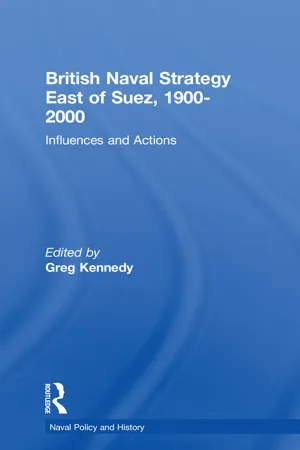
This new collection of essays by a panel of established international scholars sheds new light on what some of those influences were and what actions were taken as a result of Britain's Far Eastern commitments. Not only are new evidence and approaches to those issues addressed presented, but new avenues for further research are clearly outlined.
1
‘WEE-AH-WEE’?: BRITAIN AT WEIHAIWEI, 1898–1930
T.G. Otte
Ye Jingoes shout your very best,
Ye grumblers cease to cry;
The East is conquered by the West,
We’ve taken Wei-Hai-Wei.
Ye grumblers cease to cry;
The East is conquered by the West,
We’ve taken Wei-Hai-Wei.
We none of us know where it is,
But that’s no reason why
We should not feel heroic zeal
At taking Wei-Hai-Wei.
But that’s no reason why
We should not feel heroic zeal
At taking Wei-Hai-Wei.
George Curzon once has seen the spot,
And George is pretty spry,
And George declared that it must be got –
We must have Wei-Hai-Wei.
And George is pretty spry,
And George declared that it must be got –
We must have Wei-Hai-Wei.
German and Russian fleets, Ah ha!
Who cares for you, small fry?
We laugh at all your warlike feats,
We’re safe in Wei-Hai-Wei.
Who cares for you, small fry?
We laugh at all your warlike feats,
We’re safe in Wei-Hai-Wei.
Sir Wilfrid Lawson, Easter 1898.1
The Chinese Empire’s defeat in the war with Japan of 1894–95 marked a turning point in China’s relations with the outside world. Its rout at the hands of the smaller island power brought before the chancelleries of Europe the full extent of China’s internal and external weakness. The Middle Kingdom, it seemed, had joined the ranks of – in the Social Darwinian parlance of the day – ‘dying nations’.2 Its moribund condition raised the prospect of dividing the spoils of the Chinese carcass, and so made it an object of Great Power politics. In the immediate aftermath of the Sino-Japanese War the foreign powers competed for loan agreements, or railway, mining and other commercial concessions. The pace and character of Far Eastern developments, however, changed at the end of 1897, when Germany exploited the murder of two German missionaries to seize Kiaochow Bay in Shantung province, and turned the port of Tsingtao into a naval base. Weakened by the war with Japan, the Peking government was powerless to resist foreign encroachments upon its territory. Indeed, the German move seemed to presage a new, more acute, possibly even the final, phase of the ‘China Question’. In retrospect, The Times aptly termed the Far Eastern crisis of 1897–98 ‘a scramble for naval bases’.3 While Germany and Russia were the principal actors during the crisis, Britain, whose political and trading influence was still dominant in China, was immediately affected by the establishment of fortified German and Russian bases on the Chinese mainland. Already during the final stages of the 1894–95 war France and Russia had significantly augmented their naval squadrons in Chinese waters.4 At the end of the conflict Germany had joined with these two powers in the so-called Far Eastern Dreibund that deprived Japan of her spoils of victory. The coercive cooperation of the three continental Powers, their naval ambitions – albeit in the German case only nascent – combined with China’s apparent terminal decline, threatened to undermine Britain’s regional position. In consequence, in April 1898 the British government acquired the lease of the port of Weihaiwei on the northernmost tip of the Shantung promontory as a counterpoise to the German and Russian acquisitions of Kiaochow and Port Arthur.
Simultaneously with the northern naval base Britain also acquired the lease of the Hong Kong New Territories. Both leased territories were comparable in size and population; so were the legal and administrative arrangements under the two lease agreements.5 The fate of the two new leased territories, however, could not have been more dissimilar. While Hong Kong developed into a flourishing, commercially vibrant Crown Colony, and remained under British rule until its retrocession to Peking at the expiry of the lease in 1997, Weihaiwei was a dependent territory, never to be developed as either a naval base or a trading place. It languished in a state of neglect and uncertainty over its future, to be handed over to China in 1930. In the evocative Edwardian grandiloquence of Reginald Johnston, then a district officer and magistrate, and later the territory’s last commissioner, Britain’s ‘robe of empire [was] a very splendid and wonderfully variegated garment’. Pinned to this robe there was ‘a little drab-coloured ribbon that is in constant danger of being dragged in the mud or trodden underfoot . . .This is Weihaiwei.’6 Indeed, at the time of its acquisition, opposition politicians in London ridiculed the leased territory as ‘Wee-hy-Wee’, ‘Wee-ah-Wee’ or ‘Why-oh-Why’.7 Weihaiwei fell into oblivion soon after its unceremonious return to Chinese rule. In scholarly literature, too, it has suffered the same neglect that it suffered at the hands of Whitehall officials during the period of British rule. Insofar as it has attracted the attention of scholars, it has been used as an example of late Ch’ing diplomacy playing a weak hand against encroaching foreign Powers;8 or a blatant case of the ‘irrationality’ underpinning late-Victorian British imperialism.9 It has also been treated as a case study of British colonial administration and the economic and social modernization that it wrought.10 However, the leased territory’s place in British strategy and policy in the Far East in the early part of the twentieth century has not been studied in depth.11 In fact, Weihaiwei offers an excellent prism through which to study the facets of Britain’s regional presence, the constraints placed upon Britain’s ability to project its power in East Asia, the metropolitan strategic policy-making process and the wider Great Power context in which British policy in the area operated.
‘Cartographic Consolation’: The acquisition of Weihaiwei
Part of the reason for Weihaiwei’s neglect as a potential naval base lies in the developments that led to its acquisition. At their root was the German seizure of Kiaochow in mid-November 1897, and not Russia’s lease of Port Arthur in March 1898. Following the German move the government in London faced pressure on three different fronts. There was, first of all, the danger that a ‘policy of grab’ by the powers might be unleashed by the German action; and a scramble of this kind was generally anticipated to hasten China’s complete disintegration. This concern was hardly allayed by the German ambassador’s statement that, if nobody else would, ‘the Russians were sure to begin [the scramble] sooner or later’.12 Then there was the spectre of a revived Far Eastern triplice that haunted senior Foreign Office officials, such as the Assistant Under-secretary Francis Bertie, who supervised Far Eastern affairs. The German action at Kiaochow, he reasoned accurately, had come only after prior consultation with Russia; and Germany’s establishment at a northern Chinese port was, in fact, Germany’s reward for joining France and Russia in ousting Japan from the Chinese mainland in 1895.13 St Petersburg’s sharp reaction to the German move, and the Russo-German standoff over Kiaochow, which was also coveted by Russia, at the end of November, helped to allay fears about the firmness of Russo-German collusion and its possible poise against Britain.14 It did not remove, however, fears of a scramble for Chinese territory. Reluctant to commit himself to any definite course to counter the German action at this early stage of the crisis, lest overt British intervention led to a ‘scramble for China’, the Prime Minister and Foreign Secretary, the Marquis of Salisbury, decided to await further developments.15 The appearance of a Russian naval squadron in mid-December at Port Arthur at the northern entrance to the Gulf of Pechili, however, increased pressure on Salisbury to formulate a decisive policy. The wintering of the Russian ships in the ice-free port on the Liaotung peninsula was a clear indication of St Petersburg’s intention to follow the German move.16 Sir Nicholas O’Conor, formerly Britain’s minister at Peking and now ambassador to Russia, advised that for diplomatic and strategic reasons Britain now required an ‘adequate counterpoise to German and Russian actions’.17 Indeed, Salisbury himself was slowly edging toward the idea of establishing ‘a winter station for our fleet near Cheefo [on the southern shore of the Gulf of Pechili] or the constant presence of our vessels there’.18 On New Year’s Eve, he finally instructed the minister at Peking, Sir Claude MacDonald, to demand ‘some corresponding concession’ in the event of Germany obtaining a permanent base in northern China.19 During the course of the first week of January 1898 Salisbury and the First Lord of Admiralty ‘discuss[ed] various harbours in China’.20 Thus, the decision to acquire a port in northern China was taken much earlier than is accepted in traditional scholarly assessments. Crucially, it was taken as a necessary countermove to the German seizure of Kiaochow. At this stage in the deliberations, no reference was made to any possible Russian territorial acquisition. In this lies one of the keys to the fate of Weihaiwei after 1898.
However, the government now came under increased pressure on a third front: calls in the press and parliament for forceful British action in China.21 Demands for ‘some sensational action on our part’ were echoed by the Colonial Secretary, Joseph Chamberlain, the undoubted strong man of the Unionist administration.22 Given the importance of keeping the renegade Radical Chamberlain within the Unionist fold, his suggestions could not easily be ignored; nor was Salisbury unreceptive to ‘the swing of the pendulum at home’. Whatever his disdain for popular politics, he was resigned ‘that “the public” will require . . . cartographic consolation in China . . . [A]s a matter of course we shall have to d o it’.23 To fend off mounting public criticism of the government’s handling of the Far Eastern situation, leading Cabinet ministers delivered public speeches, declaring the government’s resolve to defend British commerce in the region. The Chancellor of the Exchequer, Sir Michael Hicks Beach, even pronounced the government to be ‘absolutely determined , . . . even at the cost of war’ to defend British interests.24 No doubt, the chancellor’s bellicose speech was meant as a warning to Russia to respect British rights and interests in China. Such ministerial statements, however, were part of a co-ordinated effort to gain time in order to negotiate a regional understanding with Russia. Such a working agreement would contain the threat of a ‘scramble for China’; but would also ‘produce some changes in the grouping of the Powers in Europe’, as Salisbury noted. For this, he won the backing of the Cabinet.25 Despite auspicious beginnings, O’Conor’s negotiations at St Petersburg eventually ran aground in early March on the twin obstacles of competing attempts to issue another loan to China and Russia’s ambitions to secure an expansive sphere of influence in northern China.26 Indeed, while negotiations for an agreement with Britain continued, Russia extracted from Peking the lease of Port Arthur and Talienwan.27
This latest turn of events caused the Salisbury administration considerable embarrassment. On 2 March the government’s foreign-affairs spokesman in the House of Commons, Salisbury’s Parliamentary Under-secretary George Nathaniel Curzon, had supported a motion, tabled by a Conservative backbencher, pledging London to maintain China’s integrity as a vital British interest.28 Curzon’s support for the motion was somewhat precipitate. When the German and Russian occupations were made permanent in mid-March, it highlighted Britain’s limited ability to protect her vital interests in the Far East. Throughout March public pressure on the government was mounting to adopt a more decisive attitude. Even in the Conservative-leaning press the government was accused of ‘ministerial vacillation, hesitation, and timidity’.29 Furthermore, in January and February the ruling party lost three parliamentary byelections in supposedly safe seats. On the hustings, Salisbury’s ‘weak’ foreign policy was ‘today the theme of every Radical canvasser’, as a senior Conservative MP warned.30 A further, diplomatic factor now entered into Salisbury’s equation. At the end of February, the Tsungli Yamên, the Chinese Board of Foreign Affairs, had offered Britain the lease of Weihaiwei. In so doing, Peking hoped to forestall possible British demands for compensation in the rich Yangtze region, but also to play off the foreign Powers against each other.31 The former headquarters of China’s Northern (or Pei-yang) Fleet until the 1894–95 war, Weihaiwei had been under temporary Japanese occupation since then, to be evacuated in May 1898 upon the payment of the last instalment of the war indemnity owed to Japan. Indeed, fearful that the Germans ‘had cast thei...
Table of contents
- Cover Page
- Title Page
- Copyright Page
- Notes On Contributors
- Series Editor’S Preface
- Cass Series: Naval Policy and History Series Editor: Geoffrey Till ISSN 1366-9478
- Introduction
- 1: ‘Wee-ah-wee’?: Britain At Weihaiwei, 1898–1930
- 2: The Idea of Naval Imperialism: the China Squadron and the Boxer Uprising
- 3: ‘Unbroken Thread’: Japan. Maritime Power and British Imperial Defence, 1920–32
- 4: What Worth the Americans? the British Strategic Foreign Policy-making Elite’s view of American Maritime power in the far East, 1933–1941
- 5: ‘Looking Skyward from below the Waves’: Admiral tom Phillips and the Loss of the Prince of Wales and the Repulse
- 6: ‘Light two Lanterns, the British are coming by Sea’: Royal Navy Participation in the Pacific 1944–1945
- 7: The Royal Navy in Korea: Replenishment and Sustainability
- 8: The Royal navy, Expeditionary Operations and the end of Empire, 1956–751
- 9: The Royal Navy and Confrontation, 1963–66
- 10: The British Naval Role East Of Suez: An Australian Perspective
- 11: The Return to Rlobalism: the Royal navy east of Suez, 1975–2003
- Select Bibliography
Trusted by 375,005 students
Access to over 1.5 million titles for a fair monthly price.
Study more efficiently using our study tools.
Frequently asked questions
Yes, you can cancel anytime from the Subscription tab in your account settings on the Perlego website. Your subscription will stay active until the end of your current billing period. Learn how to cancel your subscription
No, books cannot be downloaded as external files, such as PDFs, for use outside of Perlego. However, you can download books within the Perlego app for offline reading on mobile or tablet. Learn how to download books offline
Perlego offers two plans: Essential and Complete
- Essential is ideal for learners and professionals who enjoy exploring a wide range of subjects. Access the Essential Library with 800,000+ trusted titles and best-sellers across business, personal growth, and the humanities. Includes unlimited reading time and Standard Read Aloud voice.
- Complete: Perfect for advanced learners and researchers needing full, unrestricted access. Unlock 1.5M+ books across hundreds of subjects, including academic and specialized titles. The Complete Plan also includes advanced features like Premium Read Aloud and Research Assistant.
We are an online textbook subscription service, where you can get access to an entire online library for less than the price of a single book per month. With over 1.5 million books across 990+ topics, we’ve got you covered! Learn about our mission
Look out for the read-aloud symbol on your next book to see if you can listen to it. The read-aloud tool reads text aloud for you, highlighting the text as it is being read. You can pause it, speed it up and slow it down. Learn more about Read Aloud
Yes! You can use the Perlego app on both iOS and Android devices to read anytime, anywhere — even offline. Perfect for commutes or when you’re on the go.
Please note we cannot support devices running on iOS 13 and Android 7 or earlier. Learn more about using the app
Please note we cannot support devices running on iOS 13 and Android 7 or earlier. Learn more about using the app
Yes, you can access British Naval Strategy East of Suez, 1900-2000 by Greg Kennedy in PDF and/or ePUB format, as well as other popular books in History & Military & Maritime History. We have over 1.5 million books available in our catalogue for you to explore.