- 200 pages
- English
- ePUB (mobile friendly)
- Available on iOS & Android
eBook - ePub
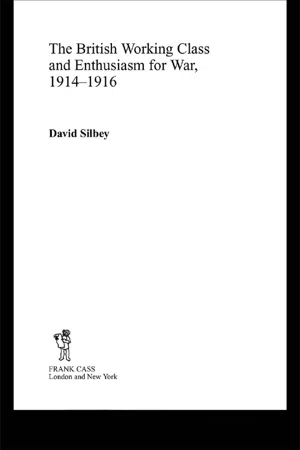
The British Working Class and Enthusiasm for War, 1914-1916
About this book
Millions of men volunteered to leave home, hearth and family to go to a foreign land to fight in 1914, the start of the biggest war in British history. It was a war fought by soldier-citizens, millions strong, most of whom had volunteered willingly to go. They made up the army that first held, and then, in 1918, thrust back the German Army to win t
1 Introduction
If you are over the age of 18, can read and write successfully, pass the very strict medical examination, if your eyesight and hearing is to a very high standard, you may serve His Majesty King George the Fifth, the Commander of all the British Army, the Royal Navy, Emperor of India, Commander of all his Colonial Forces all around the world, the sun never sets on his Empire.1
Years later, J.W. Roworth, an unemployed labourer, would remember the words of the recruiting sergeant. He thought them a ‘mouthful’, but enlisted anyway.2 He was not alone. After Britain entered the First World War on 4 August 1914, British men volunteered for military service at a rate never before seen in her history. By December, more than 1 million had enlisted. By the end of 1915, more than 2.5 million had joined. These volunteers made up half of all British servicemen in the First World War.3 They fought in Britain’s most sanguinary war. They were the soldiers who marched forward at the Somme. They were the soldiers who slogged through the mud at Passchendaele. They were the soldiers who absorbed the Germans’ spring offensive of 1918, and then, through the summer, pushed them back to the border of Germany. They were the soldiers who fought and won the war for Britain.
Historians, however, have focused only on a small subset of these volunteers, those of the upper and middle classes. Such a focus has ignored the larger part of the rush to colours, for the vast majority of the volunteers were working class.4 They came from the mines, from the factories, and from the workshops. They came from cities and the country. They came from Scotland, Wales, and England. They came from occupations where employment was plentiful, from occupations where employment was scarce, and from occupations where employment was non-existent.
Why were working-class men so willing to fight? The pre-war era had seemingly provided them with little incentive. They had a deep and abiding suspicion of the government, a suspicion returned by the ruling classes. There was little sense of cooperation between the two groups. The working class had experienced stagnant wages and rising unemployment. They had gone on strike for better working conditions with only limited success. They looked forward to a general strike in November 1914, aimed at shutting down Britain’s economy. Worse, they had seen the army used against strikers and been warned by the Prime Minister, Henry Asquith, that he would use ‘all the forces of the Crown’ against them in future strikes.5
The war itself apparently offered little reason to volunteer. Britain was never directly threatened. The counties, cities, and neighbourhoods in which the working classes lived suffered no occupation. Their friends and families were not directly in danger. The people the workers fought to defend spoke Belgian and French. The lands they protected lay across the English Channel, their place names nearly unpronounceable.6
In addition, the war itself demanded a near-unanimous effort from Britain. The First World War was an industrialized mass war. It required the mobilization of the entire society. Without what historian Michael Howard called the ‘widest possible basis of consensus within society’, Britain could not hope to prosecute the war successfully.7 Pre-war, the British government did not believe such a consensus existed.8
Historians have not yet dealt with this question particularly well. First World War historiography has tended to dismiss or downplay the subject of working-class enlistment and popular motivation.9 Those who have examined the ‘rush to colours’ have come from two very different perspectives. Social historians have started from the perspective of the working class, while military historians have viewed the problem from a military perspective. But both have treated the ‘rush to colours’ as a single occurrence, consisting of a mob of men driven to volunteer by either overwhelming passion or social control, a ‘herd’ whose ‘instinct’ it was to enlist.10 Enlistees were ‘lemming-like’, and not individuals.11 By treating the volunteers as a herd, historians have been able to apply a single motivation to them, often an emotional, even irrational one. The kindlier posited a ‘rising tide of patriotism’.12 The less gentle said that the men joined because of a ‘euphoria . . . a demoniac outburst of enthusiasm’.13 In effect, by making the motivation singular and unreasoning, historians have been able to explain it simply and without much investigation. A single reason was a simple reason.
This perspective has allowed historians to ignore inconvenient aspects of the ‘rush to colours’. Military historians have been largely uninterested in investigating the class aspects of enlistment, preferring instead to focus on the politicians, generals, and government and military policy.14 Social historians have been reluctant to look at the majority elements of the working class, which supported the war. Instead, they have focused on the small minority of anti-war protesters.
There is thus, as yet, no answer to the question of working-class enthusiasm. The basis of the war effort, the ‘consensus’, that enabled the European nations to fight a total war, has been left essentially unexamined. Such a lack leaves a gaping hole in the history of the First World War. We cannot explain how national populations came to fight so wholeheartedly for their nations and states. This book aims to begin that investigation, and fill the historical gap. It will investigate what motivations the workers had for joining up, how they spoke of those motivations, and how they acted on them.
Understanding their motivations is important for both military and social history. Military history can never come to grips with the rise and evolution of total war in the nineteenth and twentieth centuries unless it understands popular support for warring states. The soldiers and factory workers are as important to understanding modern war as are the strategy, tactics, technology, and leadership. Social history cannot claim to understand the working class until it understands the enlistment, one of the greatest mass movements of modern British history, as large as the General Strike of 1926.15
Inevitably, the foundation of such an analysis must be the words of the working-class volunteers. Observers misinterpret or misrepresent. Historians misjudge. Thus, any study of working-class motives must begin with what the workers themselves said. Though not as numerous as middle- and upper-class sources, working-class diaries, memoirs, letters, and other documents have been collected and preserved at a number of British archives. Certainly, if used uncritically, the words of the volunteers themselves may mislead. But handled with sufficient sensitivity, they provide the fundamental entry point into the thoughts and feelings of a working class at war.
Of course, such an analysis is difficult, founded as it is on a concept – class – that is itself hotly contested. As Gareth Stedman Jones has pointed out, class remains ‘a congested point of intersection between many competing, overlapping or simply differing forms of discourse – political, economic, religious, and cultural’.16 But if there has been wide disagreement about the form and expression of class, there has nonetheless long been an unspoken consensus, derived from the foundational works on class by Marx and Thompson, that classes – especially working classes – define themselves in opposition to other classes.17 Such an assumption can be dangerous. Any historiographical system that views a society on the basis of its ‘history of internal fragmentation’ obscures areas of similarities within that society. By using ‘class, gender, and race’, analyses may miss the existence or establishment of shared beliefs and interests.18 Many historians have shown a pungent sense of disappointment that British workers were not more bound by their class ties. ‘False consciousness’ among the workers distracted them from their true responsibility, which was to lead ‘the world in creating a socialist society’.19 For many historians, workers have thus not lived up to the expectations and requirements of their class position.
Much of the current literature has thus turned away from class as the supreme defining category, and has, instead, looked to language as the defining and mediating power. Gareth Stedman Jones and Patrick Joyce have suggested that there was no independent ‘class’ or experience of class, merely a linguistically self-created conception of class.20
Perhaps the best solution is simply – for the moment – to see what classes the British themselves described. The British were and are determinedly class-aware. Of what exactly did they think they were aware? Opinions differed depending on who spoke. For some, the fundamental distinction was between manual and nonmanual labour. Charles Booth, who studied the working class of London for several decades around the turn of the twentieth century, believed this. That distinction informed Booth’s groundbreaking study, Life and Labour of the People in London.21 Booth’s working classes worked in a wide range of skilled and unskilled jobs. They might earn substantial amounts of money or less or very little, they might be employed regularly or intermittently or not at all, but they were all manual labourers, and thus – to Booth – all members of the working class.22 The British Census, taken every ten years, took a similar approach. The 1911 Census broke down the British population into eight categories, numbered I–VIII. Classes I and II consisted of middle- and upper-class professions. The classes below – the working classes – were manual labourers, and thus working class.23 These were distinctions of which the British themselves, of whatever level, tended to be strongly aware. I should point out that this was not merely a self-imposed conceptual distinction. The line of division between manual and non-manual labourers was only rarely crossed. Moving from a working-class profession to a middle-class job was a rare occurrence. Over 90 per cent of working-class men remained in the same economic cohort as their fathers. They might move within the working class, but they only rarely moved out of it.24
People on the borderline of that distinction were well aware of the gap. Members of the ‘upper’ working class – those who earned a relatively generous salary and had reasonable job security – were nonetheless strongly aware of their position. For the most part, they did not believe that they belonged with people from the middle class, and they behaved in ways that reflected this. James Sloan remembered ‘a long-distance train driver on the old Great Northern Railway’ who lived next door to them. Sloan’s father managed a hat store and even though the train driver’s ‘annual earnings were probably double my father’s yet, to him, my father was always Mr. Sloan’.25
More even than the language, there was an entire physical structure within British society built around the distinctions noted by Booth and by the Census. Frederick Hunt, as a young working-class man in Kirton Lindsey, north Lincolnshire, remembered that even in church, the ‘leading Methodists’ were careful to distinguish themselves physically from everyone else by sitting in ‘two high-sided box pews which hid all but [their] hats and bald heads’.26 Even the time when people were out on the streets identified them by class. As Allen Clarke pointed out in 1899, the different classes awoke at different times: the workers rose at around five a.m., the clerks at around seven a.m., and the managers two hours later. The obvious effect of this was to segregate the streets according to class. Workers went to work in the company of other workers, clerks in the company of other clerks, and managers with managers.27
Of course, there are several problems with this view of class. First, as feminist historians have pointed out, such a classification eliminated the majority of women.28 Housework was not paid labour, and housewives were thus separated from the working class, excluded by definition. Second, this definition of class is vague at the boundary between the lower and middle class. There is no controversy over the position of an unemployed, unskilled labourer on the docks. He (or she) was working class. But what of manual labourers who earned a substantial wage? Their income often surpassed that of the lower levels of non-manual labourers, like clerks. Many of the lower middle class earned less than many manual labourers, they frequently lived in poor neighbourhoods, and their friends and relatives frequently made their living from manual work. They nonetheless insisted ‘vehemently’ on their separation and their ‘status in society’.29 Such stringency suggests that lower-middle-class men may have enlisted to prove their standing, a motivation rather different from that of the workers. It is thus necessary to scrutinize the sources closely to avoid the inclusion of such lower-middle-class men.
How did this class self-awareness spill into the war? Did the categories that the British organized themselves into before the war shape how they reacted after 4 August 1914? Did the rigid divides between working and middle and upper class remain dominant and whole? Or did class consciousness stop at the water’s edge? In a national emergency, such as was seemingly presented in 1914, were the loyalties of the working class shaped more by economic or by national bonds, and why?
The sources
The sources I have used are working-class documents. Though not as plentiful as elite records, the remembrances of working-class volunteers do exist. The great majority have been gathered at a few places in Britain. The Imperial War Museum (hereafter IWM) in London houses an enormous number of original working-class documents among its collection. The Liddle Archive (hereafter LA) at the Brotherton Library at Leeds University also holds thousands of working-class reminiscences, mostly gathered and preserved through the energy of Peter Liddle. There are also some records at the government’s Public Records Office (hereafter PRO) and National Army Museum (hereafter NAM). From these archives, my research turned up 1,702 possible working-class sources. Of these, 889 offered some tidbit of evidence, while 409 of those were men who spoke at relative length about their motivations and beliefs.
The sources contain some diaries and letters from the 1914–1918 period, but the great majority are memoirs, autobiographies, and oral interviews, created years after the fact. This presents problems. Clearly, the sources have been shaped by various different factors and in various different ways. Sometimes, the shaping is obvious. B.J. Brookes, an office boy, wrote of his wartime experiences, but:
left out anything which I have had personally to do or put up with if it is at all out of the ordinary … I have penned only such things that might, and do, continually happen to any infantryman in the British Army.30
G. Skelton’s family left out the first twenty-three pages of his memoirs because they recounted his civilian experiences before he reached France, experiences the family felt unimportant.31 Sometimes, the shaping is less obvious. The oral interviews from both the IWM and the LA took place largely in the 1950s, 1960s, and 1970s, years after the war. The number of years between the events and their recounting is fairly large for most of these records.32 The temporal distance creates some doubt about their reliability. The intervening years have certainly shaped the way that the volunteers remembered their motivations. When H.C. Parker talked of the war, years later, he identified what they had been fighting against: ‘the concentration camp, the rubber truncheon, the gas chamber, gangster rule, and the aggression founded on bloody murder’.33 Parker’s enemy seems much more like the Nazi regime of the Second World War than the Wilhelmine Government of the First World War.
Geographically, both archives provided sources from all around Great Britain. The non-English countries of Great Britain are all represented, if somewhat sparingly. Of the IWM sources used, 29 out of 796 come from Scotland (3.5 per cent), 14 out of 796 from Ireland (1.7 per cent), and 17 out of 796 from Wales (2.1 per cent). The figures, in the same order, for the LA are 9 out of 292 (3.1 per cent), 1 out of 292 (0.3 per cent), and 7 out of 292 (2.4 per cent). These percentages do not come up to the overall share of each country in the total population of Great Britain: Scotland, 10 per cent; Ireland 9.4 per cent; and Wales, 5 per cent.34 As the comparison shows, Scotland, Ireland, and Wales are under-represented in the source material. With Ireland, this may relate to much lower participation by I...
Table of contents
- Cover Page
- Cass series: Military History and Policy
- Title Page
- Copyright Page
- Tables
- Acknowledgements
- 1 Introduction
- 2 The rush to colours, business as usual, and the coming of conscription
- 3 Currents within the flood
- 4 ‘A sense of the round world’
- 5 ‘The monotony of the trivial round’
- 6 ‘Money was the attraction’
- 7 ‘We were being patriotic. Or young and silly’
- 8 Conclusion
- Notes
- References
Trusted by 375,005 students
Access to over 1.5 million titles for a fair monthly price.
Study more efficiently using our study tools.
Frequently asked questions
Yes, you can cancel anytime from the Subscription tab in your account settings on the Perlego website. Your subscription will stay active until the end of your current billing period. Learn how to cancel your subscription
No, books cannot be downloaded as external files, such as PDFs, for use outside of Perlego. However, you can download books within the Perlego app for offline reading on mobile or tablet. Learn how to download books offline
Perlego offers two plans: Essential and Complete
- Essential is ideal for learners and professionals who enjoy exploring a wide range of subjects. Access the Essential Library with 800,000+ trusted titles and best-sellers across business, personal growth, and the humanities. Includes unlimited reading time and Standard Read Aloud voice.
- Complete: Perfect for advanced learners and researchers needing full, unrestricted access. Unlock 1.5M+ books across hundreds of subjects, including academic and specialized titles. The Complete Plan also includes advanced features like Premium Read Aloud and Research Assistant.
We are an online textbook subscription service, where you can get access to an entire online library for less than the price of a single book per month. With over 1.5 million books across 990+ topics, we’ve got you covered! Learn about our mission
Look out for the read-aloud symbol on your next book to see if you can listen to it. The read-aloud tool reads text aloud for you, highlighting the text as it is being read. You can pause it, speed it up and slow it down. Learn more about Read Aloud
Yes! You can use the Perlego app on both iOS and Android devices to read anytime, anywhere — even offline. Perfect for commutes or when you’re on the go.
Please note we cannot support devices running on iOS 13 and Android 7 or earlier. Learn more about using the app
Please note we cannot support devices running on iOS 13 and Android 7 or earlier. Learn more about using the app
Yes, you can access The British Working Class and Enthusiasm for War, 1914-1916 by David Silbey in PDF and/or ePUB format, as well as other popular books in History & British History. We have over 1.5 million books available in our catalogue for you to explore.