This 1897 book, first reissued in 1984, is a key historical document from the early years of accounting, and carefully explains the various points of double entry bookkeeping. Originally intended as a new method of instruction for students of accounting, it now serves to stand as a vital piece of the puzzle of the development of the accounting profession itself.
eBook - ePub
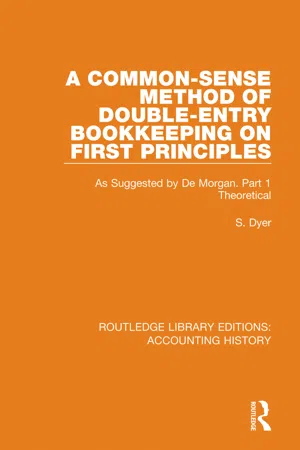
A Common-Sense Method of Double-Entry Bookkeeping on First Principles
As Suggested by De Morgan. Part 1 Theoretical
- 140 pages
- English
- ePUB (mobile friendly)
- Available on iOS & Android
eBook - ePub
A Common-Sense Method of Double-Entry Bookkeeping on First Principles
As Suggested by De Morgan. Part 1 Theoretical
Double-Entry Bookkeeping.
Theoretical Part.
The Object of Bookkeeping.—The object of Bookkeeping is to record our money transactions in such a way that we can readily tell at any time (i) what we are worth, (2) what net profits we are making, (3) what our customers owe us, and (4) what we owe them.
Double-Entry Bookkeeping is a device for detecting omissions and errors. Every transaction is entered twice over; it is recorded on opposite sides of two different accounts. When the totals of these two sides do not agree, we know something is wrong. If a Journal is kept, we have four totals which must be alike. And, without the Journal, we have always (1) two totals, and (2) two excesses, which must agree. Double Entry, then, is a device for testing or proving our Books,
Books Required.—The Journal and the Ledger are the principal books. All others are subsidiary.
1. The Ledger is the one indispensable book. From this we make out our customers’ accounts. It is a complete picture of our business. Whatever other books we keep, this must contain the substance of them all. Making entries in the Ledger we call “posting” Understanding the Ledger is understanding the whole science and art of Bookkeeping.
2. The Sales Book, or Day Book, is for recording Credit Sales—Goods sold and not paid for at the time of sale. This and the Cash Bock together show us what we sell our Goods for.
3. The Invoice Book, or Purchases Book, is for entering Credit purchases—Goods bought and not paid for at the time. This and the Cash Book together tell us what we have paid for our Goods. The invoices we receive when Good? are delivered, if filed together or gummed into a book, would form an Invoice Book.
4. The Cash Book is a record of money actually received, and money actually paid away. Bank notes count as money. When a Banking account is kept no other paper money is booked as cash.
5. The Bank Pass Book shows what my Banker receives from me, or for me. My cheques, when endorsed, show what he pays back to me, or to other people for me, at my request, on presenting a cheque or order signed by me.
6. The Bills Receivable Book records what stamped written promises of money I have received from my debtors, and when their money will be paid.
7. The Bills Payable Book records what stamped written promises of money I have given to my creditors, and when I must pay the money.
8. The Waste Book contains rough entries, made at the moment, to be afterwards transferred to other books.
9. The Journal is useful (1) as a help to posting, and (2) as an additional check; but is not necessary. It is used by wholesale houses very generally. It shows every transaction first as a Debit—i.e. on the debit side—of one account, then as a Credit—i.e. on the creditor side—of some other account.
Theory of Debtor and Creditor.—Debtor means receiver; creditor, payer, one who parts with something. The Dr. side of an account is that on which I enter what the man whose name heads the account receives from me-The Cr. side is that on which I enter what the man whose name heads the account pays to me, or parts with on my account. It must be carefully noticed that it is the person whose name heads the account that receives what is put on the Dr. side, and pays away to me what is put on the Cr. side; and the learner will have clearer ideas if he imagines every account ta be a personal one. Bank account is Banker’s account; Cash account is Cashier’s account. Suppose my business large enough for me to employ a separate clerk for every separate account. One has charge of my Trade Plant, horses and vans, premises, etc.: we will call him Valuation clerk. He has charge of my permanent assets, the property I buy, not to sell again, but to use in my business. If I buy a horse for £60, my Cashier pays away the money, and puts £60 on the paying-away or credit side of his account; my Valuation clerk receives an addition to his stock of permanent assets, and writes £60 on the Dr. or receiving side of his account. When Smith sends me £10 to pay his account, Cashier receives £10, and writes it on the Dr. or receiving side of his account; Smith has paid away £10, and so £10 must be entered on the Cr. or paying-away side of Smith’s account. One of my clerks, representing Smith, makes this entry for him. But as Smith’s name heads the account, it is Smith’s account, not mine. My own account, in my Ledger, is called Capital account, and is often headed with my name. The name must always be understood. If, when I begin business, I have £500 at the Bank, £200 at my shop, and Trade Plant worth £300, I must be supposed to hand over or pay away £500 to my Banker, £200 to my Cashier, and £300 to my Valuation clerk, at the outset. Each of these three clerks debits his own account with the value he has received—i.e. he writes it on the Debit or receiving side of his account. And as I, the master of the business, have paid it away, I write the total, ;£1000, on the Cr. or paying-away side of my own account. So with Bills—stamped written promises to pay money owing! When the clerk in charge of my Bills Receivable receives, instead of cash, a Bill Receivable, he enters it on the Dr. or receiving side of his account. When the promised money has been paid me, my clerk hands back the Bill, and writes its value on the Cr. or paying-away side, because he has paid away the Bill. When I pay away my own acceptance, my stamped written promise to pay £100, my Bills Payable clerk enters £100 on the Cr. side of his account, because he has parted with a Bill. When I keep my promise by paying, I get back my Bill Payable, and my clerk debits Bills Payable account £100, because he has received a Bill, The student must note carefully that it is a Bill for £100, not £100 cash that is received and therefore debited. The cash is Cashier’s business, and must be credited to his account, because it is paid away by Cashier. So with Goods, The Goods clerk debits his account when he receives Goods, when Goods are bought; he credits it when Goods are parted with, whether sold, stolen, taken for use of proprietor, given away, or destroyed. Hence the buying side in a Goods account is the Dr. side; the selling side, Cr. Now, when Goods are sold for cash, Cashier receives and debits his account; Goods clerk parts with property in his charge and credits his account. On the other hand, when I buy Goods for cash, my Cashier pays away and credits his account; my Goods clerk receives and debits Goods account. If my pony worth £20 is killed, my Valuation clerk’s account must be credited, for £20 worth has been parted with. If I draw out of my business £30 to live upon, Cashier pays it away to me, and credits his account £30; I receive it, and debit my own personal account, the Capital account, £30. The rule of Dr. and Cr., then, is “Debit the receiver for what is received; credit the giver for what is parted with”
This seems simple enough. But, in order to provide a double entry for every transaction, we have to open in the Ledger a fictitious account called Profit and Loss account, and our rule will not help us in making entries in that account, unless we remember that Profit and Loss account (with all its subdivisions) is a part of My own Personal account, debit entries being against me, and credit entries in my favour; just as in other personal accounts debits are against the person whose name heads the account. If my van, worth £20, gets destroyed, my Valuation clerk credits his account £20, because £20 worth has gone out, or has been parted with, of the property in his charge. But which account must be debited ? Who receives, by the accident? No one. I debit Profit and Loss account— i.e., enter it in my own Personal account against me on Dr. side. When my Banker allows me interest on my deposit account, I can either get the money, and Cashier will debit his account when he receives it, or the Banker’s representative will debit Banker’s account in my books, because the Banker is retaining £5 belonging to me; he has received £5 value from me in the use of my money, and owes it to me. But what account must I credit ? Who has paid away anything, or parted with anything ? You may think the Banker has. But if I have debited the Banker £5, and now credit him with £5, one entry cancels the other and neither need have been made. If the Banker has not paid me the it is clear that I must debit his account This is a dear gain, a clear addition to my property without any money being spent on it. I credit it to Profit and Loss. This really means that I credit my own personal account with it. It is a clear gain—an addition to the capital I lent to my business at first, and being due to me must be credited to my account. Profit and Loss is a fictitious account, which receives dead losses on its Dr. side and clear gains on its Cr. side. Whenever money or money’s worth goes out of my business without anything tangible coming bach to me for it, it is a dead loss, and one entry for it must be made on the Dr. side of Profit and Loss. Whenever money comes into my business over and above all that has been spent on the transaction, that is a clear gain, and one entry of it must be on the Cr. side of Profit and Loss. This will be better understood after reading the article on Double Entry. If the Banker handed over to me the £5 cash for the use of my money, his account would receive no entry at all in my books, because the transaction neither increases nor lessens what the Banker owes me. It is one of many transactions which I need never book at all. It is opened and closed simultaneously, and needs no record, as between the Banker and me. But as between my business and me, it needs a record, for here is £5 profit to be credited to my personal account hereafter, if not swallowed up by losses. If I made out the Banker’s account for this, I should debit him with the use of my money, and credit him with the he has paid away, and both sides being equal, the account is opened and closed simultaneously, for the interest is not due till the day it is paid. The second rule for Dr. and Cr. then is, “Debit dead losses; Credit clear gains.”
Thus it must be distinctly understood that I must not always debit the receiver, and credit the giver or payer, at least not the apparent receiver or giver. The real receiver to be debited may be myself; the real giver to be credited may be myself. My own personal account is the one to be debited or credited in some cases. Many transactions are really double, involving four entries, if booked in full, as will be explained in detail under Double Entry. When I pay my landlord £20 rent, the landlord receives £20, but I do not debit his account £20 unless I have previously credited it £20. When I am paid £15 commission for selling goods for another merchant, that merchant pays away £15 to me, but I do not credit his account with £15 unless I have previously debited him as owing £15. This must be so for the simple reason that when I debit a man’s account with £20, it shows that he has received £20 from me, and owes me £20, unless there is an entry on the other side which cancels it. By debiting the landlord’s account with £20, I represent him as owing me £20; similarly by crediting...
Table of contents
- Cover
- Half Title
- Original Title Page
- Original Copyright Page
- Title Page
- Copyright Page
- Introduction
- Table of Contents
- The Double-Entry Accounts
- The Single-Entry Accounts
- Proving Books by Trial Balance
- Object of Bookkeeping. Object of Double Entry
- Glossary of Commercial Terms and Phrases not fully explained in the text
- Appendix
Trusted by 375,005 students
Access to over 1.5 million titles for a fair monthly price.
Study more efficiently using our study tools.
Frequently asked questions
Yes, you can cancel anytime from the Subscription tab in your account settings on the Perlego website. Your subscription will stay active until the end of your current billing period. Learn how to cancel your subscription
No, books cannot be downloaded as external files, such as PDFs, for use outside of Perlego. However, you can download books within the Perlego app for offline reading on mobile or tablet. Learn how to download books offline
Perlego offers two plans: Essential and Complete
- Essential is ideal for learners and professionals who enjoy exploring a wide range of subjects. Access the Essential Library with 800,000+ trusted titles and best-sellers across business, personal growth, and the humanities. Includes unlimited reading time and Standard Read Aloud voice.
- Complete: Perfect for advanced learners and researchers needing full, unrestricted access. Unlock 1.5M+ books across hundreds of subjects, including academic and specialized titles. The Complete Plan also includes advanced features like Premium Read Aloud and Research Assistant.
We are an online textbook subscription service, where you can get access to an entire online library for less than the price of a single book per month. With over 1.5 million books across 990+ topics, we’ve got you covered! Learn about our mission
Look out for the read-aloud symbol on your next book to see if you can listen to it. The read-aloud tool reads text aloud for you, highlighting the text as it is being read. You can pause it, speed it up and slow it down. Learn more about Read Aloud
Yes! You can use the Perlego app on both iOS and Android devices to read anytime, anywhere — even offline. Perfect for commutes or when you’re on the go.
Please note we cannot support devices running on iOS 13 and Android 7 or earlier. Learn more about using the app
Please note we cannot support devices running on iOS 13 and Android 7 or earlier. Learn more about using the app
Yes, you can access A Common-Sense Method of Double-Entry Bookkeeping on First Principles by S. Dyer in PDF and/or ePUB format, as well as other popular books in Business & Accounting. We have over 1.5 million books available in our catalogue for you to explore.