- 272 pages
- English
- ePUB (mobile friendly)
- Available on iOS & Android
eBook - ePub
About this book
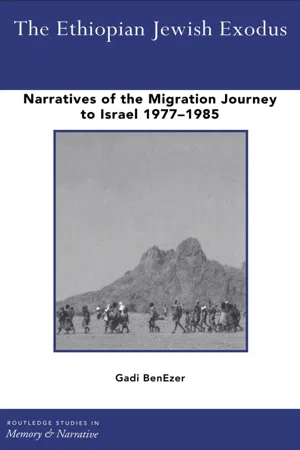
Between 1977 and 1985, some 20,000 Ethiopian Jews left their homes in Ethiopia and - motivated by an ancient dream of returning to the land of their ancestors, 'Yerussalem' - embarked on a secret and highly traumatic exodus to Israel. Due to various political circumstances they had to leave their homes in haste, go a long way on foot through unknown country, and stay for a period of one or two years in refugee camps, until they were brought to Israel. The difficult conditions of the journey included racial tensions, attacks by bandits, night travel over mountains, incarceration, illness and death. A fifth of the group did not survive the journey.
This interdisciplinary, ground-breaking book focuses on the experience of this journey, its meaning for the people who made it, and its relation to the initial encounter with Israeli society. The author argues that powerful processes occur on such journeys that affect the individual and community in life-changing ways, including their initial encounter with and adaptation to their new society. Analysing the psychosocial impact of the journey, he examines the relations between coping and meaning, trauma and culture, and discusses personal development and growth.
1
INTRODUCTION
This book is about a journey. It is about the migration journey of Ethiopian Jews to Israel via Sudan. It focuses on the experience of the journey, its meaning for the people who made it, and its relation to the encounter with Israeli society.
The migration of Ethiopian Jews to Israel since 1977 is a small yet dramatic movement, with unique features. It is interesting not only in its own right, but also because it shares, and often highlights, many features which are common to migratory movements throughout the world in the later twentieth century. It is a migration from the South to the North (the Third World to the West)1 of black people into a predominantly white society; a movement primarily of the young and the fit, inspired by a Utopian dream of life fulfilment; a dream sorely tested, if not shattered, by the experience of arrival in the ‘Promised Land’. The migration dream of Ethiopian Jews has, as we shall see, exceptionally deep roots in their traditional culture. However, their heightened expectations are similar to the experience of other migrants inspired by more secular dreams.
During the period of 1977–85, some 20,000 Ethiopian Jews left their homes in Ethiopia and—motivated by an ancient dream of returning to the land of their ancestors, to ‘Yerussalem’—embarked on a secret, illegal and highly traumatic exodus to Israel. Due to various political circumstances, they had to leave their homes in haste, go a long way by foot through unknown country towards Sudan, and stay for a period of one to two years in refugee camps there until they were brought to Israel. The conditions of the journey were extremely difficult, including torture, incarcerations, bandit attacks, walking at night, crossing mountains, hunger and thirst, illness and death. A fifth of these migrants/ refugees2—4,000 people—did not survive the journey. The migrants/refugees also faced problems that were connected to their Jewish identity and to the fact that they were heading for Israel.
Once in Israel, the immigrants were first put in absorption centres and then settled in different towns and villages. The adaptation process of these immigrants/ refugees was complicated by their ‘anomalous’ Jewish identity. Religious authorities questioned the authenticity of their Jewish identity, and their physical appearance (e.g. skin colour) set them apart from ‘mainstream’ Israeli society.
I began working with the Ethiopian immigrant community in Israel in 1982. Since then I have been working with them as a clinical psychologist and psychotherapist, and have been acting as a consultant in their absorption centres and educational and vocational settings. As I have also been trained in anthropology the arrival of Ethiopian Jews has presented a professional challenge for me: the challenge of cross-cultural (or, rather, inter-cultural) psychological work. In order to rise to the challenge I had to combine my various areas of expertise, achieved up to that time, as well as be ready to create new ways of thinking about and practising with these very different immigrants. In this process of encounter with ‘the other’, I have changed, not only professionally but also personally. The arrival of Ethiopian Jews has thus become a ‘present’ for me through which I have grown and developed professionally and personally. From this point of view, I could think of their arrival as a ‘present’ for Israeli society at large, and consequently advocate a change in policies and practice relating to this group.
During this long period that I have been ‘immersed’ in the community I have won their trust and confidence. As my work with Ethiopian Jews progressed I started hearing more and more references to the journey from Ethiopia and its meaning in relation to their current life in Israel. For example, in a general conversation a respectable elderly man suddenly shared with me his frustration that he had had to go through ritual immersion in water as part of a symbolic conversion to Judaism. He said: ‘We suffered so much on our way here and they [the religious authorities of Israel] question our Jewish identity!’
In another instance I met a young adolescent boy who, while talking about the situation in his social milieu, commented as follows:
Israelis do not know what we have gone through…the kind of journey we experienced. Israelis think we came directly from our village, that we just boarded an airplane. If they [the boys at his boarding school] only knew how much I suffered to get here, what I had to live through on our journey, that many people were left behind…did not survive. If they only knew all about that, I am sure they wouldn’t have picked on me!
What struck me in these two instances was the fact that they related so strongly to the journey as a frame of reference for the current events in Israel. The suffering of the journey served as ‘spectacles’ through which the elderly man looked at the unresolved conflict with the Chief Rabbis3 of Israel and the adolescent saw his integration problems within the boarding school. I wondered why the old man did not refer to the two millennia or so of Jewish existence in Ethiopia and chose, in making his point, the more recent journey to Israel. Why was this such a significant point of reference for him and for the adolescent at the boarding school, and, as I was later to learn, an equally significant point of reference for so many others from this community?
I started asking myself what had happened to them on their journey that could account for the fact that it played such a crucial and central role. What did it symbolise? What meaning had it acquired? In what way is this meaning linked to their current encounter with Israeli society?
With these questions in mind I set out on my own ‘journey’: a quest for the understanding of the phenomenon. I devised a systematic research project which examined Ethiopian Jews’ narratives of their journey to Israel. I focused on the experience of adolescents during their migration journey. The research was summed up as a PhD dissertation (BenEzer 1995) which I then turned into this book.
As I have stated above, this study focuses on the experience of the journey, its meaning for the people who made it and its relation to the initial encounter with Israeli society. In a nutshell, it argues that powerful processes occur on such journeys that affect the individual and the community in life-changing ways. This includes their encounter with and adaptation to their new society.
Let me briefly present the organisation of the book. The study of the Ethiopian exodus aims to fill a gap in the existing literature in relation to journeys in migration and refugee studies. This literature will be examined in the following part of this chapter. We shall then proceed to Chapter 2, where we shall meet the Ethiopian Jews in their Ethiopian context prior to the journey. That is, we shall present a brief ethnography of ‘Beta Israel’, as they were called, and their historical background. Chapter 3 centres on methodological issues, particularly the problem and challenge of conducting research in a cross-cultural context.
Chapters 4, 5 and 6, the main body of the text, describe the three themes that were found to be the major dimensions of meaning through which Ethiopian Jews constructed their experiences along the journey. These are the theme of Jewish identity (Chapter 4), the theme of suffering (Chapter 5) and the theme of bravery and inner strength (Chapter 6). I shall present and discuss the kinds of experience related to these themes, trying to let the ‘voice’ of my interviewees be heard here as much as possible. The psychosocial impact of the journey on the individual and on the community is analysed in Chapter 7. This is the most ‘psychological’ chapter in the book. Here I shall focus on the traumatic nature of the experience of the journey, the ‘psychology of trauma’ so to speak, and related issues. Here I shall also examine how the meaning of experience affects people’s coping abilities, and look at certain cultural aspects that could influence the traumatic or non-traumatic nature of events. In Chapter 8 I offer an analysis of the encounter of Ethiopian Jews with Israeli society. I shall first show how the three major themes derived from the journey, which also constitute dimensions of self-concept, corresponded to three main ethos and myths in Israeli society during the 1980s. Then I shall discuss how Israeli society failed to acknowledge Ethiopian Jews’ selfperception, thus causing considerable difficulties in their adaptation. I go on to show how Ethiopian Jews use the story of their journey in order to assert their own self-concept and identity and to find their place within Israeli society. I shall suggest that the story of the journey is in the process of turning into a myth. The book’s ‘concluding remarks’ come back in brief to some general points in the experience of journeys of the kind undergone by the Ethiopian Jewish immigrants/refugees.
JOURNEYS IN MIGRATION AND REFUGEE STUDIES
This study is about a journey. It is about the migration journey of Ethiopian Jews to Israel via Sudan. It focuses on the experience of the journey and its meaning for the people who made it. It thus deals with a real and difficult physical endeavour overland on foot, as well as a social and psychological journey, which included periods of marching and a period spent in a refugee camp.
This is an interdisciplinary study. It is informed by social studies and the humanities, mainly the disciplines of psychology, anthropology, sociology and history (oral history), and is located within the fields of migration and refugee studies.
Much of the relevant literature (other than what I intend to examine below) will be discussed at various points where applicable. Thus, the literature which deals with oral history and life story methods will be discussed in Chapter 3, which is devoted to method. This will include the appropriateness of phenomenological investigation for the research of the journey and methodological issues arising out of the cross-cultural context. The germane literature on Ethiopian Jews is the basis for the sections on history and ethnography in Chapter 2; the relationship between meaning and coping and issues related to culture and coping will be discussed in Chapter 7; and certain dynamics within Israeli society are considered in Chapter 8.
In what follows, however, I wish to show that, to the best of my knowledge, there are no studies that focus on a journey, either in the field of migration or in refugee studies. This is in spite of the fact that the literature on the former is vast and that on the latter is expanding rapidly.
The migration literature tends to focus on people either at one end of the migration process or at the other. That is, either while they are still in their country of origin or after having arrived in their country of destination. Researchers are thus dealing mainly with the situation of prospective ‘emigrants’ in their ‘sending country’ or, even more, with ‘immigrants’ at the ‘receiving’ end.
Many studies are concerned with the ‘causes’ of migration. Theories dealing with the motivations for migration tend to be dominated by the economic ‘pushpull’ model. According to this approach the researcher distinguishes between circumstances at home that repel and those abroad that attract migrants (Petersen 1968). The former (for example high rates of unemployment in the area of origin, or problems in housing) are usually viewed as inducing migration of a conservative, security-maximising nature, while the latter (economic expansion in the host country or region) are said to encourage risk-taking and incomemaximising migration (Marshall 1994:328; see also Watson 1977a:6; Jansen 1970; Taylor 1969; Wrong 1961). Economic and structural factors formed the basis of most of the analyses within this model (Ballard and Ballard 1977; Taylor 1969; Peach 1968:93).
The push-pull theories have been criticised by many. Anthropologists who have reconstructed the history of various emigrant communities demonstrate clearly that it is impossible to categorise all of the relevant factors as either ‘push’ or ‘pull’ (Philpott 1977; Foner 1977; Palmer 1977; Watson 1975; Petersen 1968).
Others (e.g. Douglass 1970) claim that the push-pull approach often implies that ‘the subjects were automatons reacting to forces beyond their control’ rather than active participants (Douglass 1970, cited in Watson 1977a:7). It is also clear that an analysis of push-pull factors remains at the highest levels of abstraction and that generalisations of this nature are rarely accepted by the migrants themselves. The push-pull approach thus obscures the inherent complexity of population movements (Watson 1977a).
In spite of the growing criticism of the push-pull approach, it seems that no other model has attracted the same degree of attention. An analysis of this kind in the literature is still ‘conventional’ (Marshall 1994:329) though it is more refined at times (see Kritz and Keely 1983:xvi; Teitelbaum 1980). Some researchers, however, are using more complex analyses and alternative hypotheses (or a combination of them) to explain the causes and motivation leading to migration (e.g. Kritz et al. 1983).
Douglas Massey, together with a group of his colleagues, has recently done a comprehensive review of the theories regarding international migration that have arisen during the last thirty years or so. They distinguish clearly between models that describe the initiation of international movement and theories accounting for why transnational population flows persist across space and time. They argue convincingly that conditions that initiate international movement may be quite different from those that perpetuate it, and that different theories— e.g. neoclassical economics versus the network theory—may have to be applied in order to understand these different processes (Massey et al. 1998, 1996).
The patterns of migration—the question of whether migrants moved through ‘social networks’ such as the extended family, the village network or the caste, thus forming a phenomenon of ‘chain-migration’, or through some other ‘patterns of migration’—were, and still are, widely discussed (e.g. Massey et al. 1998; Chamberlain 1997; Werbner 1990; Shaw 1988; Stark and Bloom 1985; Mormino 1982; Ballard and Ballard 1977; Khan 1977; Hareven 1975). Migration literature also deals with the direction and boundaries of the migration, i.e. from where to where and in what area people move. Researchers tend to group migration movements under the headings of international, regional and internal migration. While the first and the last are self-explanatory, regional refers to migrations within the continents or within common regional areas such as Southeast Asia or the Middle East (D.L.Appleyard 1992). Rural-urban and urban—rural directions of movement are usually analysed within the boundaries of internal migration (Boyle et al. 1998; Banerjee 1981).
Labour migration is another focus of attention within migration literature. This topic is researched either as an issue in itself (several journals are devoted to the subject) or within the framework of the issues mentioned above (e.g. push-pull paradigm; chain migration, e.g. Basok 2000; Cohen 1997a:57–62; Vertovec 1995; Baily 1995; Stark 1991; Grieco 1987). Marriage and return-migration are also analysed in this context (as well as in others, e.g. Zetter 1999a; Chamberlain 1997; Werbner 1990; Shaw 1988; Anwar 1979).
An extensive amount of research is concerned with migrants in their new country. A considerable part of that research, especially the analyses of the mass migration waves of the nineteenth and early twentieth centuries, was concerned with the demography of migration. An example of this is research regarding what happens to the size and structure of the population in the receiving country as a result of the migration wave, as well as the impact on the demography of the sending country (Petersen 1968).
The effects of immigrants on the economy as well as on the social and cultural structure and dynamics of the new society still constitutes much of the research (Portes and Rumbaut 1996; Portes 1995; Findlay 1994; Spencer 1994; Hu- Dehart 1993). This is, together with numerous studies on changes (and/or continuity), within immigrant groups following their arrival in the new country. Studies of ‘assimilation’, ‘integration’ and ‘acculturation’ (e.g. Berry 1992, 1993), and topics such as economic organisation, marriage, religious behaviour, giftgiving, education and political organisation constituted a great deal of the research on the migrant societies. Differences in economic success of various immigrant groups were sometimes studied and related to various causes. Such was the classic study by McClelland (1961) of the ethic of work of Jewish and Italian immigrants and their relative compatibility with the Protestant work ethic prevailing in the United States (by which he tried to explain the difference in economic success of these groups in their new country). More recent studies in this area include the prize-winning book on Ethnic Los Angeles, by Waldinger and Bozorgmehr (1997). This book deals with, among other issues, cultural characteristics of Korean and other migrants and their relation to success in various kinds of businesses and/ or occupations. The studies by Light and Gold (2000) regarding ethnic entrepreneurs and those of Alexander Portes (e.g. 1995) on the economic sociology of immigration are other important examples of this area of study.
The questions concerning when immigrants turn into a minority group (thus when they should be called ‘immigrants’ and when ‘minorities’) and whether the second generation should be referred to in the literature as part of a migrant population, for example, occupy some of the literature in the field. James Watson (1977a:5) relates how it took some months for the authors in the collection he edited on migrant and minority groups in Britain to agree on this and related issues, and consequently to agree on the title of the book. The fact that waves of immigrants indeed constitute minority groups in many countries instigated much research on issues connected with race and ethnic relations (Modood 1994, 1992; Rex and Mason 1986; Banton 1983; Cohen 1980, 1974, 1969; Rex and Moore 1967). Racial discrimination and ethnic consciousness were key issues in migration literature and fed many debates, some of which, like that on the various forms of black consciousness and the black-white dichotomy, have been recently highlighted (Bhabha 1994; Gilroy 1993a, 1993b; Hall 1991, 1990). Following the publication in the United States of Samuel Huntington’s and Arthur Schlesinger’s essays, which together constitute an attack on multiculturalism from two different points of view, a fierce debate is going on in the US in which dilemmas concerning immigration and ethnic relations are at the centre of the arguments (Cohen 1995b; Schlesinger 1992). At the same time, in Europe there is a debate in which, on the one hand, scholars discuss the right of nation-states to defend themselves against incoming migrants and ‘economic refugees’ coming as asylum seekers, and to create a ‘fortress Europe’; while, on the other hand, there is a more recent recognition that European societies are ‘shrinking’ significantly in numbers due to low fertility rates and an awareness of the need for specific skilled workers, such as in the computing, teaching and medical professions, and thus the need to actually invite immigration. This is echoed, for example, in recent British government ministers’ statements followed by the editorials of major newspapers such as The Times and the Daily Telegraph of 12 September 2000.4
Another angle within migration studies which has gained considerable attention in the last ten years or so is that which deals with diasporas, transnationalism and globalisation. Research and academic debate has focused on concepts such as ‘diasporas’ (Vertovec and Cohen 1999; Van Hear 1998; Cohen 1997b; Sheffer 1986), ‘boundaries’ and ‘borders’ (Lavie and Swedenburg 1996), ‘transnationalism’ (Rogers 2000; Glick-Schiller and Fouron 1999; Glick-Schiller 1998, 1997), ‘transversal migration’, ‘bi-location’, ‘hybrids’ (Hannerz 2000), ‘cosmopoli-tanism’ (Vertovec 2000), ‘g...
Table of contents
- Cover Page
- Title Page
- Copyright Page
- Illustrations
- Acknowledgements
- Note on Transliteration and Form
- 1 Introduction
- 2 The Context of the Journey
- 3 Interviewing and Interpreting in Crosscultural Research
- 4 The Theme of Jewish Identity
- 5 The Theme of Suffering
- 6 The Theme of Bravery and Inner Strength
- 7 The Impact of the Journey
- 8 Ethiopian Jews Encounter Israel
- Concluding Remarks
- Appendix
- Notes
- Bibliography
Trusted by 375,005 students
Access to over 1.5 million titles for a fair monthly price.
Study more efficiently using our study tools.
Frequently asked questions
Yes, you can cancel anytime from the Subscription tab in your account settings on the Perlego website. Your subscription will stay active until the end of your current billing period. Learn how to cancel your subscription
No, books cannot be downloaded as external files, such as PDFs, for use outside of Perlego. However, you can download books within the Perlego app for offline reading on mobile or tablet. Learn how to download books offline
Perlego offers two plans: Essential and Complete
- Essential is ideal for learners and professionals who enjoy exploring a wide range of subjects. Access the Essential Library with 800,000+ trusted titles and best-sellers across business, personal growth, and the humanities. Includes unlimited reading time and Standard Read Aloud voice.
- Complete: Perfect for advanced learners and researchers needing full, unrestricted access. Unlock 1.5M+ books across hundreds of subjects, including academic and specialized titles. The Complete Plan also includes advanced features like Premium Read Aloud and Research Assistant.
We are an online textbook subscription service, where you can get access to an entire online library for less than the price of a single book per month. With over 1.5 million books across 990+ topics, we’ve got you covered! Learn about our mission
Look out for the read-aloud symbol on your next book to see if you can listen to it. The read-aloud tool reads text aloud for you, highlighting the text as it is being read. You can pause it, speed it up and slow it down. Learn more about Read Aloud
Yes! You can use the Perlego app on both iOS and Android devices to read anytime, anywhere — even offline. Perfect for commutes or when you’re on the go.
Please note we cannot support devices running on iOS 13 and Android 7 or earlier. Learn more about using the app
Please note we cannot support devices running on iOS 13 and Android 7 or earlier. Learn more about using the app
Yes, you can access The Ethiopian Jewish Exodus by Gadi BenEzer in PDF and/or ePUB format, as well as other popular books in History & African History. We have over 1.5 million books available in our catalogue for you to explore.