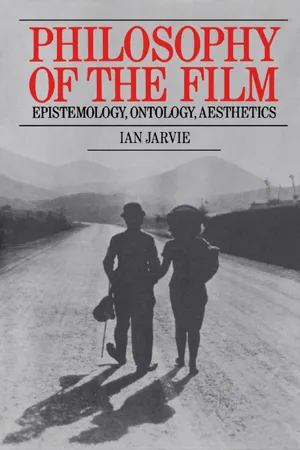
Examines the overlap between film and philosophy in three distinct ways: epistemological issues in film-making and viewing; aesthetic theory and film; and film as a medium of philosophical expression.
- 408 pages
- English
- ePUB (mobile friendly)
- Available on iOS & Android
eBook - ePub
About this book
Information
PART ONE
MOVIES AS A PHILOSOPHICAL PROBLEM
One general principle seemed to control the whole mental mechanism of the spectator, or rather the relation between the mental mechanism and the pictures on the screen. We recognized that in every case the objective world of outer events had been shaped and molded until it became adjusted to the subjective movements of the mind.
(Munsterberg 1916, p. 58)
In the cinema, what is ‘given’ to us is a sequence of stills, but what we see, or observe, or perceive, is movement; and we cannot help seeing the movement, even if we know that we are seeing only photographs of (say) an animated cartoon.
(Popper 1983, p. 45)
1
KNOWLEDGE AND EXISTENCE
Experiencing a movie we allow ourselves to be deceived; we suspend, as the cliché has it, our disbelief; we play with our sense of reality. This activist thesis is the short answer to the problem: what is philosophically interesting about films? In experiencing films people solve philosophical problems without thinking about them, thereby accomplishing what some philosophical theories do not.
Everyone is a philosopher in the sense that they have general views of the world. Film-goers among them regularly accomplish what many philosophical theories wrestle with and are defeated by; and this rehearsal of their powers is a source of great pleasure, perhaps because the human capacity to model the world and to play at modelling possible worlds is greatly to our evolutionary advantage. Professional philosophers cannot help being fascinated by the spectacle of ordinary people playfully accomplishing what the philosophers theorize about. Play is voluntary and fun. Playing at it and with it is how children come to terms with the world they have entered. Since, even for adults, the world is always changing and hence being entered anew, play does not cease to have value and to give pleasure with the end of childhood.
Writing of allowing ourselves to be deceived seems to imply that at some level we are not deceived. Is this correct or are we filmgoers genuinely deceived? Do we momentarily slip into a state of mind where we take the scenes that appear to be happening for real happenings and hence become excited, afraid, happy and so on just as though we were witnessing the real thing? Phenomenologically this would be a mistake. The texture and intensity of our feelings in situations of danger, happiness, puzzlement and so on are a good deal more intense and long-lasting than the simulacra of these emotions we experience at films. Most film-goers, for example, ‘recover’ from any feelings experienced in the cinema within quite a short time. Only a few have nightmares or are otherwise shaken up. People who go through real-life crises of, say, threats to their life, sometimes never retrieve their emotional equilibrium. Events of such importance in our lives or the lives of those close to us have lasting emotional impact even though their immediate impact varies greatly. The effect of films is transient.
What goes for emotion also goes, I think, for cognition. Writing about depth perception, Munsterberg says:
If the pictures are well taken and the projection is sharp and we sit at the right distance from the picture, we must have the same impression as if we looked through a glass plate into real space…. Nevertheless we are never deceived; we are fully conscious of the depth, and yet we do not take it for real depth. (Munsterberg 1916, pp22–3)
Some evidence suggests otherwise:
L’Arrivé [sic] d’un train en gare…was a visual tour de force, and audiences are said to have stampeded at the sight of the locomotive barreling toward them from a distant prospect into the foreground on the screen. (Cook 1981, pp. 10–11)
L’Arrivée was made by the Lumière brothers in France in 1895. Further evidence that we are, or at least, can be, deceived is provided by anthropologists reporting that primitive peoples worry about the chopped-off appearance of people on the screen (Wilson 1961); or by observing children poking the television or going round the back in search of what they can see.
To reiterate Munsterberg: while we do have the same impression as though we were looking through a glass plate into real space, most of us are not deceived into believing that that is actually the case. The simplest explanation of why some are fooled and others are not comes from children, who very rapidly learn that neither poking nor going round the back of the television set does any good: there is nothing there. It is from this notion that there is an element of learning in our cognitive and emotional responses to film that the unfortunate metaphor ‘film literacy’ derives.
The key mechanism here seems to have to do with a ‘discount’ (Friedson 1953) we are able to place on deceptions and illusions through familiarity with them. You may not be able to ‘see’ what the prestidigitator or illusionist is doing, but you ‘know’ the egg is not coming out of the ear, the lady is not being sawn in half, and you are able to discount the cognitive and affective shock of its seeming to happen. No doubt sculpted busts or statues without arms look like mutilated people when first we encounter them, as do head-and-shoulders close-ups and partial views. But familiarity breeds contentment. New devices with which even experienced cinema-goers are unfamiliar can retrieve the unguarded reaction, as when the audience flinches at a stereoscopic movie when an object looms forward, or when a powerful sense of vertigo is induced by large screens such as Cinerama or Eymax.
Film makers like to tease us by testing the strength of our learned disbelief in the difference between the real world and the screen world. They show characters watching films and then stepping into the screen. Buster Keaton does it in Sherlock Junior (1924); Olsen and Johnson do it in Hellzapoppin (1941), Steve Martin and Bernadette Peters do it in Pennies From Heaven (1982); Jeff Daniels does it in The Purple Rose of Cairo (1985). Both Elmer Rice (1930) and Gore Vidal (1974) have toyed with the idea in novels. Stephen Spielberg and Tobe Hooper used the idea for scary purposes when they had a character sucked into the television set in Poltergeist (1982).
This should alert us to a very important point about the phenomenology of film-viewing: suspension of disbelief is not the same as hallucination. The latter, I take it, is where we take for real something that happens not to be real; we cannot tell the difference. It seems that with film watching we are able to play at taking on-screen events for real. We learn not to be fooled as small children are, and we continue to enjoy movies despite no longer being fooled, even to the point of accepting the idea that on-screen characters will be fooled and fool us in ways we have learnt not to be. It is this playful distance, perhaps, that allows us to become cognitively and affectively enthralled by movies. Being enthralled by movies does not visit upon us all the consequences of real-life events. We are not usually cognitively exhausted and emotionally ravaged by movies; rather, we emerge feeling good. Part of that feeling good comes from the vigorous philosophical exercise that experiencing film represents.
This brings us back to philosophy. Two of the central problems in the Western philosophical tradition are, what do we know (epistemology), and, what exists (ontology)? They are very troublesome problems over which philosophers are deeply divided. Not least of the troubles with them is their mutual relation.
It can be argued that before we can answer the question of what exists, we have to solve the problem of what we know. Since knowledge is what we know of what exists, it is what we know about what we know that allows us to move towards articulating what we know of what exists. The tantalising Kantian possibility always remains, however, that what we know of what exists is not all that exists. Philosophers who give knowledge precedence over existence include Bertrand Russell, the logical positivists, and Karl Popper. By parallel reasoning it can also be argued that before we can solve the problem of what we know we must first solve the problem of what exists, because when we ask what we know, what we mean is what do we know of what exists, and how can we assess any claim to know something or other exists if we have not solved the problem of what exists and hence can adjudicate our claims to know that it does? Martin Heidegger and his followers give precedence to existence over knowledge.
Another and somewhat different trouble with these two problems is this. The problem of knowledge seems to be about ‘us’, since it queries what ‘we’ know. The problem of ontology, though, in asking what there is, leaves out any reference to us and appears only to speak about ‘the world’. The question arises of the relation between ‘us’ and the world, whether knowledge is a state of ‘us’ or some other sort of thing and if that, what sort of thing? Various ways of overcoming this trouble have been tried. ‘The world’, it has been argued, can only mean ‘our world’ and so the reference to ‘us’ is implicit, if disguised. The problems then of whether we can know about what exists, or whether the world is different from our knowing about it, cannot arise. ‘Knowledge’, by contrast, can be regarded as a hot line between mind and world into which we tap with differing degrees of success. Success is measured not by us but by some extra-human criteria which humans at best may dimly perceive.
Cutting through this thicket is not a task for an essay on the philosophy of film. It is enough if we can see how films enter into the debate about these problems. My own preference as a philosopher of science is to adopt a deceptively naive solution to these problems as a first approximation and to effect refinement to the extent that its simplicities prove inadequate. To the problem of, ‘what do we know?’, I should suggest the answer (a) not very much and (b) the cream of what we think we know is contained in science and mathematics. From this flows a relatively straightforward answer to the problem of what exists: (c) what exists are those entities disclosed or postulated by the current theories of mathematics and science.
The position is not as counter-intuitive as at first seems. It does not reduce the world to atoms and molecules. There is plenty of room for pink string and sealing wax, kind hearts and coronets. What it offers is a criterion. If the question is raised, ‘is this, that or the other real, does it exist?’, we may try to answer by means of the following question, ‘do our current scientific theories of the world require it, postulate it, have a place for it, seem as though they could be made consistent with it?’1 Sometimes ordinary or common-sense knowledge clashes with science, e.g. the view that disease is caused by entities called ‘germs’, or that movies appear to move because of ‘persistence of vision’.2 In such cases science may displace the putative entities of common sense from their explanatory role, perhaps even eliminate them altogether, while explaining why such common-sense views seemed tenable.
Now to locate this wilfully naive epistemology—we don’t know very much, what little we know is science, and science is the best arbiter of what is real—in relation to the troublesome issue of which is prior, knowledge or existence, and the equally troublesome isssue of what we are talking about, is it the way the world is or our grasp of the way it is? This will inaugurate a gradual programme of expanding on the idea and showing that, despite its simplicity, it is sufficient to solve many of the philosophical problems raised by films.
(a) We don’t know very much. Faced with problems needing an answer, we guess. Guesses are sifted by assessing them: (i) as solutions to the problem; (ii) for internal consistency; (iii) for consistency with other, independent, ideas already assessed; (iv) for consistency with those guesses so seemingly unproblematic we call them ‘facts’ (Popper 1959, 1963, 1972, 1983; Bartley 1961). This eliminates the problem of priority between knowledge and existence. Neither comes first; what comes first is the problem to hand. If it is a problem about our knowledge, then guesses about that will have to be checked against what there is, which will have to be, for the purposes of the discussion, taken as unproblematic; if the problem is about what there is, our guesses will have to be checked by means of what we know, which in its turn will then have to be, for the purposes of the discussion, taken as unproblematic. Neither knowledge nor existence is a secure base from which to build a bridge to the other. Both are part of our philosophical predicament. The possibility that we know nothing of what there is, or, that there is nothing, cannot be ruled out; but that is not a reason for ruling it in. This method is not new: science, mathematics and philosophy are all quite familiar with the method of working with two uncertain things to learn more about each; and this pretty well sums up the situation on knowledge and existence. The answer to the sceptical impasse argument is the progress of science.
(b) Science and mathematics are certainly created by human beings, ‘us’, but when we find and correct mistakes in them it seems we are making contact beyond ourselves, with the real world. At all events, whatever is disclosed by or constructed for science is the nearest thing we have to ‘knowledge’ about the things which ‘exist’ in the world. Certainly common sense won’t do. Yesterday’s science is today’s common sense, and if we are going to treat science as our best approximation to knowledge we must exclude defunct science.3
(c) Scientific discoveries can reasonably be claimed as transcendental, that is, as representing contact with the world beyond our act of cognition just as beyond all known time and space. ‘Transcendental’ here not implying once and for all true, a final breakthrough to things in themselves, but only that we have a method of making contact with the world, at points, here and there. That method is the method of experience; the method, that is, of deriving experiential consequences from science and then checking them out. Experience is a curb on science rather than a source of it. A simple name for this philosophy of knowledge and existence is ‘realism’: the claim that science vouchsafes us glimpses of how the world is.
Other metaphysics than realism can make sense of science, it is true, especially pragmatism/instrumentalism: which treats the entities of science much like the microchips of computers—useful to do calculations but telling us nothing about the way the world being calculated is. Popper opposes it, yet has shown (1963, ch. 2) that instrumentalism can be consistently maintained. Many views, however, can be consistently maintained that are not all consistent with each other. So consistency is at best a minimum or necessary condition for seriously entertaining a view. Perhaps the strongest argument against the pragmatism/instrumentalism alternative is this: it makes us hostage to the ad hoc adjustment. Since the instrumentalist criterion of admission to science is that a theory have predictive success, and since predictive success can often be obtained merely by adjusting the calculations or adding a lemma, there is nothing to prevent us piling up epicycles into an incoherent but still working muddle. This argument gains force from the availability of the alternative of interpreting science realistically. Realism has been the dominant interpretation of science until this century, and can thus be claimed to have been fruitful. At all events it will be adopted in this book.
Once we put science in place as our best claim to knowledge about the world, we can interpret it realistically as knowledge of a real world extending beyond our mere consciousness of it, a world of things and processes which, when we attempt to act, will curb our guesses by making some of them go wrong. Realism then faces serious problems of its own: if there is a real world of which we are a part but which extends in time, space and sorts of entities well beyond any possible experience of ours, or even of the entire human race, how do we find out what it is like? We can have our own ideas or opinions about it, but they become falsified. How can we know that they are not all mistaken and that even the idea that there is a real world is not itself a mistake?
We find this problem posed in very early philosophical texts as the problem of the relation between knowledge and opinion. In the Greek world the temptation to collapse knowledge into just a variant of opinion was resisted because of the discovery of mathematics. Mathematics seemed like an insight into the structure of the world, of doubtful application to human beings and other living creatures, but of immense application elsewhere. Unlike opinion, which was personal, mathematics was impersonal: what was correct was not necessarily what people thought was correct.
As the Ancient Greeks looked to mathematics, we in the age of film look to science. Not that science for a moment proves or demonstrates or puts beyond doubt the idea that there is a real, external world. To argue thus is to put the cart before the horse. Rather it is a metaphysical presupposition of science that realism is true. However, it is a valid argumentative stratagem to proceed in this way: assume what you want to show, carry out calculations as though it were true, and, if these calculations seem correct and no anomalies or troublesome cases crop up, claim that you have given an argument forwarding the original assumption. Only if the same results can be achieved under other assumptions is the force of this argument undermined.
Science does presuppose realism, I would maintain, makes lots of hypotheses and deductions on that basis, and hence makes a case for its assumptions. There have been in this century distinguished scientists who have dissented from this, and tried to show how science actually confounds realist assumptions and who in their place have put instrumentalist or even idealist assumptions. It is enough to signal awareness of these matters since turning aside to argue them through would ensure never getting anywhere near the philosophical problems of the film.
Let us take it then that our scientific knowledge is knowledge of a real external world, a world in which there are many sorts of things, and that science is our best effort to reach knowledge of that world and to catalogue those sorts of things. Included in this world are films, persons, and the process of persons experiencing films (not ‘viewing’ because that leaves out hearing). These persons inhabit a real world of things and processes, they know that they do, and some have a little knowledge of how the world works. Most, however, do not know how the cinema works its magic on them; that is, cannot give a scientific account of what natural laws and physical conditions make it possible for them to experience films. This is no different from their inability to give even a first approximation to the manner in which they see, hear, conceptualize and think about their everyday real world.
Yet they do have one very important piece of knowledge: the knowledge that there is a difference between the world on the screen and the world they inhabit. As already indicated, there is a phenomenological texture and durability missing from the cognitive and affective enthralment in which films hold us that is detectably different from that of real events. This is not to deny what is sometimes called the power of the world films project. Unlike reading, the pace of which the reader can control, unlike the theatre, the pace of which the actors can control as they respond to their sense of the audience, films unspool inexorably in real time, not to be stopped, slowed down or speeded up. The only choice is ...
Table of contents
- Cover
- Halftitle
- Title
- Copyright
- Dedication
- Contents
- Preface
- Acknowledgments
- Introduction: On the Very Idea of a Philosophy of the Film: Casablanca
- Part One Movies as a Philosophical Problem
- Part Two Movies as an Aesthetic Problem
- Part Three Philosophical Problems on Film
- Notes
- Bibliography
- Index of Subjects
- Index of Names
Trusted by 375,005 students
Access to over 1.5 million titles for a fair monthly price.
Study more efficiently using our study tools.
Frequently asked questions
Yes, you can cancel anytime from the Subscription tab in your account settings on the Perlego website. Your subscription will stay active until the end of your current billing period. Learn how to cancel your subscription
No, books cannot be downloaded as external files, such as PDFs, for use outside of Perlego. However, you can download books within the Perlego app for offline reading on mobile or tablet. Learn how to download books offline
Perlego offers two plans: Essential and Complete
- Essential is ideal for learners and professionals who enjoy exploring a wide range of subjects. Access the Essential Library with 800,000+ trusted titles and best-sellers across business, personal growth, and the humanities. Includes unlimited reading time and Standard Read Aloud voice.
- Complete: Perfect for advanced learners and researchers needing full, unrestricted access. Unlock 1.5M+ books across hundreds of subjects, including academic and specialized titles. The Complete Plan also includes advanced features like Premium Read Aloud and Research Assistant.
We are an online textbook subscription service, where you can get access to an entire online library for less than the price of a single book per month. With over 1.5 million books across 990+ topics, we’ve got you covered! Learn about our mission
Look out for the read-aloud symbol on your next book to see if you can listen to it. The read-aloud tool reads text aloud for you, highlighting the text as it is being read. You can pause it, speed it up and slow it down. Learn more about Read Aloud
Yes! You can use the Perlego app on both iOS and Android devices to read anytime, anywhere — even offline. Perfect for commutes or when you’re on the go.
Please note we cannot support devices running on iOS 13 and Android 7 or earlier. Learn more about using the app
Please note we cannot support devices running on iOS 13 and Android 7 or earlier. Learn more about using the app
Yes, you can access Philosophy of the Film by Ian Jarvie in PDF and/or ePUB format, as well as other popular books in Social Sciences & Media Studies. We have over 1.5 million books available in our catalogue for you to explore.