Since the mid-1980s, broadcasting in the Federal Republic of Germany has been extensively re-regulated. The traditional duopoly of the public broadcasters Ard and ZDF has been challenged by new private networks in both radio and television. In two historic judgements handed down in 1986 and 1987, the Federal Constitutional Court set out terms for a new dual order of private and public broadcasting. But how were the guidelines of the court interpreted in practice?
Pluralism, Politics and the Marketplace traces the economic and political influences which shaped the emergence of a pluralistic broadcasting system in the federal republic, and examines the conflicts between public and private broadcasting, both in West Germany and in the European Community as a whole.
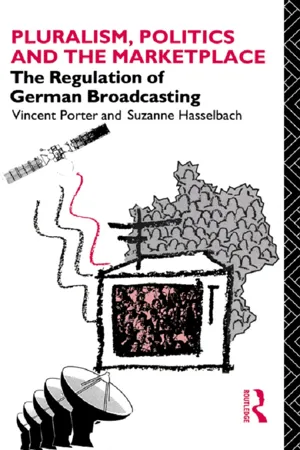
eBook - ePub
Pluralism, Politics and the Marketplace
The Regulation of German Broadcasting
- 264 pages
- English
- ePUB (mobile friendly)
- Available on iOS & Android
eBook - ePub
Pluralism, Politics and the Marketplace
The Regulation of German Broadcasting
About this book
Information
Chapter 1
The philosophies of broadcasting pluralism
From Kiel opposite the Danish coast, to Munich in the foothills of the Alps; and from Aachen on the Belgian border to, since German unification in 1990, Frankfurt-on-the-Oder on the Polish frontier, the broadcasting system of the Federal Republic is one of the largest and most powerful in Western Europe. In 1989, the broadcasting system in West Germany alone had an annual income of £2.9 billion a year.1 Some fifty-six per cent came from the £76 (DM 228) paid annually by each set-owning household in the FRG, while a further thirty-seven per cent, came from the sale of airtime. The remainder came mainly from overseas sales and dividends of the two major public broadcasting networks, ARD and ZDF (see App. X).
FROM ALLIED CONTROL TO PUBLIC BROADCASTING DUOPOLY
Despite its size, the FRG’s broadcasting system is not a huge monolith. At the end of the Second World War, the Western Allies deliberately broke the centralised broadcasting system of the Third Reich into smaller units. In the American zone the broadcasting organisations were regional, based in Bremen, Munich and Stuttgart. In the British zone, the authorities set up a zone-wide broadcasting corporation, NWDR, based on the model of the BBC; while in Rhineland-Palatinate and Baden-Württemberg in the South-West, a smaller version, Südwestfunk, was set up by the French authorities. The stations which served only one Land were set up by Land law, while those which served more than one Land were constituted by inter-Land treaties. A relic of Allied control has survived in Berlin in the shape of RIAS. This German-language radio and television station was under the authority of the US Information Service but received ninety per cent of its income from the federal government which thereby acknowledged the importance of the station’s presence for the city of Berlin which was divided during the cold war.
By 1949, when the Basic Law for the Federal Republic was drafted and agreed, broadcasting had become the responsibility of the West German Länder (see App. I). By the early 1950s, the Land-based stations joined together to form an association, which attempted to combine the organisation of a nation-wide broadcasting service with Land-based editorial freedom. The Arbeitsgemeinschaft der öffentlich-rechtlichen Rundfunkanstalten der Bundesrepublik Deutschland, or ARD as it is now universally known, formed the first network of public broadcasting corporations in the FRG. By 1955, it had nine members. The largest, which provides over a quarter of the network programming, is WDR in Cologne which seceded from NWDR. The next largest are NDR, based in Hamburg, and BR based in Munich, which provide roughly a sixth each. SDR in Stuttgart, HR in Frankfurt, SWF in Baden-Baden and SFB in West Berlin each provide between eight and nine per cent, while RB in Bremen and SR in Saarbrücken contribute a mere three per cent each. In addition, there is a complex system of financial equalisation which guarantees the smallest stations enough money to finance their programme quotas (see App. II).
For each broadcasting organisation, a Rundfunkrat, or broadcasting council, is appointed and/or elected according to provisions laid down in the relevant Land law. Although the details vary from Land to Land, the normal procedure is to establish a three-fold tier of control. The broadcasting council, which is responsible for the general policy of the organisation, has some twenty or so members, usually a mixture of politicians and representatives of employers’ organisations, trade unions, youth groups, sports associations and the churches. It appoints an Intendant, or director-general, and a smaller Verwaltungsrat, or administrative council, to supervise financial matters.
By the late 1950s, new broadcasting frequencies were becoming available in the UHF band. But the Land-based nature of broadcasting meant that the ARD system suffered from two disadvantages. First, it was an institutionally fragmented organisation, ill-designed to act as a national champion. Second, although several of the ARD broadcasters augmented their revenue by selling airtime, advertisers had no way, either through the broadcast media or through the press, of advertising to the whole of the Federal Republic. In addition, the federal government wanted to get its hands on broadcasting. In 1959, therefore, Chancellor Adenauer attempted to set up a private company, financed by state loans, to use the new frequencies. But the Länder, which argued that the proposal was unconstitutional, referred the whole question to the Federal Constitutional Court.
In an epoch-making decision, the Court agreed. Adenauer’s proposal was rejected, but from the ruins of the Constitutional Court’s rejection a new phoenix emerged, Zweites Deutsches Fernsehen, the second German television channel, ZDF. The new organisation was authorised by another inter-Land treaty, signed this time by all the Länder. Like the ARD stations, ZDF is also a public broadcaster, supervised by a three-tier control system. It is financed by thirty per cent of the licence fee, augmented by the sale of airtime on a nation-wide basis.
At the same time, the Court accepted federal jurisdiction for the external services DW and DLF, which the Bund had set up already in 1960. While both are financed from the federal budget, DLF receives an additional allocation, in recognition of its status as a truly national broadcaster to both halves of Germany. Both stations have a public service control structure, and along with RIAS they are associate members of ARD.
For the next twenty years ARD and ZDF happily co-existed side by side. In 1964, the two television networks were augmented by a series of Land-based third channels, run by the ARD stations. Radio too continued to be run by the ARD stations organised on a Land-wide basis. In the mid-1970s, however, cable and satellite technologies provided new distribution opportunities. The traditional duopoly could no longer be justified by the shortage of terrestrial frequencies. Instead the new electronic media gave privately organised groups a way into broadcasting. Conservative politicians seized the opportunity and passed new laws legitimating private, wholly commercially funded broadcasting; and by 1984 a dual system of public and private broadcasters was beginning to emerge.
But the decision of the Federal Constitutional Court in 1961 had done more than reject Adenauer’s proposal for a private television company. It had placed broadcasting firmly on the federal constitutional agenda. Broadcasting and its regulation were too serious to be left in the hands of the politicians. The guiding concern of the Court was the role played by broadcasting in the formation of public opinion, the constitutional platform of ideas which the politicians sought to represent and to interpret into legislative and administrative action.
THE CONCEPT OF PLURALISM IN THE FEDERAL REPUBLIC
The key concept which has underpinned the thinking of the Federal Constitutional Court has been that of pluralism. In the FRG, pluralism has a political and a socio-cultural dimension. It arises from liberal theory, which sees society as a series of conflicting interests which compete in the policy-making process.
Political pluralism is a doctrine of functional federalism (as against monistic absolutism) on the basis of a variety of independent associations, at least an expectation that such groups existing in reality could help to ensure civil liberties and make the state serve human needs.2
This competition of interests is intended to bring about a balance of power. Federalism is to protect different interests, views and ideas from being suppressed by a dominant regime. This concept of pluralism permeated the West German constitution, the Basic Law, which was created in 1949 under Allied supervision.3
Article 9 of the Basic Law guarantees as civil rights the free formation of associations and public assembly. Power is divided vertically, through the principle of federalism, between the Länder and the Bund.4 Article 20 of the Basic Law separates horizontally the legislature, the executive and the judiciary; and Article 21 safeguards the free formation of political parties. The role of the eleven self-governing entities of the Länder is to maintain cultural, economic and historical diversity and to provide a check to the central legislature and government of the Bund in Bonn.
Central to broadcasting regulation is Article 5 of the Basic Law, which expressly guarantees the free formation, expression and dissemination of public and individual opinion, and the institutional freedoms of broadcasting and the press. The same article also secures the freedom of art, science, research and teaching. In order to prevent state centralism and the homogenisation of mass communications and education, the areas outlined in Article 5, including broadcasting, are part of Länder jurisdiction.
The German Federal Constitutional Court, which interprets the civil rights and other legal norms laid down in the Basic Law, described the West German ideal of pluralism, which informed its broadcasting decisions, in the following terms.
The permanent process of the formation of public opinion and will flows into the act of parliamentary election which is decisive for the building of state competence…[but] the right of the citizen to participate in the political decision-making process is not expressed merely through the act of voting, but also by influencing the permanent process of the formation of political opinion, the formation of ‘public opinion’…Public opinion influences the decisions of the state agencies. Furthermore, groups, associations and various societal formations try to influence government action and legislative decision-making in the interests of their members. But above all, between elections, the political parties influence the constitutional bodies in their decisions, particularly parliamentary resolutions.5
The free formation of individual and public opinion, for which broadcasting and the press are instrumental, is ‘a fundamental building block of the free democratic order since it guarantees intellectual conflict, the free discussion of ideas and interests, which is Vital for the functioning of the state’.6
This interpretation of pluralism modifies the liberal model, widely accepted in Anglo-Saxon thinking, in several respects. In the Federal Republic, the political parties are permanent institutions of public life and are constitutionally assigned the strongest pluralist role. Over and above interest groups, the contemporary political parties are seen as the political voice of a majority of citizens cutting across particular interests. The classic idea of liberalism, that of social groups defending civil liberties against an absolute ruler, has thus been replaced by the concept of the all-embracing democratic state, the social and legal state (sozialer Rechtsstaat), which gains its legitimacy through political representation of its citizens in parliament. This strong reliance upon political parties naturally means that factional politics permeate every aspect of West German life, including its broadcasting system.
The Constitutional Court regarded not only political parties, but also other associations of interests, as ‘intermediary forces’ which precede parliamentary decision-making and are necessary for the democratic formation of the public will.7 Therefore, nonpartisan interests have also been institutionalised and hierarchised in order to carry out a number of state regulatory duties, such as the allocation of public funds to charities, collective bargaining, and public insurance. Last but not least, they have a mandate to participate in the regulation of broadcasting.
In practice, these developments tend to lead away from the liberal model of group pluralism towards a brand of neocorporatism. A harmonious view of interest group pluralism does not do justice to the political realities in the FRG. The West German system is characterised by ‘sectoral pluralism’, where participation in the policy process is largely confined to those sectors with the greatest economic and political clout.8 The scope for the democratic formation of the will in the public sphere has also narrowed with the growing complexity of modern public policy. The public will is increasingly decided by the executive and the administration.9 Indeed, the state bureaucracy and whole batteries of well-informed, legally trained civil servants, the socalled Referenten, steer and transform interest group demands, and become the main information sources of the politicians themselves. This also affects broadcasting regulation. In the process, the scope for parliamentary decision-making has been reduced.
The system of group political bargaining tends to marginalise weak and unstructured interests. Citizen initiatives have sprung up as a reaction to the rigidities of the system, but they too tend to achieve their aims through established institutions, such as the political parties. For example, there is a strong connection between the free radio associations and the Greens.
The declared purpose of the Basic Law is to maintain political, social and economic stability. Political culture is therefore ‘basically consensual and suspicious of any form of direct democracy and plebeian participation.’10 The free expression of opinion, enshrined in Article 5 of the Basic Law, is therefore constrained by Article 18, which tolerates dissent only as long as it is not abused to fight against the free democratic order. Thus radical onslaughts on the dominant ideology of the Federal Republic can be construed as illegal. As a result, chan...
Table of contents
- Cover
- Halftitle
- Title
- Copyright
- Contents
- Preface
- Acknowledgements
- Glossary of terms and abbreviations
- 1. The philosophies of broadcasting pluralism
- 2. The regulation of signal distribution
- 3. The regulatory structures for public and private broadcasting
- 4. From legislative theory to regulatory practice
- 5. Alternative forms of broadcasting in the FRG
- 6. The regulation of the market
- 7. The European dimension
- 8. Broadcasting regulation In the five new Länder
- 9. Conclusion: Beyond balanced pluralism
- Appendices
- Notes
- Select bibliography
- Suggestions for further reading—English-language literature
- Index
Trusted by 375,005 students
Access to over 1.5 million titles for a fair monthly price.
Study more efficiently using our study tools.
Frequently asked questions
Yes, you can cancel anytime from the Subscription tab in your account settings on the Perlego website. Your subscription will stay active until the end of your current billing period. Learn how to cancel your subscription
No, books cannot be downloaded as external files, such as PDFs, for use outside of Perlego. However, you can download books within the Perlego app for offline reading on mobile or tablet. Learn how to download books offline
Perlego offers two plans: Essential and Complete
- Essential is ideal for learners and professionals who enjoy exploring a wide range of subjects. Access the Essential Library with 800,000+ trusted titles and best-sellers across business, personal growth, and the humanities. Includes unlimited reading time and Standard Read Aloud voice.
- Complete: Perfect for advanced learners and researchers needing full, unrestricted access. Unlock 1.5M+ books across hundreds of subjects, including academic and specialized titles. The Complete Plan also includes advanced features like Premium Read Aloud and Research Assistant.
We are an online textbook subscription service, where you can get access to an entire online library for less than the price of a single book per month. With over 1.5 million books across 990+ topics, we’ve got you covered! Learn about our mission
Look out for the read-aloud symbol on your next book to see if you can listen to it. The read-aloud tool reads text aloud for you, highlighting the text as it is being read. You can pause it, speed it up and slow it down. Learn more about Read Aloud
Yes! You can use the Perlego app on both iOS and Android devices to read anytime, anywhere — even offline. Perfect for commutes or when you’re on the go.
Please note we cannot support devices running on iOS 13 and Android 7 or earlier. Learn more about using the app
Please note we cannot support devices running on iOS 13 and Android 7 or earlier. Learn more about using the app
Yes, you can access Pluralism, Politics and the Marketplace by Suzanne Hasselbach,Vincent Porter in PDF and/or ePUB format, as well as other popular books in Social Sciences & Media Studies. We have over 1.5 million books available in our catalogue for you to explore.