- 304 pages
- English
- ePUB (mobile friendly)
- Available on iOS & Android
eBook - ePub
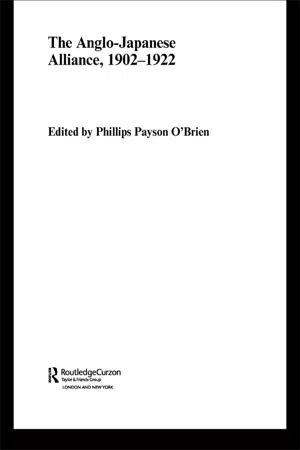
The Anglo-Japanese Alliance, 1902-1922
About this book
The Anglo-Japanese Alliance was the first formal agreement of its type reached by a Western 'great' power with a non-Caucasian nation in the modern era. As such, it represented an important milestone diplomatically, strategically and culturally. This book brings together many leading experts who examine the different aspects of the Alliance in its different stages before, during and after the First World War, who explore the reasons for its success and for its end, and who reach a number of interesting and innovative conclusions on the agreement's ultimate importance.
1 Origins of the Anglo-Japanese Alliance
In the shadow of the Dreibund
Ian Nish
In 1901 the newly built 15,200-ton, ironclad battleship, Asahi, soon to be the pride of the Imperial Japanese navy, slipped down the Clyde from John Brown’s yard at Clydebank. It eventually fought with distinction in the Russo-Japanese War. I am not suggesting that Glasgow or its shipbuilders were the cause of the Anglo-Japanese Alliance, far less of the Russo- Japanese War. But shipbuilding in Glasgow was one element in a pattern of cooperation which developed between Britain and Japan and contributed with other factors to the creation of the Alliance.
There are many causes of the Alliance, proximate causes and long-range causes. When my book on the Alliance first appeared, the reviewer in The Times Literary Supplement was kind enough to say that I had dealt with the actual negotiations which began in October 1901 in a ball-by-ball analysis. I was hurt but also flattered because historians by the nature of their trade have to offer ball-by-ball analyses. I propose to concentrate on longer-range causes rather than proximate ones, and begin in 1895. There is a problem even with that date because the concept of an ‘alliance’ between Britain and Japan is mentioned many times earlier – not of course at the level of official overtures being made but at the level of elite conversation. From the time of the Iwakura mission in 1872–1874, people throughout Britain and Europe recognized that Japan was a progressive up-and-coming country and, since alliances were much talked of in diplomatic circles, had good prospects in future of being allied to European countries.1
Sino-Japanese War and the Dr eibund intervention
The alliance that was being talked of came closer to becoming a political reality when Japan and China went to war in 1894. China’s resistance, both military and naval, crumbled; and she was forced to sue for peace. The peace negotiations were convened at Shimonoseki on 20 March 1895. But China had already been canvassing for the intervention of the powers on her behalf. It was vital, therefore, for Japan to try to forestall any desire they had to get involved.
Mutsu Munemitsu, who had been Japan’s Foreign Minister since August 1892, had been expecting action by the powers since early in the war. He recognized that Japan was unpopular in Britain because she had not taken up London’s offers of mediation before and during the war. Assuming that this frigidity was also due to Britain’s friendship with China, Mutsu made it his object to improve Japan’s relations with Britain. To this end he appointed Kato Takaaki as minister to the court of St James’s at short notice on 23 November 1894. For Kato to take over Japan’s top diplomatic post at the young age of thirty-five during a period of national emergency was a sign of Mutsu’s great confidence in him. But Kato knew Britain and spoke English well. He was to play a critical role in the unfolding of the Alliance.2
From his first meeting with the Foreign Secretary of the Liberal government, Lord Kimberley, on 4 February 1895, Kato felt that they established a fine personal rapport but perceived that Japan had still much persuading to do.3 When Japan’s peace terms were leaked by the Chinese to the powers, Kato reported to Tokyo his impression that Britain had no firm position on them but was watching the reactions of her continental rivals, Russia and France. When the commercial terms which had been separately negotiated reached him on 6 April, Kato assured Britain that all trading nations would enjoy equal rights under them. The London government received no complaints from commercial circles and broadly accepted them.4
When the treaty of Shimonoseki was signed on 17 April, the Tokyo representatives of Russia, France and Germany stepped in to give Japan their ‘friendly advice’ to withdraw some of the clauses of the Shimonoseki treaty, asking in effect for Japan to return the Liaotung peninsula to China. The Rosebery cabinet confirmed its earlier decision not to advise the Japanese ‘without knowing the ulterior measures to which it is in contemplation to have recourse in the almost certain event of Japan refusing to yield to the desires of the Powers’. Clearly Kato had given the British ministers the strong impression that Japan would reject any outside ‘advice’ and resist.5
Britain did not join this Eastern Dreibund in spite of her desire for a rapprochement with Russia. She recognized that, while Japan’s political demands on China were severe, Britain could not offer any advice because she was not willing to back it up by force or threats of force. Kato was worried, however, that Britain, in spite of Kimberley’s initial assurances, might still join the others at the last moment.6 She did not do so; and Kato was bold enough to ask how far Japan might count on Britain’s support against the Dreibund. But, while Kimberley was in Kato’s view ‘very cordial’, he defined British policy as being one of non-interference, his principal interest being the restoration of peace in the area. Though this was not said, the British cabinet felt that there was no practical way in which it could influence the situation and that China should accept the terms.7 Britain did not want to depart from neutrality; but Kimberley who was of course in touch with the Dreibund Powers did tell Kato that they too were in earnest and were not likely to be fobbed off by any compromise solutions which Japan offered.
On receipt of this report, Tokyo replied to Kato (in English): ‘Your telegram gave us a good guide in determining our action.’8 Japan had to face the fact that she was isolated and had to deal with the crisis without more than moral support from outside. That hastened her eventual climb-down on 5 May which was thankfully accepted by the three powers. It resulted in her agreeing to retrocede to China all mainland territory granted under the treaty in return for monetary compensation.
When the Liberal government collapsed on 24 June, Kato had a final meeting with Kimberley at which he expressed his appreciation of the actions of the cabinet and the friendliness of the foreign secretary. There can be little doubt about the success of Kato’s own role. Japan’s worry had been about Britain’s supposed alliance with China and Kato’s task was to wean her away from that. In fact the British soon lost any confidence they had formerly had in China. Still, the British were circumspect and non-committal during the crisis. What prevented them from taking a more resolute stance was a domestic issue, the divergent views within the cabinet over foreign policy.
Obviously the Eastern Dreibund is an important event on the road to an Anglo-Japanese rapprochement. A favourable turn had taken place in Anglo-Japanese relations as a result of the ambitions the continental powers had shown during the Triple Intervention. If Japan was to become anyone’s ally after 1895, it was not likely to be France, Russia or Germany. The fact that Germany, which had been held in such high esteem in the Meiji army, had shown herself to be anti-Japanese meant that there was now only one candidate among European powers.
East Asia in Crisis, 1896–1899
With the return of peace, Minister Kato wanted to continue his collaboration with Britain. But the cabinet changed in London and Kato had to cope with Lord Salisbury as Foreign Secretary – a more distant figure than Kimberley. Salisbury appointed as parliamentary under-secretary George Curzon, already well known for his journeys to the East and his subsequent publications. It was remarkable to have someone in charge of Eastern affairs who had travelled east of Calcutta. But Salisbury was cool towards Japan and Curzon was not as enthusiastic as he later became.9 Witness his description of the war which had just ended:
[No country ever went to war so well prepared as Japan.] Skilled topographers in disguise had mapped the high roads of China. Hydrographical surveys had acquainted the Japanese with every inlet in the Korean coast. Her mobilization proceeded with a smoothness and rapidity that excited the admiration of European military attaches. The Japanese Intelligence Department might have been engaged upon, just as it had certainly been preparing for, a campaign for years. Its spies were everywhere, in the offices and the arsenals, in the council chambers and amid the ranks of the enemy. The press was manipulated and controlled with a masterly despotism that would have been impossible in Europe. Finally the strategy of Japanese generals, if not brilliant, was deliberate, scientific and successful.10
This was the language of someone who had access to insider knowledge and was not yet ready to look at Japan through rose-tinted spectacles.
Japan may have been humbled by the Dreibund but she was still proud of her victory. When Okuma Shigenobu came to office as Foreign Minister in the Matsukata ministry in September 1896, he addressed his ministers overseas about the new age (shin jidai) on which Japan was embarking after her massive victory, and called on them to secure Japan’s new standing in the world. Japan’s confidence grew with the adoption of the gold standard and in consequence of Japan’s revised treaties which came into effect when all the other powers had agreed in 1899. There were also the successful financial dealings in London over the large indemnity which Japan was to receive as reparations from China. She set aside from this 30 million yen – then an astonishing sum – for her so-called War Vessel Replenishment Fund.11
The Japanese were building up a coterie of friends in high political circles. One of the key elements in developing Anglo-Japanese goodwill was the strength of the naval lobby in Britain. Clearly the lobbyists were aware that Japan had ploughed a large part of the war reparations into building battleships in British yards with the latest technology.12 The battleships Fuji (Thames Ironworks) and Yashima (Elswick) had been ordered before the Sino-Japanese war and were launched around February 1896. In that year the Japanese government embarked on a 10-year naval expansion programme consisting of a first-class modern fleet, four battleships, six armoured cruisers, six other cruisers, twenty-three torpedo boat destroyers, etc. Most of the ship orders went to British yards. Shikishima (Thames, launched 1898), Asahi (Clydebank, launched 1899), Hatsuse (Elswick, launched 27 June 1899, completed 1901), Mikasa (Vickers-Maxim, Barrow in Furness, launched 1901) were all completed in this brief period. There were also a number of destroyers and armoured cruisers built in British yards. Fred Jane in his Imperial Japanese Navy points out that these were not markedly dissimilar to Royal Navy vessels of comparable class.13
In Britain a new word was coming to be heard in parliamentary circles – alliance. It came most commonly from the lips of Joseph Chamberlain, the colonial secretary, who had the fierce conviction that the days of Britain’s isolation were nearing an end. It reached a peak during the serious Far Eastern crisis at the end of 1897 when the stability of the area was threatened by the actions of European powers. Russia and Germany acquired leases of ports on the coastline of China; and France and Britain were not far behind. It was in this fraught atmosphere that the question of Japan was specifically raised. Curzon wrote to Salisbury on 29 December 1897:
If European Powers are grouping themselves against us in the Far East we shall probably be driven sooner or later to act with Japan. Ten years hence she will be the greatest naval Power in those seas and the European Powers who now ignore or flout her will then be competing for her alliance.14
Chamberlain wrote quite independently to Salisbury two days later:
have you considered whether we might not draw closer to Japan? … they are rapidly increasing their means of offence and defence, and in many contingencies they would be valuable Allies. … I do not suppose that a Treaty of Alliance would be desirable but I should hope that an understanding might be arrived at which would be very useful. In any case they are worth looking after as it is clear that they do not mean to be a quantite negligeable in the East.15
Of course, Chamberlain tantalizingly used the word ‘alliance’ in connection with Germany and the United States as well as Japan and probably used it more enthusiastically in the case of the first two. Such was the variety of the allied countries he had in mind that it seems likely that he was not thinking of a full-blooded military alliance. Japanese sources are specific that Chamberlain at one of his dinner parties spoke in favour of some sort of alliance with Japan. But, in the above letter to the Prime Minister, he was only urging some sort of understanding.
Evidently Chamberlain and younger members of the cabinet were prepared to put forward these views fairly openly in conversation with the Japanese. How did Kato interpret what was being said in these contacts? The Japanese analysed the various ...
Table of contents
- Cover Page
- Title Page
- Copyright Page
- RoutledgeCurzon Studies in the Modern History of Asia
- Contributors
- Acknowledgements
- Introduction
- 1: Origins of the Anglo-Japanese Alliance
- 2: Towards a Naval Alliance
- 3: The Anglo-Japanese Alliance and British strategic foreign policy, 1902–1914
- 4: Military Co-operation under the first Anglo-Japanese Alliance, 1902–1905
- 5: The Secret Dimensions of the Anglo-Japanese Alliance, 1900–1905
- 6: Japan Debates the Anglo-Japanese Alliance
- 7: Navalism, Naval Expansion and War
- 8: Japanese Naval Assistance and its Effect on Australian–Japanese Relations
- 9: Great Britain and Japan’s Entrance into the Great War, 1914–1915
- 10: Bankers, Investors and Risk
- 11: Cultural exchange at the time of the Anglo-Japanese Alliance
- 12: Japanese art and its effect on the Art Nouveau movement in Britain
- 13: The Anglo-Japanese Alliance and the Question of Race
- 14: India, Pan-Asianism and the Anglo-Japanese Alliance
- 15: Armaments and Allies
- 16: Britain and the end of the Anglo-Japanese Alliance
Trusted by 375,005 students
Access to over 1.5 million titles for a fair monthly price.
Study more efficiently using our study tools.
Frequently asked questions
Yes, you can cancel anytime from the Subscription tab in your account settings on the Perlego website. Your subscription will stay active until the end of your current billing period. Learn how to cancel your subscription
No, books cannot be downloaded as external files, such as PDFs, for use outside of Perlego. However, you can download books within the Perlego app for offline reading on mobile or tablet. Learn how to download books offline
Perlego offers two plans: Essential and Complete
- Essential is ideal for learners and professionals who enjoy exploring a wide range of subjects. Access the Essential Library with 800,000+ trusted titles and best-sellers across business, personal growth, and the humanities. Includes unlimited reading time and Standard Read Aloud voice.
- Complete: Perfect for advanced learners and researchers needing full, unrestricted access. Unlock 1.5M+ books across hundreds of subjects, including academic and specialized titles. The Complete Plan also includes advanced features like Premium Read Aloud and Research Assistant.
We are an online textbook subscription service, where you can get access to an entire online library for less than the price of a single book per month. With over 1.5 million books across 990+ topics, we’ve got you covered! Learn about our mission
Look out for the read-aloud symbol on your next book to see if you can listen to it. The read-aloud tool reads text aloud for you, highlighting the text as it is being read. You can pause it, speed it up and slow it down. Learn more about Read Aloud
Yes! You can use the Perlego app on both iOS and Android devices to read anytime, anywhere — even offline. Perfect for commutes or when you’re on the go.
Please note we cannot support devices running on iOS 13 and Android 7 or earlier. Learn more about using the app
Please note we cannot support devices running on iOS 13 and Android 7 or earlier. Learn more about using the app
Yes, you can access The Anglo-Japanese Alliance, 1902-1922 by Phillips O'Brien in PDF and/or ePUB format, as well as other popular books in History & Japanese History. We have over 1.5 million books available in our catalogue for you to explore.