1 New Labour, governance and the politics of diversity
Janet Newman
Debates about gender and management have typically been concerned with the organisational domain. The literature has highlighted the organisational practices that reproduce unequal representations of women and men in management posts; the ways in which cultural norms and values constrain opportunities for women; and the gendered knowledges and practices of managerialism. In terms of the public sector this is, however, only part of the story. The gendering of organisational life in public services is inextricably tied to the way in which the public realm is constituted as a gendered and racialised domain.
‘Governance’ provides one set of theories through which the public realm can be understood. Governance in its broadest sense denotes issues concerning the changing role and powers of the state; the relationships between the public, private and voluntary sector in emerging patterns of service delivery; and expectations about the role of citizens, communities, families and households. In this chapter I use the term governance to embrace such state–society interactions and to open up debates about issues of diversity in the public realm.1 I deliberately focus on issues of diversity rather than gender alone because of the problem of isolating gender from other forms of social identity and other lines of social division. However, my analysis has been shaped both by drawing on the experience of women working in public services in the UK and by feminist forms of analysis and praxis.
Governance can be viewed as a gendered and racialised domain at a number of different levels of analysis. The most straightforward is the question of ‘who governs’? – the representation of different groups in the council chamber, in parliament and government. This has long been an issue of major concern to those concerned with equality agendas, who have repeatedly pointed to the under-representation of women and of black and ethnic minorities in government and local government. More recent concerns have been expressed about the constitution of the new quangocracy – the boards of public bodies that govern key institutions set up at arms length from the state itself, from school governing bodies to health trusts. While this chapter touches on such issues, they are not a major concern. I focus rather on key dimensions of emerging patterns of governance, especially those that characterise the policies and practices of the current Labour government in the UK. Labour’s attempts to develop a more inclusive, participatory approach to state–society interactions and its increasing emphasis on networks and partnerships have major implications for the policies and practices of public service organisations. These developments are shaped within and articulated through Labour’s attempt to remould the relationship between the state and ‘civil society’. They require a rethinking of the way in which public sector organisations understand their contribution to the reproduction of, or challenge to, embedded patterns of inequality in the societies they serve. There is, in particular, a need to refocus attention beyond the boundaries of internal organisational structures and policies to embrace wider conceptions of the governance processes – the patterns of state–society interaction – which are mediated through the public sector itself.
Understanding governance
Rhodes claims that governance has become the ‘defining narrative of British government at the start of the new century’ (Rhodes 2000a: 6). Work within the UK political science tradition highlights issues such as the ‘hollowing out’ of the state (Rhodes 1994; Gamble 2000) or the ‘decentring’ of state power (Pierre and Peters 2000). It is argued that the capacity of governments to control events within the nation-state has been influenced by the flow of power away from government institutions, upwards to transnational bodies, downwards to regions and localities. The development of market mechanisms and contracting through the 1980s and 1990s broke up the old state bureaucracies, and there was a proliferation of quasi-state bodies (quangos) fulfilling many of the functions previously carried out by government. All of these shifts have created problems of coordination and control by the centre. The old mechanisms of control-through-hierarchy have, it is argued, been superseded, first, by the rise of markets and, second, by the increasing importance of networks as a mode of coordinating the public domain. (e.g. Rhodes 1997; 1999; 2000a; 2000b; Stoker 1999; 2000). Governments, it is argued, can no longer achieve their goals through traditional methods of control because of their dependence on a wide range of actors across the public, private and voluntary sectors. They are increasingly obliged to govern at a distance by influencing, persuading and providing incentives for action. At the same time they are developing stronger roles in building partnerships, steering and coordinating, and providing system-wide integration and regulation.
New patterns of governance have become more significant, not only because of the fragmentation of the public domain but also because of the growing complexity of social problems and the changing nature of civil society. Kooiman (1993), for example, views government as only one of many actors in a field in which other institutions have a great deal of autonomy. The role of government is to address the problems of guiding and influencing, rather than making,public policy. This produces patterns of state–society interaction based on ‘co-’ arrangements – collaboration, cooperation, co-steering, and co-governing. This form of analysis shifts the focus of attention beyond economic structures or processes towards a much broader concern with issues of citizenship, concepts of community, and social and cultural formations.
These different strands of theory provide insights into the style of governance developed by the 1997 Labour government in the UK. Its emphasis on ‘joined up’ or ‘holistic’ government and working in partnership reflects ideas of network-based governance and the development of partnerships across the public, private and voluntary sectors. Labour has also stressed the need for an inclusive policy process that can draw multiple actors into the development and delivery of policy. It has sought to involve citizens in co-governance arrangements, seeking, for example, to bring public bodies and communities together to develop solutions to the problems of social exclusion, neighbourhood renewal, crime and disorder, low educational attainment among some categories of young people, long-term unemployment and other problems. None of these developments was invented by Labour, but Labour has placed much more emphasis on the need to modernise government in order to address these so called ‘wicked’ issues. This term captures a range of problems that are complex, have multiple strands of causation and a number of possible forms of policy intervention. Each cuts across the main departmental ‘silos’ of government and involves interaction between different tiers of government (international, national, regional, local and community based). Labour has also sought to remake the relationship between state and civil society, seeking the active involvement of citizens in the rebuilding of ‘community’ and encouraging them to act as ‘responsible’ users of welfare services.
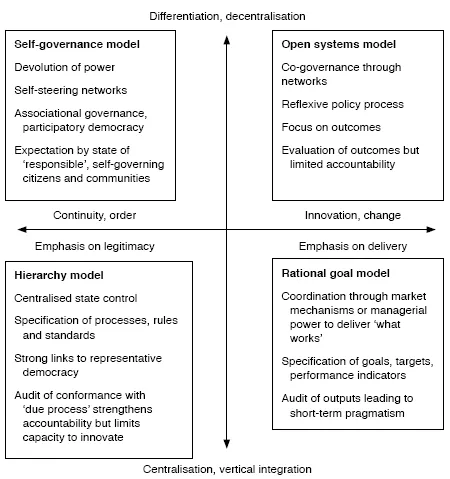
However, rather than suggesting a fundamental shift from old-style government to new forms of governance, Labour’s policies and strategies suggest a complex interface between different forms and styles of governing. The strong centralised control exerted by Labour – over the Party as well as over public services – suggests a continuing theme of hierarchical governance. Labour is also a strongly managerial administration, emphasising the search for ‘what works’ and unrolling a range of ‘modernising’ policy reforms. In Modernising Governance: New Labour, Policy and Society (Newman 2001a) I set out a framework through which the interaction between multiple models of governance might be explored. This depicts four models of governance, representing different flows of power and authority, forms of relationship, and conceptions of social action (Figure 1.1). Each model is based on distinctive discourses, embodying specific forms of language, practice and relationship. Each is associated with particular logics of decision making, which guide and coordinate action, and with specific forms of authority and conceptions of responsibility and accountability. Each, as I argue below, raises distinctive questions about how notions of equality and diversity are to be understood, and presents particular challenges for the scope and focus of equality policy and practice.
Figure 1.1 Models of governance.
Trajectories of change: bureaucracy and managerialism
This framework can help illuminate the forms in which notions of equality and diversity became institutionalised in the UK public sector. This section briefly discusses the discourses of equality that characterise ‘hierarchical’ and ‘managerial’ forms of governance.
Governance through hierarchy
The post-war welfare state was characterised by bureaucratic and hierarchical modes of governance: the bottom left-hand quadrant of my model. This was based on a liberal model of equality, strongly linked to notions of equality of citizenship and enshrined in the institutions of representative democracy. The 1960s and 1970s produced a host of procedural and legislative safeguards for the individual, and the model became institutionalised in a plethora of organisationally based policies, rules and guidelines. Its dominant discourse is that of equality of opportunity. The limitations of this model are well known: its refusal to deal with injustices experienced by groups rather than individuals, its incapacity to deal with issues of culture, and its ultimate failure to deliver substantial organisational or social change.
The debates and arguments around how to ensure equality within the constraints of the liberal model live on, not least in the institutions of representative democracy itself, as political parties argue about how to address the unequal representation of women and members of black and ethnic minority groups in parliament. As Phillips argues, ‘Embodiment matters. By their presence in decision-making assemblies, members of a previously marginalised group can better guarantee that their interests and perspectives will be articulated’ (Phillips 2000: 61). But the sites at which embodiment matters are proliferating as new forms of governance grow in importance. At the same time, patterns of economic and political change have resulted in a flow of power away from national political institutions. Women and other excluded groups, groups that have been knocking on the doors of parliament and other institutions for many years, may be gaining entry (however conditionally and temporarily) precisely at the point at which power is flowing away from those institutions themselves.
Managerial governance
During the 1980s and early 1990s, however, the development of ‘new right’ politics and the introduction of managerialism and markets into public services led to significant shifts in the discourses and practices of equal opportunities. One consequence of state and economic restructuring was the opening up of huge economic differentials between different social groups and the deepening of social divisions. A second was a demise of legitimacy for the notion of equality itself: public service organisations struggling to contain social problems, while undergoing profound transformation through the application of market mechanisms and radical downsizing, were little concerned about such ‘old-fashioned’ notions, which seemed to belong to a previous era. At the same time, however, rational management offered a new technology of equality strategies. Rather than policies and procedures, attention shifted to the potential of target setting, performance indicators and other tools to redress workforce imbalances. The discourses of culture change and of creating ‘ownership’ of equality policies seemed to offer the potential to deliver real change. As organisations adopted the language and practices of human resource management there was a new emphasis on maximising the capacity of all staff to contribute to organisational effectiveness, and good equality policies and practices began to be viewed by some as positive drivers of organisational performance and success.
These ‘rational management’ equality discourses remain dominant in the UK public sector. Indeed, they have become more significant as public service organisations such as the police have struggled to respond to charges and targets for the recruitment of under-represented groups. Such strategies are inevitably limited in their potential to deliver sustained change because the managerial ethos strips notions of equality away from their political roots. ‘Race’, gender and other issues may now be on the agenda of many organisations, especially in recruitment policies, but addressing deeply patriarchal and racist cultures is another matter. The intractability of organisational cultures leads to severe problems of retention for those groups newly recruited, especially those in which marginalised workers are not able to challenge the existing culture through collective forms of struggle and engagement. Equality in these circumstances remains an individualised concept, constrained by the consensual ethos of the new managerialism (Newman 1994; 1995).
I have done little more than briefly sketch some of the ways in which equality is understood and institutionalised in ‘hierarchical’ and ‘managerial’ forms of governance: the story of the ‘long march’ of equal opportunities in the post-war welfare state and under the new-right transformation of the public sector is relatively familiar (see, for example, Cockburn 1991). In what follows I want to spend rather more time on the questions raised by the proliferation of networks and partnerships and by the development of various forms of ‘co-’ or ‘self-’governance arrangements. I do not wish to suggest that these are displacing the established forms of governance described above: these remain very much the focus of the continuing agenda of struggle and debate. However, I do want to shift the analysis beyond the confines of traditional equality agendas in order to illuminate some concerns flowing from emergent patterns of state–society interaction.
Open system governance: networks and partnership
The governance literature suggests a move away from coordination through hierarchy or competition and towards network-based forms of coordination. This theme is strongly represented in the current public policy system. A focus on networks and partnership forms a central element of the Third Way, which seeks to transcend old ideologically based preferences for delivering services through state bureaucracies, on the one hand, and competition, on the other. It underpins Labour’s discourse of ‘joined-up government’ through which it has attempted to move towards a more holistic approach to public policy, an approach that transcends the vertical, departmental structures of government itself. Partnership also represents a powerful discourse of inclusion and collaboration that is central to Labour’s attempt to forge a consensual style of politics. Such a discourse masks the patterns of inclusion and exclusion in network-based modes of governance. Who is invited into the new collaborative arrangements is not an issue that tends to be subject to scrutiny or to be judged against formal criteria of equality. It all depends on who you know and the powers of patronage and sponsorship. Access to the elusive centres of network-based decision making is not the only issue. The discourse of partnership speaks of equality, shared values and high trust, creating an illusory unity within partnerships that directs attention away from the political realities of divergent interests and conflicting goals. Naive or optimistic views of partnership focus on what the parties have in common and ignore power differences and inequalities.
This does not mean that groups are deliberately excluded: indeed many of the new forms of partnership and network-based decision-making structures are explicitly linked to questions of social inclusion and exclusion. For example Labour has sought to draw voluntary and community organisations into partnership with the public and private sectors to deliver social policy objectives on crime and disorder, social exclusion, neighbourhood renewal and so on. Not all of this activity can be characterised as an ‘open system’ approach: strong elements of centralisation and control cut across many of the new initiatives. But networks and partnerships do represent an attempt to deal with the complexity of many areas of public policy and the incapacity of hierarchical governing to deliver long-term, sustainable policy outcomes.
This form of governance does not, however, sit easily with traditional concepts of equality. When agencies engage in ‘partnership’ with community or voluntary organisations with radical agendas the result is often a profound clash of politics and culture. ‘Presence’ at the decision-making table is not enough: as Razzaque, a black woman involved in a regeneration partnership, exp...