eBook - ePub
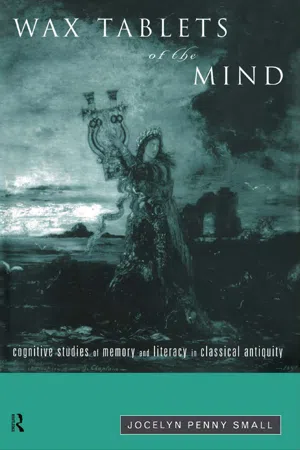
Wax Tablets of the Mind
Cognitive Studies of Memory and Literacy in Classical Antiquity
- 396 pages
- English
- ePUB (mobile friendly)
- Available on iOS & Android
eBook - ePub
Wax Tablets of the Mind
Cognitive Studies of Memory and Literacy in Classical Antiquity
About this book
In this volume, the author argues that literacy is a complex combination of various skills, not just the ability to read and write: the technology of writing, the encoding and decoding of text symbols, the interpretation of meaning, the retrieval and display systems which organize how meaning is stored and memory. The book explores the relationship between literacy, orality and memory in classical antiquity, not only from the point of view of antiquity, but also from that of modern cognitive psychology. It examines the contemporary as well as the ancient debate about how the writing tools we possess interact and affect the product, why they should do so and how the tasks required of memory change and develop with literacy's increasing output and evoking technologies.
Part I
LOGISTICS OF THE CLASSICAL LITERATE
1
MEMORY FOR WORDS
We live in a world of visible words. Even if we can’t read them, even if we don’t seek them out, we are, nevertheless, constantly bombarded by them. Buy Coke. Smoke Camels. Exit. Push. Pull. Like the silent butler and children in the Victorian era, text generally goes unnoticed. It wasn’t always this way. In the classical period, when text was still in its formative stages, its usefulness was hotly debated. Its forms were protean. Its potential was not realized. The technologies that writing was to spawn and continues to spawn were still unborn. The tools of the trade were barely there, much less refined. A pen was either a metal stylus or a reed pen and not a fountain pen not a ballpoint not a roller-tip not a felt tip not a crayon not a pastel not a pencil not a mechanical pencil. ‘Paper’ came in two basic varieties, papyrus and parchment, and these two types were sufficient through the Middle Ages.
In this chapter I consider the technological problems the creation of the written word presented to the classical Greeks and Romans: what their texts looked like and how that look affected their use. As Donald Norman says, ‘An artifact [tool] is not a simple aid. That is, you can’t just go out and find some cognitive artifact, and there you are, better at something.’1 I treat the writing of texts as a separate topic that emphasizes the process of composition, although the two processes—composing and replicating that composition in a physical text—dramatically affect each other.
THE PROBLEM OF INTERNAL VS. EXTERNAL STORAGE
Homer never mentions Mnemosyne (Memory), the mother of the Muses. He begins the Iliad with an invocation to an unidentified deity (‘Sing, goddess’), while in the Odyssey he calls upon a slightly more specific inspiration with ‘Tell me, Muse, about the man of many ways…. Beginning at any point, goddess, daughter of Zeus,/tell us.’2 The source of these epics does not come from within the poet, for his telling of the tale has nothing to do with memory. So Lucian in the second century AD has Hesiod disown all responsibility for his poetry: ‘I [Hesiod] could say that nothing that I composed belonged to me personally, but to the Muses, and you should have asked them for an account of what was put in and what left out.’3 Gregory Nagy says that it is ‘not so much that the Muses “remind” the poet of what to tell but, rather, that they have the power to put his mind or consciousness in touch with places and times other than his own in order to witness the deeds of heroes (the doings of the gods).’4 Albert Lord describes the process more generally: ‘We remember a story without memorizing its words—the idea of doing so is ridiculous. If it be appropriate we may memorize a “punch line”, but that is as far as memorization goes.’5 The best way to understand the distinction Lord is making between memory for words and memory for story is to recall one of our own fairy-tales, such as ‘Little Red Riding Hood’ or ‘Goldilocks and the Three Bears’. At no time did we consciously memorize the story, because repeated listenings and readings are sufficient for most Americans to render the tales in all their gory. Even if we tell a story in different words and with different embellishments at different times, if asked we would indeed say that it is the same story. As Lord puts it, ‘They [the oral singers] create the text anew each time they tell the story’6
With literacy comes a greater need for memory for words. It is not that memory is superlative in preliterate societies and wretched in literate ones, as many today and some then assume,7 because we differ little in cognitive capacity from Mycenaean man and, if anything, being somewhat later on the evolutionary scale, we should have better equipped brains. Children of ‘Stone Age’ New Guineans fly planes and run computers.8 As Ulric Neisser puts it, ‘By itself, the absence of something has no causal effects. Illiteracy cannot improve memory any more than my lack of wings improves my speed afoot.’9 Donald Norman addresses the issue more directly: ‘Writing something down doesn’t really change our memory; rather, it changes the task from one of remembering to one of writing then, later, reading back the information. In general, artifacts don’t change our cognitive abilities; they change the tasks we do.’10 In other words, the real distinction between the Mycenaeans and us lies not in basic brain power, but in the fact that what we choose to remember differs greatly. Michael Cole and Sylvia Scribner conclude that:
the anthropological reports are correct—their informants do in fact remember things that the anthropologists find it difficult or impossible to recall. But this performance is not reflective of greater powers of memory in general; rather it reflects the fact that the things a Philippine native or !Kung bushman finds easy to recall are different from the things that the anthropologist finds easy to recall. In short, how well someone remembers a particular subject matter depends on the subject at hand.11
Hence it is not just that literacy produced a need for memory for words on a scale that had never existed before. It is that one of literacy’s most notable effects is that it feeds upon itself. The more literate you are the more words you need to remember.
Exact wording is rarely crucial in oral societies, but often of great importance in literate ones, though this aspect took centuries to develop. In the absence of a permanent record of a text in writing or on tape or some such medium, how would anyone be able to prove whether or not two performances, separated in time, were the same? One might remember the amount of time a particular rendition took if one had an accurate measure for time, but even then some of the words could have been the same and others not. There simply would be no way to tell. Most oral societies are not only uninterested in the detail of the words per se, but even unaware of the unit of the word. Albert Lord reports the following conversation between an ‘interrogator’ (N for Nikola) and a Guslar singer (Ɖ for Ɖemo Zogiü):
N: So then, last night you sang a song for us. How many times did you hear it before you
were able to sing it all the way through exactly as you do now?
[Ɖ: Once…]
N: Was it the same song, word for word, and line for line?
Ɖ: The same song, word for word, and line for line. I didn’t add a single line, and I didn’t make a single mistake…
N: Tell me this, if two good singers listen to a third singer who is even better, and they both boast that they can learn a song if they hear it only once, do you think that there would be any difference between the two versions?…
Ɖ: There would…. It couldn’t be otherwise. I told you before that two singers won’t sing the same song alike…. They add, or they make mistakes, and they forget. They don’t sing every word, or they add other words.12
Lord explains the contradiction in the singer’s statements: ‘to him “word for word and line for line” are simply an emphatic way of saying “like”. As I have said, singers do not know what words and lines are.’13 Havelock goes even further: ‘Greek originally had no word for a word singly identified, but only various terms referring to spoken sound.’ He doubts whether ‘the isolation of the individual “word” as the basic building block of language is achieved before Plato.’14
Psychologists support this conclusion in their studies of the concept of words in two different groups of people: illiterate adults and children. In a study of the former, Robert Scholes and Brenda Willis concluded that ‘Such characteristics of the description of linguistic knowledge, previously associated with preschool children, agrammatic aphasics, and the hearing impaired, are now seen to be retained throughout life in the absence of the acquisition of literacy’15 Marilyn Adams gives a good summary of the evidence for children, and hence for illiterate adults:
In fact, many young children do not understand the word word…. Surprising as it may seem, the evidence concurs that children are not naturally prepared either to conceive of spoken language as a string of individual words or to treat words as individual units of meaning. What they listen for is the full meaning of an utterance, and that comes only after the meanings of the individual words have been combined—automatically and without their attention…. In speaking, we do not emit words one by one. We do not pause between them. Instead we produce whole clauses or sentences in one single continuous breath. In print there are spaces between the words. Each is discretely represented. As children become aware of the one-by-oneness of words in print, they begin to notice and isolate the words in speech.16
Her explanation also corroborates the formulaic nature of oral poetry. Epithets produced in single continuous breaths would naturally function as whole and indivisible units. Another study of children demonstrates that knowledge of words is not monolithic, but ‘continues to evolve and mature—indeed, significant changes occur when children are well into the period of concrete operations.’17 Something similar happened in classical antiquity: the idea of the word and how it works developed over time.
Linguists further explain why oral cultures and illiterates do not know words:
Spaces between groups of letters became important as the conventions of writing evolved. In alphabetic systems, spaces are now universal and as a result literate people learn to recognize ‘words’ as visual rather than auditory units. In a real sense, the first orthographers of a language make the decisions about how words are to be perceived in that language.18
Today one can literally see how the spoken word differs from writing by looking at spectrograms of connected speech. The ups and downs of the waves so seamlessly join each other that the breaks between words are often impossible to distinguish.19 Computers have the same problem in trying to understand speech. Nicholas Negroponte proposes an approach that a Guslar singer could understand: ‘the slurring and blurring of words …can be partially simplified by looking at language as multiword utterances, not just as single words. In fact, handling runtogetherspeech in this fashion may well be part of the personalization and training of your computer.’20 He gives the following exampl...
Table of contents
- COVER PAGE
- TITLE PAGE
- COPYRIGHT PAGE
- PREFACE
- INTRODUCTION
- PART I: LOGISTICS OF THE CLASSICAL LITERATE
- PART II: THE HISTORICAL DEVELOPMENT OF ANCIENT MEMORY TECHNIQUES
- PART III: WRITING HABITS OF THE LITERATE
- CONCLUSION
- NOTES
- SELECT BIBLIOGRAPHY AND ABBREVIATIONS
Trusted by 375,005 students
Access to over 1.5 million titles for a fair monthly price.
Study more efficiently using our study tools.
Frequently asked questions
Yes, you can cancel anytime from the Subscription tab in your account settings on the Perlego website. Your subscription will stay active until the end of your current billing period. Learn how to cancel your subscription
No, books cannot be downloaded as external files, such as PDFs, for use outside of Perlego. However, you can download books within the Perlego app for offline reading on mobile or tablet. Learn how to download books offline
We are an online textbook subscription service, where you can get access to an entire online library for less than the price of a single book per month. With over 1.5 million books across 990+ topics, we’ve got you covered! Learn about our mission
Look out for the read-aloud symbol on your next book to see if you can listen to it. The read-aloud tool reads text aloud for you, highlighting the text as it is being read. You can pause it, speed it up and slow it down. Learn more about Read Aloud
Yes! You can use the Perlego app on both iOS and Android devices to read anytime, anywhere — even offline. Perfect for commutes or when you’re on the go.
Please note we cannot support devices running on iOS 13 and Android 7 or earlier. Learn more about using the app
Please note we cannot support devices running on iOS 13 and Android 7 or earlier. Learn more about using the app
Yes, you can access Wax Tablets of the Mind by Jocelyn Penny Small in PDF and/or ePUB format, as well as other popular books in History & Ancient History. We have over 1.5 million books available in our catalogue for you to explore.