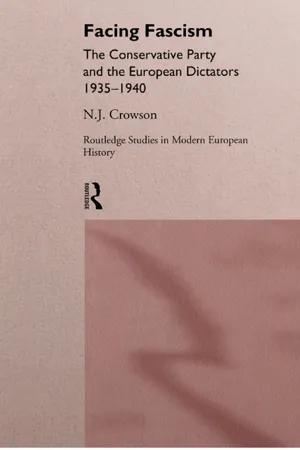
- 284 pages
- English
- ePUB (mobile friendly)
- Available on iOS & Android
eBook - ePub
About this book
This book examines the Conservative party's responses to the problems of fascism from 1935 - 1940.
Crowson provides the historical context for the foreign policy of the period and examines the historiography of the Conservative party. He offers a new perspective on its policies and the reaction of its various elements to the deepening international crisis.
Part I
1 Facing the dictators
Attitudes and perceptions
It is said that knowledge is power. Evidently if one is in possession of the facts then deciding upon a particular course of action can be made easier. For Conservatives in the 1930s, resident in a parliamentary democracy with the benefits of security derived from Britain’s island status, understanding and appreciating the transformation that was taking place on the continent was not necessarily an easy task. How did they acquire knowledge of the dictators? As the international situation deteriorated one would expect the emergence of a general distrust of the dictators. Other factors were operating that played upon the prejudices, fears and expectations of the party. Although many of these influences are difficult to quantify, it has nevertheless been possible to identify a number of potential factors such as religion, personal experience, history and culture. The importance of understanding these motivations rests with enabling a greater appreciation of how and why foreign and defence policy evolved in the late 1930s. With a greater knowledge of European affairs came a determination either to conciliate the dictators, or to oppose with every means possible.
THE CONSERVATIVE TOURIST
Personal visits to the dictator countries played a significant role in formulating assessments of the threat posed. It was a feature of the period, rather reminiscent of the eighteenth—and nineteenth-century ‘grand tours’, for Conservatives to travel the continent over a period of weeks, with Germany and Italy considered to be fashionable destinations. The summer of 1933 saw Duff Cooper and his wife motoring through Germany en route for Austria, whilst ‘Chips’ and Honor Channon toured Germany, Austria and Yugoslavia during August and September 1936, ensuring that they were in Berlin for the Olympics. The young Somerset de Chair, shortly to become MP for Norfolk South East, toured Europe in 1929, taking in a visit to Italy and an audience with Mussolini. Not all who intended to travel actually made it. The Scottish Junior Unionist League had planned a two-week trip to Germany for mid–1938 but abandoned it ‘in view of the recent changes in the political situation’ that arose because of the Anschluss.1 These visits by Conservatives to the continent were undoubtedly important in shaping many of their future responses to the threat posed by the European dictators. At the same time impressions created from such visits were mixed. Following a business trip to Germany in early 1937, a constituent of Eden’s wrote:
they are a queer lot over there, they look at things from an entirely different viewpoint to ours and they appear to see no difficulty in holding opinions which on the face of them are mutually contradictory.2
For a Chippenham activist returning in July 1937, the ‘vigour and efficiency’ of the Nazi state left ‘little doubt’ that the European dictators were contemptuous of British policy because of her military weakness.3 Leo Amery visited Rome in 1938 shortly after the Anglo-Italian agreement. His talks with Italians and their leaders left him with the impression that Italy ‘was wholeheartedly delighted and relieved to be free of too exclusive a dependence on Germany’. For Amery such reports confirmed his own prejudices about the need for Anglo-Italian rapprochement and the creation of a new Stresa front.4
Cuthbert Headlam visited Germany in September 1937. He went expecting to hear a lot and possibly ‘get some new ideas about the German point of view, and where the world is going’ and returned believing ‘more clear[ly]’ that trouble was brewing. Although such visits reinforced to tourists the threat posed, they did not necessarily discourage them from supporting the government’s policy of negotiation and concession.5 Headlam, at least until after the Munich crisis, believed
that the only policy now is for us to try and get on friendly terms with the Nazi government: express our willingness to discuss the whole economic position with them directly—and then, if it is possible to let them have some territory, to make certain that we get a good return for what we give
—whilst pushing on with rearmament if all else failed.6 This was equally demonstrated by Chippenham’s MP Victor Cazalet, who visited Germany in April 1936 with his sister Thelma, Irene Ward and Hamilton Kerr, who were MPs for Islington, Wallsend-on-Tyne and Oldham respectively. The Cazalet party returned gloomy at the prospect of Hitler’s determination to reunite the German-speaking people, and at the corrupt and brutal nature of the regime. The ‘trip did not alter our views, but merely endorsed those which we already had’, Victor Cazalet wrote.7 Nevertheless, he continued to keep faith in appeasement: ‘personally I take the view that whatever you may feel and think about dictators—it is good to talk, always be willing to talk and listen and then by chance you may be able to influence them’.8 This view would remain with Cazalet even after Munich, although from then onwards he, as with Headlam, felt increasingly pessimistic about the possibilities of avoiding war.9 Cazalet and Headlam were representative of mainstream Conservative opinion. Despite differences in age and perspective, both had used their knowledge of European affairs to conclude the necessity for rapprochement. Public displays of rebellion over foreign policy were extremely rare, but in private they were expressing doubts which they ensured became known to the leadership. There might appear to be a contradiction of terms with Conservatives recognising the brutality of a dictatorship and yet finding no qualms about conciliating and negotiating with such a system. In fact, it stemmed from a sense of realism. Regarding Germany, critics of appeasement have retrospectively argued that if Britain had stood more firmly against Hitler then dissident elements within the country might have overthrown the regime. Some have even suggested that the British government ignored the pleas from these elements for assistance.10 Yet there was a firmly held belief amongst Conservatives that no matter how repellent a dictatorship may appear, it was essentially a system for governing, chosen and accepted by its nation’s population. In other words, the internal politics of foreign nations were none of Britain’s business. It was a view accepted by contemporary Conservatives—both supporters and critics of appeasement.11
It is clear that the Italian and German propaganda machines recognised the importance of personal visits. They were seen as one of the chief ways in which sympathy for the dictator countries could be fostered.12 The Germans were especially careful to cultivate those Conservatives they perceived to be sympathetic or influential. Ronald Tree, visiting Berlin in May 1934 with the Liberal (soon to be National Liberal) MP Robert Bernays, found that only he was granted an audience with Hitler. Bernays’ exclusion owed much to him having recently published a book which was critical of the Nazi regime. He observed that ‘the Nazis are becoming more eclectic in their choice of “reliable” MPs. Arnold Wilson is taken everywhere. All who support the [India] white paper are regarded as degenerates. It is extraordinary how they worship strength’.13 These reliable ‘fraternisers‘ encompassed many from the right and centre of the party. Most were capable of expressing approval about the nature of nazism. A few of those with a diehard background, such as Thomas Moore, had associated themselves during the early 1930s with the emerging, and at that time respectable British Union of Fascists.14 However, these links were soon severed after the violence of the 1934 Olympia meeting and the withdrawal of support by the Rothermere press empire. This flirting with fascism may have been due to a sense of frustration with the existing political situation in Britain. The National governments of the early 1930s, despite their huge Conservative majorities, appeared unable to deal with the problems in foreign policy, defence and the economy; problems which the fascist dictatorships seemed so readily to overcome. It encouraged some to question the effectiveness of British institutions and to ask whether they were sustainable. Evidently, personal visits to the fascist states reinforced these doubts. Numerous Conservatives visited Germany at the invitation of the regime, and frequently attended rallies at Nuremberg to hear Hitler speak. For example, Lord Apsley, Frank Sanderson, Thomas Moore, Arnold Wilson and Murray Sueter were guests of Ribbentrop in September 1936. For these visitors a trip to a Nuremberg rally could prove profoundly influential. The considerable space given to the experience by visitors in their private journals and letters illustrates the impact.15 The sight of massed youth, the banners and militaristic style could be overwhelming. For some it was evidence of the revival of the German spirit; to others its was proof of the threat of impending war.16 For someone like Arnold Wilson the sight of the Hitler Youth and SA illustrated the benefits that British youth would receive if it undertook compulsory military training.17
But the extent to which each dictator succeeded in cultivating the desired image is more questionable. When Conservatives compared their German experiences with visits to Italy, the latter received a more favourable review. The legitimacy of the Italian regime was more generally accepted because of the longevity of Mussolini’s rule. Visitors tended to believe that the Italian nation retained a healthy, if ultimately loyal, scepticism about its leaders and was less regulated than its German counterparts. This interpretation was clearly visible in Arnold Wilson’s account to the 1922 Committee in early 1936. Wilson reported that he had noticed ‘some bitterness’ in official Italian circles about the imposition of sanctions, but explained that ‘he had been treated with great courtesy by all Italians. There was no atmosphere of repression and fear as in Germany and the people were strongly behind their government’.18 Similar interpretations had been reached by Duff Cooper in 1934 following visits to the two countries.19 Furthermore, in the aftermath of Munich the fraternisers were increasingly able to recognise Hitler’s hegemonic ambitions and the brutality of which his regime was capable. By the time Hitler annexed Prague the vast majority of fraternisers had realised that Hitler posed a serious threat to British interests which required his being challenged, and some would be called upon to give their lives fighting nazism from September 193920 In contrast Mussolini had become little more than an irritant.
BRIEFINGS, LOBBYING AND PROPAGANDA
The desire of the dictator states to welcome visits from leading Conservatives rested on the assumption that they would act as unofficial ambassadors, enabling the dictators to discern the interests of the British whilst ensuring that their concerns were communicated to the British decision-making elites. This process took place on two levels. One involved those who visited the continent reporting to their fellow party members and Whitehall officials their impressions of the visit.21 For example, the 1922 Committee regularly had guest speakers lecturing on their experiences abroad. The mix of speakers in 1935 and 1936 suggested that for foreign affairs at least, those MPs attending the committee were being briefed by both admirers and detractors of the dictators. Lord Rennell, a career diplomat who had briefly been a Conservative MP, spoke in June 1935 on disarmament and the deteriorating situation in Abyssinia. He was followed the next month by Horace Rumbold, the British Ambassador to Berlin, who gave a very negative assessment of the German regime. In February 1936 Arnold Wilson told the committee of his impressions of Italy and Germany, and was followed in April by a lecture on Russia delivered by Sir Bernard Pares, professor of Russian language, literature and history at University College London. The talks for May and June were given by the retired diplomat Francis Lindley and Lord Londonderry respectively. The latter recounted his impressions of a recent visit to Germany.22 The desire of visitors to report on their impressions was evident. Lord Mount-Temple, who was the president of the Anglo- German fellowship, following his meeting with Hitler in mid–1937, cabled London ahead of his return to request an immediate briefing with Neville Chamberlain; whilst Ronald Tree was asked by the Foreign Secretary to report on his impressions of Germany and the Saar plebiscite.23
The second level required enrolling the services of the fraternisers in organisations that sought to promote conciliation between the nations. This also had the consequence of providing a conduit for officials from the dictator regimes to deliver propaganda about their causes direct to the British population. Such organisations were the Anglo-German Fellowship and the Scoto-Italian Society. In reality it was those organisations seeking to promote Anglo-German rapprochement that had the greater impact. Many of the fraternisers were associated with the Anglo-German Fellowship. Essentially it was a non-political organisation with the principle purpose of promoting ‘fellowship between the two peoples’. However, its annual report for 1936–7 considered that even if apolitical in intention ‘its fulfilment must inevitably have important consequences on policy’. It was a role that was not without controversy.24 Questions were asked in the House of Commons about the Fellowship’s role, provoking strenuous denials of complicity by its members.25 Mount-Temple, formerly a whip and transport minister in the 1920s, was its chairman. He had a personal audience with Hitler in 1937 and had frequent contact with leading Nazi officials.26 Throughout 1938 and 1939 Mount-Temple regularly entertained Nevile Henderson, the British ambassador to Berlin, at his Hampshire estate, Broadlands. It was an illustration of the extent to which the Fellowship had access to the foreign policy decision-making elites. At the end of February 1938, Mount-Temple wrote to The Times concerning the ‘rise of German nationhood’. Having read the letter, Henderson responded by expressing his agreement: ‘it may not be pleasant for ourselves or others but nothing is going to prevent the unity of Germany during this century or the oneness of the Deutsches Volk’. 27 In total the Fellowship claimed a membership of nine hundred, of which twenty-two were Conservative MPs, in addition to a further eleven Conservative and eleven cross-bench peers.28
NEWSPAPERS
Undoubtedly, newspaper coverage had an impact, especially on the backbencher and the local activist who were not privy to civil servant briefings. Although such questions are extremely difficult to quantify, one can assume that those involved in the Conservative party were from a middle- to upper-class background, educated and therefore literate enough to read one of the broadsheet papers such as The Times or th...
Table of contents
- Cover Page
- Title Page
- Copyright Page
- Illustrations
- Acknowledgements
- Introduction
- Part I
- Part II
- Conclusion
- Appendix I
- Appendix II: Relations Between Foreign Policy Sceptics and Local Parties and their Voting Record
- Notes
- Bibliography
Trusted by 375,005 students
Access to over 1.5 million titles for a fair monthly price.
Study more efficiently using our study tools.
Frequently asked questions
Yes, you can cancel anytime from the Subscription tab in your account settings on the Perlego website. Your subscription will stay active until the end of your current billing period. Learn how to cancel your subscription
No, books cannot be downloaded as external files, such as PDFs, for use outside of Perlego. However, you can download books within the Perlego app for offline reading on mobile or tablet. Learn how to download books offline
Perlego offers two plans: Essential and Complete
- Essential is ideal for learners and professionals who enjoy exploring a wide range of subjects. Access the Essential Library with 800,000+ trusted titles and best-sellers across business, personal growth, and the humanities. Includes unlimited reading time and Standard Read Aloud voice.
- Complete: Perfect for advanced learners and researchers needing full, unrestricted access. Unlock 1.5M+ books across hundreds of subjects, including academic and specialized titles. The Complete Plan also includes advanced features like Premium Read Aloud and Research Assistant.
We are an online textbook subscription service, where you can get access to an entire online library for less than the price of a single book per month. With over 1.5 million books across 990+ topics, we’ve got you covered! Learn about our mission
Look out for the read-aloud symbol on your next book to see if you can listen to it. The read-aloud tool reads text aloud for you, highlighting the text as it is being read. You can pause it, speed it up and slow it down. Learn more about Read Aloud
Yes! You can use the Perlego app on both iOS and Android devices to read anytime, anywhere — even offline. Perfect for commutes or when you’re on the go.
Please note we cannot support devices running on iOS 13 and Android 7 or earlier. Learn more about using the app
Please note we cannot support devices running on iOS 13 and Android 7 or earlier. Learn more about using the app
Yes, you can access Facing Fascism by Nick Crowson in PDF and/or ePUB format, as well as other popular books in History & World History. We have over 1.5 million books available in our catalogue for you to explore.