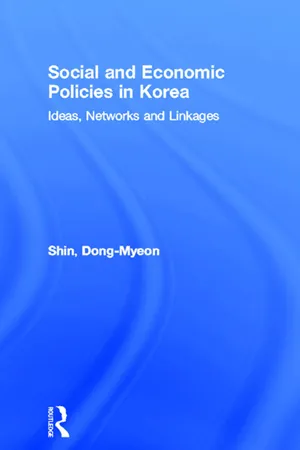
The sustained remarkable economic growth in the East Asian countries - Japan, South Korea, Taiwan, Hong Kong and Singapore - has brought about a great deal of debate over the role of the state in the market and society. Shin analyses the dynamic process of state interventions in the economy and social affairs in Korea from the early 1960s until the present with special reference to five policy areas: macro-economic policy, industrial policy, social security policy, labour policy, and education and training policy.
Social and Economic Policies in Korea develops a unique explanation about the development of Korean social policy using the concepts of 'policy idea', 'policy network', and 'policy-linkages' to examine the causes, patterns and consequences of state interventions in the economy and social affairs over time. It should interest students and researchers of East Asian studies, social policy and development studies.
- 264 pages
- English
- ePUB (mobile friendly)
- Available on iOS & Android
eBook - ePub
About this book
1 Introduction
The past three decades have witnessed the emergence of East Asian economies on to the world stage: Japan, followed by the East Asian newly industrialised countries (NICs) – South Korea (henceforth Korea), Taiwan, Hong Kong and Singapore. According to the International Monetary Fund (IMF), in 1997 these five countries accounted for 11.1 per cent of the total world GDP and 17.4 per cent of total exports (IMF, 1998: 133). This sustained remarkable economic growth has brought about a great deal of debate over the role of the state in the market or society. Within this ongoing debate, there have been three controversial issues which, I believe, should be explored in more depth.
The first one is concerned with the role of the state in the economy. As acknowledged, an astonishing economic performance in this region has brought forth a new paradigm in the field of development economics and comparative political economy, which has been centred around the concept of the developmental state. The supporters of the developmental state paradigm argue that East Asia’s remarkable economic success can be mainly attributed to the active role of the state in formulating a vigorous economic system that promotes capital accumulation, innovation and productivity growth.1 In addition, they maintain that the failure of manufacturing in many advanced capitalist economies, especially the USA and the UK, is not just the result of macro-economic mismanagement but of lagging investment, innovation and productivity growth. In other words, it is argued that the manufacturing sector in these countries can only effectively be revived through an industrial policy similar to those of the East Asian countries.
The developmental state paradigm appears to be successful not only in providing a vivid proof to challenge neo-classical economics but also in bringing the state back into politics by elucidating the causal nexus between political institutions and economic performance. In addition, the developmental state paradigm has offered a powerful empirical foundation for refuting the fatalism of dependency theory. The influence of this paradigm on academic debates became prominent enough for even the World Bank, normally regarded as a citadel of neo-liberalism, to acknowledge the importance of industrial targeting in promoting economic growth in the East Asian countries (World Bank, 1993). However, the developmental state paradigm has faced increasing criticism due to its misleading assumptions with regards to major theoretical concepts such as state structure, state capacity and state autonomy (Haggard and Moon, 1990; Evans, 1995; Moon and Prasad, 1994; Shin, 1996; E. M. Kim, 1997).2
On the other hand, the virtue of the East Asian developmental model has always been criticised by neo-classical economists. The financial meltdown in East Asia in 1997–8 has made their criticism more persuasive. The East Asian financial crisis had indeed dramatic effects not only on the countries of the region itself but also on the scholarly debates over the sources and limits of the ‘East Asian miracle’ model of development. The methods used by the East Asians in constructing this miracle are put into question by the financial chain-reactions of 1997 and in many cases have been found wanting. When the Korean financial crisis broke out in November 1997, many commentators arrived at the view that the East Asian developmental model had reached an impasse.
All these features make it worthwhile to revisit the ongoing debates on state intervention in the economy. The first objective of this book is to examine the changing role of the state in the economy with special reference to economic policies in Korea. In order to achieve this aim, I will discuss the following questions: (1) What are the main policy instruments of the state for economic development? (2) Why have state economic policies changed? (3) What are the political and social consequences of state intervention in the economy?
The second peculiar feature of the existing literature is that, compared to numerous studies of economic development in these East Asian countries, there have been few studies of their welfare systems. It is widely acknowledged that in Western industrialised countries, the welfare state became an integral feature of development after World War II. Castles (1989) has maintained that, whatever country is under investigation, welfare state development is in large part a function of economic development, demographic change and democratic socialist rule (Castles, 1989: 6). Thus, one would expect East Asian countries to have also developed welfare states just like Western countries, though they have not experienced social democratic governments. On the other hand, they might be expected to develop a welfare model distinct from Western welfare states, since they have experienced a unique version of capitalism.
There are few studies on the subject produced by Western scholars, and most of them tend to focus on the issue of whether or not there is an East Asian welfare model distinct from Western counterparts. However, there has not been general agreement over the characteristics of the East Asian welfare systems. Some argue the distinctiveness of these welfare systems, supporting the ‘East Asian welfare model’ (Jones, 1990, 1993; Goodman and Peng, 1995). Jones (1990, 1993) has argued that the Confucian tradition of familial piety and loyalty has been the overpowering force behind welfare policy, so that East Asian countries have contrived ‘Oikonomic welfare states’. Goodman and Peng (1995) have also argued that these countries have incorporated many aspects of Western social welfare ideas, but in practice deviate fundamentally from Western experience. On the other hand, others argue that there is little to indicate a distinct ‘East Asian welfare model’ that cannot be grasped with the standard conceptual tools of welfare state theory (Esping-Andersen, 1999; Goodman and White, 1998). Esping-Andersen maintains that the social welfare systems in this region (though most of his examination was confined to Japan) appear a hybrid case of the ‘three worlds’ typology (Esping-Andersen, 1999: 92). According to Goodman and White, East Asian countries are welfare laggards, which is regarded as ‘the West’s past rather than its future’ (Goodman and White, 1999: 20).
However, both sides paint only a partial picture of the welfare systems in East Asian countries. They tend to pay little heed to the political economy of each country in which social welfare programmes have developed. As a matter of fact, East Asian welfare systems have developed in circumstances distinct from their Western counterparts; they have developed within economic contexts characterised by state-led growth economies with sustained nearly full employment, in political contexts characterised by a conservative ‘one-party’ democracy with relatively weak civil society and opposition, and in social contexts characterised by rather authoritarian employment practices and gender inequality. Also, little is in fact known about their substantial welfare programmes. Probably, these weaknesses are due to the lack of information written in English available to scholars. Thus, a political economic explanation of the welfare system of each country in this region is particularly worthwhile in order to enhance the opportunities for comparative social policy study.
If we confine our attention to the studies of the Korean welfare system, there are also few studies written, either in English or in Korean. In Korea, academic debates on the subject began to develop in the second half of the 1980s,3 which tend to focus on highlighting determinants to explain the development of the Korean social welfare system rather than examining the degree of its uniqueness through comparison. The relative youth of this interest is hardly surprising given the fact that by 1987 Korea had introduced only two social security programmes, namely the Industrial Accident Compensation Insurance Programme (1964) and the Medical Insurance Programme (1977) for limited social groups, together with a modest social assistance programme (1969). I will now review the studies dealing with the development of the Korean welfare system in order to highlight the necessity of this study.
There have been by and large three contending perspectives in this area: the Marxist approach, the statist approach and the political economy approach. The first perspective derives from Marxism and sees politics and power in class terms, and the economy as a source of contradictions, exploitation and hence of collective conflict. Adopting a theoretical framework developed in the Neo-Marxist school, several scholars, especially among junior groups, have argued that social policy in Korea has been developed as an instrument of social legitimation in the face of intensified contradictions in monopolistic capitalism (Health and Social Research Committee, 1989; R. H. Kim, 1989; Y. M. Kim, 1989).4 There is little doubt that they have contributed not only to undermining the modernisation thesis that had been dominating social policy studies in Korea but also to understanding structural causes of social policy. Nevertheless, their explanations tend to be a priori reasoning, given that Korean capitalism has worked on the foundations of highly regulated labour markets and industrial structure, authoritarian employment practices, weak labour movements and underdevelopment of the political party system, especially the absence of left-wing parties.
The second perspective evolves from the statist approach and emphasises the role of the state in social policy development. This perspective has gained wide support among Korean scholars, since the Korean social welfare system, in particular before the late 1980s, was determined by a state politically insulated from society. This perspective can be subdivided into two forms, which I will refer to as the actor-centred approach and the institution-centred approach. The first has focused on the political interests of the state elite and argues that the development of social policy in Korea has been primarily determined by the politics of ‘legitimacy’ (S. N. Ha, 1989; H. J. Kwon, 1995). There is little doubt that the introduction of a social security programme was a result of a political process where political incumbents tried to use the power and resources of government in order to recapture the allegiance of disaffected blocs in society. On the other hand, the second approach has focused on the configuration of the executive branch, especially between economic and social ministries, and argued that differences in this configuration in turn have varied consequences for social policy (M. K. Chung, 1993). It is true that the imbalance between economic and social ministries in terms of organisational power and capacity has brought about the limited development of social security in Korea. However, both ‘political legitimacy’ and ‘power imbalance’ explanations offer a partial picture with regard to the development of social policy in Korea. They still need a more comprehensive examination of the causes of social policy development. For a thorough examination of the development of social policy, we need to take into account other factors prompting policy development such as changes in both socio-economic structures and international markets, social coalitions, requirements of economic policy, and policy legacies.
The third perspective has been developed by those who apply the political economy approach to the development of welfare systems. According to this perspective, welfare system development was in large part a function of political and economic changes (Deyo, 1992; Kang, 1993; H. K. Lee, 1992, 1999; Joo, 1999). H. K. Lee (1992) has argued that since the late 1980s the social security system in Korea has transformed from a residual one to a corporatist welfare state. According to her, this transformation was a result of the changed power balance between the capitalists and the workers, but also of the political transition from conservative and authoritarian to democratic regime. Those who support this perspective share with Marxism a keen eye for issues such as power, inequalities and conflict but do not automatically assume that ‘class struggle’ is the engine of change or that capitalist institutions are repressive. Its great analytical asset lies in its sensitivity to the historical transformation of social welfare systems. With one substantial reservation, this perspective is in fact guiding this study. My reservation has to do with the blindness of most political economy studies on Korean social policy development towards policy linkages between economic policy and social policy. We should bear in mind that the development of social policy in Korea has been greatly influenced by the requirements of economic policy.
Thus, the theoretical perspectives surrounding explanations of the development of the welfare system in Korea, which could contribute to our understanding of East Asian welfare regimes, still need to be developed further for a systematic understanding of it. I will develop a more comprehensive explanation in the pages that follow.
The second objective of this book is to investigate the evolution and characteristics of the welfare system in Korea in order to ascertain the changing role of the state in social welfare provision. I will investigate possible answers to the following questions: (1) What are the characteristics of social welfare? (2) Why has social security policy changed? (3) What are the outcomes of state intervention in social welfare?
Finally, but most importantly, academic inquiry into developmental processes and conditions in East Asian countries has produced a substantive body of theory, but the implications for social policy have not been properly examined. Though there has been a growing concern in the literature with the social dimensions of economic growth and restructuring in the region (Deyo, 1987, 1989; Koo, 1987; MacPherson, 1992; Vorgel and Lindauer, 1998), the theoretical issues surrounding explanations for the policy linkages between economic and social policies have not yet been the subject of extensive inquiry or debate. It is acknowledged that in Western welfare states during the Golden Age of post-war expansion, Keynesian economic policy had been compatible with the extension of the welfare state, especially with regard to automatic stabilisation through unemployment and other social security benefits (Hall, 1989a and b). If this is the case for Western welfare states, which patterns of policy linkages have East Asian countries developed?
One would expect that the systematic use of social policy to pursue economic development goals has been most pronounced in this region, since East Asian states have intervened more directly in the economy. If so, what are social policy outputs as a consequence of policy linkages? Regarding this issue, Deyo’s (1992) study is possibly the only discussion available. He has urged that East Asian social policies have been more strongly shaped by the developmental priorities of politically insulated states. He has also highlighted the compatible relationship between export-oriented industrialisation and social policy, especially in the areas of social wage and income policy. His work gave me some insights with regard to the idea of policy linkages. Yet his study tends to be motivated by substantive policy issues with little analytical framework so that it needs to be elaborated further for a systematic understanding of the policy linkages. Thus, very little systematic work has been done in this area.
Policy formation and changes are dynamic and sequential processes. Changes in both social-economic structure and international political economy will affect the configuration of social groups and rearrange social coalitions by shifting their underlying material interests. The ideological outlook and material interests of a social coalition by and large shape policy objectives. Yet, the choice of policy instruments is not necessarily the result of the social coalition. Several aspects of institutional features can influence the choice of policy options. It should also be noted that the policy choice made in economic policy subsequently has an important effect on shaping the form and content of social policy. Given the fact that economic and social policies are not determined in isolation from each other, it is necessary to explore the policy linkages between economic and social policies in order to understand the development of social policy. We could benefit from the examination of the policy linkages between economic and social policies in developing general statements with regard to the role of the developmental state in social policy, which could be applied to other East Asian welfare regimes.
From this understanding, the third objective of this research is to examine how, why and to what extent Korea has come to adjust its economic and social policies. The following questions will be investigated: (1) What are the characteristics of policy linkages between economic policy and social policy? (2) What are the requirements of economic policy at different moments in time? (3) What are the consequences of policy linkages with respect to the development of social policy?
The scope of the research and some definitions
In order to achieve the above research objectives, this study deals with the dynamic process of state intervention in the economy and social affairs in Korea since the early 1960s when the state started to pursue industrialisation according to the Economic Development Plan. Thus, the time span is four decades, including five political regimes: the Park Chung-hee regime (1...
Table of contents
- Cover
- Title
- Copyright
- Dedication
- Contents
- List of tables
- List of figures
- Acknowledgements
- List of abbreviations
- 1 Introduction
- 2 The roles of the state in the economy and social welfare
- 3 A theoretical framework for analysing the process of policy formation and change
- 4 Social and economic policies during the export-led industrialisation of the 1960s
- 5 Social and economic policies during the heavy and chemical industrialisation of the 1970s
- 6 Stabilisation, liberalisation and social policies: 1980—1992
- 7 Social and economic policies under globalisation: 1993-1997
- 8 Financial crisis, economic policy and social policy: 1998-present
- 9 Conclusions
- Epilogue: assessment of the existing social security system in Korea
- Notes
- Bibliography
- Index
Trusted by 375,005 students
Access to over 1.5 million titles for a fair monthly price.
Study more efficiently using our study tools.
Frequently asked questions
Yes, you can cancel anytime from the Subscription tab in your account settings on the Perlego website. Your subscription will stay active until the end of your current billing period. Learn how to cancel your subscription
No, books cannot be downloaded as external files, such as PDFs, for use outside of Perlego. However, you can download books within the Perlego app for offline reading on mobile or tablet. Learn how to download books offline
Perlego offers two plans: Essential and Complete
- Essential is ideal for learners and professionals who enjoy exploring a wide range of subjects. Access the Essential Library with 800,000+ trusted titles and best-sellers across business, personal growth, and the humanities. Includes unlimited reading time and Standard Read Aloud voice.
- Complete: Perfect for advanced learners and researchers needing full, unrestricted access. Unlock 1.5M+ books across hundreds of subjects, including academic and specialized titles. The Complete Plan also includes advanced features like Premium Read Aloud and Research Assistant.
We are an online textbook subscription service, where you can get access to an entire online library for less than the price of a single book per month. With over 1.5 million books across 990+ topics, we’ve got you covered! Learn about our mission
Look out for the read-aloud symbol on your next book to see if you can listen to it. The read-aloud tool reads text aloud for you, highlighting the text as it is being read. You can pause it, speed it up and slow it down. Learn more about Read Aloud
Yes! You can use the Perlego app on both iOS and Android devices to read anytime, anywhere — even offline. Perfect for commutes or when you’re on the go.
Please note we cannot support devices running on iOS 13 and Android 7 or earlier. Learn more about using the app
Please note we cannot support devices running on iOS 13 and Android 7 or earlier. Learn more about using the app
Yes, you can access Social and Economic Policies in Korea by Dong-Myeon Shin in PDF and/or ePUB format, as well as other popular books in Business & Business Development. We have over 1.5 million books available in our catalogue for you to explore.