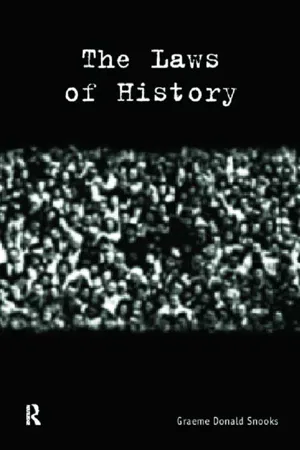
This is an original and controversial reflection on the course of human history and a remarkable attempt to develop a scientific model of laws for the social sciences. It:
* considers the nature of laws and the reasons we might expect to find them in history
* employs an underlying framework concerning societal dynamics, historical change, and institutional change, which are in fact the laws of history.
This volume consolidates the author's previous research in The Dynamic Society and The Ephemeral Civilization.
- 312 pages
- English
- ePUB (mobile friendly)
- Available on iOS & Android
eBook - ePub
The Laws of History
About this book
1
The Eternal and the Ephemeral
As they step into the same rivers, different and still different waters flow upon them.
(Heraclitus, early fifth century BC)
Philosophers and scientists down through the ages have grappled with the polarizing concepts of the eternal and the ephemeral in human society. Some identify the ephemeral with everyday reality and the eternal with an underlying process of systematic change, while others see the eternal reflected in a changeless ‘reality’ lying behind the ephemeral appearances of the everyday. Most, however, appear content with the appearances of a surface reality.
Those who seek the eternal in changeless forms – in an ideal world – see change either as the annihilation of a past ideal or as the way to a future ideal. As ideal forms can only be explored metaphysically, these philosophers seek a knowledge of the eternal through imagined ‘laws’ of destiny. Their ideas are translated into action by attempting either to eliminate change, or to exploit it to achieve their vision of a better world. In this they are no friends of the Dynamic Society.
In this book the eternal is to be found in those dynamic forces underlying the ephemerality of the everyday. Change is the only constant in life. There are no ideal worlds either past or future. There are no perfect forms from, or to, which human society is inexorably moving. There is only continuous journeying. The reality of this continuous change can only be explored empirically, and the dynamic patterns must be explained with scientific rather than metaphysical ‘laws’ of history. This distinction between ephemeral events and eternal dynamic processes underlying these events makes it possible to regard their uniqueness as compatible with the laws of history. The critical problem we face is how to devise a method – a method that has eluded us for millennia – to discover these scientific laws.
Can history have laws?
From the very beginning we must be clear about the meaning of scientific laws. The essential point to understand is that laws in all fields of science must be regarded as provisional. They must be capable of empirical refutation, even if they are never actually refuted. It is this characteristic that makes them scientific. In contrast, so-called metaphysical ‘laws’ are not open to empirical refutation and, therefore, can be accepted or rejected only as a matter of faith. Also, it should be clear that laws do not have a physical presence. While we might lapse into expository rhetoric about the quest for and discovery of laws or how we might recognize or find them, it must never be forgotten that laws are merely plausible explanations of regularities that have been detected in our evidence of the real world.
The central aim of this book is to develop a method of deriving the scientific laws underlying the eternal and ephemeral forces in human society. Obviously, these laws, like all laws, can only claim to be provisional law-like statements. In two earlier books attempts were made to identify and model these forces. The Dynamic Society (1996) is concerned with the fundamental or eternal forces responsible for global change in human society over the past 2 million years, and The Ephemeral Civilization (1997) examines how these forces account for the ephemerality of the world around us – for institutional change. In these books I show that what is stable is ephemeral and what is in flux is eternal. This is the great paradox of life.
This book is also concerned with earlier attempts to discover the laws of history, in order to understand why they were unsuccessful. Those scholars who see the eternal in ideal forms and focus on imagined ‘laws’ of destiny I have called ‘meta-physical historicists’, and those who focus on changing ephemeral forms in an attempt to discover scientific laws are called ‘positive historicists’. The metaphysical historicists failed to find scientific laws because they focused solely on metaphysical constructs of the mind that have no application to the reality of the everyday world. These great thinkers include Hesiod, Heraclitus, Parmenides, Plato, Hegel, Marx, Spencer, Spengler, and Toynbee. The positive historicists, on the other hand, failed to formulate scientific laws because they focused on patterns in historical events rather than on patterns in the dynamic mechanisms underlying these events. These great empiricists include Comte, Saint-Simon, J.S. Mill, Henry Buckle, the German and British historical economists, the American institutionalists and, more recently, W.W. Rostow. They failed, in effect, to develop a method by which the vast historical record could be made to relinquish the secrets concerning those forces governing its development.
In the past, ‘historicist’ has been used as a term of abuse by scholars such as Karl Popper and Friedrich Hayek, and has led others, such as Ronald Levinson, to defend their abused heroes against this charge.1 The term, therefore, must be defined. ‘Historicist’ is used here as a category to identify those attempting to generalize about the dynamics of human society and to derive laws of historical change. It includes the above deductive and inductive approaches of the metaphysical and positive historicists, and an entirely new category that I will call the ‘existential historicist’. A distinction between the positive and existential historicists can be made on the grounds that the former focuses on the pattern in historical events and the latter on the pattern in the processes underlying these events.
An elaborate mythology has arisen concerning the laws of history. This is an outcome not only of genuine confusion but also of deliberate misrepresentation. Only once these matters have been clarified can we dispense with the mythology.
There is considerable confusion over what is meant by the laws of history. By drawing on an analogy with the laws of the physical world, it will be argued that the laws of history are provisional statements concerning regularities in the way human society changes over time. The regularities in history that laws need to express, it is argued in Chapter 2, are to be found at the level not of historical events but of the underlying dynamic processes. As these processes or mechanisms have already been reconstructed in The Dynamic Society and The Ephemeral Civilization, our laws of history can be derived from these dynamic models. The laws of history, therefore, are merely the laws of social dynamics. The issue is quite straightforward: if it is possible to model the dynamics of human society, and we have shown that it is, then there must be laws, possessing universal and necessary characteristics, underlying these models. To deny these laws of history it is necessary to deny the effectiveness of these dynamic models. And to do so would imply that human life, in contrast to the natural world, is no more than a cosmic lottery.
The central issue in deriving the laws of history is whether we can develop a simple and effective method for doing so. Such a method, called the existential quaternary method – the four steps of induction – is presented for the first time in this book (in Chapter 7). As the name suggests, it has four empirical steps involving the identification of historical patterns, the development of dynamic models, and the derivation of a hierarchy of laws. The first step involves the reconstruction of quantitative and institutional timescapes in the historical record. These dynamic timescapes include the historical paths taken by human society as a whole, as well as by various individual societies, and the institutions required to facilitate these changes. While the timescapes are historical outcomes, they enable us to speculate sensibly about underlying mechanisms. Yet it is not possible, as the positive historicists thought, to derive laws from these patterns of events. The second step identifies the fundamental existential model needed to explain in general terms the rise and fall of human society. As shown in The Dynamic Society, this can only be done after extensive historical enquiry over the very longrun. This model is the basis for our primary laws of history. The third step involves the use of the general dynamic model in conjunction with the quantitative timescapes to reconstruct the specific historical mechanisms that are discussed in The Dynamic Society.2 These mechanisms include the great dispersion, the great wheel of civilization, and the great linear waves of economic change, each respectively driving the technological paradigm shifts in the palaeolithic, neolithic, and modern eras. Secondary laws of history can be derived from these dynamic mechanisms. The fourth step involves the use of the general and specific dynamic models to explain institutional change, and to derive the tertiary laws of history.
This quaternary method provides us with a tripartite hierarchy of laws defined in terms of their relationship to the general model. The primary laws are derived directly from the general model; the secondary laws are, in effect, derived from the primary laws; and the tertiary laws are, in effect, derived jointly from the primary and secondary laws. I say ‘in effect’ because in practice historical laws can only be derived from existential models. This is explained in detail in Part II.
The confusion about the laws of history also extends to what their existence might imply for the nature of human society. It is often suggested that if human society is governed by systematic laws, then historical outcomes must be inevitable and human beings can have no free choice. Nothing could be further from the truth. The laws of history are the outcome of individuals attempting to achieve their objectives of survival and prosperity by making choices that are restricted only by their abilities and their physical and social environments. These laws are not imposed on individuals either by some divine force as suggested by the metaphysical historicists and their critics, or by their genetic make-up as argued by sociobiologists.3 While the outcomes can, with degrees of probability, be predicted once we know the conditions under which these free choices are made, they are not forced on individuals who are always free to deny their own self-interest. And this denial does happen. There are irrational individuals who freely condemn themselves to poverty and early death, and there are irrational societies – such as Nazi Germany, Imperial Japan, and Soviet Russia – that pursue racial and political rather than material objectives and, thereby, experience poverty or extinction.
It is a common error to believe that a ‘free’ society can only exist if there are no laws of history. In fact, the reverse is true. Human society, either free or unfree, could not exist at all in a world devoid of laws of history. The world would be a cosmic lottery in which no society could establish itself. There would be no social cause and effect, no probability that because we experienced a particular response to our actions today we would ever experience it again. We would not be able to build social structures because we would be unable to rely on the cooperation of other people. We would not invest our surpluses because we could not expect to ever gain any return. It would be like trying to make sense of a physical world in which there were no natural laws – no laws of motion, of gravity, of light and sound, or of chemical reactions. Indeed, natural scientists who have considered the philosophy of the human sciences are puzzled that historians cannot identify any generally accepted laws of history and that the very existence of such laws is denied. As we shall see in Chapter 2, these natural scientists are convinced that the nature and problems of the social sciences are no different in kind to those of the physical sciences, just that their practitioners are less able!
In The Dynamic Society I argue that the reason the social sciences have not been as successful as the physical sciences is due not to the relative abilities of the respective practitioners, but to the fact that human observers of human agents are blinded by their own self-deception. We desperately attempt to conceal our real natures from ourselves. Further, in The Ephemeral Civilization I argue that this self-deception is a survival mechanism that I call existential schizophrenia. If we were forced, on a daily basis, to face our true nature and the real impact on others of our actions, we would find it hard to meet our biologically determined desire to survive and prosper. We are past masters at rationalizing our actions. We have even convinced ourselves that our self-interested actions are really altruistic. Existential schizophrenia is an excellent survival mechanism, but it is a formidable barrier to understanding the true nature of human society. But, unlike the postmodernists, we need not regard this as a hopeless task.
Physical scientists do not face the same problem. They are able to observe the natural world more objectively, because the observer is not identical to the observed. Science is not a potential battlefield for the survival of the individual scientist, as history is for the historian. This is the root cause of the natural scientists’ puzzlement over the failure of the human sciences to generate any laws governing history.
Finally, we need to consider the actions of those who deliberately add to the mythology concerning the laws of history in order to support their own methodological approaches. The most relentless antihistoricists, such as Popper, Hayek, and Mises, were extreme deductivists. They ruthlessly attacked historicism and hurled the term ‘historicist’ around as a verbal weapon to rout, not these long-dead law-seekers, but their very much alive inductivist opponents in philosophy and economics. They were determined to destroy the easily demolished metaphysical historicists because their world views, their reputations, and their careers depended on it. Their orchestrated attack in the mid-twentieth century was so savage that few thereafter were prepared to risk the slings and arrows of outrageous fortune in the historicist cause. Metaphysical historicism was so discredited, even if scurrilously, that no one was prepared to explore new non-metaphysical historicist methods. These intellectual warriors made an already difficult task impossible for at least half a century.
More recently, the scientific study of history has been attacked from an entirely different quarter – that of postmodernism. There is an irony here as postmodernism also rejects, and would be rejected by, the antihistoricists. As I do not intend returning to this subject, a few paragraphs will be devoted to postmodernism, not because its attacks have, or will, penetrate to the core of the social sciences, but because there will be the inevitable question: what about postmodernism? What indeed?
It is difficult to define postmodernism because there is no single definition that would be widely accepted or pass uncontested.4 Originating in French literary and art criticism in the 1950s and 1960s, postmodernism spread throughout the humanities, slowly at first but with increasing momentum from the late 1970s and early 1980s. Since then its presence has been noted on the margins of the social sciences and even the natural sciences.5 This intellectual movement is the product of two major developments. The first is associated with Jacques Derrida and Roland Barthes, who rejected the traditional view that language can represent reality. Instead, they argued, not very sensibly, that language constitutes or even creates reality.6 Clearly this is a rejection of scientific empiricism. The second development occurred in the 1980s and is associated with Michel Foucault and Jacques Lacan. They argued, not very originally, that knowledge is power and traditional scholarship (monopolized by whites, males, heterosexuals, rationalists) exercised that power over those excluded from this knowledge (females, coloured people, non-heterosexuals, children, non-rationalists). This led on to the spurious argument that knowledge and truth are relative to one’s social circumstances and conditioning. And, as there are no absolute truths, there can be no laws of society or of history. Little wonder that this movement has been seen as a ‘flight from reason’.7
Postmodernism will not penetrate the core of social science because it betrays a fundamental misconception about both the relationship between models and reality, and the nature of the scientific method. It is ridiculous to suggest that a model (or ‘representation’) constitutes, let alone creates, reality. Any intellectual discipline with pretensions to real-world relevance that is unable to distinguish between its models and reality is in real trouble. As argued in The Ephemeral Civilization, the wide acceptance of this idea is an outcome of the blurred distinction between reality and fantasy in the modern electronic media, and the further idea that truth is relative to one’s social position derives its popularity from its usefulness as a tool for improving one’s materialist position – the postmodernist as homo economicus. Finally, the only test of our ideas about reality is whether they are refutable and, if they are, whether they can be refuted. The scientific method is no respecter of social dis...
Table of contents
- Cover
- Title
- Copyright
- Dedication
- Contents
- List of illustrations
- Preface
- 1 The eternal and the ephemeral
- PART I The law-seekers
- PART II The laws
- Notes
- Glossary of new terms and concepts
- References
- Index
Trusted by 375,005 students
Access to over 1.5 million titles for a fair monthly price.
Study more efficiently using our study tools.
Frequently asked questions
Yes, you can cancel anytime from the Subscription tab in your account settings on the Perlego website. Your subscription will stay active until the end of your current billing period. Learn how to cancel your subscription
No, books cannot be downloaded as external files, such as PDFs, for use outside of Perlego. However, you can download books within the Perlego app for offline reading on mobile or tablet. Learn how to download books offline
Perlego offers two plans: Essential and Complete
- Essential is ideal for learners and professionals who enjoy exploring a wide range of subjects. Access the Essential Library with 800,000+ trusted titles and best-sellers across business, personal growth, and the humanities. Includes unlimited reading time and Standard Read Aloud voice.
- Complete: Perfect for advanced learners and researchers needing full, unrestricted access. Unlock 1.5M+ books across hundreds of subjects, including academic and specialized titles. The Complete Plan also includes advanced features like Premium Read Aloud and Research Assistant.
We are an online textbook subscription service, where you can get access to an entire online library for less than the price of a single book per month. With over 1.5 million books across 990+ topics, we’ve got you covered! Learn about our mission
Look out for the read-aloud symbol on your next book to see if you can listen to it. The read-aloud tool reads text aloud for you, highlighting the text as it is being read. You can pause it, speed it up and slow it down. Learn more about Read Aloud
Yes! You can use the Perlego app on both iOS and Android devices to read anytime, anywhere — even offline. Perfect for commutes or when you’re on the go.
Please note we cannot support devices running on iOS 13 and Android 7 or earlier. Learn more about using the app
Please note we cannot support devices running on iOS 13 and Android 7 or earlier. Learn more about using the app
Yes, you can access The Laws of History by Graeme Snooks in PDF and/or ePUB format, as well as other popular books in Business & Business General. We have over 1.5 million books available in our catalogue for you to explore.