In the age of HIV, antibiotic-resistant bacteria, the Ebola Virus and BSE, metaphors and experience of contagion are a central concern of government, biomedicine and popular culture.
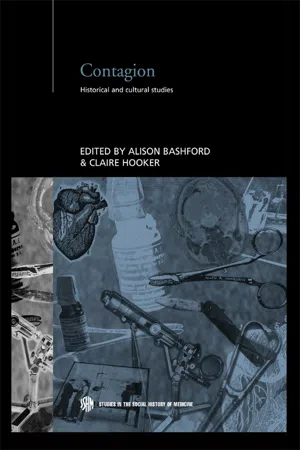
Contagion explores cultural responses of infectious diseases and their biomedical management over the nineteenth and twentieth centuries. It also investigates the use of 'contagion' as a concept in postmodern reconceptualisations of embodied subjectivity.
The essays are written from within the fields of cultural studies, biomedical history and critical sociology. The contributors examine the geographies, policies and identities which have been produced in the massive social effort to contain diseases. They explore both social responses to infectious diseases in the past, and contemporary theoretical and biomedical sites for the study of contagion.
- 256 pages
- English
- ePUB (mobile friendly)
- Available on iOS & Android
eBook - ePub
Contagion
About this book
Part 1
Contagion and cultural histories of the modern world
1 The meaning of contagion
Reproduction, medicine and metaphor
Margaret Pelling
Contagion, it seems, is spreading again.1 This is owing in part to the social, political and moral climate induced by the recrudescence, in the later twentieth century, of significant infectious disease. Migrations, revolutions in means of communication, and other changes bringing proximity where before there was distance, have also encouraged commentators to plunder the concept. As an idea, particularly a negative idea expressing a sense of threat, crowding, or contamination, contagion has proved remarkably persistent in western culture, and present usage probably owes more than it would admit to this tradition.2 As a source of analogies relating to means of influence, it has a particular attraction for cultural historians as well as social psychologists. Analogical reasoning, heavily criticised but never eliminated by dominant traditions in western natural philosophy from the seventeenth century onwards, is intrinsic to the history of the concept of contagion, and is increasingly favoured by historians. The present chapter will focus on theories of disease in the nineteenth century, when popular notions of contagion, as it would appear, finally became ‘scientific’. A crucial point to make at the outset is that this does not necessarily involve narrowing the terms of discussion. The structure of reasoning about contagion and disease causation included within itself as broad a frame of reference as a cultural historian could desire. That this has been lost sight of is due partly to a failure to understand the terms of contemporary discussions, partly to our own conditioning as beneficiaries of twentieth-century biomedicine, and partly to anglophone neglect of the history of ideas. In addition, the figures inviting discussion – Sydenham, Cullen, Liebig, Farr, Pasteur – were all, in different ways, able to reach wide international as well as national audiences.
The terms contagion and infection, although vague, convey a relatively straightforward meaning to the modern lay person. They refer primarily to the fact that certain diseases, caused by living organisms, are passed from one person to another. It would generally be assumed that contagion is direct, by contact; infection indirect, through the medium of water, air, or contaminated articles. Both are comprehended in the apparently simple question, ‘is it catching?’ However, as recent attempts at health education in respect of AIDS have shown, this question is not simple at all. Moreover ‘infection’ is commonly applied in a more general sense, for example for clean wounds that ‘go bad’. Each concept has a long and complex history which was temporarily simplified by the triumphs of bacteriology in the later nineteenth century. The twentieth century inherited a story involving a striking contrast, between the germ theorists (scientific, laboratory-based, objective), and the sanitarians (bureaucratic, unscientific, politically motivated, bringing about improvement as it were by accident), who were miasmatists and believed that smells caused disease. This story, based primarily upon the two main phases of the British public health movement, was reinforced by older medical historians searching for early believers in germ theory who could be portrayed as lonely pioneers in a struggle between opposite points of view.3
This retrospective account had many attractive features. It implied that the decline of infectious diseases was brought about by scientific progress in the field of medicine.4 It laid stress on the importance of instrumentation, especially microscopy. Interest in germ theory appeared to have burgeoned with the renewed scientific spirit first of the Renaissance and then of the seventeenth and nineteenth centuries.5 However there were also many problems. One was that the classical world, in spite of laying the groundwork for modern science, did not appear to have evolved a concept of contagion.6 A second was that the status of the contributions of the early pioneers proved difficult to determine from the positivist point of view. Most importantly, detailed analysis tended to show that even ‘germ theorists’ used the concepts of contagion, infection and miasm as if they were difficult to distinguish, overlapping, or even interchangeable.
If there is a single explanation for these difficulties, it lies in the need for precise definition according to historical context. As in the case of other long-lived and related concepts, for example ‘germ’, ‘species’, ‘virus’, and ‘spontaneous generation’, the concepts of contagion, infection and miasm accumulated layers of connotation over time, and effectively became not single concepts but many. Each period added its own attempts at definition, but was inevitably affected by the previous history of the concept. Interestingly, attempts to replace traditional terminology for the sake of clarity usually failed.7 It should be stressed that the historian’s difficulty in arriving at workable definitions even within a specific historical context is often a reflection of contemporary lack of precision. For a number of reasons this area of debate was particularly subject to confusion and ambiguity. In addition, many writers deliberately exploited this confusion, using over-simplification either to discredit ideas, or to force their acceptance. One obvious way of doing this was not to distinguish between the new version of the concept, and the old.8
The first point of definition that needs to be made is that it is historically inadequate to regard these concepts as purely medical. They have had a wide currency in a range of areas of thought and practice, which is reflected in an accretion of metaphor and analogy. Most of these analogies were not irrelevant to, but were part of, the argument. Contagion and infection are intimately bound up with basic concepts of matter and purpose in the natural world, and at one level can be seen as part of elite culture. However, they are also closely related to (a) folk belief and practice, (b) practical experience in agriculture, horticulture, animal husbandry and technologies such as dyeing and wine-making, (c) modes and metaphors of reproduction, in the immaterial as well as the material world, (d) different crises of epidemic disease and shifts in the prevalence of endemic diseases at different periods, and (e) political, economic and epistemological conditions at a given time influencing the relationship both between ‘theory’ and ‘practice’, and between the individual and the state. Ideas of contagion are inseparable from notions of individual morality, social responsibility, and collective action. This is shown most strikingly in respect of measures of isolation and quarantine, and the public health movements subsequent to industrialisation.
The ‘person to person’ emphasis of the post-bacteriological period might lead us to see concepts of contagion as dependent upon high-density living or urbanisation. This is however too narrow: it is more accurate to see contagion as reflecting the relationship between things in the world, as well as the influence upon the human being of factors in close and remote spheres of his/her environment. In analysing humanity’s situation the classical period adopted a structure of causation which was elaborated in subsequent periods, and which continues to be relevant, although often going unrecognised. The history of the concept of contagion cannot be understood without reference to this traditional multifactorial structure of natural and supernatural causation. This structure was briefly obscured, not invalidated, by the bacteriological period and by advocates of laboratory medicine. Laboratory science was successful in severely restricting, and hence manipulating, the number of factors involved in causing the phenomenon under investigation. Modern western medical science has proceeded not by supplying full explanations, but by a process of specialisation in which some categories of cause have been ignored, or eliminated. In the later twentieth century, with the decline of most infectious diseases in the developed world, and the transition to chronic and degenerative diseases as dominant causes of death, there began a gradual return to multifactorial explanations of disease more in accordance with traditional concepts. This ‘exclusivity’ of bacteriology was challenged by clinicians and epidemiologists from as early as the turn of the twentieth century.9 It is arguable however that many medical scientists are still inclined to reduc-tionist habits of thought which have also persuaded the layperson to expect both single-factor causes of disease, and their corollary, ‘magic bullets’ as specific cures for such diseases.
This artificial simplicity in the explanation of disease is well represented for present purposes by the aphorism of John Snow (1813–58), a major English epidemiologist: ‘to be of the human species, and to receive the morbid poison in a suitable manner, is most likely all that is required.’10 This formula seems inspired as well as straightforward in its attribution of cause and effect. However, even this statement is not as simple as it appears. What did it mean to receive the poison in a suitable manner? Why, if effect simply followed cause, was not everyone affected by disease who was exposed to it? To his contemporaries, there was a range of additional questions which Snow was simply choosing to ignore. Why did diseases prevail in some places and not others? Why did epidemics – or pandemics – rise and then decline, and affect the world at some times and not at others? Does disease consist of stimuli affecting the body, or the body’s reaction to these stimuli? By the nineteenth century these were long-established questions, which could be made to correspond to the traditional structure of causation. As in Snow’s own case, conflicting views were often an effect of concentrating upon one among the possible range of causes at the expense of the others.
Classical philosophy and epistemology made available to medicine an elaborate structure of explanation involving a hierarchy of causes.11 First, primary, or remote causes were cosmological or divine (for example the influence of stars and planets, the wrath of god or gods) and were more obviously subject to religious controversy. The refusal to consider primary causes is usually seen as an aspect of secularisation and is identified with periods of particular conflict in western thought between religion and science, but as a strategy it dates back to the classical period. Remote causes related to the state of the atmosphere, or influences (such as volcanic action or the weather) broad enough in scope to bring about the rise and fall of epidemics. The ‘epidemic constitution’ of Thomas Sydenham (1624–89) is an example.12 Exciting, efficient or immediate causes related primarily to the more local environment or experiences of the diseased person, and were generally congruent with the ‘non-naturals’.13 They could include factors such as diet, emotion (stress) or exposure to weather, but also injury, poisons, or other more specific agents of disease. Predisposing causes could overlap with this category but were also invoked to cover characteristics of the individual’s life or heredity which might render him or her unusually liable to a given disease. Proximate causes came closest to defining the diseased state or process occurring in the diseased body.14 Different periods are perhaps distinguished less by their answers to these questions, than by the questions that were selected as the most important. The first bacteriological explanations of disease in the nineteenth century tended to ignore proximate and predisposing causes, as well as primary causes, a strategy of which contemporaries were well aware, and which fuelled both resistance and reaction.
It follows that to compare a belief in epidemic constitutions with a belief in germ theory is not necessarily to compare like with like. Similarly, ‘miasm’ would tend to describe a more general level of cause, relating to locality, compared with contagion, which could best be seen as an exciting cause. Infection might be seen as bridging these two levels of cause. It should be stressed that an agent in one category of cause could be seen as also belonging to, or changing into, another category, as a result of a given set of circumstances. Causes could act singly or in concert in any given instance of disease. This traditional, inclusive form of analysis was often used tacitly or imperfectly, but was remarkably persistent. It helps to explain why in historical terms contagion and miasm have been more readily seen by theorists as alternative or complementary, rather than contradictory, factors in disease.
The notion of contagion also involved the question of how prop...
Table of contents
- Cover Page
- Title Page
- Copyright Page
- Illustrations
- Contributors
- Acknowledgements
- Abbreviations
- introduction Contagion, Modernity and Postmodernity
- Part 1 Contagion and Cultural Histories of the Modern World
- Part 2 Contaminating Capacities in Postmodernity
- Select Bibliography
Trusted by 375,005 students
Access to over 1.5 million titles for a fair monthly price.
Study more efficiently using our study tools.
Frequently asked questions
Yes, you can cancel anytime from the Subscription tab in your account settings on the Perlego website. Your subscription will stay active until the end of your current billing period. Learn how to cancel your subscription
No, books cannot be downloaded as external files, such as PDFs, for use outside of Perlego. However, you can download books within the Perlego app for offline reading on mobile or tablet. Learn how to download books offline
Perlego offers two plans: Essential and Complete
- Essential is ideal for learners and professionals who enjoy exploring a wide range of subjects. Access the Essential Library with 800,000+ trusted titles and best-sellers across business, personal growth, and the humanities. Includes unlimited reading time and Standard Read Aloud voice.
- Complete: Perfect for advanced learners and researchers needing full, unrestricted access. Unlock 1.5M+ books across hundreds of subjects, including academic and specialized titles. The Complete Plan also includes advanced features like Premium Read Aloud and Research Assistant.
We are an online textbook subscription service, where you can get access to an entire online library for less than the price of a single book per month. With over 1.5 million books across 990+ topics, we’ve got you covered! Learn about our mission
Look out for the read-aloud symbol on your next book to see if you can listen to it. The read-aloud tool reads text aloud for you, highlighting the text as it is being read. You can pause it, speed it up and slow it down. Learn more about Read Aloud
Yes! You can use the Perlego app on both iOS and Android devices to read anytime, anywhere — even offline. Perfect for commutes or when you’re on the go.
Please note we cannot support devices running on iOS 13 and Android 7 or earlier. Learn more about using the app
Please note we cannot support devices running on iOS 13 and Android 7 or earlier. Learn more about using the app
Yes, you can access Contagion by Alison Bashford,Claire Hooker in PDF and/or ePUB format, as well as other popular books in History & World History. We have over 1.5 million books available in our catalogue for you to explore.