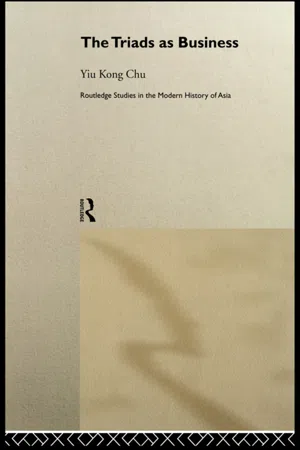
There is no doubt that the triads have become recognized as a sophisticated and international criminal force and, following the handover of Hong Kong to China, there have been increasing fears that their influence will spread to the West through emigration. This book investigates the reality behind the myth with a study of the Hong Kong triads, generally regarded as the headquarters of triad societies throughout the world. Yiu Kong Chu examines their origins, their organized extortion from legitimate businesses large and small, and their more recent moves into illegal activities such as drug trafficking, human smuggling and gambling.
Contrary to the popular belief that Hong Kong triads are replacing the Italian Mafia as the most powerful criminal organization in the world, this book argues that Hong Kong triads may be declining, as other ethnic Chinese crime gangs emerge as powerful crime groups in Western societies.
Based on interviews with ex triad members and victims of the triads, police from Hong Kong, mainland China and Europe, as well as documentary evidence The Triads as Business gives a vivid and compelling picture of the triads as part of a wider society.
- English
- ePUB (mobile friendly)
- Available on iOS & Android
eBook - ePub
The Triads as Business
About this book
Information
Chapter 1
Triads, business, and markets
Triads are a menace
It is claimed that triad members existed among the indigenous inhabitants of Hong Kong Island even before the British ceded it to be their colony in 1842. On 8 January 1845, the first Ordinance to pass the Legislative Council was to deal with the suppression of triads and other secret societies. After 150 years, to date, triad societies still exist in Hong Kong, which is now a Special Administrative Region of the People’s Republic of China.
It has long been believed that Hong Kong triads possess a central organisation with a ‘godfather’ at the top directing their local and overseas branches to organise a variety of criminal activities. The influence of the triads seems to have reached every corner of Hong Kong society–from school bullying gangs to drug rackets, illegal gambling, loan sharking, prostitution, illegal immigration, and extortion through to bona fide business operations like restaurants, clubs, and transport companies. Hong Kong triads are also believed to pose a serious threat to the law and order of Western societies. As Black (1991) asserts:
Before Communist China takes over Hong Kong in 1997, the world’s most ruthless criminal cartel will be stepping up its bid to take control of the underworld of Western society, and to spread within our culture like a criminal cancer. This cartel is the Chinese Triads–the yellow peril of the East, and now the West.
Are the above contentions correct? Ironically, in the 1960s and 1970s official US agencies held a similar conspiracy view that there was a nationwide syndicate known as mafia or Cosa Nostra which was alien to American society. It was organised by Italian immigrants who were of Sicilian origin. This alien organisation was so rigidly structured and highly centralised that it was able to control the whole American underworld. Hong Kong triads–the Chinese mafia–are now perceived as a giant criminal organisation with an omnipotent power controlling local and overseas branches for various criminal activities.
The study of Hong Kong triads
While contemporary Hong Kong triads have attracted much media attention locally and internationally, very little research has been done on this subject. The only comprehensive study on Hong Kong triads is Morgan’s Triad Societies in Hong Kong published in 1960. This was a police report describing triad activities and practices in Hong Kong from 1945 to 1958. There are also many short articles written by Hong Kong and Western police officers who have dealt with triad criminals in the last twenty years (Ellithorpe 1974; Straten 1977a,b; Winterton 1981; Donnelly 1986; Roache 1988; Andrae 1989; Boocock 1991; Main 1991; Merritt 1991a,b; Ball 1994; Williams 1994). In addition, several journalistic books about contemporary triads have been published (Robertson 1977; Posner 1988; Booth 1990; Black 1991). Although these publications provide some valuable information about triads in Hong Kong or in overseas Chinese communities, they are investigative reports rather than academic works.
Since the 1980s, several Hong Kong scholars have carried out research on some aspects of triad societies. Lo (1984) discusses the relationship between juvenile gangs and triad societies. Chan (1987) examines the process of becoming a triad member. Che (1990) deals with the causes of delinquent youths’ participation in triad activities. Huque (1994) discusses the Triad Renunciation Scheme which allowed triad members a chance to sever ties with their organisations in the early 1990s. Bolton, Hutton and Ip (1996) give a detailed account of many of the issues relating to the use of triad language. Since the research papers above are short reports or articles, they do not provide a sound theoretical approach for the study of Hong Kong triads.
Two outstanding pieces of research on Chinese secret societies or criminal gangs in overseas Chinese communities have been published. Mak’s book on The Sociology of Secret Societies (1981) argues that there are three conditions which gave rise to the emergence and persistence of Chinese secret societies in Singapore and Malaysia: (1) the inadequacy of legal protection given to the Chinese immigrants in the early Straits Settlements; (2) the adaptability of secret societies to change, for example the shift in their activities from occupational monopolisation in the early Straits Settlements to territorial demarcation in contemporary society and the reduction in hierarchical positions; and (3) the symbiotic relationship between local Chinese secret societies and the larger society. Although Mak’s research gives unique insights into the emergence of Chinese secret societies, there is little discussion of organised crime committed by secret society members in Malaysia and Singapore.
Chin’s book on Chinese Subculture and Criminality (1990) represents the first systematic academic research on Chinese organised criminality. Chin adopts a subculture theory to investigate the relationship between triad subculture and gang delinquency in New York’s Chinatown. He observes that in the development of Chinese crime groups, the values and norms of triad subculture have been paramount. Initially, triad subculture stressed patriotism and righteousness. Later, loyalty to the triad groups replaced these and brotherhood became the core value. However, when the manifest and latent functions of these self-help groups became less important, the groups gradually replaced their patriotic or benevolent causes with criminal activities. Thus, Chin claims that the degeneration of patriotic triad societies into criminal gangs is due to the change of triad values and norms over the past two centuries.
Although there is no doubt that Chin’s study has produced enormously valuable data about contemporary Chinese gang activities in the USA, his subcultural explanation does not seem to match very well with historical facts. According to recent historical findings, the Tiandihui, the original name of the triad society, did not appear to be an anti-government organisation. It was originally a mutual-aid association which emerged to resolve the conflict among various migratory dialect groups in the southern regions of Fujian province in mid-eighteenth-century China. More importantly, members of Tiandihui, or triads, at their earliest stage, were involved in different kinds of organised crime, especially selling protection to the people who needed to travel frequently for a living (Murray and Qin 1994).
In addition, the basic elements of triad subculture or norms are surprisingly similar to codes of conduct of other well-established criminal organisations, such as the Sicilian mafia. For instance, both organisations emphasise ‘Do not disclose the secrets of the organisation’, ‘Do not become police informants’, ‘Do not betray your fellow members’, ‘Do not become involved with the wives of your colleagues’, and so on (Morgan 1960; Gambetta 1993). Thus, it seems more interesting to study why different ethnic crime groups adopt a set of similar rules than use these ‘cultural characteristics’ to explain the behaviour of triad members (Diego Gambetta, personal communication, 21 May 1996). Since academic studies, theoretical writings in particular, on Hong Kong triads are extremely limited, we are still not sure what exactly Hong Kong triads do in different kinds of organised crime.
Organised criminals: entrepreneurs, extortionists, or protectors?
Over the years, organised crime has been a subject of controversy in criminology. There is no consistent definition of organised crime. ‘Organised crime’ has been used interchangeably with ‘syndicate crime’, ‘professional crime’, ‘organisational crime’, ‘illegal enterprise’, ‘underground empire’, ‘gang’, ‘secret society’, or simply ‘mafia’. Related to the definitional debates are controversies about the origin and organisation of organised crime. Is organised crime an imported product or an integrated part of the society? Is organised crime centrally structured or highly unorganised? In recent years, some scholars have tried to focus on the core activities of organised crime. Do organised criminals mainly supply illegal goods and services, or do they practise extortion or sell private protection?
Since traditional US authorities see organised crime as a conspiracy, organised crime groups are believed to participate in all kinds of illegal activity. In 1966, Hoover, the FBI director, said: ‘La Cosa Nostra is the largest organization of the criminal underworld in this country, very closely organized and strictly disciplined. They have committed almost every crime under the sun …’ (President’s Commission on Law Enforcement and Administration of Justice 1967: 19).
Smith (1978, 1980) and Haller (1990) do not agree that there is a giant criminal organisation, such as mafia, which is able to monopolise illegal industry. They claim that organised crime is a set of small and ephemeral illegal enterprises which emerge to respond to market needs. In this context, organised criminals are entrepreneurs who provide the goods and services which are proscribed by law. However, Schelling (1984) argues that ‘organised crime’ is not directly involved in running illegal businesses. He claims that the core activity of a ‘criminal organisation’ (e.g. mafia) is ‘extortion’ and its major victims are illegal entrepreneurs who supply illegal goods and services to the public. Illegal entrepreneurs are weak at protecting themselves because they are deprived of legal protection and this gives the criminal organisation the opportunity to extort money from them.
Gambetta (1993) has developed an economic theory of protection and has applied it to the Sicilian mafia. His theory gives unique insights into the origin, organisation, and role of the Sicilian mafia in the markets of both legal and illegal commodities. Protection, he argues, is a key resource in transactions in which there is a high risk of cheating and in which state protection is either unavailable or inefficient. Private and essentially illegal agencies, such as the Sicilian mafia, may emerge to provide protection to entrepreneurs operating in these markets.
The mafia was originally a southern Italian phenomenon–particularly virulent in western Sicily (Gambetta 1993: 75–99). Its geographic distribution was the result of the distrust endemic to the area, which became particularly marked after feudalism was officially abolished in 1812. The main effect of the demise of feudalism–the transformation of land into a market commodity subject to legally defined individual property rights–created a new demand for protection by property owners. Nevertheless, the new Italian state–which has never completely succeeded in acquiring legitimacy in the south–was not very effective in enforcing private property rights and in settling disputes. The lack of public trust thus turned that demand into one for private protection. Gambetta claims that the existence of this demand does not imply that someone able to meet it will necessarily emerge. In Sicily, however, many men versed in the use of violence–private armies, disbanded soldiers, and bandits–became unemployed after the break-up of feudalism and began to sell private protection to whoever wanted to buy it. It was from these groups, Gambetta argues, that the mafia originated.
Gambetta (1993: 100–26) asserts that the Sicilian mafia as a protection firm is neither a tight-knit secret sect nor a totally disorganised entity. The internal organisation of an individual family is hierarchical. The reason is that in the protection market the use of violence is essential and the efficient deployment of force requires a military type of organisation. However, the relationship among mafia families is not centralised, but rather takes the form of a cartel. There is not even a single cartel embracing all Sicilian families, but a number of cartels. The ‘commission’, by creating a coalition of bosses, is mainly aimed at disciplining the members of each family. Gambetta maintains that, nevertheless, the arbitration role of the commission has proved far from infallible. Families, especially the larger ones, have retained their independence.
Although the mafiosi use violence, Gambetta (1993: 40–3) does not agree that the mafia is a non-rational force. He finds that the use of violence is crucial for a mafioso to establish his reputation as a reliable protector. In order to reassure his clients that he can supply credible protection, the protector must be able to show that he can successfully punish ‘misbehaviour’. Gambetta notes that competition among protectors is perhaps the most common reason for its use. While cars compete on the basis of speed, safety, durability, and comfort, protectors compete in terms of toughness. The mafioso who hits hardest not only eliminates his vanquished competitors but also advertises himself to customers as a reliably tough character and the most reliable protector.
Gambetta (1993: 127–55) observes that the word ‘mafia’ has become a trademark in the protection market. This brand name evokes an entity with a seriously threatening reputation, and anyone who can convincingly claim to be part of it is likely to be considered a reliable protector and reap the benefit of this belief. Mafia families share an interest in protecting their trademark from abusers of various sorts, including those pretending to be members of the mafia, who, if caught, are violently punished. The only way in which someone can truthfully claim to be a member of the mafia is by having undergone the initiation ritual and by this being known with certainty to other mafiosi. The initiation ritual serves several functions, including acting as a fragile barrier against impersonators.
Gambetta (1993) opposes the view that mafiosi are illegal entrepreneurs primarily involved in the supply of illegal goods and services to the public. He also disagrees with Schelling’s view that the mafia do not supply a real service but merely practise extortion at the expense of illegal dealers. He maintains that the mafia is a set of firms specialising in the supply of private protection. The primary beneficiaries are the entrepreneurs, legal and illegal alike, who are protected by the mafia. In Sicily, the mafiosi often intervene to collect debts or delay repayments. In addition, the mafia is able to protect business entrepreneurs against other criminals, such as thieves, extortionists, and kidnappers.
Perhaps the most important service provided by mafiosi is to assist business entrepreneurs in monopolising the market. According to Gambetta and Reuter (1995: 128), some markets have certain characteristics that make the formation of cartels both attractive and difficult to sustain. These markets are characterised by poor product differentiation, low technology, unskilled labour, inelastic demand, trade unions, and small size of firms; however, the barriers to entry are low. In order to avoid competition, the mafia is ‘invited’ by business entrepreneurs to keep out new entrants and enforce the agreements among cartel members.
Gambetta (1993: 33) explains that ‘time horizon’ crucially affects whether protection will turn into extortion. If the mafiosi see a long future in their business, they are less likely to harass customers or provide low-quality services for fear of lowering their future income. If the time horizon shortens because of instability among mafia families, the temptation to prey grows. Furthermore, if potential customers know that the mafioso’s ‘life expectancy’ is short, they will be more reluctant to pay protection, and a greater degree of coercion will be required to make them do so. The overall degree of stability of the protection industry is an important factor in predicting mafiosi’s behaviour.
Gambetta (1993: 227) asserts that the mafia supplies, first and foremost, the organising force. Mafiosi and illegal dealers are not one and the same. The latter are usually independent economic agents licensed and protected by the former. Gambetta (1993: 226–8) claims that illegal entrepreneurs are the major customers of the protection industry because all illegal markets are both unprotected and subject to legal action. The mafia is particularly interested in supplying its protection services to the entrepreneur in certain illegal markets. For instance, as Schelling (1984) suggests, the entrepreneur who relies on high visibility to attract customers and compete for attractive locations is an ideal customer of protection. These markets encourage collusion among entrepreneurs, and this makes protection both feasible and worthwhile. By contrast, the mafia may find burglars and car thieves unattractive for protection because any territorial sharing among them is very difficult to police.
Gambetta (1993: 234–44) claims that the Sicilian mafia as a protection agency is less likely than often believed to have participated in drug trafficking because guaranteeing transactions in the heroin market is arduous. Owing to the complex nature of drug trafficking, each operation–importing from sources, refining, exporting, and selling to consumer markets–is performed by independent groups. Although some mafiosi are involved in drug trafficking, they do not supply guarantees for the whole sequence of drug transactions. Therefore, in this capacity, they should be seen as illegal entrepreneurs rather than as protectors. In addition, Gambetta finds evidence that investment in the drug market tends to be a private business among individual members. Seldom does a mafia family deal in drugs; only individual mafiosi do.
In conclusion, Gambetta (1993: 155) defines the mafia as a set of firms active in the protection industry under a common trademark with recognisable features. These firms acknowledge one another as the legitimate suppliers of authentic ma-fioso protection and they are able to prevent the unauthorised use of their trademark by pirate firms. His economic theory of protection can be summarised as follows. First, protection firms such as the Sicilian mafia may emerge to meet a high potential demand for private protection. Second, while the internal organisation of a protection firm is hierarchical, the relationship among protection firms takes the form of cartels. Third, violence is used to build up and maintain a protector’s reputation as a credible protector, and initiation ceremonies are used to define membership and thus to protect the protector’s trademark from impersonators. Fourth, protectors are not extortionists but are able to provide real services to entrepreneurs. The more uncertain the prospect of remaining in business for a long time, the more likely that protection will drift towards extortion. Finally, if a protector invests in illegal industries, it is a strictly private business.
Triads, business, and markets
There is little doubt that triads are a menace in both Hong Kong and the international community. The word ‘triad’ conjures up many things to people: fear, intrigue, mystery, brutality, and violence. As a Hong Kong journalist puts it: ‘Its use of arcane signs and symbols strikes a responsive chord in the young. It is this same “mystery” that threatens the more mature. We fear what we don’t know.’ (HKS 7 May 1986). The most direct and effective way to raise their mysterious veil is to see Hong Kong triads as business firms and investigate what exactly they do in legal, illegal, and international markets. Inspired by Gambetta’s economic theory of protection, this research is specifically designed to test whether Hong Kong triads mainly supply illegal goods and services, practise extortion or sell private protection. In other words, are Hong Kong triads entrepreneurs, extortionists, or protectors in legal, illegal, and international markets?
In Hong Kong, triads are notorious for organised extortion from legitimate businesses, such as the entertainment industry, street hawking, wholesale markets, and minibus services. The recent extension of their reach to interior decoration businesses and the trading of properties, alongside the use of intimidation of famous film stars to make them perform in particular films, has aroused great public concern. According to popular belief, triad members are mere extortionists and the business community is virtually helpless to resist their demands. The results of the research reported in this book will argue that triad societies may also be able to provide real protection services. Triads can be employed by entrepreneurs to protect their businesses against attack by other gangs, manipulate a market by suppressing competitors, or recover stolen property or debts.
Triads are also known to have long been involved in the illegal businesses of drugs, gambling, pros...
Table of contents
- Cover Page
- The Triads as Business
- Title Page
- Copyright Page
- Figures and Tables
- Foreword
- Preface
- Acknowledgements
- Newspaper and Journal Abbreviations
- Chapter 1: Triads, Business, and Markets
- Part I: The Triads
- Part II: Legal Markets
- Part III: Illegal Markets
- Part IV: International Markets
- Part V: Implications and Reflections
- Appendix 1: Data Sources
- Appendix 2: The Formation of the Tiandihui
- Appendix 3: The 14K
- Appendix 4: Translation of a Triad Expulsion Order
- Appendix 5: The Big Circle Boys
- Appendix 6: An Actress’s Experience with Triads
- Bibliography
Trusted by 375,005 students
Access to over 1.5 million titles for a fair monthly price.
Study more efficiently using our study tools.
Frequently asked questions
Yes, you can cancel anytime from the Subscription tab in your account settings on the Perlego website. Your subscription will stay active until the end of your current billing period. Learn how to cancel your subscription
No, books cannot be downloaded as external files, such as PDFs, for use outside of Perlego. However, you can download books within the Perlego app for offline reading on mobile or tablet. Learn how to download books offline
Perlego offers two plans: Essential and Complete
- Essential is ideal for learners and professionals who enjoy exploring a wide range of subjects. Access the Essential Library with 800,000+ trusted titles and best-sellers across business, personal growth, and the humanities. Includes unlimited reading time and Standard Read Aloud voice.
- Complete: Perfect for advanced learners and researchers needing full, unrestricted access. Unlock 1.5M+ books across hundreds of subjects, including academic and specialized titles. The Complete Plan also includes advanced features like Premium Read Aloud and Research Assistant.
We are an online textbook subscription service, where you can get access to an entire online library for less than the price of a single book per month. With over 1.5 million books across 990+ topics, we’ve got you covered! Learn about our mission
Look out for the read-aloud symbol on your next book to see if you can listen to it. The read-aloud tool reads text aloud for you, highlighting the text as it is being read. You can pause it, speed it up and slow it down. Learn more about Read Aloud
Yes! You can use the Perlego app on both iOS and Android devices to read anytime, anywhere — even offline. Perfect for commutes or when you’re on the go.
Please note we cannot support devices running on iOS 13 and Android 7 or earlier. Learn more about using the app
Please note we cannot support devices running on iOS 13 and Android 7 or earlier. Learn more about using the app
Yes, you can access The Triads as Business by Yiu-kong Chu in PDF and/or ePUB format, as well as other popular books in Social Sciences & Criminology. We have over 1.5 million books available in our catalogue for you to explore.