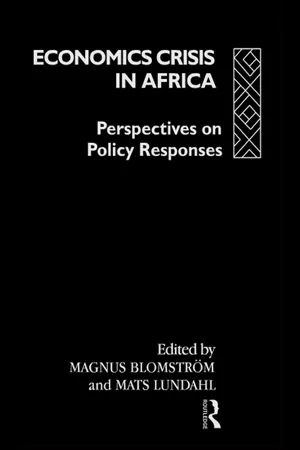
While the pitiful images of famine victims generally emanate from the very poorest countries in Sub-Saharan Africa, the entire region faces an intense economic crisis. Why is this area in a state of near-permanent crisis and perhaps more importantly, what can be done about it?
In Economic Crisis in Africa the authors use country studies to examine how this situation has come about. The book is divided into four parts: Part I presents an overall perspective of the African Crisis and its management; Part II addresses the problems of the external sector; Part III discusses the crises and structural adjustment from a microperspective; and finally, Part IV examines changes in economic systems which took place during the 1980s. At a time when famine again threatens the area, this work offers a valuable insight into a highly complex and critical situation.
- 368 pages
- English
- ePUB (mobile friendly)
- Available on iOS & Android
eBook - ePub
About this book
1
INTRODUCTION
Magnus Blomström and Mats Lundahl
Sub-Saharan Africa is in a deep economic crisis. For instance, the World Bank (1989:2) reports that Africa, a region of 450 million people in 1987, had a total GDP of around 135 billion US dollars, about the same as that of Belgium, which has only 10 million inhabitants. A similar indicator of Africa's economic performance is the fact that Singapore, a small island of only 2.7 million inhabitants, exports some 50 per cent more manufacturing products than all of Sub-Saharan Africa together (Blomström 1990). These two observations indicate the seriousness of the problems dealt with in this book.
The situation in Africa has been bad for a long time, but during the 1980s it deteriorated much further. The continuing crisis has several dimensions. Stagnating or negative economic growth, serious balance of payments and fiscal problems and sluggish agricultural performance, coupled with rapid rates of population increases, are only some signs of the economic disaster. The social dimensions of the crisis include increasing unemployment, decreasing expenditure on social services and education, worsening nutrition and continuing high infant mortality. Environmental problems, such as desertification and deforestation, are accelerating. Moreover, the political systems are generally characterized by corruption, inefficiency and instability. And as if this was not enough, we are now hit by the news of another round of severe drought and famine in Africa.
Why this disaster? Unfortunately, there is no simple answer to that question. The background to the African crisis is complex and highly debated (see, for example, Milner and Rayner 1992; Rose 1985; Säve-Söderberg and Taxell 1988; World Bank 1989). The internal factors behind Africa's economic decline that are most frequently mentioned include misdirected macroeconomic policies, corruption and administrative inefficiency, lack of industrial tradition and low technological capability, poor health care and education and high population growth. Among the important external factors, fluctuations in terms of trade take a leading position. Although the country studies presented in this book stress different sources for the crisis, they generally conclude that internal factors have played a more crucial role than external ones.
Today, most African countries are facing the task of achieving important structural changes in their economies. The intermediate objectives of the ongoing adjustment programmes are generally to reduce inflation, to eliminate deficits in the balance of payments, in the government budget or in public enterprises, and to adjust to growing debt services (Commander 1989). However, in the long run, the purpose is different. The long list of fundamental objectives reaches from the aim to accelerate economic growth, eliminate hunger and malnutrition and improve income distribution, to the need to lower the demographic pressure and solve environmental problems. However, as the chapters of this book show, the results of stabilization and adjustment programmes have been rather bleak so far.
The book is divided into four parts. Part I gives an overall perspective of the African crisis and crisis management. Part II addresses problems of the external sector. Part III discusses the crises and structural adjustment from a micro perspective. Finally, Part IV examines changes in economic systems which have taken place during the 1980s.
CRISIS AND CRISIS MANAGEMENT
The economic and social conditions in Sub-Saharan Africa have been gloomy most times since independence. After an initial period of growth, most African economies stagnated, and during the 1980s they began to decline. With only a few exceptions, per capita income has been falling during the last decade and most of the other development indicators have deteriorated in the same manner. There are few signs of improvements, despite the countries’ own efforts and the inflows of aid resources.
Most countries have now introduced far-reaching structural adjustment programmes, but the projections for growth and development are still bleak. In fact, most projections for the first half of the 1990s suggest that scheduled debt service will continue to increase in the African countries and there are no signs of an upward trend in the inflow of new financial resources. Moreover, the manufacturing sector in most African countries is still far too small to allow significant import substitution. In this perspective, growth of export earnings is presumably the only means of obtaining the foreign exchange needed to import intermediates and investment goods.
In Chapter 2, ‘Trade Compression and Economic Decline in Sub-Saharan Africa’, Peter Svedberg presents a cross-country study of Africa's export performance and potential. He shows that very few African countries had sustained growth of real export earnings over the 1971–87 period. To some extent, this is explained by stagnating or deteriorating prices of primary commodities, but in most cases, it had more to do with the failure to expand export volumes. The reason for the poor export performance can be debated. Misdirected trade policies have obviously played an important role, but Svedberg also discusses alternative explanations.
Recently there has been a move towards more outward-oriented trade policies in Africa. Almost all countries that had significantly overvalued currencies earlier devalued considerably during the latter part of the 1980s. However, according to Svedberg, it is difficult to know how the present exchange rates are related to some ‘fundamental equilibrium’, since many of the countries still maintain tight government control of most capital and current account transactions. It is nevertheless noticeable that, during the past few years, no country in Africa had a currency that was as extremely overvalued as in the late 1970s and the first half of the 1980s.
So far the impact on export volumes of the devaluations in the countries with high previous overvaluation seems to have been small. By the late 1980s export growth had picked up only in one country, Ghana. In countries like Sierra Leone, Tanzania and Uganda, there is yet no sign of a sustained improvement. This suggests that it may take time for new price signals to result in increasing production and that an equilibrium exchange rate may not be a guarantee for rapid export volume expansion. Svedberg claims that such a rate must be accompanied by other export-stimulating policies, such as improved producer prices, extension of credits and macroeconomic stability, to give the intended effects. Moreover, in the short term, export growth in most African countries can only be achieved through the rehabilitation of existing (mainly primary product) export sectors. In the somewhat longer term, diversification of both products and markets is necessary.
In Chapter 3, ‘Understanding Structural Adjustment: Tanzania in Comparative Perspective’, Göran Hydén and Bo Karlström argue for a broad approach to the analysis of structural adjustment policies, encompassing political as well as economic considerations. Analyses of structural adjustment in developing countries have traditionally focused on such macroeconomic issues as the effects of exchange rate changes and other policy shifts on domestic resource allocation, exports and the balance of payments. Over the past several years, however, research has broadened to cover longer periods of adjustment time and the interaction of economic and political variables.
Hydén and Karlström begin their chapter by surveying the structural adjustment literature and use the Tanzanian experience as an illustration. They review economic policies and attempts at policy reforms in Tanzania over the past ten to fifteen years, and construct a simple framework for analysing, in political terms, the scope for implementing structural adjustment policies in a developing country. In line with a growing number of studies of structural adjustment, they believe that a better understanding of the political dynamics of economic reforms is necessary.
Both in their literature review and their account of the Tanzanian case, Hydén and Karlström find that the adjustment process is filled with ambiguities and conflicts. Therefore, in order to understand structural adjustment policies and, particularly, to implement them successfully, they claim that it is necessary to incorporate these two concepts into the analysis. Their thesis is that ambiguity provides openings for effective policy action (room for manoeuvre), while conflict obstructs such action.
Arne Bigsten's contribution, ‘Regulations Versus Price Reforms in Crisis Management: The Case of Kenya’ (Chapter 4), discusses how policy-makers in Kenya met economic shocks. Focus is on the choices made by policy-makers between administrative regulations and the use of markets in bringing about the desired economic adjustment. According to Bigsten, a major constraint on policy reform in Kenya has been the influence of vested interests that stand to lose from the reforms.
In Kenya, political positions are often used as a base for successful economic activities. The core insiders in the Kenyan economy are individuals with political power and associated groups in the bureaucracy. One can also find economically-powerful individuals outside this group, but they are often well connected to the core group. The outsiders are those that have to act in the market without the benefit of political connections. The state is used by insiders as a means of allocating the rents of the system. The outsiders have much fewer possibilities of reaping these rents. The demarcation line between insiders and outsiders thus, in the Kenyan case, has to be drawn on the basis of political connectedness.
Bigsten claims that one of the major constraints on growth in the African economies is the unwillingness to undertake reforms that threaten the entrenched élite. (Politicians and their associates have an interest in preserving the existing system of controls on imports and investment.) He reviews the macroeconomic trends in Kenya, and discusses the determinants of monetary policy, external sector policy, agricultural policy and employment policy.
In general, it seems as if Kenya has found it easier to implement price-related reforms than institutional reforms. There are yet no clear signs that the country will change to an export-oriented economy, where producers are faced with international competition. There is also a clear lack of enthusiasm for parastatal reform, since this encroaches on the scope for political action. The same reason can be given for the lack of enthusiasm for liberalization of import regulations and investment controls. Still, the distortions have not been so pervasive that macroeconomic management has been rendered ineffective. Although imbalances have at times been serious, it has always been possible to return to a sustainable position. Therefore, Kenya's economic record is still among the better ones in the region.
During the past decade it has become increasingly clear that the external debt situation is a severe obstacle to growth and development in Africa. In Chapter 5, ‘Reducing the Debt Burden of Sub-Saharan Africa’, the African debt crisis is discussed by Joakim Stymne. Africa's long-term debt has risen by almost twenty times during the last two decades and is now equal to the region's gross national product. This makes Africa the most heavily-indebted region in the world, with debt service obligations of almost half of its export revenues.
Stymne concentrates on one basic assumption of debt renegotiations in the context of Sub-Saharan Africa, namely, that a debt renegotiation is expected to make normalization possible between a debtor country and its creditors. Normalization means that debtors do not repeatedly find it necessary to take recourse to ‘exceptional financing’, of which the most important categories are the use of rescheduling and the accumulation of payments arrears. Normalization is desirable, because exceptional financing, for a variety of reasons, is very costly for the debtor. For example, a country which requests rescheduling may be seen as riskier than a country which avoids it, which increases the costs of using normal sources of finance.
Theory tells us that sovereign debtors only make debt payments if it is in their interest to do so, that is, if the costs of default do not exceed the costs of making the resources available for debt service. It is difficult to quantify the costs of default directly. Stymne, therefore, looks at the revealed behaviour of the countries of Sub-Saharan Africa. This indicates that when the scheduled debt service ratio exceeds about 25 per cent, the costs of using exceptional finance are perceived as lower than the costs of maintaining a normal relationship with the creditors. Such a debt service ratio corresponded to a debt ratio of more than double the actual one of Sub-Saharan Africa in 1989. This suggests that it will be very difficult for these countries to normalize the relationships barring substantial debt relief.
Finally, Stymne employs a simple simulation model to get an idea of the magnitude of economic adjustment (on the debtor side) and debt relief (from the creditors) that would be necessary to reduce the debt burden sufficiently to normalize relationships. His simulation suggests that a rapid recovery of exports (an annual export growth of 7 per cent) is required to improve the ability of the debtors to get their economies in shape. Moreover, the payment situation of the debtors will not be normalized in a foreseeable future, unless debt relief is forthcoming which is significantly in excess of what is now being provided. A cancellation of about 50 billion US dollars of claims is necessary.
THE EXTERNAL SECTOR
The second part of this book is devoted to the external sector. There seems to be a general agreement today about the positive contribution of trade to economic growth and development (Little, Scitovsky and Scott 1970; Bhagwati 1978; Krueger 1978, 1983). The gradual demise of import-substitution development strategies, based on tariffs and other protective instruments, and the growing appeal of export-oriented strategies, are clear indications of this consensus. A wind of liberalization has swept across Africa during the 1980s, and today fewer countries strive for self-reliant industrialization and development behind high tariff barriers.
One interesting example of such a trade liberalization is Zimbabwe, discussed by Dick Durevall in Chapter 6, ‘Trade Liberalization: The Zim-babwean Way’. At independence in 1980 the prospects for Zimbabwe looked quite good, but the high expectations were never met. Income per capita grew by only 1 per cent annually during the 1980s. Although this was respectable in comparison with most other Sub-Saharan countries, it was much lower than Zimbabwe's earlier growth performance, indicating that the economy had not recovered altogether from the deep recession of the last half of the 1970s.
According to Durevall, the most likely explanation for the stagnation of the Zimbabwean economy is that the import substitution policy has run its course. The share of manufacturing in GDP is close to 30 per cent, which means that most importables that can be substituted are already produced in the country.
In order to increase economic growth, the Zimbabwean government adopted a structural adjustment programme at the end of 1990. The programme consists of the five parts:
- Macroeconomic stabilization (for example, by reducing the budget deficit, devaluing the currency and raising real interest rates).
- Public sector reforms (privatization, rationalization, cost based or market pricing, and so on).
- Trade liberalization.
- Deregulation, which covers a number of markets.
- A social programme (for example, the health and educational sectors will expand, and those who become unemployed as a result of the adjustment process will be compensated).
Durevall is optimistic about Zimbabwe's future and argues that the probability that the reform will become a success is higher than in most other African countries. Trade liberalization has been discussed in Zimbabwe for several years and many important groups are in favour of it - especially the organizations of the manufacturing industry. The country has a strong private sector, a large manufacturing industry, a well-developed capital market, a broad export base, a well-functioning infrastructure and a fairly well- educated labour force. Nevertheless, things could go wrong. Since the process of opening up the trade account is controlled, there is intensive lobbying from private companies that want to delay the reform. If the government starts to give in, credibility in the reform could be lost. This risk would be enhanced if Zimbabwe does not manage to raise the capital needed.
Another threat to the programme, according to Durevall, is the rate of inflation. This already amounts to 25 per cent, which is 10 percentage points more than forecasted. Rapidly rising prices will create public discontent which could persuade the government to abandon the programme or change the power structure within the government towards those who are against the reform.
Being a poor country, landlocked inside South Africa, creates special problems. In Chapter 7, ‘Structural Adjustment and Economic Management in a Dependent Economy: The Case of Lesotho’, Lennart Petersson deals with the difficulties of implementing a structural adjustment programme to reduce financial imbalances and to promote growth in the small, open and undiversified economy of Lesotho. Petersson points to the limited capacity of the government to shape and implement reform programmes, but also to the fact that the country faces severe constraints in pursuing economic policy, due to its close economic and institutional links with South Africa. Thus, monetary and fiscal policy are constrained by the country's membership of the Southern African Customs Union and the Common Monetary Area. The integration of factor and commodity markets reduces the ability to establish independent wage and interest rates, and to implement indirect taxes on traded goods which differ from those of South Africa. As a result, the liberalization of markets has largely meant an increased adaptation to the South African market.
The importance of structural measures has been emphasized in Lesotho's adjustment programme, but the success of those depends on the achievement of macroeconomic balance. Such a balance also seems to have been reached. Between 1988/89 and 1990/91, public savings increased substantially and the balance-of-payments position improved. However, Petersson shows that the main factors behind these improvements ha...
Table of contents
- COVER PAGE
- TITLE PAGE
- COPYRIGHT PAGE
- FIGURES
- TABLES
- THE CONTRIBUTORS
- PREFACE
- 1: INTRODUCTION
- PART I: CRISIS AND CRISIS MANAGEMENT
- PART II: PROBLEMS OF THE EXTERNAL SECTOR
- PART III: THE MICRO LEVEL
- PART IV: ECONOMIC REFORMS AND SYSTEM REFORMS
Trusted by 375,005 students
Access to over 1.5 million titles for a fair monthly price.
Study more efficiently using our study tools.
Frequently asked questions
Yes, you can cancel anytime from the Subscription tab in your account settings on the Perlego website. Your subscription will stay active until the end of your current billing period. Learn how to cancel your subscription
No, books cannot be downloaded as external files, such as PDFs, for use outside of Perlego. However, you can download books within the Perlego app for offline reading on mobile or tablet. Learn how to download books offline
Perlego offers two plans: Essential and Complete
- Essential is ideal for learners and professionals who enjoy exploring a wide range of subjects. Access the Essential Library with 800,000+ trusted titles and best-sellers across business, personal growth, and the humanities. Includes unlimited reading time and Standard Read Aloud voice.
- Complete: Perfect for advanced learners and researchers needing full, unrestricted access. Unlock 1.5M+ books across hundreds of subjects, including academic and specialized titles. The Complete Plan also includes advanced features like Premium Read Aloud and Research Assistant.
We are an online textbook subscription service, where you can get access to an entire online library for less than the price of a single book per month. With over 1.5 million books across 990+ topics, we’ve got you covered! Learn about our mission
Look out for the read-aloud symbol on your next book to see if you can listen to it. The read-aloud tool reads text aloud for you, highlighting the text as it is being read. You can pause it, speed it up and slow it down. Learn more about Read Aloud
Yes! You can use the Perlego app on both iOS and Android devices to read anytime, anywhere — even offline. Perfect for commutes or when you’re on the go.
Please note we cannot support devices running on iOS 13 and Android 7 or earlier. Learn more about using the app
Please note we cannot support devices running on iOS 13 and Android 7 or earlier. Learn more about using the app
Yes, you can access Economic Crisis in Africa by Magnus Blomström,Mats Lundahl in PDF and/or ePUB format, as well as other popular books in Economics & Economic Theory. We have over 1.5 million books available in our catalogue for you to explore.