eBook - ePub
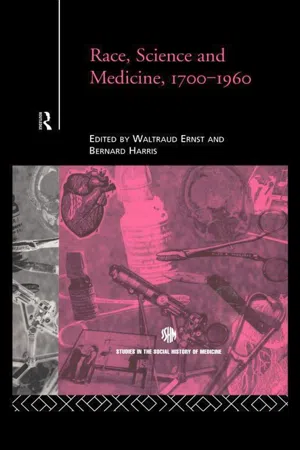
Race, Science and Medicine, 1700-1960
- English
- ePUB (mobile friendly)
- Available on iOS & Android
eBook - ePub
Race, Science and Medicine, 1700-1960
About this book
Considering cases from Europe to India, this collection brings together current critical research into the role played by racial issues in the production of medical knowledge. Confronting such controversial themes as colonialism and medicine, the origins of racial thinking and health and migration, the distinguished contributors examine the role played by medicine in the construction of racial categories.
1 Introduction
Historical and contemporary perspectives on race, science and medicine
DOI: 10.4324/9780203025420-1
During the last two decades the study of race and ethnicity as an important independent academic specialism has become well established within a range of social science disciplines such as sociology, political sciences, anthropology, cultural studies and geography.1 This ‘explosion of academic interest in the subject of race’2 does, however, not suggest an agreement on the conceptualisations most adequate to explain the category of race. On the contrary, among academics the concept of race remains a controversial and contested one.3
Traditionally most historians have been careful to distance themselves from the moral and political implications of biological definitions of race; they have referred to it as a given (albeit characteristic and problematic) preoccupation of certain periods during the last two centuries. The interactions of particular colonial and migrant communities were conceived of as mere manifestations of the frictions of cultural contact. Racial attitudes and behaviours came to be viewed as but constitutive elements of particular groups’ traditions and folklore, of the same order as ethnic idiosyncrasies, national costumes, food preferences and other cultural practices. Such historical accounts tended to remain almost at the anecdotal level and tended to ignore the wider power structures within which these episodes were embedded.
As recent authors of the postcolonial and subaltern4 schools of thought have shown, the writing of colonial histories has had an enduring effect on representations of race, in the popular media as well as the scientific community. Notwithstanding honourable exceptions, such as V.G. Kiernan and Eric Hobsbawm, the tendency to relegate the analysis of race to a realm beyond historical research, and to provide instead collections of variably amusing or sinister historical vignettes, has in itself contributed to the reification of race.5 Whether historians see their role as unavoidably political or not, writing about race in history cannot merely involve a dispassionate assessment of historical evidence: it provides the basis for the construction of historical – and thus necessarily also for present-day – political discourse.6 As the historian D.A. Lorimer put it: ‘the subject of race is at root a question of power and is, therefore, whether we like it or not, profoundly political’ .7
Historians write history (and get their work refereed and published) within the constraints and preoccupations of present-day political and academic contexts. Any historical account of race – as much as any present-day study of racism – therefore needs to be created in awareness of its own specific political and academic context. The political positions and strategies that may be encoded in it need to be made explicit. Long before the advent of postcolonial, postmodern and subaltern studies, Gunnar Myrdal expressed this point succinctly in the (German) introduction to his Asian Drama, appropriately subtitled ‘the mote in one’s own eye’:8
The issue of objectivity in research cannot simply be sidestepped by striving to exclude value judgments. On the contrary; the investigation of any social problem is, and has to be, affected by value judgments. There never was such a thing as ‘ disinterested social science’ and there never will be. The attempt to run away from value judgments is futile and even harmful. Value judgments are in us – however much we try to repress them – and they direct our work.9
Contributors to this book share an ambition to break away from and to expose some of the ‘dangerous and destructive patterns that were established when the absurdity of “race” was elevated into a central political, cultural and economic concept and endowed with a power to both determine and explain the unfolding of history’.10 That these ‘dangerous patterns’ have been persistent and enduring is evidenced by the current academic revival and general popularity of writing based either on socio-biological theories11 or on ideas that encode and legitimate racial discrimination in terms of ‘culture’.12
Opinions diverge as to the extent to which post-Enlightenment thinking and the various responses to and extensions of it (such as Romanticism) were inherently flawed.13 Some believe that the categories themselves, although laying claim to universal truth, were part of but one particular philosophical mind-set that came to prominence already inherently implicated with racial ideology. Others hold that Enlightenment traditions projected the possibility of human emancipation, yet were limited in the expression of their emancipatory potential by social and political circumstance, and economically based class interest during the emergence of capitalism.
According to the former view, the elevation of scientific discourse to a major component in the project of modernity and the Eurocentrism inherent in the Western scientific enterprise has aided both the development of racial hierarchies and the creation of the long-enduring myth of science as an impartial, pure and value-free endeavour, superior to other peoples’ modes of thinking. Alternatively it could be argued that it is one thing to ‘discover’, identify, categorise and classify plants, beetles as well as peoples, but quite another to transform such categories and classifications into hierarchies that suggest stratification in terms of social and moral inferiority. The process of categorisation would then not in itself be normative, but rather evaluative attributions would be based upon moral and social preferences, subjective value judgements and the striving for political power. The unfounded transformation of a statement about perceived difference into one about social or moral desirability and thence political dominance is starkly illustrated by Disraeli’s well-known proclamation that ‘race implies difference, difference implies superiority, and superiority leads to predominance’.14
The conundrum of the conceptual status and the socio-political consequences of the Enlightenment has not been resolved satisfactorily. Yet there now exists agreement on some parameters. The consensus is that scientific racism, racial medicine and colonial rule were for a time closely linked, variously reinforced and justified each other. Claims to racial superiority and Western scientific and medical hegemony are seen to have emerged alongside each other in the wake of the Enlightenment, culminating eventually not only in scientifically based racism in the nineteenth and racial medicine in the twentieth century, but also in the perceived enhancement and legitimisation of colonial expansion by reference to medical and scientific progress. Lyautey’s dictum that ‘medicine is the only excuse of colonialism’15 vividly encapsulates this. The interrelatedness of race, science and medicine, and its extension to the colonial realm during the nineteenth century, in particular, therefore constitutes one major focus for this book.
Taking issue with the Enlightenment roots of hierarchical racial thinking and with Western scientific and medical hegemony is, however, vital not only for colonial history. Debates on the ontological status and political implications of ideas such as freedom, equality and individual rights on the one hand, and of claims to difference and particular group rights on the other, are also central to Western theories of decolonisation and multiculturalism in the twentieth century. The tendency to transform questions of politics, rights and morals into questions about nature, biology and culture has persisted. Immigrants and minority groups in Britain and elsewhere in Europe have been caught up in the tension between claims to equal rights and citizenship on the one hand, and to difference and the rights to cultural and political self-expression on the other.
Historically, the conflation of ideas of racial difference with moral values and political rights was facilitated during the nineteenth century by newly emerging biological and anatomical frameworks that constructed the qualities of particular peoples as fixed and transhistorical, thus quasi-naturalising social and political formations in terms of a racial logic of belonging. As a critical historian of ‘ scientific racism’ put it: ‘In effect, a theory of politics and rights was transformed into an argument about nature; equality … was taken to be a matter not of ethics, but of anatomy’.16 In the early twentieth century, in contrast, important changes occurred as race was increasingly encoded not only as biologically determined but also as culturally based. Since then equality has become more a matter of culture than of biology alone.17 It is this shift in conceptual emphasis that is at the centre of the essays on aspects of early twentieth-century racial theories and medical practices in Britain itself.
Research on the crucial role of the Enlightenment in the creation of a racialised science and in the scientific and cultural justification of racism has also alerted us to the dangers of overgeneralisation and homogenisation of historical perspectives. Despite the value of critical analyses of the all-pervasive and powerful Enlightenment and post-Enlightenment gazes and discourses, not least in the eminent tradition of Foucault, many authors have pointed out that we also need to see the great variety and plurality, not to say ambiguities, of these discourses. These argue that the attribution of any singular train of thought and intention to Enlightenment or post-Enlightenment thinkers is misleading – in regard to racial theories as well as medical practices.18
Much recent literature on the link between science and race suggests that Western science and its representatives assumed a preeminent role in the invention, justification and dissemination of ideas of racial hierarchies as part of the project of the civilising mission and the universal spread of Western scientific knowledge. This led, first, to the formation of nineteenth-century ‘scientific racism’ and, subsequently, to the ‘retreat of scientific racism’ between the World Wars, when the definition of race as a biological concept was complemented by cultural notions of race. Arguably, we then witnessed the unravelling of the post-war scientific consensus on race, signalled by the ‘return of racial science’.19 These whole-scale characterisations of particular historical periods in terms of the varying ways in which science and race are thought to be intertwined constitute an important challenge to positivist thinking and are useful for the purposes of conveniently clear-cut classification and accentuation of long-term historical trends. At the same time they are problematic precisely on account of the generalisation on which they are based. They might therefore more appropriately be taken as the starting point for, rather than the conclusion of, further debate and in-depth probing of the historical evidence.
The concept of ‘scientific racism’, for example, rightly highlights the point that from the early nineteenth century to the present day the various branches of science and their representatives have not simply been involved in the pursuit of a socially and politically disinterested and objective enterprise, but have, to various extents, been implicated in the justification and construction of racist categories. In the main, ‘ scientific racism’ has become synonymous with ‘biologistic’ racism as it emerged alongside evolutionary and Social-Darwinist ideas. Yet in-depth studies of particular strands of late nineteenth- and early twentieth-century medical and psychological theories of racial difference (see Harris, Sawday, Thomson and Worboys in this volume) suggest that such an equation may be too simplistic. ‘Scientific racism’ was variously and diversely refashioned during this period in biologistic as well as cultural terms. As Harris shows, medical observers in the late nineteenth and early twentieth centuries interpreted differences in the health status of Jews and Gentiles in cultural rather than biological terms. Worboys suggests that, contrary to general trends, commentators on tuberculosis favoured biological explanations from 1914 onwards. Thomson discerns a move away from biology to culture within the discipline of psychology in the period between the World Wars and suggests that different scientific disciplines produce or favour different sorts of scientific racism, as in the case of psychology which seems to have shifted away from biology-based conceptualisations to a cultural emphasis under the influence of anthropological ways of thinking.20
These findings indicate first of all that, once we look at the historical evidence of racism in science and medicine in more detail, we may be confronted with diverse strands and complex configurations of ‘ scientific racism’ within particular scientific disciplines and in relation to different medical syndromes and socio-political settings. ‘Scientific racism’ presents itself in cultural as well as biologistic guise. Further, even when expressed in the language of ‘culture’ , a biologically based perspective may, in the last instance, still be at work, as when ‘culture’ is evoked as if intrinsically linked to the biological inheritance of a race. Unlike earlier debates on the role of the environment (in contrast to a people’s constitution and character) that predate the advent of scientific racism (see essays by Saakwa-Mante and Augstein in this book), the cultural coding of race rose to prominence once it was realised, from around the late nineteenth century onwards, that biological differences between ‘races’ were in themselves not very significant. Cultural differences were referred to as quasi-inherited – as if culture was ‘in the genes’. The move between, and conflation of, biological and cultural definitions of race still haunts present-day debates and popular conceptions. The long-standing debates on the status of ‘biology’ and ‘culture’ (progressing from previous ones about the role of ‘constitution’ and ‘environment’) raise the further important question as to whether binary distinctions, such as those of notions of racial difference based on biology and those based on culture, can legitimately be sustained.
As has been shown in earlier post-World War II methodological debates, researchers have indeed a tendency to iron out evidence of inconsistency and to smooth over ambiguities that might distract from the perceived desirability of arriving at unequivocal statements and clear-cut dichotomies. In addition, historians make allowance for what are seen as the exuberant style and lack of logical consistency in much Victorian writing, for example, and dismiss these as idiosyncratic contingencies, not relevant to the core arguments. By so doing, an important point in regard to the way in which racialised discourses strengthen their hegemony may be overlooked. In fact, the ambiguities, contradictions and discrepancies manifest within particular racial theories and racialised medicine are more likely to strengthen than weaken racial discourses. Racial discourses work well not despite their logical inconsistencies, ambiguities and mixing up of premises but because of them. They are destructively all-pervasive precisely because they are overdetermined and multivariant, creating the possibility for different arguments or perspectives (moral, biological, cultural, etc.) to be accentuated within different contexts and depending on the aims pursued.
It is not least this chameleon-like versatility of racialised discourses, their facility in shifting from ethical norms to biological arguments or to those of cultural identity, that has proved so painfully overpowering to those victimised by it.21 The insistence that the presumption of ‘a single monolithic racism’ needs to be replaced by context-specific analyses of the multifarious historical formulations of particular ‘racisms’ has rightly led to an increased awareness of the multidimensionality of racial discourses, encouraging a focus on the variable spatial and temporal contexts within which particular discourses are articulated.
A number of chapters in this collection look at how the heterogeneity of racial discourses manifests itself. They deal with aspects such as the diversity of thinkers in any particular period (e.g. Augstein); the variety of perspectives employed in any one particular thinker’s writings (e.g. Saakwa-Mante, Thomson); differences of outlook and opinion present in scientific and philosophical, in contrast to public, discourses and practices (e.g. Jackson, Sawday, Worboys); differences in the tenor of scientific debates ...
Table of contents
- Cover Page
- Half Title Page
- Title Page
- Copyright Page
- Table of Contents
- Notes on contributors
- 1 Introduction: historical and contemporary perspectives on race, science and medicine
- 2 Western medicine and racial constitutions: surgeon John Atkins’ theory of polygenism and sleepy distemper in the 1730s
- 3 From the land of the Bible to the Caucasus and beyond: the shifting ideas of the geographical origin of humankind
- 4 Colonial policies, racial politics and the development of psychiatric institutions in early nineteenth-century British India
- 5 Racial categories and psychiatry in Africa: the asylum on Robben Island in the nineteenth century
- 6 ‘An ancient race outworn’: malaria and race in colonial India, 1860–1930
- 7 Tuberculosis and race in Britain and its empire, 1900–50
- 8 Changing depictions of disease: race, representation and the history of ‘mongolism’
- 9 Pro-alienism, anti-alienism and the medical profession in late-Victorian and Edwardian Britain
- 10 A virulent strain: German bacteriology as scientific racism, 1890–1920
- 11 ‘Savage civilisation’: race, culture and mind in Britain, 1898–1939
- 12 ‘New men, strange faces, other minds’: Arthur Keith, race and the Piltdown affair (1912–53)
- Index
Trusted by 375,005 students
Access to over 1.5 million titles for a fair monthly price.
Study more efficiently using our study tools.
Frequently asked questions
Yes, you can cancel anytime from the Subscription tab in your account settings on the Perlego website. Your subscription will stay active until the end of your current billing period. Learn how to cancel your subscription
No, books cannot be downloaded as external files, such as PDFs, for use outside of Perlego. However, you can download books within the Perlego app for offline reading on mobile or tablet. Learn how to download books offline
Perlego offers two plans: Essential and Complete
- Essential is ideal for learners and professionals who enjoy exploring a wide range of subjects. Access the Essential Library with 800,000+ trusted titles and best-sellers across business, personal growth, and the humanities. Includes unlimited reading time and Standard Read Aloud voice.
- Complete: Perfect for advanced learners and researchers needing full, unrestricted access. Unlock 1.5M+ books across hundreds of subjects, including academic and specialized titles. The Complete Plan also includes advanced features like Premium Read Aloud and Research Assistant.
We are an online textbook subscription service, where you can get access to an entire online library for less than the price of a single book per month. With over 1.5 million books across 990+ topics, we’ve got you covered! Learn about our mission
Look out for the read-aloud symbol on your next book to see if you can listen to it. The read-aloud tool reads text aloud for you, highlighting the text as it is being read. You can pause it, speed it up and slow it down. Learn more about Read Aloud
Yes! You can use the Perlego app on both iOS and Android devices to read anytime, anywhere — even offline. Perfect for commutes or when you’re on the go.
Please note we cannot support devices running on iOS 13 and Android 7 or earlier. Learn more about using the app
Please note we cannot support devices running on iOS 13 and Android 7 or earlier. Learn more about using the app
Yes, you can access Race, Science and Medicine, 1700-1960 by Waltraud Ernst, Bernard Harris, Waltraud Ernst,Bernard Harris in PDF and/or ePUB format, as well as other popular books in History & World History. We have over 1.5 million books available in our catalogue for you to explore.