- 312 pages
- English
- ePUB (mobile friendly)
- Available on iOS & Android
eBook - ePub
About this book
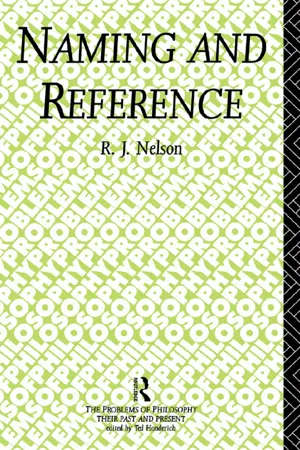
The question of how language relates to the world is one of the most important problems of philosophy. What the word `God' refers to and the question `Does God exist?' are clearly linked. The existence or non-existence of God (or electrons or unicorns) is directly related to the issue of what and how a name names. Naming and Reference tackles the challenge of explaining the referring power of names. More specifically it explores the reference of lexical terms (especially proper names and pronouns) and the issue of empty or speculative names such as `Satan' and `leptons'. The lack of semantics of such terms is a serious difficulty for linguistics, cognitive science and epistemology. In the first half of the book, a survey of the history of the subject is made from Locke to Kripke and Fodor. The second half contains a theory of reference which takes seriously the causal notion of reference, while at the same time preserving Frege's distinction between sense and reference. The algorithmic theory of reference that results treats reference in explicitly non-semantical terms. It incorporates or reflects the latest work in computational logic, cognitive science, philosophy of mind, linguistics and brain biology.
Information
CHAPTER 1
Introduction
1. From words to things
Anyone given to reflection is likely to have strong feelings about what counts as an important philosophical question. ‘Does God exist?’ ranks high, as does ‘Is man a machine?’ and ‘Are there rational grounds for moral judgment?’ However, ‘Ought poetry reflect the politics of its age?’ ranks pretty low, except for literary critics and otherwise unoccupied philosophers.
The nature of reference of words is one of the high questions. It does not seem to be very exciting, even for a philosopher, until you notice that the question, ‘Does the word “God” refer to anything?’ asks the same thing as ‘Does God exist?’ An answer to one is surely an answer to the other.
Yet there is certainly a difference. The verbal question is slightly irritating. ‘Does God exist?’ calls for a plain yes or no. And if you are an agnostic you can drop it. But ‘Does “God” refer?’ hints at trouble: some one is kidding you or wasting your time. It is hard to deny that ‘God’ unlike ‘Spfch’ refers to or means something, but that doesn’t mean God exists. Or does it?
On the other hand it seems nothing needs less explanation: we all speak and listen more or less successfully every day. The pronoun ‘I’ refers to me, ‘you’ to you; the noun phrase ‘this desk’ refers to the proverbial desk before me, and ‘this book’ to this very book. Nothing could be less open to wonder or worry than the objects of words. As to ‘God’: if you believe, the word refers and if you do not it is fiction, and that’s the end of it.
However, things are not as simple as that. Does ‘I’ refer to you? Does ‘1010’ refer to ten or to one thousand and ten? Does ‘1010’ refer to anything for one-year-old Johnny? To what? To anything for a computer? What do you mean by ‘refer?’ Do computers refer when a programmer makes symbol declarations? Does the name ‘Hamlet’ refer? What about ‘zero’? What about ‘the least rapidly divergent series’? Does ‘tachyon’ refer? If so, to what? If not so, why do some people have theories about them?
One might easily make a case that the question ‘what is reference?’ is the hardest, if not the most important, in all of philosophy—not to say in linguistics and cognitive science. One contemporary writer insists that in spite of the spectacular gains in linguistic theory of the past thirty years, especially Chomsky’s transformational grammar, and the ‘heroic efforts to understand the dimension of language associated with meaning and reference, we are as much in the dark as ever’ (Putnam 1975:215).
If learned agreement among investigators—all using the same publicly available data and all born from the same cultural background—is taken as a measure of the success of a science, the study of reference is the biggest failure around. No issue has been faced in more diverse and incompatible ways. Reference is being pursued right now as a part of semantics, semiotic, linguistics, ontology, epistemology, analytical philosophy, psychology, anthropology, cognitive science, computer science, neuroscience, metaphysics and, most recently, physics; and the action has generated zero output. Contemporary research attracts no prizes.
One reason for the mess is difference in aim. Logicians want to know the role of reference in reasoning in science and in philosophy itself. Cognitive scientists want to know how it figures in concept formation or in the dynamics of communication. Neurobiologists want to know whether it is locally distributed or scattered over the cortex. None has broken ground, although most inquirers now agree (it took 2500 years from Plato to get to this point) that the relation of word to thing is governed by causal law much as other phenomena in natural science are. Indeed, this is the line we shall pursue.
In order to get on with the complexities of the subject, I want to identify the basics and set up a strawman for a bout of needling.
When people speak with one another they talk of things which they observe, avoid, seek, think about, or describe in some way. Pronouns like ‘you’ and ‘I’ refer to individual objects, you and me, present in discourse. Proper names like ‘Russell’ ‘Lady Ottoline’ ‘Gibraltar’ and ‘Arcturus’ refer to particulars which might not be within sight or hearing but do or did exist somewhere at one time.
Common names and adjectives apply universally to many objects, not only to one thing. For instance ‘philosopher’ applies to any philosopher you choose; not only to Russell, but to Plato, Kant and Wittgenstein. ‘Tree’ applies to all trees, ‘tangos’ to tangos, and so on.
Suppose Jones informs us that Bertrand Russell was a philosopher and also a mathematician, uttering the sentence
Bertrand Russell was a philosopher and also a mathematician.
In this sentence, ‘Bertrand Russell’ is a name of or refers to the person Bertrand Russell. ‘Philosopher’ is a predicate and is true of or applies to any philosopher. In general, predicates describe or attribute properties or qualities to objects named by names.1 Both sorts of word carry semantical weight and make sense to one who knows English, even when they are isolated from the whole sentence.
What Jones says about Russell is true. However, terms refer and apply in false sentences as well. ‘Russell was a Swedenborgian’ is false, so far as I know, and therefore ‘Russell was not a Swedenborgian’ is true. In this sentence ‘Russell’ refers the same as before, and ‘Swedenborgian’ applies to Swedenborgians. ‘Not’ has the force of denying that ‘Swedenborgian’ applies to Russell.
The words ‘not’, ‘and’ and ‘also’ occurring in these sentences are not names and do not refer (in any clear way) to anything; moreover, they are not predicates and thus convey no news about things. Their office is connective. Of course names and true predicates can be fashioned out of almost any words. An example is ‘he is an also-ran’ where we have given ‘also’ a bit of independent sense by joining it with ‘ran’ to make a predicate. But playing it straight, I’ll assume that all speakers of English, including ourselves, know in a rough way which parts of the language have independent meaning and which do not. For a logician’s abstract approach the separation of glueing material from the main items is easy—names and predicates carry the semantical burden and the ‘ands’, ‘ifs’ and ‘neithers’ come along to connect words into full sentences. We shall follow this approach.
The theory of reference is about referring terms of languages, i.e. about names, predicates, the objects they refer to or apply to, and for whom. It is a part of semantics, which also studies meaning as well as reference. The difference between the reference or application of a word and its meaning or sense is subject to great dispute. But we can see at once that the two do not coincide.
For instance ‘mermaid’ means half fish, half girl, but does not apply to anything, i.e. there are no mermaids. Again, ‘liver’ does not mean the same in English as ‘heart?’ yet ‘has a liver’ and ‘has a heart’ apply to exactly the same animals.
Conversely, a term could mean one thing and refer to many. For instance, in ‘I am reading this sentence’, ‘I’ has a fixed meaning but a different referent for each reader—one for you (you) and another for me (me).
Just what the difference is for proper names is not clear. Some thinkers deny that proper names like ‘Russell’ have meaning on a par with that of predicates. For example, they might argue that you cannot give a definition of ‘Feynman’ while you can of ‘physicist’. Anyone who understands English knows what ‘physicist’ means, approximately; on the other hand he or she might know English, yet not know what ‘Feynman’ designates: does it refer to an Austrian mountain, an Italian sports car, an American physicist, or a rabbi? Others say a name plays a meaningful role of some sort whether it refers or not. ‘Cerberus’ does not name anything, although it means a three-headed dog, and ‘Pegasus’, which is also empty, means a winged horse.
Again, contrary to the view that proper names do not mean anything, ‘Russell’ and ‘Bertie’ refer to the same individual, for friends, but do not mean the same; for ‘Russell=Russell’ tells you nothing, while ‘Russell=Bertie’ conveys some knowledge you might not have had before you were told.
The distinction between meaning and reference is far less clear than a few obvious examples suggest, especially when you consider that many other expressions (such as ‘comprehension’, ‘ground’ ‘sense’, ‘intension’ and ‘connotation’) have been used by logicians with not quite the same meaning as ‘meaning’ but for the same thing—some dimension other than reference. Some philosophers, notably Bertrand Russell at one stage in his thought, used ‘meaning’ in about the same way as we are using ‘reference’ so that for him the meaning of a proper name was its object. Since there is no such thing as God, according to the Russellian atheist (I am not saying Russell was an atheist), ‘God’ is a meaningless word. For the non-Russellian atheist, however, it is meaningful but has no referent.
The more common view is that meanings are not ordinary objects, whatever they are, but possibly goings-on in the head, or platonic entities, or properties of things. For the time being we will stick with substantial objects ‘out there’, and allow meaning to dwell in a methodological limbo.
For this reason I will focus on reference, not meaning, in this introduction. This policy neither requires that we abolish the use of ‘meaning’ nor bans concepts of meaning or intension from our ruminations. It just requires that we do not pretend to have a theory of meaning or to allow meaning a place in the theory of reference until we are in a stronger position than we are now to say what it is. Thus you can say ‘perhaps the meaning of the term “horse” is one thing and the reference another’ or ‘a word might be meaningful, but not apply to anything’ and be understood, without being able to offer an explication of the word ‘meaning’ or even to justify the implied distinction of meaning from reference. You can walk without knowing leg anatomy and you can talk grammatically without knowing a thing about grammar; moreover, you can use semantical terms, including ‘meaning’ without having a theory of semantics. But do not confuse habit and theory.
The distinction between the familiar use of concepts and the explanation of them calls for a distinction between pretheory and theory. This distinction is extremely important throughout all of science, but here in particular. ‘Mass’ does not mean the same to a piano mover as it does to a physicist, although we fancy it applies to the same objects for both. And pretheoretical use of ‘meaning’ by ourselves does not convey what it might mean, one day, in theoretical semantics. Meanwhile, we have no business using the concept as a building block for a theory. One of our aims right now is to see why.
The theory of reference overlaps grammar, although the questions it raises here are largely independent of it. Sentences are built of referring terms and other lexical items; so syntax presupposes a fund of names and predicates. On the other hand we face a reverse tendency when we note that terms are frequently identified as such according to grammatical context. For instance in ‘red is her favorite color’, ‘red’ is the name of the object red, while in ‘The spot is red’, ‘red’ is a predicate. A somewhat more subtle example: ‘she is a pretty little girl’ has an occurrence of ‘pretty’ that is adverbial if the sentence is read in one way and adjectival if read in another.
What counts as a name and what counts as a predicate sometimes depends on the use of terms. You can use them variously, as in ‘Russell’ to speak of Russell or to talk about the name itself; for example ‘Russell’ contains seven letters. One might also use a name, jocosely, as a predicate: ‘Schmid is no Russell’ or even ‘that is Russell’.
Familiar uses of sentences are to assert facts, make declarations, admonish, entertain or to illustrate points of grammar. There is no language without speakers, listeners, writers and readers; they are responsible for reference through utterance. But for the time being let these users dwell in the background while we abstract out just the reference relation itself.
To put the matter as plainly as possible, then, we shall focus on the relation between names or predicates and things: the relation between ‘Russell’ and Russell, ‘philosopher’ and philosophers, ‘0’ and zero, ‘quark’ and quarks, ‘she’ and she, ‘the author of Hamlet’ and Shakespeare, and ‘the chief designer of the first stored program computer’ and the foremost investigator of the mathematical theory of games.
Now anyone seeking a robust intellectual diet might be inclined to quit this business right here: if ‘“Russell” refers to Russell’ is a harbinger of things to come, linguistic reference must be pretty thin stuff. The relation between the name ‘Russell’ and the man could not be nearly as intriguing as the relation between Russell and Whitehead or between Russell and Lady Ottoline Morrell. What’s in it?
To answer the dare, let us set down some tentative definitions which might warm us to the fact that ‘“x” refers to x’ is very interesting stuff indeed.
Let us write a list of some of the name-thing pairs that most who understand English would accept; it is in effect a very long (infinite) report of English speakers’ pretheoretical knowledge of what refers to what. Eventually it is this knowledge which has to be explained. The first entry pairs ‘Abel’ with Abel etc., and may (temporarily) be thought of as expressing that ‘Abel’ refers to Abel.
‘Abel’—Abel‘Abel’—Eve’s second son‘Bach’—Bach‘Christ’—Christ‘God’—God‘the author of Romola’—George Eliot‘Russell’—Russell‘Lady Ottoline’—Lady Ottoline‘the president of the United States in 1991’—George Bush‘1’–1‘4/4’–1‘π’–3.141592…‘the principal inventor of the digital computer’—the coauthorof The Theory of Games and Economic Behavior‘Pegasus’—Pegasus‘Titania’—Titania‘Titania’—the fairy queen in A Midsummer Night’s Dream‘Peaseblossom’—Peaseblossom etc.
Notice that this list includes grammatically proper names like ‘Abel’ and the numeral ‘1’ and also definite descriptions. The latter are complex names whose constituents are usually the definite article ‘the’ strung together with an expression forming a descriptive phrase. Examples above are ‘the president…’ and ‘the principal inventor…’, which describe certain people.
We do not presuppose any more than a speaker of ordinary English would; namely, we do not take it (although we might) that Abel, Bach and God actually exist(ed), while Titania does not. I will return to this after introducing the more technical ideas we need. For the moment let us assume that each name or description on the list names at most one thing, but perhaps not any.
Proper names and descriptions are not the only referential terms in ordinary English. Indefinite pronouns such as ‘some’ and personal pronouns and demonstratives are others. But they are not names.
First, let us look at ‘some’. Suppose you hear a noise in the next room and infer that someone entered it. ‘Someone’ refers to an individual, and ‘entered the room’ applies to him or her. At nearly the same time you infer from hearing a sigh of comfort and a squeak of a spring that someone sat down in a chair. You express your belief by ‘someone entered the room’ and ‘someone sat down in a chair’. From these sentences you certainly cannot infer ‘someone entered the room and sat in a chair’, as the affair could include two persons.
On the other hand, on the occasion of Jones entering the room, consider ‘Jones entered the room’ and ‘Jones sat in a chair’. It clearly follows ceteris paribus that ‘Jones entered the room and sat in the chair’ is true. In the second case there is a simple, direct, valid inference, and in the first not. Failure in the first case can be traced to the indefiniteness of the pronoun ‘someone’. Someone entering the room need not be the same as someone sitting in a chair. ‘Someone’ indefinitely refers to at least one thing, not at most one thing as proper names and descriptions do. ‘Some’, ‘most’ and ‘all’ do not definitely refer and are not to be counted as singular terms.
As to definite pronouns ‘I’, ‘he’, ‘they’, etc., demonstratives ‘this’, ‘that’, etc. and space-time words ‘here’, ‘now’, ‘then’ etc., all fix their references by pointing or nodding in immediate experience involving speakers and listeners. Hence these words are denominated collectively as indexicals. Within context, indexicals point to exactly one referent, not counting halucination or bad perceptual mistakes. In this respect they are something like proper names. However, out of context they refer to nothing. For example ‘that girl’ uttered in the absence of girls does not refer to anyone unless speaker and listener have a context—probably established in an ongoing conversation—in mind.
Again, while we await a waiter, ‘I am hungry’ is about me, if I am the speaker, but is about you if you are. The ...
Table of contents
- Cover Page
- Title Page
- Copyright Page
- Preface
- Chapter 1: Introduction
- Chapter 2: Natural Signs
- Chapter 3: Sense and Reference
- Chapter 4: Naming and Describing
- Chapter 5: Truth Without Reference
- Chapter 6: Reference and Speech Act
- Chapter 7: Steps Toward Naturalism
- Chapter 8: Cause and Function
- Chapter 9: Mechanism
- Chapter 10: Direct Reference
- Chapter 11: Mind and Semantics
- Appendix
- Notes
- Bibliography
Trusted by 375,005 students
Access to over 1.5 million titles for a fair monthly price.
Study more efficiently using our study tools.
Frequently asked questions
Yes, you can cancel anytime from the Subscription tab in your account settings on the Perlego website. Your subscription will stay active until the end of your current billing period. Learn how to cancel your subscription
No, books cannot be downloaded as external files, such as PDFs, for use outside of Perlego. However, you can download books within the Perlego app for offline reading on mobile or tablet. Learn how to download books offline
Perlego offers two plans: Essential and Complete
- Essential is ideal for learners and professionals who enjoy exploring a wide range of subjects. Access the Essential Library with 800,000+ trusted titles and best-sellers across business, personal growth, and the humanities. Includes unlimited reading time and Standard Read Aloud voice.
- Complete: Perfect for advanced learners and researchers needing full, unrestricted access. Unlock 1.5M+ books across hundreds of subjects, including academic and specialized titles. The Complete Plan also includes advanced features like Premium Read Aloud and Research Assistant.
We are an online textbook subscription service, where you can get access to an entire online library for less than the price of a single book per month. With over 1.5 million books across 990+ topics, we’ve got you covered! Learn about our mission
Look out for the read-aloud symbol on your next book to see if you can listen to it. The read-aloud tool reads text aloud for you, highlighting the text as it is being read. You can pause it, speed it up and slow it down. Learn more about Read Aloud
Yes! You can use the Perlego app on both iOS and Android devices to read anytime, anywhere — even offline. Perfect for commutes or when you’re on the go.
Please note we cannot support devices running on iOS 13 and Android 7 or earlier. Learn more about using the app
Please note we cannot support devices running on iOS 13 and Android 7 or earlier. Learn more about using the app
Yes, you can access Naming and Reference by R.J. Nelson in PDF and/or ePUB format, as well as other popular books in Philosophy & Philosophy History & Theory. We have over 1.5 million books available in our catalogue for you to explore.