- 384 pages
- English
- ePUB (mobile friendly)
- Available on iOS & Android
eBook - ePub
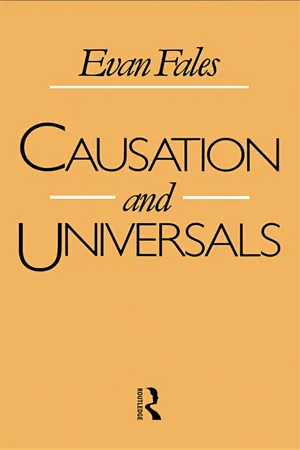
Causation and Universals
About this book
The world contains objective causal relations and universals, both of which are intimately connected. If these claims are true, they must have far-reaching consequences, breathing new life into the theory of empirical knowledge and reinforcing epistemological realism. Without causes and universals, Professor Fales argues, realism is defeated, and idealism or scepticism wins. Fales begins with a detailed analysis of David Hume's argument that we have no direct experience of necessary connections between events, concluding that Hume was mistaken on this fundamental point. Then, adopting the view of Armstrong and others that causation is grounded in a second-order relation between universals, he explores a range of topics for which the resulting analysis of causation has systematic implications. In particular, causal identity conditions for physical universals are proposed, which generate a new argument for Platonism. The nature of space and time is discussed, with arguments against backward causation and for the view that space and time can exist independently of matter or causal process. Many of Professor Fales's conclusions seem to run counter to received opinion among contemporary empiricists. Yet his method is classically empiricist in spirit, and a chief motive for these metaphysical explorations is epistemological. The final chapters investigate the perennial question of whether an empiricist, internalist and foundational epistemology can support scientific realism.
Information
Part one Causal realism
1 Natural necessity
1. METHODOLOGICAL PROLOGUE
It has been one of the most generally agreed upon doctrines of empiricism that there is no such thing as natural necessity. It is also one of the most universally troublesome doctrines. For, although the details are likely to be complicated, there is little doubt that a great many philosophical problems could be brought much closer to solution, if not actually solved, by means of the assumption that there are necessary connections in nature. Among these problems are: the problem of induction, the problem of providing a satisfactory analysis of the logical form of many of the laws of nature and of scientific explanations, the problem of providing a semantics for many of the subjunctive conditionals and disposition statements we use, and the provision of a sufficiently fullbodied conception of causation to sustain causal theories of reference, perception, and knowledge.
Abstinence from natural necessity has been largely responsible for the chronic anemia suffered by empiricist treatments of all these problems. This situation has led some philosophers, notably Arthur Burks, to attempt the construction of formal systems incorporating a causal operator. Others have investigated the related problem of formalizing subjunctive conditionals.1 But such systems are empty unless they can be provided with an adequate semantics. Talk of physically possible worlds, and the like, only defers the day of reckoning. Sense must be made of such talk. Of course the dialectical desirability of having a notion of natural necessity is one thing; getting such a notion into the philosophical arsenal without cheating is quite another. Much effort has been invested in seeking ways to avoid the essentially skeptical conclusions of Hume while remaining true to the spirit of his objections to natural necessity. But in the end, we are forced, I think, to confront directly the central issue in terms of which Hume’s destructive analysis of causal claims is cast. That is to say, we must confront the nature of those experiences from which our idea of causal connections derives indirectly – as a matter of theoretical inference or – as I shall maintain – “directly.” So this is where I propose to begin. Because I will be disagreeing with Hume – indeed, disagreeing with him on phenomenological grounds – it will be necessary to make a number of methodological observations before proceeding to the main task.
First, a terminological point of some importance. In his treatment of causation, Hume often speaks of the problem as that of finding some necessity in nature; and in these opening remarks, I myself have adopted this usage. However, for reasons which will presently emerge, I believe the notion of causal relation to be more fundamental than that of natural necessity, and not, strictly used, equivalent to it. Thus my initial and primary focus will be on this relation. Necessary connection – if by this one means the necessity of one event’s following upon another – will occupy a back seat. More generally, it is my view that a grasp of causal relations underlies our understanding of both necessary and sufficient conditions for the occurrence of an event, of (some, not all types of) natural law, of many counterfactuals, subjunctives, and disposition statements, and of the notion that (some) laws of nature are defeasible. In all of these related cases, I believe the ontologically and semantically fundamental notion is causation itself. Thus I am out of sympathy with attempts to reduce this notion to one of the others.2 I shall not attempt to develop in detail a semantics for subjunctive and dispositional statements3 but I shall have some things to say about laws and about the related problem of induction.
My first methodological point concerns the role of phenomenological appeals in philosophy. Like Hume, I hold that the contents of sensory experience provide the starting point (or more precisely, one of the starting points)4 for our thinking about the world. Therefore, that which we find in experience represents a court of last appeal with respect to those questions which are, or ought to be, decidable on such grounds. Distinct from their claim to epistemic fundamentality, however, is the claim that sense experiences provide us with knowledge. That further claim requires – and has traditionally been supported by – the view that the contents of experience are themselves known. And this must be distinguished from the claim that there is nothing more fundamental to be appealed to, should disputes arise as to what we are taught by experience.
I intend to engage in just such a dispute with Humeans; yet I should agree with Hume that there are some things about the contents of one’s own sense experience which can be known with certainty. But I also wish to insist that not all sensory content is cognitively transparent; and that it is not easy to articulate a general formula for just what it is that can be known in this way; certainly not as easy as some empiricists have supposed: though Hume himself, at times, is suitably cautious on this score. After all there are, embarrassingly, disagreements about the nature of sense experience; and it is incumbent upon the foundationalist to provide an explanation for this.
Moreover, whatever it is that may be known directly on the basis of sense experience must be independent of any philosophical theory of perception, and of any theory about the ontological status of the constituents of experience. For we surely have no business claiming that any particular philosophical analysis of this sort is known to be true (by philosophers, let alone by lay perceivers), whether it be a sense-datum theory, an adverbial theory, or a mental-state theory. Thus in making phenomenological appeals I shall try to state my disagreement with Hume, so far as is possible, in a way which does not presuppose any commitment to particular philosophical theories.
At the same time, I shall adopt an idiom – ‘sense content’ is a case in point – which may suggest or appear to favor a sense-datum theory. I do so partially for expository convenience, and what I say is, or ought to be, translatable into an idiom congenial to alternative theories of perception. Any theory must be able to provide an analysis of ordinary descriptions of perceptual awareness; and my goal is not to deviate from normal or natural usage. Eventually – but only in Part three – I shall provisionally adopt a sensedatum theory; so my present terminology also presages that provisional commitment. (I say provisional because I am far from convinced that the analysis of perception requires the positing of such entities as sense data.)
There is a rather cavalier way of dealing with disagreements at the level of sensation; and it is perhaps initially rather surprising that it is not more frequently mobilized to explain such differences. It consists simply of arguing that where such differences of opinion exist, it is because there are corresponding differences between the contents of the inner sensoria of the differing parties. We make this kind of move without hesitation when, for example, the difference occurs between a person who is physically blind and one who has normal eyes. Yet we are extremely hesitant to attribute such differences in experiential content to persons all of whose sense organs appear to be in good working order. From a philosophical perspective, this is rather puzzling, since it is not clear that the high confidence we attach to experiential congruence is justified. Nevertheless, it is sound philosophical strategy, in adjudicating or explaining phenomenological disagreements, to resist the temptation offered by this maneuver. Not only would this be a weak strategy dialectically – the Humean is unlikely to be moved by the claim that one has perceptual powers which differ systematically and pervasively from his own – but, used without independent justification, it would concede at the outset to skepticism more than we wish ultimately to concede. On the strategy I am forswearing, it would be alleged that Hume and all his followers have been equipped with impoverished inner sensoria: though they could see, hear, and smell, they have had no direct experience of causal connection – a defect which no doubt would cripple one (from the perspective of those endowed with this power) far more than blindness or deafness. Instead, it is my view that a sufficiently careful analysis of his own experience would have led Hume to change his mind – or at least exercise greater caution – in supposing there to be no “original” of the concept of causation to be found there.
Such boldness on my part needs to be supported by some words about the perils of phenomenological analysis. These problems are of at least three overlapping sorts. There are problems arising in the effective communication of phenomenological discoveries to others; I shall call these language-related problems. There are problems arising from the extraordinary complexity and wealth of detail which characterizes many experiences. Finally, there is the difficulty that the phenomenal character of many experiences, even fairly simple ones, is genuinely unclear. For example, it is often unclear into how many constituents an experience can be analyzed.5
The language-related problems include the likelihood that experience is too rich to be fully described by any actually existing natural language; and the fact that there is not very much one can say, at least of a philosophically enlightening sort, about sensations which are sufficiently elementary. When description and analysis fail, the best one can sometimes do for those who do not grasp what one is talking about is to try to get them into the situation of having that experience in a relatively salient way, and then, proceeding by means of the various devices of ostension and elimination, to get them to focus on what one has in mind. Arguing, as I shall, that we have identifiable experiences of causal relation will require in part resorting to this kind of strategy.
The problem of complexity has, as its corollary, the problem of deciding what is phenomenologically simple, and is in this respect a problem which is one among several which force us to admit that even what is “given” can be puzzling; its intrinsic nature is far from transparent to reflection. Take simplicity. If one gazes at a uniformly red wall, covering the entire visual field, it is tempting to say that the color is phenomenologically simple. Dismissing the suggestion that the color which is seen has spatial parts, and is on that account complex, we encounter a further objection which must be taken more seriously. It is possible to show that color perception is analyzable into three independently variable characteristics, to wit, brilliance, saturation, and hue. Arguably, these are the phenomenally simple constituents of color perception. Even such a trivial example suffices to show that judgments of simplicity and complexity are not so apodeictic as to brook no disagreement. Similar disputes are bound to arise, as indeed they have, over the analysis of experienced events and their relations.
Another locus of phenomenological unclarity is the phenomenon of inattention. Everyone recognizes what it is to focus upon certain items within a visual or auditory field, so as to have the other items recede into the background. But how are we to understand this difference between what is attended to and what is not? Metaphorical descriptions of relative vividness, and the like, may be suggestive, but they are not really accurate and are apt to mislead. That which is “out of focus” is still present in the perceptual field, and hence present to consciousness, yet in a sense it is also absent from consciousness. For example, let two qualitatively identical spheres be present within one’s visual field, and let attention be focussed upon the right one and not upon the left one. Then is the difference between the experience of them a phenomenal difference in the sensory images which one has – that is, in the objects of perception – or is it to be found in the nature of the act(s) of consciousness? Or, indeed, is the act/object distinction itself misguided? I believe it would be foolhardy to claim certainty with respect to this question or the others which I have mentioned. It should become sufficiently obvious presently how these remarks variously bear upon the problem of analyzing putative candidates for the experience of causal relation.
2. NATURAL NECESSITY AND LOGICAL NECESSITY
An essential feature of Hume’s skepticism about natural necessity is his denial of the reducibility of natural necessity to logical necessity. Most philosophers have found Hume’s arguments convincing in this regard, but some have not. The thesis that causal relations are logical relations or something closely akin has been advocated, for example, by Stout (1935), Ewing (1935), Harré and Madden (1975), and Blanshard (1962).6 This theory is one which I reject. We do not in the first instance acquire our knowledge that one event causes another by having such a sufficiently detailed knowledge of the first that we are able, by standard deductive procedures, to infer the occurrence of the second. Although it is possible to construct a description of an event which has causal implications, making sense of such a description presupposes that we have a prior understanding of causal connections. Nevertheless, it will be useful to examine some of the arguments put forward on behalf of the logical relation thesis. The arguments I shall discuss are due to Blanshard and Madden.
Blanshard’s main arguments are to be found in his Reason and Analysis.7 He argues, to begin with, that there are various relations of necessity which we find in experience, though not within the sensory content of experience. This just shows, he claims, that our experience of nature is not exhausted by its sensory content. And in particular, it shows that we have some knowledge of necessary connections which is grounded in our experience of objects, even though the necessity is not a distinct constituent of the sensory experience of those objects. Here are some of Blanshard’s examples: that this scarlet patch is more like this crimson patch than like that azure one; that this surface cannot at once be both blue and red; that this pink shade is a color; that the space between the ends of this ruler can be divided without limit; that this sweet taste is different from that sour taste. I have excluded a few of Blanshard’s examples which are essentially mathematical. The rest cannot, I think, be construed as involving logical necessity, at least not in a narrow sense. However the examples are quite disparate, and it is not easy to find a single element common to them all, which accounts for their necessity (or appearance of necessity – it may, for example, be false that the physical space between the ends of a ruler can be divided without limit). Common to many of them, however, seems to be the fact that the necessary relation they exemplify is an internal relation. That sweet and sour are different tastes, for example, is entailed by their natures. But does this not mean that we have here a case of logical necessity? And if so, should it not be unsurprising that there is no constituent of experience which can be singled out as the experience of the relevant relation? Yet there is some justice in replying on Blanshard’s behalf that if we wish to speak here of logical necessity, we are dealing with a relation of a very different kind than those deductive relations between propositions which depend upon the truth-functional operators and quantifiers. For in the former case but not in the latter, our apprehension of the relation is dependent upon a recognition of the sensuous content of certain experiences. Thus in the former case, the relation is in a sense to be found in sensory experience: we plausibly speak of tasting the difference between sweet and sour.
Secondly, Blanshard makes a distinction between imagination and conception. Conception, it seems, is for Blanshard stronger than the Cartesian notion of forming a clear and distinct idea of a thing, for it appears to require in addition that this idea reflect a complete understanding of its object. With this ...
Table of contents
- COVER PAGE
- TITLE PAGE
- COPYRIGHT PAGE
- OVERVIEW
- PREFACE
- ACKNOWLEDGMENTS
- PART ONE CAUSAL REALISM
- PART TWO UNIVERSALS
- PART THREE EPISTEMOLOGICAL REALISM
- NOTES
- BIBLIOGRAPHY
Trusted by 375,005 students
Access to over 1.5 million titles for a fair monthly price.
Study more efficiently using our study tools.
Frequently asked questions
Yes, you can cancel anytime from the Subscription tab in your account settings on the Perlego website. Your subscription will stay active until the end of your current billing period. Learn how to cancel your subscription
No, books cannot be downloaded as external files, such as PDFs, for use outside of Perlego. However, you can download books within the Perlego app for offline reading on mobile or tablet. Learn how to download books offline
Perlego offers two plans: Essential and Complete
- Essential is ideal for learners and professionals who enjoy exploring a wide range of subjects. Access the Essential Library with 800,000+ trusted titles and best-sellers across business, personal growth, and the humanities. Includes unlimited reading time and Standard Read Aloud voice.
- Complete: Perfect for advanced learners and researchers needing full, unrestricted access. Unlock 1.5M+ books across hundreds of subjects, including academic and specialized titles. The Complete Plan also includes advanced features like Premium Read Aloud and Research Assistant.
We are an online textbook subscription service, where you can get access to an entire online library for less than the price of a single book per month. With over 1.5 million books across 990+ topics, we’ve got you covered! Learn about our mission
Look out for the read-aloud symbol on your next book to see if you can listen to it. The read-aloud tool reads text aloud for you, highlighting the text as it is being read. You can pause it, speed it up and slow it down. Learn more about Read Aloud
Yes! You can use the Perlego app on both iOS and Android devices to read anytime, anywhere — even offline. Perfect for commutes or when you’re on the go.
Please note we cannot support devices running on iOS 13 and Android 7 or earlier. Learn more about using the app
Please note we cannot support devices running on iOS 13 and Android 7 or earlier. Learn more about using the app
Yes, you can access Causation and Universals by Evan Fales in PDF and/or ePUB format, as well as other popular books in Philosophy & Philosophy History & Theory. We have over 1.5 million books available in our catalogue for you to explore.