- 272 pages
- English
- ePUB (mobile friendly)
- Available on iOS & Android
eBook - ePub
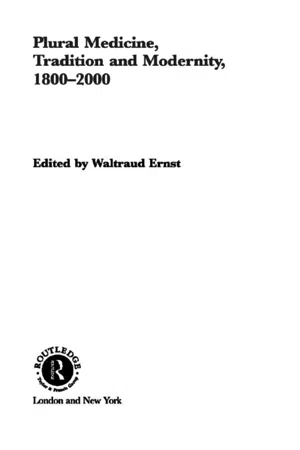
Plural Medicine, Tradition and Modernity, 1800-2000
About this book
Research into 'colonial' or 'imperial' medicine has made considerable progress in recent years, whilst the study of what is usually referred to as 'indigenous' or 'folk' medicine in colonized societies has received much less attention. This book redresses the balance by bringing together current critical research into medical pluralism during the last two centuries. It includes a rich selection of historical, anthropological and sociological case-studies that cover many different parts of the globe, ranging from New Zealand to Africa, China, South Asia, Europe and the USA.
1 Plural medicine, tradition and modernity
Historical and contemporary perspectives: views from below and from above
Waltraud Ernst
In current writing on the history and development of medicine ‘pluralism’ figures prominently. Cant and Sharma, for example, entitled their recent book A New Medical Pluralism? and asked whether the perceived increase in the popularity of alternative medicines meant that we were witnessing a new form of medical pluralism.1 The idea of pluralism seems to capture particularly well medical developments at a time when the world is supposed to be in its ‘post-modern’ and ‘post-colonial’ stage, and when references to cultural diversity and the variety of local practices abound.2 Even the similarly ubiquitous term, ‘globalisation’, which implies, in the view of some, the undermining of variety and pluralism, has come to be seen by many instead as the apotheosis of a plurality of local practices, as encapsulated in the slogan ‘think globally and act locally’.3 Emphasis is on the wide range of medical approaches patients turn to and the multitude of existing and newly emerging professional interest groups and formal as well as informal medical institutions – from high-tech cardiac wards staffed by specialist nurses and doctors, to health clubs, traditional Chinese medicine centres, internet discussion groups and chat rooms filled by occasional as well as habitual web surfers, and spiritual or psychotherapeutic healing sessions attended by what Sharma called ‘earnest seekers’, ‘stable’ and ‘eclectic users’.4
However, pluralism is new neither as a favoured concept within the history and philosophy of science (or within philosophy in general), nor as a phenomenon characteristic of medicine. In regard to the latter, we have learned from historical analyses such as Porter’s The Popularization of Medicine, 1650–1850 that ‘the terrain of healing has always been characterized by great diversity’, with learned or scientific medicine existing alongside popular or folk traditions, irregular or alternative medicine, as well as ‘quackery’.5 The variety of medical practices has also for long been a major focus within social anthropology. Arthur Kleinman and Charles Leslie, founding figures of medical anthropology in the USA, highlighted the existence of different strands of folk medicine alongside ‘learned’ Asian medicine as well as the varied, culturally specific medical traditions that co-exist alongside (or compete with) ‘Western’ medicine.6
One of the early classics of medical anthropology published in 1976, Asian Medical Systems, is based on the contention that ‘Asian medical systems are intrinsically dynamic, and, like the cultures and societies in which they are embedded, are continually evolving’.7 In a number of essays the ‘culture of plural medical systems’ is very much at the centre of analysis.8 Patients’ perspectives and what have become known among social historians of medicine as ‘views from below’ were not neglected either, as practices such as ‘healer hopping’ – namely patients’ strategies of consulting a number of healers in their pursuit of cure and better health care – were investigated in as much detail as other cultures’ medical literature and their practitioners’ variedly applied treatment regimes. Unlike in much of the medical historical and sociological writing of the same period, within the context of medical anthropology patients were perceived as active subjects rather than merely passive objects, subjugated by the prevalent medical discourse and suffering the treatments imposed on them by domineering medical experts.
Perhaps most importantly though, from the perspective of medical anthropology, Western medicine’s claim to epistemological and therapeutic superiority was being challenged by contrasting it with the successful treatment outcomes and the high levels of patient satisfaction of a variety of non-Western medical systems. It was shown that Western medicine was not always the universally preferred (or easily accessible) treatment option in all areas of the globe, and that a number of profoundly effective and highly sophisticated ‘traditional’ systems of healing not only predated the arrival of modern Western medicine in non-Western cultures, but also adapted successfully to the changing circumstances of a modern world.
Medical historians have only slowly come to avail themselves of the conceptual and empirical insights of anthropological scholarship in non-European cultures. Up until the 1990s or so a strand of ‘social historians’ of medicine, newly formed during the 1970s and 1980s, had been too busy throwing off what they perceived as the shackles of ‘Whig’ history, breaking away from the traditional, narrow historiographic focus on the medical profession, on medical institutions, and medical ideas. With social history of medicine came a focus on medical alternatives or ‘heterodoxies’, folk medicines, ‘quackery’, as well as on ‘the patient’s view’.9 On the whole, however, this new historiographic approach remained, much like its Whig predecessor, for a time essentially Euro- and Americo-centric in scope and in outlook. Critical publications on the history of colonial medicine, and the persistent vigour and challenge of fashionable subaltern and post-colonial theories eventually caused social historians of medicine, too, to draw on anthropological perspectives and to consider the development of non-Western medical paradigms and indigenous medicine worthy subjects of historical analysis.10
Despite the current trend towards anthropologically informed histories and inter-disciplinarity, typically only lip-service is paid to the recognition of non-Western perspectives as valid medical systems epistemologically, if not therapeutically, on a par with Western medicines. But at least recently published textbooks and encyclopaedias of medical history now contain (albeit short) chapters on ‘Eastern’ or ‘non-Western’ traditions alongside ‘the Western tradition’, and university courses on history of medicine in Britain include modules on non-Western medical perspectives.11 The cross-fertilisation between medical anthropology and medical history certainly constitutes a welcome development. At least potentially it enables previously marginalised non-Western ideas and practices to be valued, if not yet always on their own terms, then at least alongside Western medicine, as part of a plurality of traditions – within both Western and non-Western cultures. This book is a contribution to the growing field of studies that cut across academic methodologies and theoretical concerns and, most importantly, aim at breaking away from an exclusively Western and biomedically centred perspective. The essays on medical ideas and practices in India and Africa reveal the extent to which different medical traditions, including Western medicine, have prevailed and continue to exist alongside and, at times, in competition with, each other. In other chapters a similar situation is shown to have been prevalent also in nineteenth-century England, and modern-day China, Britain, Northern America, and New Zealand.
Despite the fecundity of inter-disciplinary and pluralist perspectives a number of conceptual (and perceptual) problems still persist. First of all, the conundrum of dichotomously arranged categories that tend to unduly restrict phenomena to criteria relevant to their binary opposites remains as yet unresolved. Debates about dichotomies and the move towards pluralism are, of course, not characteristic only of medical history and anthropology. Medical sociologists, cultural theorists, philosophers and literary studies scholars, too, are variously engaged in breaking away from the restrictions of deterministic monisms or dualisms and simplistic concepts and perceptions based on seemingly clear-cut binary constellations.12 They all attempt to fathom the extent to which pluralist perspectives allow more sophisticated analyses.
Despite critical awareness, terms like ‘indigenous medicine’, ‘folk medicine’ and ‘healer’, for example, even if used in their plural forms, are still redolent of those features that they have for long been thought of as lacking in comparison to their binary opposites (namely ‘Western medicine’, ‘learned medicine’ and ‘medical expert’). So much have they become seen as synonymous with ‘unscientific’, ‘superstition’ and ‘quack’ that even when they are not explicitly denigrated, their scientific status, the validity of their knowledge base and the integrity of their practitioners is almost automatically impugned. ‘Western medicine’, in contrast, is not usually required to justify its status as a ‘scientific’ procedure – it is implicitly thought of as such, even if, as explored in Bradley’s essay on hydropathy and orthodoxy, the basis on which the claim to scientificity is established may not be as solidly ‘objective’ and ‘scientific’ as it appears to Western imagination.13
We may well have come to see pure, perfect and pristinely delineated medical ‘systems’ and categories as inherently ‘ideological constructs’ that need to be used with caution.14 Their legacy, however, still lingers on even as we turn attention to medical ‘encounters’ or ‘exchanges’ or ‘interactions’ between … – well, one medical ‘system’ or category and another. The language of pluralism still tends to reflect the very same static and discrete meanings and perceptions that many writers, including the contributors to this book, aim to challenge and expose as products of restricted and restrictive imaginations and ideologies. Even terms such as ‘hybridity’ and ‘syncrecy’, ‘the global’ and ‘the local’, fashioned and put forward as solutions, tend instead to further highlight and illustrate the very problem of dichotomising a reality that is multi-faceted, forever in flux and never purely delineated, as these terms, too, are built on the assumption of pre-existing discrete (however vaguely defined) entities.
An emphasis on medical pluralism alone thus can, of course, not offer a straightforward solution to dichotomous polarisation. Its apparent capacity to challenge Euro-centrism, cultural myopia and prejudice may, however, make it conceptually preferable to the earlier focus on ‘Western medical superiority’, ‘power’ and ‘domination’ that did as much to reify these as to expose them. The current weariness with the 1960s and 1970s focus on issues of power, domination and hegemony and the wish to embrace a – seemingly – less deterministic perspective make pluralism appear as a more positive term that is congruent with and supportive of what is widely perceived as desirable social and political developments, such as the emergence of modern multi-cultural societies in former colonies and in Western countries with significant immigrant populations. As is shown in the essays on the options offered to and chosen by ‘consumers’ of healthcare in Britain, India and New Zealand, medical pluralism is indeed an important feature of multi-cultural societies all over the globe.
However, the emphasis on pluralism also harbours certain dangers. To begin with, it may well give further credence to one of the persistent ideological ploys of Western biomedicine: that medicine is located outside the realms of power, domination and hegemonic strife. An exclusive focus on medical pluralism in the domains of medical ideas and professional institutions, and in regard to patients’ freedom of choice colludes with the image of the medical market place and the sphere of healing as a ‘liberal heaven’, in which patients of all social and cultural backgrounds are supposed to have free choice and easy access to their favoured medical treatment; where medical professionals and itinerant healers of all stripes are said to ply their trade alongside, and in mutual respect for, each other; and where biomedicine could not only be simply one of a number of different modes of healing but also abstains from undue claims of epistemological superiority and greater efficacy and efficiency.
It is important here to differentiate carefully between the desirability of medical pluralism and the extent to which it has been realised in a ‘globalised’ medical world that is still powerfully dominated by American and European pharmaceutical firms, and by the promulgation of Western images of a healthy life-style and of biomedicine as the ultimate point of reference for the assessment of health problems and treatment outcomes. Analyses that focus on pluralism therefore still need to be situated squarely within the wider social and political context, being also sensitive to issues of power and medical hegemony. The essays in this book are written with this contention in mind. As shown in the chapters by Arnold and Sarkar, Scheid, Liebeskind, and Reis, patients’ and practitioners’ choices of and preferences for particular approaches are not simply individual decisions, but are also closely related to the struggle and search for national(ist) identity and the assertion of, and resistance to, cultural and political hegemony. An analytic focus on medical discourses in addition to reflections on patients’ views from below and practitioners’ virtuosity are therefore called for. As pointed out by Cant and Sharma, ‘The biomedical power which social scientists have wished to critique is no illusion. Historically speaking it has grown from … biomedicine’s political alliance with the state and … its espousal of scientific method as the basis for its authoritative claims to knowledge and expertise’.15
Another potential flaw of pluralist perspectives has been discussed particularly well by philosophers of science who argue that although pluralism is rightly envisaged to encapsulate tolerance towards different cultural and scientific frameworks and practices, it still requires to be constrained in some way on moral grounds (and, for some, on ontological grounds as well). Acceptance of differing views may on the whole be desirable, but on occasion particular approaches ought not to be tolerated (as in the case of Nazi medical experiments). This need to impose restrictions on medical practices and procedures on morally justified grounds posits again the very problem that medical pluralism may have been hoped to have dispensed with, namely the question of who is to assume the authority to decide on restrictions of pluralism and, therefore, issues of power, hegemony and domination.
The resulting problem is illustrated well by discussions in the United Kingdom and the United States about government intervention and professional regulation of the pluralist, alternative medicine market and the policing of health-related internet sites. Vankevich explores this issue further in his essay on the limits of pluralism. When the ethics, efficiency and effectiveness of alternative approaches are to be assessed, authorities steer precariously between the Scylla of imposing the well-tried and supposedly superior, scientific criteria of biomedicine on a whole range of healing practices, and the Charybdis of leaving the public exposed to potentially unprofessional, unethical and fraudulent, or simply ineffective, practices. In a similar vein patients’ and alternative practitioners’ interest groups, too, make at times incompatible demands when canvassing consumers’ rights to free choice and access to a range of treatments, while simultaneously reasserting government’s and scientific experts’ obligation to protect the public from potentially harmful practices.
Far from constituting a counter-paradigm to those much favoured up until recently (such as power discourses, medical systems and hegemony), a critical and informed pluralist perspective could therefore be conceived of as bringing both diversity and power issues into view. Importantly, power needs to be looked at not only in regard to Western biomedicine, the usual ‘bad guy’ in revisionist histories of the Foucaultian as well as the post-colonial genre. Traditional and non-Western systems of healing that have more commonly been seen mainly as victims of Western domination and arrogance are on their part not immune or averse to professional power play, shrewd global marketing and personal networking either. This point is explored in the chapters on Chinese medicine (Scheid), homoeopathy (Arnold and Sarkar), Unani (Liebeskind), and Ayurveda (Bode), in which the romanticised vision of non-Western systems of healing, as aloof from the profane domains of politics and profiteering, and true only to their ancient origins, spiritual values and holistic philosophy, is challenged.
It also is important to keep in mind that supposedly never-changing medical traditions such as Ayurveda (Hindu medicine), Unani (Islamic medicine), and Chinese medicine are not only made up of a number of different schools and diverse strands, but that they have also, over time, adapted in a variety of ways to changing local circumstances and global trends, and even shown themselves more recently as particularly adept in becoming active players in the medical market place – in their country of origin as much as in the West. Ayurvedic medical centres, for example, flourish not only in their expected strongholds (such as Varanasi in India), but also in cosmopolitan conurbations such as Mumbai, New Delhi and Calcutta, as well as in New York and London where Ayurvedic doctors can now be consulted and ‘traditional Ayurvedic’ remedies easily purchased in any ‘Body Shop’.
This phenomenon could well be lamented and construed as crass Westernstyle commercialisation of traditional medicine, as some sort of McDonaldization16 of traditional medicine that ought to be differentiated from the ‘real’ thing, the pure and original Ayurveda based on an age-old tradition that has been clearly codified in the ancient Vedic texts and practised the same way ever since. A significant number of traditionalist Ayurvedic practitioners as well as some New Age Western protagonists of the ‘real’ Traditional Ayurveda do indeed perceive these recent developments in such terms. However, they could also be seen as testimony to the fact that any one ‘tradition’ or ‘medical system’ is inherently heterogeneous (i.e. ‘plural’) and represented by different groups of people with diverse views on how practice ought to be adapted (or not) to changing circumstances – a potential for profiteering and commercialisation notwithstanding.
Moreover, just because a medical corpus can trace its origins back to some ancient text does not mean that it has to be inheren...
Table of contents
- Cover Page
- Title Page
- Copyright Page
- Figures
- Contributors
- 1 Plural medicine, tradition and modernity
- 2 Medicine on the margins?
- 3 In search of rational remedies
- 4 Arguing science
- 5 Categorising ‘African medicine’
- 6 Medical pluralism and the bounding of traditional healing in Swaziland
- 7 Nurses as culture brokers in twentieth–century South Africa
- 8 Kexue and guanxixue
- 9 Spirituality, belief and knowledge
- 10 Local–global spaces of health
- 11 Indian indigenous pharmaceuticals
- 12 Health for sale
- 13 Limiting pluralism
Trusted by 375,005 students
Access to over 1.5 million titles for a fair monthly price.
Study more efficiently using our study tools.
Frequently asked questions
Yes, you can cancel anytime from the Subscription tab in your account settings on the Perlego website. Your subscription will stay active until the end of your current billing period. Learn how to cancel your subscription
No, books cannot be downloaded as external files, such as PDFs, for use outside of Perlego. However, you can download books within the Perlego app for offline reading on mobile or tablet. Learn how to download books offline
Perlego offers two plans: Essential and Complete
- Essential is ideal for learners and professionals who enjoy exploring a wide range of subjects. Access the Essential Library with 800,000+ trusted titles and best-sellers across business, personal growth, and the humanities. Includes unlimited reading time and Standard Read Aloud voice.
- Complete: Perfect for advanced learners and researchers needing full, unrestricted access. Unlock 1.5M+ books across hundreds of subjects, including academic and specialized titles. The Complete Plan also includes advanced features like Premium Read Aloud and Research Assistant.
We are an online textbook subscription service, where you can get access to an entire online library for less than the price of a single book per month. With over 1.5 million books across 990+ topics, we’ve got you covered! Learn about our mission
Look out for the read-aloud symbol on your next book to see if you can listen to it. The read-aloud tool reads text aloud for you, highlighting the text as it is being read. You can pause it, speed it up and slow it down. Learn more about Read Aloud
Yes! You can use the Perlego app on both iOS and Android devices to read anytime, anywhere — even offline. Perfect for commutes or when you’re on the go.
Please note we cannot support devices running on iOS 13 and Android 7 or earlier. Learn more about using the app
Please note we cannot support devices running on iOS 13 and Android 7 or earlier. Learn more about using the app
Yes, you can access Plural Medicine, Tradition and Modernity, 1800-2000 by Waltraud Ernst in PDF and/or ePUB format, as well as other popular books in History & World History. We have over 1.5 million books available in our catalogue for you to explore.