eBook - ePub
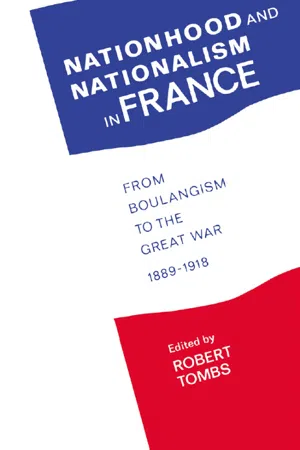
Nationhood and Nationalism in France
From Boulangism to the Great War 1889-1918
- 304 pages
- English
- ePUB (mobile friendly)
- Available on iOS & Android
eBook - ePub
About this book
Leading international historians examine the impact of nationhood and nationalism on French life. World-renowned contributors (many publishing for the first time in English), include Eugene Weber, Zeev Sternill, Pierre Sorlin and Jean-Claude Allain.
PART 1
Sentiment and ideology
Introduction
Robert Tombs
We agreed, in our discussions in Cambridge, that it was desirable and necessary to make a clear distinction between the sentiment of nationhood and the ideology of nationalism. The former was compatible with a wide range of social, political and intellectual positions, from royalist to socialist. The latter promoted the values and interests of the nation to a position of primacy, subordinating or even excluding from consideration other loyalties or beliefs.
Yet to make the distinction between sentiment and ideology was and is no simple matter. Obviously, even the seemingly most apolitical sense of nationhood is based on an ideology, for the nation itself is an ideological construct: as Maurras said, ‘there is naturally no France’.1 That thing to which one feels a sense of belonging has been created and its characteristics and its boundaries defined (or invented), not only in geographical but also in cultural and often racial terms. Eugen Weber discusses some examples below. Furthermore, the language of nationhood was so widespread and prominent among practically all parties that, as Pierre Sorlin suggests, it was difficult for avowed nationalists to distinguish themselves clearly from everyone else, at least in terms that the man on the Clichy omnibus could understand.
The problem of comprehension was not confined to the politically unsophisticated, for the intellectual components of nationalist ideology— what Raoul Girardet has called ‘the nationalism of the “nationalists”’2— were on one hand diverse and even contradictory; and on the other hand, many of them were shared with opponents professing what one might call ‘the nationalism of the non-nationalists’. In their chapters, Eugen Weber, Christian Amalvi and Gerd Krumeich analyse some of the diverse historical references that nationalists of various tendencies held to, and which also overlapped with those of the ‘non-nationalists’.
As Eugen Weber explains, theories of national origins could be used to promote division or reconciliation. The Frankish invasion was for long— certainly from the 1790s at least to the 1870s—a metaphor widely used to explain the origins of class divisions between the nobility, descended from the conquering Franks, and the common people, descended from the vanquished Gauls. Class conflict and revolution were therefore seen as stemming from racial conflict—a concept that could be used to aggravate or alternatively to evade present realities. For moderate republicans such as Henri Martin, the history of Gauls and Franks could become a message of ‘national unity and integration’ by showing that the modern French nation was the fruit of the fortunate historic intermingling of races and civilizations, with conflict relegated to the distant past. During the stresses of the 1880s and 1890s, there was a need to define again what the nation was, and Vercingétorix and Joan of Arc were elements in a mythology that could be used either to include or to exclude.
The towering event in the national mythology was the revolution, traditionally the benchmark of right and left. But as Christian Amalvi shows, nationalists held fundamentally opposing views of it. While one pole, that of Maurras and his followers, repudiated the whole revolution as evil, and another pole round Drumont reviled it as the harbinger of Jewish capitalism, the most dynamic element of the nationalist alliance, Déroulède and his Ligue des Patriotes, and its most prominent intellectual, Barrès, eulogized the revolution as the inspiration of energy. Even those whom Amalvi dubs ‘ordinary nationalists’, those crypto-monarchists who saw in nationalism a way to revive a mouldering cause, accepted the militaristic aspects of the revolution as part of the national saga. The great left/right fissure in the French ideological tradition, therefore, ran through the middle of the nationalist party.
The same polyvalence of national themes can be seen in two great symbolic figures of the time. The first was historical, Joan of Arc, whose nineteenth-century interpretations are minutely examined by Gerd Krumeich. The second was contemporary, Alfred Dreyfus, whose family and personal history are reconstituted by Michael Burns. Joan, merely a cypher for earlier generations of royalist historians, was rediscovered as a popular national heroine by the left—men such as Michelet and Quicherat—in the 1840s, as part of a populist national saga which, as Weber shows us, included Vercingétorix and the Gauls as earlier resisters of foreign oppression. It was the left who began to celebrate Joan as a daughter of the people, a proto-nationalist ‘betrayed by the king and burnt by the Church’. But from the 1860s onwards the church itself adopted a similar view of Joan as popular heroine, the symbol of a rival Catholic nationalism, combining love of France with religious devotion. Both these versions could claim some legitimacy, and Krumeich rejects the facile view that their exponents were mere manipulators of mythology. In the long run, it was the Catholic version that tended to prevail, being able to base itself on an older Catholic-nationalistic tradition. Hence, Joan’s statue in Paris became (and remained) a place for nationalist rallies from Action Française to Le Pen. We see, then, that the same myth was disputed by opposing political forces.
An even greater irony is brought out by Michael Burns: Dreyfus, the nationalists’ hate figure, had led the life of a nationalist paragon. Having left Alsace out of loyalty to France, he had devoted himself, just as much as the most passionate of Déroulède’s Ligueurs, to preparing for la revanche. For Dreyfus, just as for Barrès who execrated him, the French nation represented a supreme spiritual value: ‘Above all human passions, above all human error, there is the Fatherland…and it will be my supreme judge’ (see page). This, surely, is an expression of the ideology of nationalism, and not merely the sentiment of nationhood.
Dreyfus and Barrès might be taken to embody what Zeev Sternhell argues were two strands within the French nationalist tradition: the one individualist, universalist, rationalist and democratic; the other particularist, organicist and racialist. It has often been assumed that these two strands corresponded to the political left and right respectively (and hence the common description of nationalism moving from left to right in the late nineteenth century). But Sternhell argues that the two strands were always linked, even within the works of the same writers such as Michelet, one of the prophets of the romantic ‘left-wing’ nationalism of the mid-nineteenth century, in which both universalistic liberal and antiindividualist deterministic ideas coexist.3 What was new about the ‘new nationalist’ ideology of the end of the century, says Sternhell, was that it avowedly gave primacy to what had previously been partially concealed: ‘By definition [it] denied the validity of any universal and absolute moral norm: truth, law, justice only existed in order to serve the needs of the collectivity’ (see page). It was in these ideas, he argues, that the radical significance of nationalism lay, and he further suggests that the nationalists had ‘a chance of success only as long as they remained true to their leftist and populist origins’. Another view, however, would be that it was the absence of an opportunity to practise successful leftist and populist politics that forced them into a compromise—the fate of would be revolutionaries lacking a revolutionary situation—with conservatives. From this fate they, unlike the Italian and German fascists, fortunately lacked the opportunity or the strength to escape as long as the Third Republic lasted.
A different set of problems is raised by Pierre Sorlin and Stéphane Audoin-Rouzeau: how, and to what extent, did both the sentiment of nationhood and the ideology of nationalism reach the mass of the population, and how deeply did it influence their everyday thoughts and feelings? Both approach the problem in very different ways, and yet reach a number of suggestively complementary conclusions. Sorlin makes a bold and controversial attempt to gauge the extent to which the very language of nationalism was capable of being understood by a nonpolitical audience in the late nineteenth and early twentieth centuries, and also whether the use of language in nonpolitical contexts reflects the political preoccupations of the time. He also examines national themes and symbols in popular imagery. He concludes that although there was in common circulation vocabulary and imagery connected with what we have termed ‘the sentiment of nationhood’, it was very difficult for nationalists to get across their distinctive message: linguistically, there was ‘no room’ for them. It was suggested earlier that nationalism fed on the sentiment of nationhood; but it may be that, as far as mass appeal was concerned, it tended to be swallowed up by it. As Stone, Offen, Arnaud and Nord show later in the book, republican varieties of ‘quasinationalism’ were still very much alive. Hence, the distinctive message of the nationalism of the nationalists failed to get across clearly to a mass audience. In Sorlin’s words, ‘the conceptual context [may have been] particularly unsuited not to the elaboration of a doctrine but to its circulation’ (see page).
Audoin-Rouzeau analyses the writings of soldiers in the trenches during the Great War. He finds that nationalist themes are scarcely present, with the possible exception of an emotional tie to the earth in which the dead lay buried—a sentiment which may be a reflection of Barrèsian nationalism, but which in any case seems to be expressed mainly by the more educated soldiers. The author finds that even the language with which the schools of the Third Republic tried to inculcate a sentiment of nationhood is present only very selectively. He further suggests that, far from being a creation of the end of the century, the sentiment of nationhood that helped to hold the army of 1914–18 together had much older foundations.
The findings of Sorlin and Audoin-Rouzeau prompt a further reflection. This gap in understanding between the minority on whom nationalist ideas made an impact, and the mass of the population for whom more familiar themes (such as religion or duty) had greater significance, gives a further perspective on the mutual need of radicals and monarchists for an alliance under the nationalist banner. The radical nationalists stood to gain the popular constituency still clinging to the monarchists, who conversely were attracted by the former’s intellectual prestige and dynamic populism.
What, then, was ‘the nationalism of the nationalists’? The meeting of two Utopianisms, one revolutionary, the other traditionalist, which for all their seemingly irreconcilable differences of belief, aspiration and history, and of the heterogeneous sociological composition and interests of their constituencies, shared common denominators: a long-ingrained detestation of the ‘bourgeois’ political order founded on individualism, utilitarianism and all that Benjamin Constant had termed ‘la liberté des modernes’; and a consequent yearning for various notions of a purified, united, organic society. Together they formed one side in the conflict between pluralists and their enemies which, Raoul Girardet suggests,4 has been a fundamental ideological and political divide during the past two centuries, but which does not coincide with the familiar division of right and left.
NOTES
1 Quoted by Christian Amalvi, below p. 41.
2 Le Nationalisme français (new edn, Paris: Seuil, 1983), p. 16.
3 Michelet’s contradictions are rigorously analysed by Tzvetan Todorov, in Nous et les autres. La réflexion française sur la diversité humaine (Paris: Seuil, 1989).
4 Mythes et mythologies politiques (Paris: Seuil, 1986), p. 143.
1
Gauls versus Franks: conflict and nationalism
Eugen Weber
In the beginning was the conflict. This chapter is about conflict, about metaphors of conflict and about metaphors of resolution that lead to further conflict. Sixteenth-century France, torn by wars of religion which were also social wars, rediscovered its Gaulish ancestors also reft by antagonism and contest, also subjugated and kept in thrall by ruthless, preying foes.
François Hotman, a Protestant convert, spends part of his life as a refugee. His Franco-Gallia, written in bitter reaction to the massacre of St Bartholomew, summoned up Gauls and Franks to attack usurping royalty. Étienne Pasquier, a good Catholic, would lose his wife and one of his sons fighting against the Ligue. Writing about the political struggles of his time, Pasquier was to forge an image of Gauls divided and conquered, fated to live in bondage to their conquerors, the Franks. After the conquest, said this version of French history, only Franks were free, only Franks were noble. The people were the Gauls. As a friend of Ronsard put it, a lawyer ennobled by Henri III, ‘Entendez toujours pars le mot de François les nobles; car du commencement aucun ne porta ce nom, qu’il ne fut exempt d’impôts.’1
But the civil wars passed, the discourse of discord waned and was almost forgotten, to be recalled only in the eighteenth century, and then in increasingly explicit terms. I remind you only of Boulainvilliers, for whom the Gauls had become and remained subjects of the Franks, as much by right of conquest as by the obedience the strong exact from the weak, liberty and liberties being the prerogative of the Franks alone and of their descendants; the only ones to be recognized as nobles, that is, Boulainvilliers insists, as lords and masters.2
The Comte de Boulainvilliers was an eccentric. But his argument, however extreme, proved influential because it furnished a basic metaphor for claims and counterclaims, ever more shrill, ever more desperate. It served as premise for the nobiliary reaction—first against the Crown that had nibbled and crunched away their historic rights, but also a...
Table of contents
- Cover Page
- Title Page
- Copyright Page
- Acknowledgements
- Preface
- Part 1: Sentiment and ideology
- Part 2: Nationalism and politics
- Part 3: Policy in the era of nationalism
Trusted by 375,005 students
Access to over 1.5 million titles for a fair monthly price.
Study more efficiently using our study tools.
Frequently asked questions
Yes, you can cancel anytime from the Subscription tab in your account settings on the Perlego website. Your subscription will stay active until the end of your current billing period. Learn how to cancel your subscription
No, books cannot be downloaded as external files, such as PDFs, for use outside of Perlego. However, you can download books within the Perlego app for offline reading on mobile or tablet. Learn how to download books offline
Perlego offers two plans: Essential and Complete
- Essential is ideal for learners and professionals who enjoy exploring a wide range of subjects. Access the Essential Library with 800,000+ trusted titles and best-sellers across business, personal growth, and the humanities. Includes unlimited reading time and Standard Read Aloud voice.
- Complete: Perfect for advanced learners and researchers needing full, unrestricted access. Unlock 1.5M+ books across hundreds of subjects, including academic and specialized titles. The Complete Plan also includes advanced features like Premium Read Aloud and Research Assistant.
We are an online textbook subscription service, where you can get access to an entire online library for less than the price of a single book per month. With over 1.5 million books across 990+ topics, we’ve got you covered! Learn about our mission
Look out for the read-aloud symbol on your next book to see if you can listen to it. The read-aloud tool reads text aloud for you, highlighting the text as it is being read. You can pause it, speed it up and slow it down. Learn more about Read Aloud
Yes! You can use the Perlego app on both iOS and Android devices to read anytime, anywhere — even offline. Perfect for commutes or when you’re on the go.
Please note we cannot support devices running on iOS 13 and Android 7 or earlier. Learn more about using the app
Please note we cannot support devices running on iOS 13 and Android 7 or earlier. Learn more about using the app
Yes, you can access Nationhood and Nationalism in France by Robert Tombs in PDF and/or ePUB format, as well as other popular books in History & World History. We have over 1.5 million books available in our catalogue for you to explore.