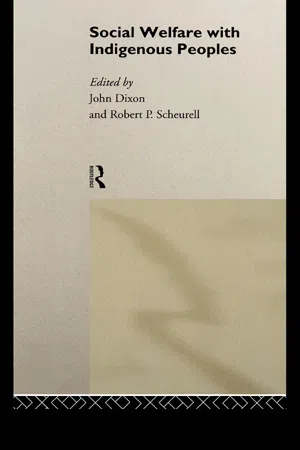
In many areas of the world, there has been an earlier indigenous population, which has been conquered by a more recent population group. In Social Welfare with Indigenous Peoples, the editors and contributors examine the treatment of many indigenous populations from five continental areas: Africa (Sierra Leone, Zimbabwe); Australasia, New Zealand; Central and South America (Brazil, Mexico); Europe (Scandinavia, Spain) and North America.
They found that, regardless of whether the newer immigrants became the majority population, as in North America, or the minority population, such as in Africa, there were many similarities in how the indigenous peoples were treated and in their current situations. This treatment is examined from many perspectives: political subjugation; negligence; shifting focus of social policy; social and legal discrimination; provision of social services; and ethnic, cultural and political rejuvenation.
eBook - ePub
Social Welfare with Indigenous Peoples
- 360 pages
- English
- ePUB (mobile friendly)
- Available on iOS & Android
eBook - ePub
Social Welfare with Indigenous Peoples
About this book
Information
1 The First Nations of Canada:
social welfare and the quest for
self-government
Hugh Shewell and Annabella Spagnut
There are three distinct groupings of native peoples in Canada: the Indians, the Inuit and the Metis (McMillan, 1988). Amongst them there are many differences in social organization, culture and demographics, and, in this chapter, it would be impossible to explain in any detail the genesis and impact of government social policies upon all of them. Our discussion, then, will focus on the Indian (First Nations) populations of Canada. We do this for two reasons. First, they are the only native group defined and governed by specific legislation of the dominant Canadian state; that is, the Indian Act (Canada, Revised Statutes of Canada, 1988). Second, the general group of peoples referred to as Indians have inhabited North America for the longest period. Their historical relationship with the western European cultures is especially symbolic of the intrinsic dilemmas facing all native nations in Canada today and, in particular, is embodied in their present relationship with the federal Department of Indian Affairs and Northern Development.
THE HISTORICAL CONTEXT OF FIRST NATIONS-EUROPEAN RELATIONS IN CANADA
The fur trade, dispossession and subjugation
The history of First Nations-European relations originates during the period of the fur trade beginning in the sixteenth century. The fur trade can be seen as a period in which First Nations were not only drawn inexorably into the history of western European capitalism and expansion but also, as a result, one in which their own cultures and national groupings experienced profound changes in population, economies, social organization and geographic distribution (Trigger, 1985; Wolf, 1982).
The colonial period from the late eighteenth to the mid-nineteenth centuries was characterized by a distinct change in the attitude of Europeans towards First Nations and in the accelerated dispossession of their lands. Fisher (1977:73) observed:
Indigenous society and behaviour is viewed through a cultural filter that distorts ‘reality’ into an image that is more consistent with European preconceptions and purposes. The process is complete when the image…becomes the basis for policy and action.
The change in Europeans’ attitude can be linked directly to their change in purpose from trade to settlement. Once the land became the object of European possession, Indians came to be seen as a hostile force, primitive savages who obstructed progress (Fisher, 1977:94).
Following Canadian Confederation in 1867 the federal government, which had been given responsibility for Indian matters under the new constitution, continued the policy of ‘civilization’ and assimilation under laws carried forward from the colonial legislatures. Also, the government continued to make treaties with First Nations in western Ontario and the prairie territories as these areas became the object of rapid settlement and economic expansion (Frideres, 1988; McNaught, 1988). The post-Confederation period from 1867 until 1945 was a period best described as Indian subjugation, during which successive federal administrations attempted to make Indians completely subject to the will of the state. The federal government, in concert with provincial legislatures, continued to displace Indians from their lands and confined them to reserves for the purpose of civilizing them with white, European ways, and sought to create among them a menial, working-class population (Titley, 1986).
Beyond the world of Indian affairs Canada was changing. Rapid industrialization, the Great Depression of the 1930s and the Second World War had an enormous impact on social and economic thought in Canada. The inability of capitalism and free market principles to provide and distribute social and economic goods equitably and adequately, the sacrifice of life for the state in two world wars, and a state which was wanting in its constitutional functioning and responsiveness to economic crisis created a climate for significant domestic reforms in the post-Second World War period (Banting, 1987; Guest, 1985; Owram, 1986). By the end of the war Canada was a nation concerned about equality and the rights of citizenship: it was a nation set to embark on the path of the interventionist welfare state (Guest, 1985; Owram, 1986). In the spirit of a new social consciousness, mainstream Canadians became more aware of the impoverishment of Indians and, with a certain collective shame, sought the amelioration of their condition in Canada (Miller, 1991).
The era of citizenship
Following the recommendations of the 1944 Parliamentary Committee on Post-war Reconstruction, and in response to public pressure, the federal government, in 1946, appointed a Joint House of Commons and Senate Committee on Indian Affairs. Its mandate was to enquire into the policies of the Indian Affairs Branch of the Department of Mines and Resources as well as into the general conditions of Indians living on reserves, with special emphasis on their status as citizens of Canada (Tobias, 1976; Canada, Special Joint Committee, Session No. 1, 1946, pp. iii-iv). The Committee reported to Parliament periodically over the course of its mandate, and these reports consistently centred on the necessity of advancing Indians to full citizenship. The fundamental assumption that Indians were to be assimilated was not questioned, but the tone of the assumption changed. It was no longer a question of subjugating Indians and of degrading their cultures, but of extending to them their rightful opportunities to be full and equal citizens of Canada. This required the state to become more active in their development and welfare. The state, through the Indian Affairs Branch, was to assume a positive mantle and become the advocate of Indian interests and the agent of their democratic equality.
The recommendations of the Special Joint Committee in 1948 set the policy agenda of Indian Affairs for the next 35 years. In 1949, in a symbolic move, Indian Affairs was made a branch of the Department of Citizenship and Immigration. This was followed in 1951 by the enactment of a new Indian Act which, while eliminating the worst features of the original Act, continued to mandate the Department to accomplish its same ‘civilizing’ aims (Tobias, 1976:25–6). Throughout the 1950s and into the 1960s the Department emphasized the integration of Indians into mainstream society. Three areas were stressed: the education and social integration of Indian children; the provision of public works programmes on reserves to create the illusion of economic integration; and, the extension of provincial laws and services on to reserves so that Indians might be treated exactly like other Canadians (Miller, 1991; Shewell, 1991a; Weaver, 1981).
Persistent and endemic Indian poverty and unemployment gave rise to a further Joint Parliamentary Committee review of the Department’s policies and progress beginning in 1959. One important outcome of this committee was the unconditional extension of the federal franchise to adult Indians in 1960. However, the work of the Indian Affairs Branch posed a more difficult problem. Citizenship and Indian integration had become yet another paternalistic mission of the government. In their own testimony before the Committee, Branch officials maintained that progress was slow partly because of varying degrees of Indian readiness to enter ‘modern’ Canadian life and partly because of the reluctance of the provinces to extend their services–especially welfare services–on to the reserves (Canada, Joint Committee of the Senate and of the House of Commons on Indian Affairs, Minutes of Proceedings and Evidence, 1959–61). The Committee ended by endorsing the objectives of Indian Affairs and called for more federal-provincial cooperation in their achievement.
In early 1963 influential pressure was again brought to bear on the federal government to find ways to alleviate Indian poverty and to develop programmes that would bring Indians into the mainstream of Canadian life (Weaver, 1981:20–1). This pressure resulted in a commissioned, independent study of the Indian Affairs Branch, A Survey of the Contemporary Indians of Canada, known as the Hawthorn Report (Hawthorn, 1966; Weaver, 1981:20–1). Central to the Report was a powerful theme supporting the integration of Indians into Canadian society through the full extension of social, political and civil rights coupled with the protection of their historically special status. Indians, the Report argued, should be regarded as ‘citizens plus’. The Report, while critical of the Indian Affairs Branch, recommended its thorough reorganization (not its abolition, as some had hoped) and reiterated the necessity of the Branch being an advocate of Indian interests and a co-operative partner with them in future policy development (Weaver, 1981:23–4).
Finally, the Hawthorn Report was especially critical of the provinces which, it opined, were at best indifferent to the plight of the First Nations. As the other key players to integration, the provinces were decidedly resistant to involvement in Indian matters (Hawthorn, 1966, in Getty and Lussier, 1983). Constitutionally, the provinces continued to insist that Indians were the sole responsibility of the federal government despite considerable opinion to the contrary (Shewell, 1991a; Weaver, 1981:27). This created a de facto situation where Indian Affairs, in order to continue to promote integration, increasingly began to provide the services and infrastructure akin to provincial and municipal government at the band level.
We now come to a watershed period in the history of First Nations-Canada relations. The Hawthorn Report, while never fully endorsed by the federal government, did inspire considerable reform within Indian Affairs. But it was its theme of equal citizenship which carried forward into the federal government’s next and boldest attempt to resolve the ‘Indian problem’. Beginning in the late 1960s, the federal, Liberal administration of Pierre Elliott Trudeau entered into on-going consultation with First Nations’ leadership to determine the future of Indian policy and of the Indian Act (Weaver, 1981; Miller, 1991:223–9). In June 1969 it tabled in Parliament the Statement of the Government of Canada on Indian Policy, known as the White Paper. The White Paper proposed fundamental changes in the status of Indian peoples in the social structure of Canada. It recommended: the repeal of the Indian Act and its replacement by an Indian Lands Act; the end of the distinct status for Indians and the speedy assurance of full citizenship with attendant services and opportunities; and finally, the dissolution of Indian Affairs (Weaver, 1981:166–7). The White Paper was seen by many to be a progressive document of the 1960s, in tune with social reform and civil rights. It proposed to end not only discrimination but also the insular colonialism of Indian Affairs, something the Hawthorn Report had failed to do (Weaver, 1981:24). Yet its objectives were troubling. Upon analysis it was the continuation of a familiar theme: civilization and assimilation. But this time it was to be civilization without protection, citizen status without the ‘plus’. Existing historical and treaty rights were to be ended and any outstanding grievances resolved through the proposed Indian Lands Act. Indians were to shed their Indian status forever, get on with being full and equal citizens, and forget about historical might-have-beens (Weaver, 1981:55; Gibbins and Ponting, 1986; Tobias, 1976:26).
Indian leaders condemned the government proposals. So intense was their opposition that the federal government withdrew the White Paper in 1971 and declared an end to assimilation policy (Weaver, 1981:187). Some analysts (Gibbins and Ponting, 1986) assert that Indian policy has since been thrown into purgatory and never reformulated. We take a somewhat different view. Although the federal government dropped the legislative proposals of the White Paper the programme objectives remained in place. This meant that throughout the 1970s Indian bands were increasingly developed as modified forms of municipal governments. The federal government infused large amounts of funds into the provision of administrative and service infrastructures, as well as creating employment both in the on-reserve management of band affairs, the delivery of services and in community and public works (Driben and Trudeau, 1983). What could not be accomplished through legislation could still be done through the relentless expansion of federal and quasi-provincial programmes.
The quest for self-government
After 1971 the landscape against which the Department of Indian Affairs conducted its business changed rapidly. Up to 1971 the Department had administered its policy and programmes relatively unchallenged; now the entire Indian agenda of the Canadian government was under scrutiny not only by the Indian First Nations and their allied organizations but also by public policy groups and interested academics. The White Paper rejuvenated Indian politicization. Although Indians had always resisted government policies that resistance now entered a confrontational phase. Until 1969 Indians had sought economic and social justice through a cooperative strategy and had complied somewhat with the goals of citizenship providing they could maintain their unique status in Canada. The First Nations wanted to share in Canada without having to compromise their heritage and inherent rights. When, in 1969, it became apparent that the government still intended that they be assimilated, Indian strategy became proactive. Although Indian Affairs continued to expand and enrich its programmes, the political relationship with First Nations changed. Beset by government programmes which they were increasingly required to administer, but faced with continued economic and social deprivation, a politically articulate Indian leadership began to demand the right to self-government (Frideres, 1988; Miller, 1991).
In 1980, in an effort to allay Quebec separatism, Prime Minister Trudeau decided the country was ready to establish a renewed federalism through the repatriation of the constitution together with a charter of entrenched rights and freedoms. The task of repatriation was politically and legally difficult. Not only did the provinces have to agree to repatriation and an amending formula, but also to the principles and contents of the proposed charter (McNaught, 1988). The proposed charter attracted intense lobbying from various groups anxious to ensure that their rights were recognized and entrenched. Significant among these groups were aboriginal peoples. At first, the provincial premiers refused to entrench the basic rights of aboriginals. But continued lobbying by their national organizations finally resulted in existing aboriginal rights being affirmed in principle, together with a specified, time-limited constitutional process during which those rights would be defined (Greene, 1989:58–9, 234). All the provinces–with the critical exception of Quebec–agreed to the new accord, and the Constitution Act, including the Charter of Rights and Freedoms, became law in 1982.
Although federal government programmes continued to foster integration and ‘mainstream normalization’, there was a growing public understanding of the unique historical status of First Nations and of their demand for self-government. Th...
Table of contents
- COVER PAGE
- TITLE PAGE
- COPYRIGHT PAGE
- CONTRIBUTORS
- PREFACE
- ACKNOWLEDGEMENTS
- 1. THE FIRST NATIONS OF CANADA: SOCIAL WELFARE AND THE QUEST FOR SELF-GOVERNMENT
- 2. SOCIAL WELFARE OF THE INDIGENOUS PEOPLES WITHIN THE UNITED STATES OF AMERICA
- 3. THE HUICHOL AND YAQUI INDIANS OF MEXICO
- 4. SOCIAL WELFARE OF INDIGENOUS POPULATIONS IN BRAZIL
- 5. WELFARE RULES AND INDIGENOUS RIGHTS: THE SAMI PEOPLE AND THE NORDIC WELFARE STATES
- 6. THE GYPSIES AND THE SOCIAL SERVICES IN SPAIN
- 7. FROM EXCLUSION TO DEPENDENCE: ABORIGINES AND THE WELFARE STATE IN AUSTRALIA
- 8. BI-CULTURALISM, SOCIAL POLICY AND PARALLEL DEVELOPMENT: THE NEW ZEALAND/MAORI EXPERIENCE
- 9. SOCIAL WELFARE OF INDIGENOUS PEOPLES IN ZIMBABWE
- 10. THE IMPACT OF THE SOCIAL-WELFARE SYSTEM ON THE TEMNE ETHNIC GROUP OF SIERRA LEONE
Trusted by 375,005 students
Access to over 1.5 million titles for a fair monthly price.
Study more efficiently using our study tools.
Frequently asked questions
Yes, you can cancel anytime from the Subscription tab in your account settings on the Perlego website. Your subscription will stay active until the end of your current billing period. Learn how to cancel your subscription
No, books cannot be downloaded as external files, such as PDFs, for use outside of Perlego. However, you can download books within the Perlego app for offline reading on mobile or tablet. Learn how to download books offline
Perlego offers two plans: Essential and Complete
- Essential is ideal for learners and professionals who enjoy exploring a wide range of subjects. Access the Essential Library with 800,000+ trusted titles and best-sellers across business, personal growth, and the humanities. Includes unlimited reading time and Standard Read Aloud voice.
- Complete: Perfect for advanced learners and researchers needing full, unrestricted access. Unlock 1.5M+ books across hundreds of subjects, including academic and specialized titles. The Complete Plan also includes advanced features like Premium Read Aloud and Research Assistant.
We are an online textbook subscription service, where you can get access to an entire online library for less than the price of a single book per month. With over 1.5 million books across 990+ topics, we’ve got you covered! Learn about our mission
Look out for the read-aloud symbol on your next book to see if you can listen to it. The read-aloud tool reads text aloud for you, highlighting the text as it is being read. You can pause it, speed it up and slow it down. Learn more about Read Aloud
Yes! You can use the Perlego app on both iOS and Android devices to read anytime, anywhere — even offline. Perfect for commutes or when you’re on the go.
Please note we cannot support devices running on iOS 13 and Android 7 or earlier. Learn more about using the app
Please note we cannot support devices running on iOS 13 and Android 7 or earlier. Learn more about using the app
Yes, you can access Social Welfare with Indigenous Peoples by Professor John Dixon,John Dixon,Robert P. Scheurell in PDF and/or ePUB format, as well as other popular books in Medicina & Prestazione di assistenza sanitaria. We have over 1.5 million books available in our catalogue for you to explore.