- 200 pages
- English
- ePUB (mobile friendly)
- Available on iOS & Android
eBook - ePub
About this book
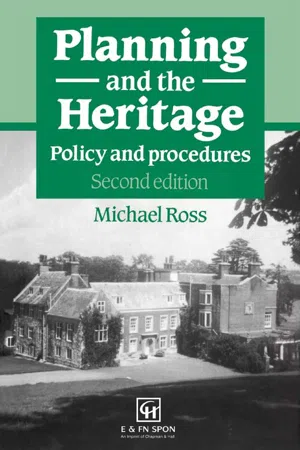
This is a clear guide to heritage legislation in the UK. It is set out in plain, non-legal language and will guide the planner, developer, architect or conservationist through the legislation, explaining the policy and procedures which govern the protection of historic buildings as well as providing clear explanations of the issues involved, including listing, planning appeals and grants.
Information
Chapter 1
WHY CONSERVE?
Man is a naturally conservative animal. We dislike change for change’s sake and, except for the occasional break, we crave the familiar and establish routines if none exists. Fresh fields and pastures new excite us but they also make us nervous and wary unless and until they obtain their own familiarity. To cling to one’s surroundings—to conserve—is simply a variation of this theme. It is as natural as the urge to protect ourselves and our families. But is it right? Can it be justified in a fast-changing world when the idea of progress, even if no longer accorded the halo of sanctity, is still considered by the vast majority of us as a given good? In this chapter, we shall examine why we wish to conserve buildings and exactly what conservation means.
There are perhaps three reasons why we wish to conserve the best of our buildings: the archaeological, the artistic and the social. The first two factors have always been with us, although their importance has grown in the last 100 years or so. The archaeological motive is the instinct to preserve something of historic interest. At its crudest, it is simply a desire to preserve the past as a curiosity. There is nothing particularly wrong with this. Probably the majority of visitors to our country houses and museums go in order to derive some entertainment value from comparing the lifestyles of our ancestors to the present day. It is the instinct that moved humans in past ages to preserve anything at all from our history where it did not have a continuing use, and it was probably the motive behind the very first conservation legislation in this country. At its best, the archaeological factor is scholarly and even, on occasion, passionate in its belief that the past can yield something for the present.
The artistic factor is similarly important. It springs from the desire to preserve something of beauty which has been built with the skill and care of the craftsman. The very first conservation movement—the Society for the Protection of Ancient Buildings—was founded, in part, as a reaction to the mass-produced excesses of Victorian England. That we now value some of those mass-produced artefacts ourselves is simply a commentary on our own changing perceptions. In the last 30 years of the twentieth century, we have become more tolerant of architectural and aesthetic style. We no longer ignore the eighteenth century as an irrelevance as our grandparents did between the wars; we do not revile Victoriana as our parents did; and many of us have conceived a liking for inter-war styles and even—though perhaps less in architecture than with the other arts—for the post-war. There are probably fewer fixed points in our contemporary iconography than in any previous age: we are conditioned in our tastes by a rich variety of styles and we value them and seek to conserve the best examples. From medieval barns and churches through Palladian mansions and Victorian factory buildings to art deco cinemas and red telephone kiosks, popular taste in architecture has never been more varied. Our concern for the heritage—to conserve—reflects our desire to keep those styles and archetypes to which we can relate artistically.
It is a social factor, however, that has driven the cause of conservation forward so strongly in the past 20 to 30 years. Put simply, it is a feeling of unease at the pace of change and the nature of change. It is an attempt to hold on to the familiar and reassuring. In its broadest terms it can be related to the changing and diminished role of Britain in the post-war years and the growth of a positive industry in the manufacture of nostalgia in the artistic media—from L.S. Lowry through Chariots of Fire to the endless period dramas of contemporary television. In terms of the environment, it is related to the destruction of many of our historic centres before, during and after the war and their redevelopment in architectural styles which have won little public acclaim and which, in some well-publicized cases, have failed monstrously even as machines for living and working in.
There is of course a picture of Britain and it is familiar to all of us from calendars, books, picture postcards and our TV screens. It consists of thatched or tiled cottages in the south, paired with sleepy market towns and ornate churches, and a north comprising rugged stone cottages and the satanic mills of Blake’s Jerusalem. The fact that this is a caricature, and is even accepted by most people as such, does not detract from its strength. Ask any television cameraman to produce an image to express the south, and the chances are that he will pick a Devon lane or Salisbury Cathedral; an image of the north, and he will pick a Yorkshire dale or a Lancashire mill town. The images are reassuring and they contain, like any caricature, a certain truth.
The image comes closer to home. The Londoner may not care too greatly if the mill is to be demolished; nor is the Yorkshireman likely to mourn the loss of a Devon lane. But they do care if well-loved landmarks nearer home disappear, because this endangers their identity.
The image changes again. We all of us care if a feature, not necessarily even a landmark, disappears after years of familiarity. Whether the feature is of any interest or not is irrelevant. We knew it. We lived with it. It was part of our being. Without it, we feel a little less whole, a little less comfortable. Suddenly, we wish we could have prevented its going.
We are conservationists.
Conservation movements are very much produced in reaction to change. The first conservationists were resisting the excesses of the Industrial Revolution: a second wave came in the 1920s and 1930s as new development took off again and the unplanned growth of towns threatened the countryside and swallowed up whole villages and towns on the edges of our greater conurbations. Finally, in our own time, the handiwork of the Luftwaffe followed by the comprehensive rebuilding of so many of our towns and cities and continuing urban expansion have produced the third and greatest wave of conservation reaction.
The law has reacted to the conservationist pressure, but it has been able to protect only the best of our buildings (and more recently our most lovely areas). To the man or woman in the street lamenting the demolition of their local cinema or the house they were born in, the legislation must seem criminally inadequate. For them, the protection of the best architecture seems academic. If change means for them their displacement from well-known and well-loved surroundings to an out-of-town housing estate or a tower block, their feelings of alienation may become a social or even a medical problem. The difficulties experienced by people who have been affected this way lie outside the scope of this book, but they are familiar to anyone who has dealt with conservation questions and in particular the psychology of conservation.
The politicians have ignored conservation at their peril. They started after the last war with the noblest of motives to rehouse a population many of whom had lost their homes to the bombers or who lived in substandard accommodation. The post-war age was the great era of central planning. Mother always knew best, but in this instance mother was the Government or the local authority. Much of what they did was excellent. Much of what they did was necessary and humane. But its effects were sometimes successful only in solving one ill by creating another.
Perhaps it was not the face of redevelopment but the way it was carried out that now turns the blood cold. Communities uprooted, decanted and reassembled produced an understandable hostility and this in turn has been responsible for much of the vandalism and more serious anti-social behaviour with which we are all too familiar. The new communities that were planned were often soulless—unending grids of streets and courtyards, often entirely lacking in social or even shopping facilities. Then there were the tower blocks, which were good for some but a living hell for others. Corbusier’s drawings, as fine and fantastical as the Italian futurists of the early years of the century, often became built nightmares in the hands of lesser architects acting for councils with an overriding interest in cost. The aftermath of the Ronan Point disaster in 1968 simply accelerated their rejection by most of society.
Those new communities that succeeded—and some did succeed—did so because they were successful in recreating a sense of community which, even where it had not existed, was associated with the old houses and towns that had been left behind. Oddly enough some of the much criticized tower blocks are now themselves becoming success stories under the impact of new central and local government initiatives designed to improve their fabric, provide the amenities that should have been provided in the first place (such as entryphones and adequate lighting in public areas), and to create a new sense of community. By the late 1960s, there was a loss of confidence in modern architecture and it has never since been regained. The architectural profession has been notoriously bad at defending its own corner. When tested, architects have not always proved able to answer their critics. For a time in the mid-seventies, when the conservation movement was gaining ground, it seemed as if the well-designed new building was one that tried its best to disappear from view altogether by hiding behind landscaped features or curtain walls of blackened glass. Community architecture—which was little more than the architect heeding what the users of his building told him about what they wanted—was treated as revolutionary and in some quarters as a form of deviancy. The architects’ response to public revulsion against modernism was the toytown delights of post-modernism, with its silly ornamentation and false decoration.
It is small wonder that against this background the emphasis should turn from new build to restoration and refurbishment and it was actually found in many cases to be cheaper. Since the late 1960s, comprehensive redevelopment and clearance have dropped slowly out of the housing vocabulary. Repair and improvement have become the buzz-words. To conserve is better than to redevelop. The successful man or woman aims to buy an old cottage or house in the country where in the mid-thirties they might have commissioned a Maxwell Fry or a Walter Gropius to build them a concrete cube in the Home Counties. The magazine racks have blossomed with Traditional this and Period that. The architects’ own magazines are not even generally available, unlike their counterparts on the Continent.
There is another point, and it is an important one. A Picasso is hung in a gallery. Beethoven belongs in the concert-hall and can be silenced by turning the knob of a radio. But architecture is all around us. It is the only genuinely popular art form. We cannot shut our eyes to it. We must not only live with it but in it, and unless we have the wherewithal we usually have little choice in the matter. It should be the most democratic and popular of the art forms, and the fact that modern architecture has so few admirers and the traditional styles so many is a vote not only on what is best liked but also on what actually works.
Traditional architecture is not only familiar to us but to coin a phrase it mixes well. Britain has few towns which are set pieces of one style of architecture. Most streetscapes consist of a variety of architectural styles from different ages; there are, however, certain conventions. They are likely to retain the same building line; they are probably built or faced with similar materials or, if these are different, there is usually a pleasing sense of variety. There will almost certainly be a little ornamentation, even if it is only on cornices or around windows and porches. Compare this to the street where a piece of insensitive modern architecture has been introduced. The building material may be unsympathetic; the building will bulk large, and ornamentation is likely to be lacking. Any new building is likely to obtrude by its very newness.But it should be capable of complementing its older neighbours. There should be a dialogue between them. The bold architectural statement has its place, but the average High Street is the wrong one. Good, sensitive modern architecture—once scathingly referred to as Heritage Year infill—certainly has a place, and those who practice it have found plenty of clients over the last few years. WHY CONSERVE?
Has the pendulum swung too far? Are we in danger of turning the country into a huge conservation area? There are certainly strong economic arguments against keeping heritage buildings up at any cost. Industrialists who find themselves located in a listed building may simply find it uneconomic to maintain. At worst, their livelihood may be threatened and removal to new premises may be impracticable or too expensive. Again, we might question whether the constant imposition of aesthetic judgements about what is of special architectural interest is wholly compatible with propertyowners’ rights to do what they like with their own property. Finally, will there ever be an end to the Government’s programme of producing lists of historic buildings enjoying statutory protection, or to local authorities’ designation of conservation areas where lesser degrees of control apply?
The Department of the Environment has done its best to answer these fears. Listing and inclusion in a conservation area place few new burdens on owners, and the listed building consent process exists to test among other things the economic viability of maintaining a listed building. But the doubts remain. Only a tiny percentage of our total building stock may be listed, but the figures seem to continue to expand. A nation that regained some of its self-confidence in the 1980s and is committed to economic growth on the free enterprise model may find the idea of onerous state and local authority controls anathema. The Conservative Government since 1979 has done much to streamline planning controls, especially in those growth areas which may be suitable for designation as Simplified Planning or Enterprise Zones. Has the time perhaps come when the conservation of the built heritage should similarly be given a new look and a halt called to the increasing numbers of buildings and areas enjoying protection?
We shall attempt to answer these questions in the ensuing chapters. Conservation has had a good press over the last 25 years for the reasons we have been advancing. But the development that is prevented at the last moment by a late spot-listing; the householders who find their double-glazing contract is worthless until they receive consent for the work to their newly-listed house; the owners aggrieved that their house has been listed without their being able to comment on the proposal and fearful of its implications—these are the sort of individual problems that need to be addressed, not least because the individuals concerned are unlikely to be unscrupulous property developers. In fact, Government has addressed these questions and has managed to produce satisfactory solutions in most cases. But the days when the conservation movement had a clear run of public opinion are long since gone. There are respectable arguments against conservation and they must be answered intelligently. Where they cannot be answered, they should be attended to.
Perhaps the key to the pro- and anti-conservation arguments is the word conservation itself. In the dictionary, it has a very similar meaning to preservation but, so far as historic buildings and architecture are concerned, there is a difference and it is more than a semantic one. Conservation has come to allow for the possibility of change—for the better—where preservation has retained its original sense of pickling. The difference is most evident in the legal definition of conservation areas, which are defined as areas of special architectural or historic interest, the character or appearance of which it is desirable to preserve or enhance. Similarly, the act of listing does not mean that a building must necessarily be preserved in its original state for all time (although there is a presumption against change). The listed building consent process allows for works of alteration or extension, especially where these enhance the chances of preserving the building. As we shall see, there has been almost a growth industry in finding new uses for old buildings. Departmental circulars extol the practice, architectural books demonstrate the practical aspects, and architects themselves have been responsible for some remarkable work, all in the name of conservation and its implication of change where change is due.
This change of emphasis is itself due at least in part to the growing pressure that we have experienced in the heritage field over the past 35 years or so. Early legislation thought merely in terms of preservation—as in Building Preservation Orders, which preceded the present listed building controls. But two sorts of pressure have acted to change matters. In the first place, the speed and intensity of development have forced on us the necessity of either adapting our old buildings to new uses and modern standards or of sweeping them away. Not unnaturally, we have chosen the path of adaptation, and that route now has the blessing of official policy, as we shall see. Adaptation in this case means not only the most dramatic cases of old buildings being found totally new uses requiring a certain amount of internal and even external alteration. It also means bringing old buildings into line with the needs of the late twentieth century—in terms of safety standards and in simple terms of central heating and other forms of comfort. Achieving this in a way that allows the building to keep its special interest is one of the challenges that the local planning authority conservation officer as well as the individual owner and his professional advisers must face.
The second pressure has been the sheer growth in the numbers of listed buildings and conservation areas. Our appreciation of the heritage has accelerated partly as a reaction to the pressures of development, but it has itself produced a challenge to society. Developers have found increasingly that the sites they wish to develop are occupied by listed buildings or are situated in conservation areas, and that their plans may accordingly be opposed not just by local protesters but by the planning committee. There has been a pressure on them to adapt their proposals, to make use of the buildings that they find on-site or to design new ones that are in keeping with the character and appearance of the surrounding area. Sometimes to their surprise, they have found that this is cheaper than total redevelopment and produces more pleasing results. The challenge has been to the architect and the planner to find the right result in each individual case. Most often, the end-product has been a good oldfashioned British compromise—but it has been none the worse for that. The days when the architectural profession castigated infill architecture have gone: but so too have the days of the diehard preservationist for whom to remove stone from stone of any listed structure was a confession of vandalism. It has been a long and hardfought contest, and in some quarters it still goes on. But conservation now allows for the possibility of adaptation, and it has gained a respectability with everyone involved with the development system, and is no longer the concern of a single lobby.
That is perhaps the greatest tribute to the way that we care for our heritage in this country. The numbers of listed buildings and conservation areas have both grown fourfold since the early 1970s. Both are often to be found in urban centres where development pressure is greatest. There are still battles between the developer and the conservationist: the Mansion House Square proposals in the City of London and the controversy over the foundations of the Rose Theatre in Southwark were witnesses to that. Significantly, both were in central areas of the capital where property prices are high. There are plenty of local contests too as most amenity societies would testify. But the idea of conservation, the presumption that the old must survive—and on occasion adapt has triumphed. The notion of the continuing community, one which acknowledges the value of much of its past and treasures its qualities, has taken root in architecture and planning as it has in other areas of life. We prefer organic change to radical change and on occasion we prefer no change at all. Much damage has been wrought to our historic centres in the process of coming to this conclusion: whole communities and areas have been cleared away, and not always because rehabilitation and restoration were too expensive an option. The philosophy of conservation, however, is accepted by the majority; architects, developers, planners and politicians cannot ignore this fact.
Chapter 2
THE RISE OF THE HERITAGE
2.1
The beginnings
When did conservation begin? If the music-hall song is to be believed, not by the time of the Civil War and all those ruins that Cromwell knocked about a bit. Curiously enough 1660 acts as something of a watershed for us, for it was after the Civil War that the first glimmerings of a new sensitivity about historic architecture can first be detected with the flowering of English medieval research and Anglo-Saxon studies.
John Aubrey’s Chronologia Architectonica of the 1670s was one of the first works of architectural history in the English language and attempted to establish some sort of progress in the development of English medieval architecture. Anthony Woods’ Antiquities of Oxford (1674) was in much the same vein, as was the snappily-titled A Survey of the Cathedrals of York, Durham, Carlisle, Chester, Man, Lichfield, Hereford, Worcester, Gloucester and Bristol (1727) by Browne Willis. For the first time, it seems that writers were turning their attention from places and events to architecture, and in particular to that fascination with Gothic architecture which was to inspire so many in the eighteenth and nineteenth centuries. There was not as yet any desire to conserve old buildings (the purists will recall that at this very time Sir Christopher Wren was adding a contemporary extension to Hampton Court quite out of keeping with the original fabric); but at least someone was taking an interest. Following this came the foundation of the Society of Antiquaries in 1717 and the charmingly-named Society of Dilettanti in 1733, taking up and forward the theme of the gentleman scholar.
The trend towards scholarship, while never universally taking hold, began to affect architecture and the way that society—or at least one wealthy portion of it—viewed the past. In the late eighteenth and early nineteenth centuries, the torrid tides of the romantic movement held sway over the fashion-setters of the day, clashing but usually with happy results with the classical aspirations of others. For the country-house builders, well-sited ruins and groups of cottages became essential elements in the landscape. This was the age of the picturesque: there was nothing particularly conservationist about it. If the ruins were not in the right place, they were built as new. If a group of buildings spoiled the view, however charmingly dilapidated, they were moved. But at least it was a start. Here was the first recognition that the past was not something entirely to be passed over or destroyed. Perhaps it was their exposure to vistas of Roman ruins on their Grand Tours that caused so many of the great men of the day to begin to be interested in their own past.Starting with Gothic architecture (and chiefly ...
Table of contents
- Cover Page
- Title Page
- Copyright Page
- PREFACE
- Chapter 1: WHY CONSERVE?
- Chapter 2: THE RISE OF THE HERITAGE
- Chapter 3: HERITAGE COMES OF AGE
- Chapter 4: THE MAIN PLAYERS
- Chapter 5: LISTED BUILDINGS
- Chapter 6: LISTED BUILDING CONTROL
- Chapter 7: CONSERVATION AREAS
- Chapter 8: ANCIENT MONUMENTS
- Chapter 9: ENHANCING THE HERITAGE
- Chapter 10: THE FUTURE OF THE HERITAGE
- Appendix A: THE CRITERIA FOR LISTING
- Appendix B: LIST OF ADDRESSES
- Appendix C: BIBLIOGRAPHY
Trusted by 375,005 students
Access to over 1.5 million titles for a fair monthly price.
Study more efficiently using our study tools.
Frequently asked questions
Yes, you can cancel anytime from the Subscription tab in your account settings on the Perlego website. Your subscription will stay active until the end of your current billing period. Learn how to cancel your subscription
No, books cannot be downloaded as external files, such as PDFs, for use outside of Perlego. However, you can download books within the Perlego app for offline reading on mobile or tablet. Learn how to download books offline
Perlego offers two plans: Essential and Complete
- Essential is ideal for learners and professionals who enjoy exploring a wide range of subjects. Access the Essential Library with 800,000+ trusted titles and best-sellers across business, personal growth, and the humanities. Includes unlimited reading time and Standard Read Aloud voice.
- Complete: Perfect for advanced learners and researchers needing full, unrestricted access. Unlock 1.5M+ books across hundreds of subjects, including academic and specialized titles. The Complete Plan also includes advanced features like Premium Read Aloud and Research Assistant.
We are an online textbook subscription service, where you can get access to an entire online library for less than the price of a single book per month. With over 1.5 million books across 990+ topics, we’ve got you covered! Learn about our mission
Look out for the read-aloud symbol on your next book to see if you can listen to it. The read-aloud tool reads text aloud for you, highlighting the text as it is being read. You can pause it, speed it up and slow it down. Learn more about Read Aloud
Yes! You can use the Perlego app on both iOS and Android devices to read anytime, anywhere — even offline. Perfect for commutes or when you’re on the go.
Please note we cannot support devices running on iOS 13 and Android 7 or earlier. Learn more about using the app
Please note we cannot support devices running on iOS 13 and Android 7 or earlier. Learn more about using the app
Yes, you can access Planning and the Heritage by Michael Ross in PDF and/or ePUB format, as well as other popular books in Architecture & Urban Planning & Landscaping. We have over 1.5 million books available in our catalogue for you to explore.