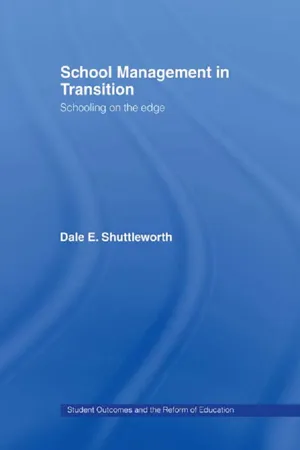
School Management in Transition examines the impact of the neo-conservative political agendas which still hold sway in education. It describes the transition that has occurred in the school leader's role from teacher-administrator to quality control supervisor and how some schools have developed strategies to deal with the resulting issues.
Based on a study carried out by the Organisation for Economic Cooperation and Development (OECD), the book analyzes issues such as decentralization, testing, external assessment and privatization in the education systems of nine of the world's most industrialised countries: the USA, UK, Japan, Mexico, Belgium, the Netherlands, Sweden, Greece and Hungary. It contrasts different school management models in these countries and goes on to identify innovation and best practice designed to tackle such concerns as declining professional morale, premature retirements and teacher shortages.
This book provides a unique insight into what is really happening in school leadership and management, and will be of great interest to school leaders, academics, researchers and policy makers.
- 184 pages
- English
- ePUB (mobile friendly)
- Available on iOS & Android
eBook - ePub
About this book
Information
1 Crisis in the classroom
A provocative series by Louise Brown in the Toronto Star newspaper dealt with the ‘crisis in the classroom’. She provided the following ‘sample want ad’ for a prospective school principal in the year 2000.
WANTED – Experienced manager; someone who can influence client groups of all ages, boost staff morale, hold spending under budget, juggle union contracts, referee arguments, defuse violence, schmooze politicians, grasp new legislation and spell it out for others, who can be discreet yet speak out when needed and who, in any spare time, can charm the larger community into donating items for which there is no longer any budget.
WARNING – The hours are long, job security is weak and you will bear the brunt of public reaction to every change to hit the school system.
Louise Brown 's job description captures a feeling for the sense of crisis and despair which school leaders face as educational managers in a new social, political and economic age.
Schooling for an industrial age
The emergence of schooling as an essential public service has most often mirrored economic and societal trends. In an agricultural economy, workrelated apprenticeship and problem-solving skills were the learning mode with limited need for literacy and numeracy. Children contributed to the wealth and well being of the family through their labour – tending the flocks, tilling the soil or weeding the garden. There was a job and a sense of identity for everyone as valued members of the economic unit. That all began to change, as farming became more automated and improved literacy and numeracy skills were needed to support commerce in agricultural goods and services.
The industrial revolution, particularly in the late nineteenth and early twentieth centuries in the United Kingdom and the United States, defined and accelerated the need for literacy, numeracy and scientific skills. Public schooling blossomed as society became increasingly urbanised, providing a workforce for the burgeoning manufacturing and resource harvesting industries. The size of the family, once a source of rural pride and economic strength, now became a liability in the crowded cities and mill towns. As academic and vocational training became essential to fill the employment needs of the industrial age, the strength and well-being of the family was continually threatened. More parents were drawn onto the production lines allowing less time for nurturing and value mentoring. Schools not only met the need for a skilled and literate workforce, but they also became agents of socialisation, morality and citizenship, as well as providing safety and security for children in an increasingly complex and threatening urban environment.
Schools have also reflected their times both physically and organisationally. During the nineteenth and twentieth centuries, their architecture had much in common with the utilitarian and functionalism associated with the housing of assembly lines. As organisations, they often assumed the supervisory style of a manufacturing enterprise feeding its branch plants. The principal, as branch manager, was responsible for providing services according to a predetermined common set of standards, and anticipated outcomes, called the curriculum and programme. It was very much a hierarchical managerial model with principals directing teachers, who supervised and instructed children, in response to the needs of parents and employers. By the latter part of the nineteenth century, national (and state) governments mandated formal systems of education, with a set curriculum and provision for teacher training and certification, to ensure loyal, productive and socially contented citizens. State schooling signalled the advent of mass education and the spread of popular literacy throughout the United Kingdom, the United States, continental Europe and beyond.
In the 1880s the American efficiency expert, Frederick Winslow Taylor, introduced a technique, later to be known as ‘time and motion studies’, to the steel industry. He applied objective scientific data and management to increase output by ‘working smarter’. Scientific management believes that every act of every worker can be reduced to a mechanical principle and then made more efficient (Stein 2001). Productivity exploded as machines created greater capacity and Taylorism was applied to the industrial process.
The self-esteem of workers suffered however as individual craftsmanship and problem-solving skills were sacrificed in an ever-spiralling quest for increased production. What they gained was an increase in wages and lower prices for consumer goods, but the relationship of workers to the workplace changed dramatically.
After World War I, the success of American industrial production made scientific management influential throughout the world. It was not long before the lessons gained from the American (and British) workplace jumped from the factory floor to the classroom. The Carnegie Foundation for the Advancement of Teaching led the way by espousing the organisation of schools along more modern, national, scientific and bureaucratic lines – ‘the factory school was born’ (Abbott and Ryan 2000).
The key to worker success in the scientifically managed factory was the ability to read and comprehend shop manuals and do basic mathematical calculations. All workers then needed the ‘3Rs’ to survive in the modern industrial workplace. Schools met the challenge very successfully, and in several decades literacy and numeracy rates soared from single digits to the eightieth and ninetieth percentiles.
Schools were also given the task of ‘sorting’ individuals to suit the needs of an increasingly specialised labour market. A system of ‘meritocracy’ evolved to decide which students should receive advanced education and training to assume managerial and leadership positions and which should be relegated to toil on the factory floor. It was a system that operated under the premise that 10 per cent would lead and 90 per cent would follow. To quote Charles Eliot, president of Harvard University in 1897:
The duty of democratic education, in addition to preparing a whole literate populace, was to cultivate the natural aristocracy, so that the whole community could benefit from the fulfilment of its ablest citizens … and so that educational resources would not be wasted on those unable to employ them profitably.
(Boorstin 1973)
This process of ‘educational sorting’ and meritocracy was seen by governments of the day as a just way to reward intelligence and avoid discriminating on the basis of class, race or gender. To promote good government and avoid corruption, professional administrators became enamoured with the creed of scientific management to improve organisational performance and efficiency.
The factory system of education was not unique to the United States and soon gained a world following. To quote the English historian David Wardle concerning British schools:
It was the factory put into the educational setting … Every characteristic was there, minute division of labour … a complicated system of incentives to do good work, an impressive system of inspection and finally an attention to cost efficiency and the economic use of plant.
(Wardle 1976)
Schooling for a new economy
Schools of the nineteenth and twentieth centuries helped governments, business and industry to cope with a traumatic shift from an agrarian society of small, dispersed communities, to an industrial factory-based economy of large impersonal cities and workplaces. Schools were also organised efficiently to provide safety and security to the children (and adolescents) of working adults unable to impart the skills, values and attitudes to ensure survival in a mass industrial society.
The later part of the twentieth century however began a revolutionary restructuring of our social, cultural and economic environment. Our massive, entrenched system of education, designed for a different time, is now struggling to cope with a radically transforming post-industrial age. To quote Harvard 's Howard Gardner:
It would not be an exaggeration to maintain that schools have not changed in a hundred years. Both in the United States and abroad, there are new topics (such as ecology), new tools (personal computers, VCRs), and at least some new practices – universal kindergarten, special education for those with learning problems, efforts to ‘mainstream’ students who have physical or emotional problems. Still apart from a few relatively superficial changes, human beings miraculously transported from 1900 would recognise much of what goes on in today 's classrooms – the prevalent lecturing, the emphasis on drill, the decontextualised materials and activities ranging from basal readers to weekly spelling tests. With the possible exception of the Church, few institutions have changed as little in fundamental ways as those charged with the formal education of the next generation.
(Gardner 1999)
There has also been a dramatic change in the way we produce and distribute goods and services; organise companies; workplaces, and indeed the overall economy. In the former economy, ‘vertical integration’ was a basic principle in organising a company so that it could control as much in-house as possible. The new economy encourages outsourcing and even ‘virtual companies’ made possible by new information and communication technologies and the Internet. It is estimated that by 2004, these ‘e-commerce’ systems will generate U.S. $6.8 trillion compared to $80 billion in 1998. Companies are faced with the challenge to move to the new economy in order to be at the forefront of new opportunities that emerge in this new industrial revolution. Traditional limits to economic expansion are no longer relevant (Crane 2000a).
Where does this leave schooling and our traditional educational service systems? The increased globalisation of trade and the influence of information technology have led to a period of prolonged prosperity among the world 's richest, most industrialised countries. For the average worker in these countries, however, the new economy has often meant employment instability due to plant closures, restructuring of workforces and global outsourcing (the end of the ‘job for life’). But in the United States and Britain, workers actually put in more hours on the job (or more than one job) than their counterparts in other industrialised nations. Greater earning power and easier credit has fuelled a boom in prosperity and consumer spending, but at what cost?
An increasing number of women have joined the labour force to sustain the economy and life style of the family unit (especially lone-parent families) or to enlarge their purchasing power. As a result, fewer children are being born in developed countries, especially to parents with more than high school education. When adults do have a family, there is an increasing trend to ‘outsource’ the raising of their children to child care and educational professionals. School personnel are being asked to do more and more to pick up the deficit in the parenting role. To quote Abbott and Ryan (2000): ‘Kids are being born into more affluence, but they get less and less time with adults who love them.’
Schooling in the industrial age was very much shaped by the science of behaviourism, which defined educational success as:
- mastery of basic skills;
- largely solitary study;
- generally uninterrupted work;
- concentration on a single subject;
- much written work;
- higher analytical ability.
Today 's social and economic environment argues for a different model of learning:
- mastery of basic skills;
- ability to work with others;
- being able to deal with constant distractions;
- working at different levels across different disciplines;
- improving of verbal skills;
- problem solving and decision making.
These are the kinds of competencies which employers often quote as basic characteristics of the post-industrial age employee. It is interesting to note that ‘basic skills’ is the only common element between the two ages. Could it be that schools, which focus on the first (nineteenth- and twentieth-century) list, are creating ‘disabilities’ among students destined for living and learning in the new economic age (Abbott and Ryan 2000)?
Rise of neo-conservatism
After World War II, industrialised nations, particularly the United States and the United Kingdom, experienced a growing disillusionment with big business, big labour and big government. Building on the free market theories of F. A. Hayek and Milton Friedman, social security and the welfare state were under attack (Hayek 1944; Friedman and Friedman 1979). In the 1970s these theories became a movement, led by Margaret Thatcher and Keith Joseph in the U.K., which embraced the idea of an economy that offered greater risks and greater rewards to achieve a higher standard of living and prosperity for all. They wished ‘to liberate the economy from what they saw as the negative influences of government ownership, union domination and regulation in order to release the drive and ambition of individual entrepreneurs’ (Abbott and Ryan 2000).
They blamed big government for stripping citizens of their individual rights by seizing control of essential services such as schools, welfare, roads and even garbage collection. Ronald Reagan in the U.S. soon picked up the chant in 1984, when he argued that government had ‘pre-empted the family, neighbourhood, church and school organisations that act as a buffer and a bridge between the individual and the naked power of the state’ (Coleman 1987).
Thus the neo-conservative revolution was born with Thatcherism and Reaganomics demanding and securing a downsizing of government spending, particularly on essential human services, such as health and education. As a result, the call for lower taxes, a balanced budget and debt reduction became the pathway to political power across the western world. These policies have been championed by successive governments at both national and state levels. While the result in the 1990s has been unparalleled economic growth and increased prosperity for some, it has also led to massive socio-economic inequalities in both U.S. and the U.K. To quote the Economic Policy Institute in Washington, D.C.:
The United States had the highest overall poverty rate among 16 advanced economies in the late 1980s and 1990s. High-income families (those in the ninetieth percentile of family income) in the United States earn almost 6 times more than their low-income counterparts (those in the 10th percentile). The average ratio for other advanced economies is under four with only the United Kingdom (with a ratio of about five) anywhere near the United States level.
In fact, U.S. inequality is so severe that low-income families in the United States are worse off than low-income families in the 12 other advanced economies for which comparable data exist, despite the higher average income level in the United States. (The United Kingdom is the only country where low-income families are worse off than in the United States). Inequality in the United States (along with the United Kingdom) has also shown a strong tendency to rise over the last two decades, even as inequality was relatively stable or declining in most of the rest of the advanced economies (Mishel et al. 1999). Today 's policies of decentralisation, deregulation, privatisation and school reform are among the legacies of the neo-conservative political movement.
The result for students, teachers, parents and school managers has been a sense of confusion as to what their role should be as we move from the twentieth to the twenty-first century – from the industrial to the post-industrial age. Is learning and schooling compatible with the demands of scientific management from the industrial age seeking ‘one best system’ of standardisation and homogenisation? This ‘cult of efficiency’ demands that schools be more effective when there is no understanding of what makes a school effective in a post-industrial economy which stresses innovation, differentiation and flexibility rather than top-down command and control.
While neo-conservatism has applied the rigid industrial principles of scientific management and cost effectiveness to schooling and other public services in its quest for political domination, the needs of the emerging postindustrial economy are not being met. Schools find themselves struggling to survive on the cutting edge of a social, political and economic revolution.
Reflections
It has been said that the educational reform movement that is sweeping the world was born out of an industrial age neo-conservative political ideology formulated in the United States and the United Kingdom. The language of educational reform would have been fam...
Table of contents
- Cover
- Half Title
- Student Outcomes and the Reform of Education
- Full Title
- Copyright
- Contents
- Preface
- Acknowledgements
- 1 Crisis in the classroom
- 2 Leadership in transition
- 3 Loosening the ties
- 4 Test-score Olympics
- 5 Top-down reform
- 6 Outsourcing the service
- 7 Bottom-up renewal
- 8 Community education partnerships
- 9 Micropolitics of governance
- 10 Zero tolerance
- 11 Digital divide
- 12 Learning to manage knowledge
- 13 Tracking innovation
- 14 Management for a learning society
- 15 Leaders for the twenty-first century
- Appendix: National profiles
- Bibliography
- Index
Trusted by 375,005 students
Access to over 1.5 million titles for a fair monthly price.
Study more efficiently using our study tools.
Frequently asked questions
Yes, you can cancel anytime from the Subscription tab in your account settings on the Perlego website. Your subscription will stay active until the end of your current billing period. Learn how to cancel your subscription
No, books cannot be downloaded as external files, such as PDFs, for use outside of Perlego. However, you can download books within the Perlego app for offline reading on mobile or tablet. Learn how to download books offline
Perlego offers two plans: Essential and Complete
- Essential is ideal for learners and professionals who enjoy exploring a wide range of subjects. Access the Essential Library with 800,000+ trusted titles and best-sellers across business, personal growth, and the humanities. Includes unlimited reading time and Standard Read Aloud voice.
- Complete: Perfect for advanced learners and researchers needing full, unrestricted access. Unlock 1.5M+ books across hundreds of subjects, including academic and specialized titles. The Complete Plan also includes advanced features like Premium Read Aloud and Research Assistant.
We are an online textbook subscription service, where you can get access to an entire online library for less than the price of a single book per month. With over 1.5 million books across 990+ topics, we’ve got you covered! Learn about our mission
Look out for the read-aloud symbol on your next book to see if you can listen to it. The read-aloud tool reads text aloud for you, highlighting the text as it is being read. You can pause it, speed it up and slow it down. Learn more about Read Aloud
Yes! You can use the Perlego app on both iOS and Android devices to read anytime, anywhere — even offline. Perfect for commutes or when you’re on the go.
Please note we cannot support devices running on iOS 13 and Android 7 or earlier. Learn more about using the app
Please note we cannot support devices running on iOS 13 and Android 7 or earlier. Learn more about using the app
Yes, you can access School Management in Transition by Dale Shuttleworth in PDF and/or ePUB format, as well as other popular books in Education & Education General. We have over 1.5 million books available in our catalogue for you to explore.