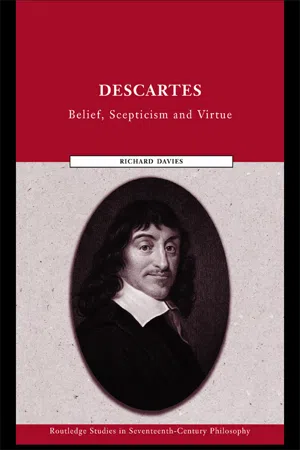
Descartes is often regarded as the founder of modern philosophy, and is credited with placing at centre stage the question of what we know and how we know it. Descartes: Belief, Scepticism and Virtue seeks to reinsert his work and thought in its contemporary ethical and theological context. Richard Davies explores the much neglected notion of intellectual virtue as it applies to Descartes' inquiry as a whole. He examines the textual dynamics of Descartes' most famous writings in relation to background debates about human endeavour from Plato down to Descartes' own contemporaries. Bringing these materials together in a novel format, Davies argues for a new approach to Descartes' ideas of scepticism and the sciences. The book also offers fresh interpretations of key passages of the Meditations . Descartes: Belief, Scepticism and Virtue offers an original reassessment of some of the most important bodies of work in Western Philosophy.
The scheme I adopt for setting out Descartes’ theory of knowledge embodies a range of structural and conceptual features that can be traced in Aristotle’s thought about the moral virtues. This latter is well-known and relatively well-understood material which has generated a large secondary literature of its own, to some of which I refer to make some of my more unfamiliar attributions to Descartes seem less wayward.
The most general structure that is indebted to Aristotle is the doctrine that a moral virtue is opposed to two vices, which are themselves opposites. Thus, at EN, II vii, 1107 a 33, Aristotle alludes to a diagram of the virtues and their opposed vices that may have been hanging on the wall of his lecture room (Jackson 1920), one version of which is in the text at EE, II iii, 1220 b 38–1 a 12, another of which is supplied in Aristotle (1953: 104). For instance, the virtue of courage is opposed to two vices: cowardice and rashness. Both of the vices are harmful to their possessor and to others, though in differing respects and at different times. In each person, the vicious tendencies will be active in different strengths.
The resulting triad provides the organisation of the following chapters into parts: first we investigate the vice of excess in one department of the theory of knowledge. Thus, as rashness stands as an excess relative to courage, so credulity is an excess in belief-formation. Then we see how Descartes understands the opposed vice of defect. As cowardice is the defect of courage, so scepticism is the failure to acquire beliefs to which we are properly entitled. Lastly, we look at the mean between them and the beliefs it requires, permits and forbids. Where some recent studies of Descartes have concentrated almost exclusively on scepticism and the sceptic, I aim first to illustrate how the excess of credulity constitutes a difficulty that is in several important respects prior to the defect of scepticism. The threat posed by human credulity calls for an account of the resources we have for controlling the beliefs we have and, thus, for a theory of assent and dissent that allows us to tread between the opposed vices.With this material in place, we shall be able to locate better the virtue, namely doxastic rectitude, that lies between them and understand what its actualisation amounts to.
The hope on which my choice of this articulation rests is that, by bearing in mind the terminology, the structures and expectations of virtue theory, we can overcome some standing obscurities in the reading of Descartes. If that hope is justified, then I shall have provided the means to reduce some imbalances and distortions that have crept into Cartesian studies and into epistemology in his wake. Thus, my central claim is that by applying virtue-theoreticinsights we can do better for Descartes than many other ways of building on or replying to him.
Genera of virtue
But, first, a step back to get a broader view of the structures of virtues and vices that can be used to help bring these points to the fore.
One very standard taxonomy of the virtues generally divides them into the moral, the theological and the intellectual. Each of these categories has its own more or less standardised sub-divisions. The standardisation is perhaps most entrenched in treatments of the cardinal theological or ‘deiform’ virtues; at least since St Augustine, there is relatively little dispute about what the virtues are: and they are set out in the Bible as faith, hope and charity (I Corinthians, 1: 13). Presumably this is because those who give prominence to these virtues as theological are already party to a vision with a fairly unified source, namely, the medieval syntheses of Platonic and Aristotelian theory with Judeo-Christian revelation.
There is somewhat more debate about how the cardinal theological virtues are constituted and about their mutual relations. For instance, for St Thomas, it is only accidentally (relative to God) that the theological virtues are to be considered as lying in a mean, though there are human standards that apply (ST, Ia IIæ, qu. 64 art. iv). For this reason, the theological virtues do not provide a particularly illuminating model for what I want to say about Cartesian epistemology. This is not to deny, what I shall, in fact, frequently assert, that Descartes’ basic view of the acquisition of human knowledge is theocentric and influenced by the particular revelation of the Bible and subsequent tradition.
There is rather less agreement about the right account of the moral virtues. Indeed, in the next chapter, I shall sketch the elements of a virtue theory that is non-Aristotelian in character and derivation, and that is attributable to Descartes. This is a Stoic theory, according to which the individuation of the particular virtues is a secondary matter to hammering home the idea that everything that is not under our immediate control is harmful.
Nevertheless, thinkers who have pursued, and still pursue, lines similar to Aristotle’s need to determine which virtues are to be regarded as those that contribute most to a flourishing life. For instance, Aristotle gives great prominence to the sort of courage a man needed in the sort of war that was fought in his day (EN, III vi–ix) and he seems to take military courage to be a paradigmatic case of the virtue (EN, III viii). Yet, it is far from certain that courage of that particular sort, or indeed (physical) courage in any marked degree, should have the same centrality in considering the sort of life that is lived by most people in the West today. Again, there are well-known issues to be raised and settled about whether prudence or practical reason
is a properly moral or an intellectual virtue; and about whether justice is a moral virtue of a specially other-regarding kind or the whole of political virtue. In considering these virtues, he does not, of course, deny either that all virtues may have some application in all spheres of life; the point, rather, seems to be that there are virtues that are equally applicable in each, as justice is identified as the complete, global or overarching virtue in EN, V i, 1129 b 31, and, in VI xviii, 1145 a 1–2, practical wisdom is said to be a virtue whose presence implies the presence of all the others. Some of the ways of raising and settling these questions are at least partly a matter of terminology; but such choices can have far-reaching effects on the complexion of the resulting vision, especially concerning the interrelations of the moral virtues on which we concentrate.
There is least standardisation of all when we turn to the intellectual virtues; here the picture seems to be much hazier and the room for stipulation much greater. In part, this is because one of the templates that one might think of using to begin marking out the territory – the sixth book of EN – is a curiously structured review of rather heterogeneous types of operation. The same can be said of the parallel passages in EE, V and of the highly compressed jumble of similar material in MM, I xxxiv, 1196 b 4–8 b 20. Though EN, VI presents itself as enquiring into the right principle that determines the mean between excess and defect generally (EN, VI i, 1138 b 20–1), it proceeds to run through some of the modes or states that are involved in the soul’s arriving at truth by affirming or denying (EN, VI iii, 1139 b 15ff.) offering a survey that carries on to the end of the sixth chapter (1141 b 23), and then turns (or perhaps returns) to consider prudence in relation to politics and to other mental attainments.
At the very least, Aristotle’s treatment in EN, VI is cursory and unsystematic when compared, for instance, with the more careful discriminations he employs in II vii to differentiate the functions of the various moral virtues, as having to do with the regulation of particular emotions, such as fear and confidence (1107 b 1), to do with identifiable spheres of activity, such as giving and getting money (1107 b 9), or to do with specifiable types of goods, such as honour (1107 b 22). The differentiæ he uses there provide not merely a sort of table of contents for the second part of Book III and Books IV and V, but also an understanding of the ways that certain virtues have their characteristic reference-points. Aristotle here gives a significantly more focused sense of what is involved in the moral virtues he discusses, than he does after the transition at the beginning of VI ii that introduces his discussion of the grades and types of knowledge that he stakes out.
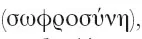
It is also noticeable that, in his discussion of the intellectual virtues, Aristotle makes very little reference to the triadic structure to which I have already referred and that underpins his occasional admissions that there are virtues and vices for which we have no particular name, even though the structure can lead us to see what such dispositions must be. Thus, relative to temperance
there is the excess vice of profligacy
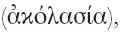
but the defect of taking too little pleasure, which is a sort of insensibility
being very rare, does not have a special name as a vice (EN, III xi, 1119 a 6–12); it is as a vice that this sort of insensibility has no name in the sense that the use of the name is not, on its own, a way of condemning someone. But, it is easy to think that some sorts of insensibility – for instance to the relatively sophisticated pleasures of art-appreciation – do tell us something damning (though perhaps not ‘morally’ damning) about the person to whom they are attributed. Similarly, Aristotle notes the lack of a name for the virtue in the mean between the excess of overweaningness and the defect of unambitiousness at EN, II vii, 1107 b 30–5 and IV iv, 1125 b 24–6.1
Genus and species
Even if EN, VI does not provide a very satisfactory guide to follow, we can still take a hint from Aristotle’s better practice – when he is dealing with the moral virtues – to individuate intellectual virtues.
There is more than one way we might do this.
We might want to distinguish some intellectual capacities in terms of their objects in order to capture the obvious differences among and within individual people that we find, for instance, in calculating skills, in remembering names-and-faces, or in abilities at learning foreign languages. Such distinctions do seem fairly salient in that they seem to go with certain types of cast of mind; but it is hard to see how deep they cut and it is unfortunate that they smother an important distinction between virtues and capacities we shall return to shortly.
Alternatively, we might follow Bacon’s ‘Of Studies’ (1625a: 797–8) in thinking that there correspond to different types of exercise – such as conversing, reading and writing – different kinds of excellence – in this case ‘readiness’, ‘fullness’ and ‘exactness’ – that can be enhanced by practice and that serve to reinforce each other.2 A typology of this sort may well give us a sense of the relations between certain abilities and their development, though it will tend to presuppose much that deserves to be made explicit about the peculiar nature of intellectual endeavours.
Again, we might seek in the work of the mind some features that correspond very closely to moral virtues, such as honesty, courage and conscientiousness (see Montmarquet 1992b: 19–34). But we can see pretty quickly that a taxonomy of this sort will be more likely a reflection of preexisting ethical commitments than a structure that can be used to underpin such preferences. It is also likely to overstress the obligatory seriousness of mental operations.
There are also proposals that are avowedly teleological, paying appropriate attention to ‘the aims of thinking or enquiring’ (Cooper 1994: 460) and dividing them into kinds according to their central sites as the inquisitive, the forensic, the judicial, the educative and the all-pervasive (ibid.: 461). While appreciating the capaciousness of this sort of effort, I am inclined, for our slightly more limited purposes, to propose a scheme that discriminates primarily in accordance with the phases of cognition. I try not to prejudice the questions of what cognition might turn out to be or of what its objects are, beyond saying that cognition is to enquiry what action is to deliberation.
Thus, the beginning of enquiry will have its specific virtue, perhaps curiosity, which will lie in a mean between the defect of dullness and an excess that might be called bafflement. The sort of curiosity at issue is a prerequisite for getting going with questioning: an unwillingness to let questions lie unanswered and a refusal to raise more questions than can be contemplated at once.
Likewise, the prosecution of an enquiry depends on tenacity, a virtue lying between, on the one hand, discouragement or a sort of accidie, and, on the other, the sort of stubbornness that will not accept failure. All the same, apart from the normal lack of energy to look into things deeply, there is a sort of laziness that can be raised to the status of a principle if a person has decided that he really does not need to know any more about, say, the Bloomsbury Group, or has resigned himself to never understanding what a musical key is. In the former case, there is what one might reasonably think of as a righteous impatience with the twitter of the Sunday supplements. In the latter, though, there may a kind of of self-satisfaction related to that of Dorothea’s father in George Eliot’s Middlemarch, who claims to have gone into this and that in his youth but come away thinking that no good will come of going too far into things.3
Pricking on and being pricked on by pertinaciousness there will be a cluster of skills, aptitudes and discriminatory faculties that are ruled by a closely related virtue that involves being aware of the grade and type of exactitude that is possible in a given sphere. This is what Aristotle attributes to the person with a sense of perspective
EN, I iii, 1095 a 1 and PA, I i, 639 a 4...
Table of contents
Cover Page
Title Page
Copyright Page
Acknowledgements
Abbreviations
Introduction
Part I: Structures
Part II: Excess
Part III: Defect
Part IV: The mean
Afterword
Notes
Bibliography
Trusted by 375,005 students
Access to over 1.5 million titles for a fair monthly price.
Study more efficiently using our study tools.
Frequently asked questions
Yes, you can cancel anytime from the Subscription tab in your account settings on the Perlego website. Your subscription will stay active until the end of your current billing period. Learn how to cancel your subscription
No, books cannot be downloaded as external files, such as PDFs, for use outside of Perlego. However, you can download books within the Perlego app for offline reading on mobile or tablet. Learn how to download books offline
Perlego offers two plans: Essential and Complete
Essential is ideal for learners and professionals who enjoy exploring a wide range of subjects. Access the Essential Library with 800,000+ trusted titles and best-sellers across business, personal growth, and the humanities. Includes unlimited reading time and Standard Read Aloud voice.
Complete: Perfect for advanced learners and researchers needing full, unrestricted access. Unlock 1.5M+ books across hundreds of subjects, including academic and specialized titles. The Complete Plan also includes advanced features like Premium Read Aloud and Research Assistant.
Both plans are available with monthly, semester, or annual billing cycles.
We are an online textbook subscription service, where you can get access to an entire online library for less than the price of a single book per month. With over 1.5 million books across 990+ topics, we’ve got you covered! Learn about our mission
Look out for the read-aloud symbol on your next book to see if you can listen to it. The read-aloud tool reads text aloud for you, highlighting the text as it is being read. You can pause it, speed it up and slow it down. Learn more about Read Aloud
Yes! You can use the Perlego app on both iOS and Android devices to read anytime, anywhere — even offline. Perfect for commutes or when you’re on the go. Please note we cannot support devices running on iOS 13 and Android 7 or earlier. Learn more about using the app
Yes, you can access Descartes by Richard Davies in PDF and/or ePUB format, as well as other popular books in Philosophy & Epistemology in Philosophy. We have over 1.5 million books available in our catalogue for you to explore.