- 304 pages
- English
- ePUB (mobile friendly)
- Available on iOS & Android
eBook - ePub
About this book
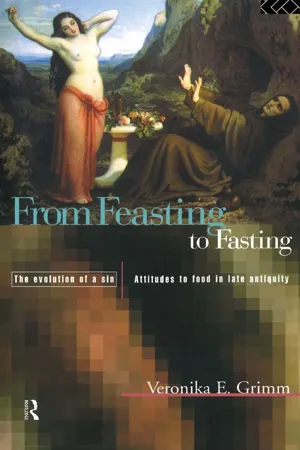
In this highly original study, Veronika Grimm discusses early Christian texts dealing with food, eating and fasting. Modern day eating disorders often equate food with sin and see fasting as an attempt to regain purity, an attitude which can also be observed in early Christian beliefs in the mortification of the flesh. Describing first the historical and social context of Judaism and the Graeco-Roman world, the author then proceeds to analyse Christian attitudes towards food. Descriptions of food found in the Pauline Epistles, the Acts of the Apostles, Tertullian or Augustine are compared to contemporary Jewish or Graeco-Roman pagan texts. Thus a particular Christian mode of fasting is elaborated which influences us to the present day; ascetic fasting for the suppression of the sexual urges of the body. Winner of the 1995 Routledge Ancient History Prize
1
THE JEWISH BACKGROUND
Jesus of Nazareth was born a Jew and spent his entire life among Jews.1 In his lifetime his friends and detractors, his followers and admirers, were Jews. The early Christians carried their message through Jewish contacts in Palestine and in and around synagogues in the Jewish Diaspora that spread through the Hellenistic cities of the Mediterranean basin, Asia Minor, and even to Rome itself.2 When the two faiths parted ways, the new religion took with itself a substantial part of Jewish literature, claiming the holy books as its due inheritance. An examination, then, of this inheritance, and the way in which it was being understood by the Jews themselves in the early centuries of Christianity, when contact and even competition with Judaism figured significantly in the growth of the movement, may aid our understanding of Christian attitudes to food and fasting. This chapter will attempt to give a short survey of a very complex and large topic: Jewish thought and practice concerning eating and fasting as these are expressed in biblical and extra-biblical Jewish writings and in some non-Jewish sources that may testify to Jewish thought and custom in the time of the Roman Empire, both in the Land of Israel and in the far-flung Jewish communities of the Diaspora.
FOOD AND FASTING IN THE TORAH
The Jews saw themselves, from ancient times, as a unique society that functioned on the basis of a set of written laws.3 Important aspects of life were regulated by laws in many other ancient societies; however, the giver of the Jewish Law was not a wise human ruler, a Hamurabbi or a Solon, to the likes of whom other societies attributed the creation of their laws, but an all-seeing, all-powerful god,4 who created the whole universe, including humankind, who gives generously but can also take away, who blesses and curses, and who can be pleased and displeased by the minutest actions of his creatures—a ruler from whose sight there is no escape. This all-powerful god elected His people and made a contract with them. Jewish society, in principle, is based upon a charter, a covenant5 offered by Yahweh to the sons of Israel and their descendants, whom he had chosen from all the peoples of his creation. All who share in the covenant for all time to come wear a visible, indelible mark as a sign of it: all male Jewish children to this day are circumcised.6 Yahweh liberated his chosen people from bondage and then gave them his laws. As long as they worshipped Him and together with their households, including slaves and even beasts of burden, obeyed Him by observing the laws, He promised to provide them with peace and prosperity. The Jews’ perception of their god as their liberator from slavery, as giver of land and political sovereignty, has tied the religious and political life of the nation inseparably together.7
The Law of God, regarded as the Law of the Jewish nation, covered all conceivable aspects of life from the behaviour of the individual to that of the whole community of Israel. Community life centred on the service in the Temple while this existed; where and when it did not exist, as in the Diaspora, the Torah still informed the lives of the widespread Jewish groups, whose distinct identity it helped to maintain. Whatever way it was interpreted, whether strictly observed or not, the Torah was ever present, a part of the definition and self-definition of the Jew.
This Law, the written Torah, tolerates with equanimity the human body with its fundamental biological requirements, including the need for food, drink and sexual intercourse. The manner of satisfaction of these needs, however, is subject to elaborate rules and regulations, which, while aiming to provide amply for these needs, clearly exclude certain ways to their satisfaction as prohibited by God, either as ‘impurity’ and unacceptable in those wishing to enter God’s Sanctuary or as ‘abomination’ in the eyes of God in all times and all places. The most salient precepts of the Law with relevance to the life of each individual, and which together distinguish it from the laws of the Graeco-Roman surroundings, were the following: it ordered the circumcision of all males, as mentioned above; it required the setting aside of every seventh day as consecrated to God, a day of rest for all; and finally, it set out the dietary laws that regulate what Jews may eat.8 The Law lists the animals the flesh of which is for consumption and prohibits the eating of pork and a large number of other species designated as ‘unclean’.9 The Law also forbade Jews the eating of blood,10 and the boiling of a kid in its mother’s milk,11 which by the first century came to be interpreted as a prohibition on the mixing of meat with dairy products.
The dietary laws in Leviticus and Deuteronomy list the permitted and forbidden species among the quadrupeds, the birds and the fish, and in addition provide the principle by which the edible can be clearly separated from the inedible in each of these categories. A point worth noting is that the elaborate list of dietary regulations set out in the Pentateuch presupposes a meat-eating population. If, as is often claimed by modern historians, meat was a negligible part of the ancient diet and most people only ate meat on sacrificial occasions,12 one may wonder why the Law enumerates a large number of animal species, both in the permitted and the forbidden categories, that were definitely not suitable for sacrifice. Yahweh, like most other ancient deities, demanded only domestic animals for the altar, from the herd and from the flock, but the people of Israel were permitted to hunt and eat ‘the deer, the gazelle, the roebuck, the wild goat, the ibex, the antelope, and the mountain sheep’,13 not to mention the locust and the cricket.14 Rather than addressing a largely vegetarian society, the only meat protein of which came from the occasional sacrifice of its highly priced working beasts, the Law appears to confront a human society that in order to obtain its necessary nutrients in a most efficient form would eat, if not regulated, just about anything that moved.15 In the eyes of the law-makers this was not fitting for the people of Israel. The reasons for this are not known but through the ages many hypotheses have been put forth to account for the choice of permitted meat, ranging from various hygienic to separatist ones. There is not a shred of evidence for the hygienic claims; a lot is to be said, however, for the separatist ones. Whether it was knowingly intended by the framers of the Law or not, the dietary rules of the Jews have kept the observant from eating the food of others, and therefore, to a greater or lesser degree, have always separated the Jews from the surrounding world.16
The Torah that embodied the core of Jewish religious life, as we have seen, gave explicit permission for meat eating.17 It is conceivable that this clear and unequivocal permission in the written Law is responsible for the dearth of exhortations to vegetarianism18 as an expression of piety among the ancient Jews. The arguments, and there were many, among the pious concerned the purity of food,19 while the eating of God-given and God-permitted meat seems to have been seldom questioned. Not even the pietist parties or sects are known to have urged vegetarianism; the Pharisees, who, according to Josephus, ‘despised delicacies in diet’,20 and who may have seen themselves as experts and guardians of the purity laws,21 ate meat; so too did the Essenes, sectarians who regarded themselves as the true Israel and adhered to all the precepts of the Law of Moses and observed all the biblical feasts, which entailed the eating of meat.22 Even the proverbially frugal diet of John the Baptist included locusts, an animal permitted for consumption by the Law! Among ancient Jewish writers whose work is extant, the only one who valued alimentary self-denial and a meatless diet very highly is Philo of Alexandria. About him and his Therapeutae we shall have more to say below.
The aim of the purity laws set out in the Hebrew Bible is to safeguard the proper worship of God in his Sanctuary. The God of Israel demanded daily worship amidst exacting rules of ritual purity, and since, in addition to the priestly castes, all males in Israel were potentially partakers of the temple worship, the laws of purity encompassed all aspects of life. Consequently, the Law made no distinction between private and public domain. As E.P.Sanders so rightly emphasized, the peculiarity of Judaism was to bring all life under divine law, to treat deceiving one’s neighbour as being just as serious as accidentally eating food that should have gone to the priests or the altar.23
The God of Israel, like other gods of his age, required sacrifice: offerings from all edible agricultural produce and, outstanding among these, a large number of animals daily in a variety of different rites. In addition to holocausts, in which the whole animal was burned on the altar on behalf of the community, there were first-fruit offerings as a token given back to God for his great bounty;24 sacrifices were offered as atonement for the sins of the community, accompanied by public confession, and also oblations for private sin. Sin was any action on the part of the community or the individual, committed or omitted, wilfully or even inadvertently, that displeased Yahweh. Importantly, there were also sacrifices offered as a part of reparation for damage caused to one’s fellows and many voluntary votive offerings. Only ‘clean’ and unblemished animals could be used, and the participants in the sacrifice and all who entered the Temple had to be purified. Jewish thinkers often insisted that purification meant cleansing both body and soul.25 Despite the fact that the commandments and provisions ordained for the sacrificial worship of God in the Mosaic code clearly indicate a central Temple cult, the dietary laws definitely, and to a large extent the other laws concerning ritual purity, were extended beyond the Temple and were understood by the ancient sources and later by the rabbis to encompass all of Israel. Purity was an ideal in ancient Judaism.26 God’s command of his people, ‘You shall be holy for I the Lord your God am holy!’,27 was interpreted as a command addressed to all Israel, and not only to its priests, to keep away from defilement, and from all that was regarded as abomination in the eyes of God.
In the mind of the shapers of the Jewish Law, three things endangered ritual purity, and these were contact with dead bodies, (skin) disease and sexual discharges (including childbirth).28 As all three of these were part of life they were not in themselves regarded as wrong, sinful or forbidden, but they conveyed a condition, a temporary one removable by the appropriate ritual cleansing, that prevented entrance to the Temple and eating consecrated food lest they cause defilement of the holy place, which constituted a most grievous sin. As a consequence of this, the ritual of worship was carried out only by healthy males, without blemish on their bodies, who had no contact with dead bodies and were purified of all seminal discharge. Women were excluded from the ritual worship, presumably on account of the ‘impurity’ of their menstrual flow, or on account of their sexual behaviour when not menstruating and, finally, on account of the impurity brought upon them by childbirth. Sexual behaviour, while generally regarded as God-given legitimate pleasure, was, however, strictly regulated and limited to married partners; all sexual discharge that could not, potentially at least, result in the conception of legitimate offspring was considered in the class of ‘abominations’, with homosexuality,29 prostitution30 (both capital offences) and masturbation heading the list.
Feasting was an integral part of the Temple cult. The various sacrifices, with the exception of the total burnt offerings, were accompanied by a communion meal, the priests as representatives of the people taking part in the holy food of Yahweh, or the community present at the Temple all taking part, while in private votive sacrifice the offerer and his family ate, after giving the priests the portion due to them.31 The aftermath of the solemn ceremony was a joyous feast.
In the presence of the Lord your God…you shall eat the tithe of your grain, your wine and your oil, as well as the firstlings of your herd and flock…spend the money for whatever you wish—oxen, sheep, wine, strong drink or whatever you desire. And you shall eat there in the presence of the Lord your God, you and your household rejoicing together.32
Whatever may have been the theological interpretations of the sacrifices, as communion with the deity and communion and fellowship with the people who shared in the festive meal or identification with the whole people whose customs these followed, the feasts were seen by ancient Jewish writers as an important aspect of the cult. Philo of Alexandria in the first century AD , writing about the Temple cult in Jerusalem, observed that by eating their portion of the sacrificial feast the people shared in God’s own food and thus entered a holy ‘partnership’.33 Furthermore, these festivals strengthened social cohesion by encouraging the formation of new friendships, ‘the sacrifices and libations—writes Philo—are the occasion of reciprocity of feeling and constitute the surest pledge that all are of one mind’.34 Philo, an Alexandrian Jew who may or may not have had firsthand experience with the Temple sacrifices in Jerusalem,35 is supported in this view by Josephus, the historian who, as a member of a priestly family, had amp...
Table of contents
- Cover Page
- Title Page
- Copyright Page
- Acknowledgements
- Abbreviations
- Introduction
- 1 The Jewish Background
- 2 The Graeco-Roman Background
- 3 Food and Fasting in the Pauline Epistles
- 4 Food and Fasting in the Acts of the Apostles
- 5 Clement of Alexandria
- 6 Food and Fasting in the Works of Tertullian
- 7 Food and Fasting in Origen and Eusebius
- 8 Jerome and Ascetic Propaganda
- 9 Augustine and Ascetic Practice
- Conclusion
- Notes
- Note on the Sources
- Bibliography
Trusted by 375,005 students
Access to over 1.5 million titles for a fair monthly price.
Study more efficiently using our study tools.
Frequently asked questions
Yes, you can cancel anytime from the Subscription tab in your account settings on the Perlego website. Your subscription will stay active until the end of your current billing period. Learn how to cancel your subscription
No, books cannot be downloaded as external files, such as PDFs, for use outside of Perlego. However, you can download books within the Perlego app for offline reading on mobile or tablet. Learn how to download books offline
Perlego offers two plans: Essential and Complete
- Essential is ideal for learners and professionals who enjoy exploring a wide range of subjects. Access the Essential Library with 800,000+ trusted titles and best-sellers across business, personal growth, and the humanities. Includes unlimited reading time and Standard Read Aloud voice.
- Complete: Perfect for advanced learners and researchers needing full, unrestricted access. Unlock 1.5M+ books across hundreds of subjects, including academic and specialized titles. The Complete Plan also includes advanced features like Premium Read Aloud and Research Assistant.
We are an online textbook subscription service, where you can get access to an entire online library for less than the price of a single book per month. With over 1.5 million books across 990+ topics, we’ve got you covered! Learn about our mission
Look out for the read-aloud symbol on your next book to see if you can listen to it. The read-aloud tool reads text aloud for you, highlighting the text as it is being read. You can pause it, speed it up and slow it down. Learn more about Read Aloud
Yes! You can use the Perlego app on both iOS and Android devices to read anytime, anywhere — even offline. Perfect for commutes or when you’re on the go.
Please note we cannot support devices running on iOS 13 and Android 7 or earlier. Learn more about using the app
Please note we cannot support devices running on iOS 13 and Android 7 or earlier. Learn more about using the app
Yes, you can access From Feasting To Fasting by Veronika Grimm in PDF and/or ePUB format, as well as other popular books in History & Ancient History. We have over 1.5 million books available in our catalogue for you to explore.