eBook - ePub
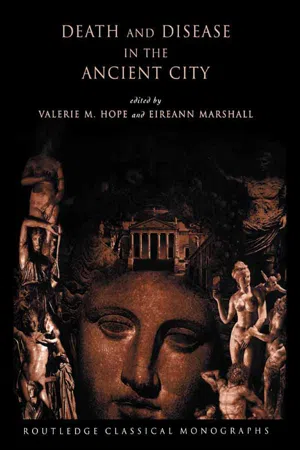
Death and Disease in the Ancient City
- 208 pages
- English
- ePUB (mobile friendly)
- Available on iOS & Android
eBook - ePub
Death and Disease in the Ancient City
About this book
This innovative volume draws on recent research in archaeology, ancient history and the history of medicine to discuss how people in the ancient world understood and dealt with illness and death in the urban environment.
Trusted by 375,005 students
Access to over 1.5 million titles for a fair monthly price.
Study more efficiently using our study tools.
1
INTRODUCTION
Valerie M.Hope and Eireann Marshall
She bared her poor curst arm; and Davies, uncovering the face of the corpse, took Gertrude’s hand, and held it so that her arm lay across the dead man’s neck, upon a line the colour of an unripe blackberry, which surrounded it
Thomas Hardy, The Withered Arm
To cure her ailing arm, cursed by witchcraft, Gertrude Lodge of Hardy’s The Withered Arm was advised to place the limb upon the neck of a recently hanged man, thereby ‘turning her blood’ and changing her constitution. The scene unites death and disease, but in an unusual fashion. Death becomes the cure of the disease rather than disease the cause of death. Unfortunately for Gertrude the shock of discovering that the hanged man, whose death she has wished for to effect her cure, is her husband’s illegitimate son, leads to her own sudden demise. Death is ultimately triumphant.
The association between death and disease in the context of the ancient city lies at the heart of this volume. Linking the topics of death and disease together, however, is not as straightforward as it may at first appear. On the one hand the connection between them is clear, and is mirrored in the general organisation of this volume: disease preceded and often led to death; the two would seem to be inextricably linked. On the other hand tracing the relationship between disease and death in the ancient world is not always straightforward. The plague of Athens, for example, was defined by the ancients as a disease that caused a great number of deaths, but in ancient discussion factors other than hygiene, medicine and germs come into play (Longrigg). Equally we can find parallels to Hardy’s nineteenth-century tale, where ill-health has no medical explanation and no medical cure. In the ancient world the idea of obtaining cures from the dead was not unheard-of. The bodies of the dead, especially those who had died a violent or premature death, became imbued with special powers (Hope). Disease and death were not purely medical problems, but could be part of the world of religion, superstition and even magic. This serves to emphasise that what the modern world regards as the standard associations between disease, health, hygiene and death may not have held true in the ancient context.
The subjects of death and disease are areas of current and expanding research among ancient historians and reflect interests developed from archaeological, sociological and anthropological studies. Several recent publications on the ancient city have focused upon hygiene, disease and pollution (Grmek 1991; Scobie 1986; Parker 1983). The study of the treatment of the dead by the ancients has also produced fundamental work exploring how social structures were constructed through and by funerary rituals and how the treatment of the dead reflected attitudes to death itself (Sourvinou Inwood 1995; Bodel 1994; Morris 1992; von Hesberg 1992). The contributors here explore ways in which death and disease affected the lives of the ancients by drawing upon a wide range of textual and material evidence. The chapters address views of ancient disease causation; public and private health measures; how the natural and urban environment affected the well-being of the individual; how the city was organised to protect the health and safety of the living; how the dead were disposed of; and how the living sought protection from the polluting influence of both the diseased and the dead. Human frailty and mortality influence the structure and functioning of all societies. Questions as to how the ancients coped with their own mortality, how they sought to classify and control the causes of death, and how they treated the dying and the dead, are central to any understanding of antiquity.
The volume begins with a case study which serves as a complement to this introduction by exploring both death and disease in the context of a specific settlement (Marshall). The papers then move from disease (Brock; Kosak; Lon-grigg; Nutton) to death (Hope; Bodel; Lindsay) by way of considerations of how concerns about disease and death affected the urban environment, topography and organisation (Nutton; Borca; Patterson). Throughout the emphasis remains on the ancient city. Death and disease, or at least their identification and description, are largely urban phenomena. This is not deliberately to dismiss the rural. In terms of disease causation there was little differentiation between the urban and rural environment (Kosak). Yet it is on the city that our evidence focuses, and it is in general from the perspective of the urban-dweller that features of the natural environment are classed as healthy or unhealthy (Borca; Nutton). In addition, it is often only when they are viewed on a large scale that ancient death and disease become identifiable issues to a modern viewer. Bodel’s estimated figures for the annual death rate in Rome emphasise that a mass population could bring into the public arena issues of how and where the dead were buried and disposed of. Equally, diseases and metaphorical diseases influenced how people viewed the urban environment and its political, social and religious organisation (Brock; Kosak). Indeed, when exploring ancient death and disease in the urban context it is often difficult to differentiate the practical and physical on the one hand from the religious and spiritual on the other. Disease and death could both be viewed as products of religious pollution (Marsall; Longrigg), but increasingly there was an awareness of the physical and hygienic implications present in disease and the importance of the proper disposal of the dead for the well-being of the city (Bodel; Lindsay). In short, death and disease, however they were defined and viewed, could become important factors in shaping the urban environment. How an ancient city was structured, functioned and was also perceived by its inhabitants was in part influenced by responses, reactions and beliefs about death and disease. Some of these had a positive impact for life in the city others less so.
Marshall investigates how both death and disease were regarded and defined in the ancient Greek city. Using the city of Cyrene as a case study Marshall notes how the dead, as a cause of pollution, were marginalised and distanced from the city. The dislocation of death helped to define the city because it defined what the city was not. However, a few prized heroes were buried at the very heart of Cyrene. Power and status could counteract pollution, and Marshall argues that this indicates that pollution was regarded as a religious issue rather than one of hygiene. Indeed disease in the city was often seen in metaphorical rather than physical terms; political disorder was often conflated with medical illness and the health of the city was perceived as the preserve of it rulers. The ancient view of disease causation and medical treatment was often closely connected to religion and the gods.
The complexity of ancient views on disease causation, and its relationship to the ancient Greek city in particular, is a theme taken up in the chapters by Lon-grigg, Kosak and Brock. All are interested in literary representations and descriptions of diseases, both practical and metaphorical. Kosak explores the representation of disease and disease causation in the ancient Greek city, especially in the writings of the Hippocratic authors and tragedians. The Hippocratic writers believed that the urban environment was no more unhealthy than the country because diseases were caused by the interaction of the individual with his environment rather than by contagion. As such, diseases were not perceived to be more prevalent in the densely populated cities than in the countryside around them. This was a view which could also occur in tragedy. Kosak notes how the perception of city walls as not only protecting but also enclosing the inhabitants led some writers to represent the walls in a negative fashion. Much attention was focused on the walls of cities such as Thebes and Troy, which were not always favourably perceived; by contrast tragedians did not focus on the walls of Athens. Although the focus on city walls allowed the writers to distinguish city from country, they did not describe the city as diseased and the country as healthy. Cities might be characterised as particularly prone to political or human suffering, but they were not represented as loci of disease. However, ancient authors did describe cities which suffered from civil disorder as diseased. The causes of these metaphorical diseases were notexpanded upon, but they resembled a real illness since both were caused by a lack of balance and harmony.
A similar lack of balance and harmony are noted by Brock in his analysis of stasis, which suggests that stasis could be regarded in similar terms to a real disease. In other respects the parallels between the two are less well developed. Ancient writers such as Thucydides, Lucretius and Virgil describe plagues in detail whereas diseases which afflict cities suffering from stasis are described in only general terms. Hence stasis-struck cities are said to suffer from a wound or to be in some way swollen. Equally, some writers such as Thucydides suggest an awareness that real diseases may be caused by infection and contagion whereas stasis-illnesses are not said to be infectious. However, Brock notes that Thucydides describes the Athenian plague and the stasis afflicting Corcyra in similar terms; both are caused by a collapse of morality. The way stasis-illnesses were presented also differed between the fifth and fourth centuries BC. Fourth-century writers, especially the orators, often described stasis-illnesses in more moralistic terms than their predecessors since they were influenced by personal motivation, especially the desire to discredit political foes.
Longrigg draws comparisons between the way in which mythological plagues and the Athenian plague are represented in literature. Plagues in works such as the Iliad and Oedipus Rex are often attributed to a god’s anger and are cured when the relevant god is placated. Since these diseases are caused by the gods they are not infectious as such, and there was little to be gained from practical hygienic measures to prevent their spread. By contrast Thucydides does not attribute the Athenian plague to divine wrath. Thucydides provides a careful description of the plague; he suggests that it may have been exacerbated by the overcrowding in the city and also implies that it may have been infectious. However, others may not have shared Thucydides’ rationalistic view of the pestilence. Few practical measures seem to have been employed to prevent its spread; there were, for example, no quarantines, evacuations or proper disposals of the dead. Some appear to have believed that divine wrath was involved; Diodorus records how the Athenians purified Delos in the belief that the plague was sent by Apollo. It would seem that the rationalism present in Thucydides, and in fifth-century BC medical texts, did not necessarily reflect ordinary opinion. Many Athenians may have perceived the plague which afflicted them in similar terms to the plagues which afflicted mythical cities.
Nutton takes up the theme of the ancient view of disease causation in exploring whether medical knowledge was employed to benefit public health and improve environmental conditions, largely in the context of the Roman period. Although some writers were aware of the medical risks to be found in the dirty, polluted and corrupted city they seem to have offered little practical advice and the emphasis generally fell on the pros and cons of the natural rather than the man-made environment. The ideal was that cities, buildings and army camps should be founded in good and healthy locations. But if a patient did live in a city on a bad site it was crucial for the doctor to know what the environmental dangers were and to recommend appropriate precautions. Yet such advice was aimed very much at the individual rather than the wider community. Matters of public health were instead issues of political and social control. The doctor might advise but he lacked influence and power. Thus from the medical perspective a healthy community was made up of healthy individuals.
Borca also explores settlement organisation, but focuses on a specific environmental factor rather than more general considerations of death and disease. Proximity to a marsh, fen or bog could make a settlement potentially unhealthy. Borca investigates how these liminal areas were in theory to be avoided when founding an ancient city. Yet in practice some settlements did develop in or near marshes and this was not always viewed as a bad thing since other environmental factors could counteract the negative aspects of marsh life. In exceptional cases marshes could even provide positive advantages, giving strategic protection to vulnerable sites. There was then a certain ambivalence towards the marsh. On the one hand the marsh was a distant ‘other’ place, appropriate for only beasts, brigands and barbarians, and man, like the bee, was unsuited to this dirty and damp environment. On the other hand people did live alongside swamps, marshes and fens, adapting both themselves and the environment to their advantage. The swamp might be held up as a paradigm of all that was unhealthy and diseased, but people did live within these areas and accepted them rather than seeking to destroy them.
Patterson investigates the impact of environmental factors and the effects of death and disease on urban organisation. Patterson focuses on the topography of the city of Rome, especially its periphery. What boundaries surrounded the city? and what activities did they seek to exclude and control? The boundaries defined ritual, military and economic spheres of activity, but these individual boundaries were surprisingly flexible. As the city expanded its periphery was redefined and reordered. Indeed the margins of the city were not purely associated with negative activities, the burial of the dead and noxious, unhealthy industry. Instead the periphery could be an active space—aggrandised and monumentalised—as is so well illustrated by an examination of the roads, such as the Via Annia, which led from the city. When we picture the outskirts of Rome, the roads, walls and gates, it is the tombs of the dead which often spring to mind. Yet these need to be placed in a wider environment and alongside temples, arches, gardens, houses, villas and workshops. The suburb was not just characterised by negative associations such as death and disease; instead it had the potential to display honour and prestige, even if some of the more mundane and seedy activities of the area did, in the final scenario, serve to undermine any lasting sense of glory.
Marginal zones such as the marsh and cemetery often illustrate the ambivalence with which both disease and death could be regarded. Although these areas could be viewed as unhealthy and undesirable, they are often still integrated into the urban environment (Patterson; Borca). Similarly the city itself could be seen in some ways as diseased, but in other ways as no less healthy than the countryside (Nutton; Kosak; Brock). Those who practised medicine or who sought to explain disease causation could also receive a mixed response (Nutton; Longrigg). However, this sense of ambivalence is seen most clearly in the way in which the dead and those who had contact with them were treated and regarded. The dead could be viewed as pollutants, but in some cases were allowed burial within settlements (Marshall; Patterson). Above all the corpse until its disposal was halfway between the world of the living and the world of the dead; an ambivalence and uncertainty which could affect all those who came into contact with it.
This ambivalence to the dead, dying and death is explored in the chapters by Bodel and Lindsay. Bodel focuses upon the professionals involved in Roman funerals, including their role in the disposal of the unclaimed bodies of the city of Rome. Rome’s annual death rate must have been in the thousands, and ensuring that all these human remains were properly disposed of was challenging. In many ways it was regarded as a practical problem rather than a spiritual or religious one. But attitudes towards undertakers and those handling the bodies of the dead could be complex. The type of work undertaken by these individuals was necessary, but also sordid and distasteful. Undertakers appear to have been shunned and despised. Was this because they were regarded as physically dirty; or were they perceived as spiritually polluted; or were they viewed as profiting at the expense of others’ misfortunes? Whatever the precise reasons, it seems that funerary workers were increasingly separated from the rest of the population; a separation they shared in common with the public executioner, an actual vehicle of death. This marginalisation of undertakers and executioners reflected their roles as moderators between the world of the living and the world of the dead.
Lindsay also notes the negative attitude to funeral professionals in exploring the nature of Roman death-pollution. There often appears to have been a fear or avoidance of the dead and those who had close contact with them. In particular Lindsay examines the impact of a death upon the family involved; the taboos which affected magistrates and undertakers; the aspects of the funeral which suggest both the announcement of and purification following death-pollution; and how ideas of pollution may have influenced the locating of graves and cemeteries. It is clear that understanding what motivated fear of contamination, and whether this was regarded as spiritual or practical, is complex. This is especially so since many of the rituals and practices were anachronistic and their meaning not fully understood.
Despite all its negative connotations and its potential to pollute, the corpse was also a powerful symbol in the hands of the living, and the chapter by Hope explores how the corpse could be manipulated through either honour or abuse. The Roman ideal may have been for decent and respectable burial in a marked grave, but some were precluded from this, while others, even if they achieved it, failed to rest in peace for long. The bodies of the dead were powerful symbols to be honoured or dishonoured; corpses could be mutilated, dumped and denied burial as a way of punishing the dead for the crimes or failings of life. At the same time the corpse could also hold a certain fascination; the severed head, the crucified criminal and the dead gladiator were feasts for the eyes. For the super- stitious the dead could even gain magical and therapeutic powers; to touch certain corpses was to be cured. The simultaneous fascination, fear, honour and dishonour associated with the dead created an ambivalent attitude to the cemetery. On the one hand it was a space associated with honour, ritual and respect; on the other it was perceived as the haunt of restless spirits, witches and other unsavoury characters. The ever-present dead and the fear of death, whether brought about by natural causes such as disease or by man’s hand in revenge and punishment, shaped both the urban environment and the experiences of its inhabitants.
These chapters seek to explore death and disease both as related and individual phenomena. But at the outset it needs to be emphasised that these are broad subjects and that it has not been possible to explore all aspects of death and disease or all areas where they overlap and interact. The contributions are by their nature and by the nature of the volume selective. In particular they often dwell on the practical rather than the emotional or even spiritual side of the subject. In part this is dictated by the nature of our evidence and sources. It is difficult to access how people coped with disease or faced the fact of their own mortality or dealt with the emotions, suffering and bereavement brought about by death and disease. Despite these and other caveats—some of which no doubt provide ample opportunities for future research—we believe that the following chapters provide valuable insights into death and disease in the ancient city.
2 DEATH AND DISEASE IN CYRENE
A case study
Eireann Marshall
While contemporary western cities are often represented in positive terms, as centres of culture and power, they are just as frequently associated with bad health and, ultimately, death. Urban environments have largely been perceived as harbingers of disease because of the waste disposal problems which are inherent to densely populated areas and because the spread of disease is seen to be facilitated by cramped living conditions. The city has also been perceived as unhealthy because of problems associated with the disposal of the dead. Since corpses are believed to cause disease, a vicious circle is created, wherein the likelihood of disease and death is not only increased by unhe...
Table of contents
- Cover Page
- Title Page
- Copyright Page
- Contributors
- Acknowledgements
- Abbreviations
- 1 Introduction
- 2 Death And Disease In Cyrene
- 3 Sickness In The Body Politic
- 4 Polis Nosousa
- 5 Death And Epidemic Disease In Classical Athens
- 6 Medical Thoughts On Urban Pollution
- 7 Towns And Marshes In The Ancient World*
- 8 On The Margins Of The City Of Rome
- 9 Contempt And Respect
- 10 Dealing With The Dead
- 11 Death-Pollution And Funerals In The City Of Rome
- Bibliography
Frequently asked questions
Yes, you can cancel anytime from the Subscription tab in your account settings on the Perlego website. Your subscription will stay active until the end of your current billing period. Learn how to cancel your subscription
No, books cannot be downloaded as external files, such as PDFs, for use outside of Perlego. However, you can download books within the Perlego app for offline reading on mobile or tablet. Learn how to download books offline
Perlego offers two plans: Essential and Complete
- Essential is ideal for learners and professionals who enjoy exploring a wide range of subjects. Access the Essential Library with 800,000+ trusted titles and best-sellers across business, personal growth, and the humanities. Includes unlimited reading time and Standard Read Aloud voice.
- Complete: Perfect for advanced learners and researchers needing full, unrestricted access. Unlock 1.5M+ books across hundreds of subjects, including academic and specialized titles. The Complete Plan also includes advanced features like Premium Read Aloud and Research Assistant.
We are an online textbook subscription service, where you can get access to an entire online library for less than the price of a single book per month. With over 1.5 million books across 990+ topics, we’ve got you covered! Learn about our mission
Look out for the read-aloud symbol on your next book to see if you can listen to it. The read-aloud tool reads text aloud for you, highlighting the text as it is being read. You can pause it, speed it up and slow it down. Learn more about Read Aloud
Yes! You can use the Perlego app on both iOS and Android devices to read anytime, anywhere — even offline. Perfect for commutes or when you’re on the go.
Please note we cannot support devices running on iOS 13 and Android 7 or earlier. Learn more about using the app
Please note we cannot support devices running on iOS 13 and Android 7 or earlier. Learn more about using the app
Yes, you can access Death and Disease in the Ancient City by Valerie M. Hope, Eireann Marshall, Valerie Hope,Eireann Marshall,Valerie M. Hope in PDF and/or ePUB format, as well as other popular books in History & Ancient History. We have over 1.5 million books available in our catalogue for you to explore.