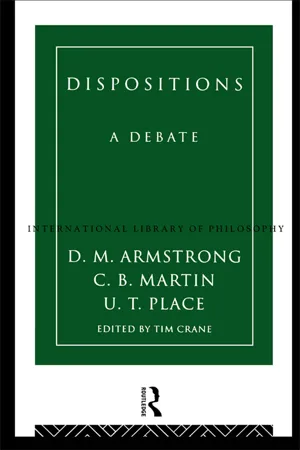
Dispositions are essential to our understanding of the world. Dispositions: A Debate is an extended dialogue between three distinguished philosophers - D.M. Armstrong, C.B. Martin and U.T. Place - on the many problems associated with dispositions, which reveals their own distinctive accounts of the nature of dispositions. These are then linked to other issues such as the nature of mind, matter, universals, existence, laws of nature and causation.
- 208 pages
- English
- ePUB (mobile friendly)
- Available on iOS & Android
eBook - ePub
About this book
Information
Topic
PhilosophySubtopic
Mind & Body in PhilosophyPart I
THE ARMSTRONG-PLACE DEBATE
1
DISPOSITIONS AS CATEGORICAL STATES
D.M.Armstrong
AN ATTEMPT TO CHARACTERIZE THE DISPUTE
Let us consider a statement such as ‘This glass is brittle’ said truly of an unstruck glass. It is uncontroversial that this statement entails a counterfactual statement along these general lines: If this glass had been suitably struck, then this striking would have caused the glass to shatter. We need not worry about the detail of this statement. To do so would deflect attention from the more fundamental ontological issues that we wish to consider.
The authors of this discussion agree in accepting a principle which C.B.Martin originally dubbed the ‘truthmaker principle’. According to this principle, for every true statement, or at least for every true contingent statement, there must be something in the world which makes the statement true. ‘Something’ here may be taken very widely. Gustav Bergmann spoke not of a truthmaker for true statements, but rather of an ontological ground for their truth. It seems to be the same idea.1 The principle appears to us to be fairly self-evident, although we are aware that a number of philosophers whom we respect do not accept it. We think that, putting it in moral terms, the truthmaker principle, or principle of an ontological ground, keeps one ontologically honest.
We now apply the truthmaker principle to the counterfactual truth about the glass. What makes this truth true, what is its ontological ground? It is vital to realize that, by itself, the principle does not mandate any particular answer. One very bad answer that would, nevertheless, satisfy the principle would be to postulate that the world contains a counterfactual state of affairs or fact: viz. the state of affairs that if, contrary to fact, the glass had been suitably struck, then this striking would have caused the glass to break. On this view, the counterfactual statement has a form that pictures rather directly the form of a certain portion of reality: the counterfactual state of affairs.
It seems to all of us, however, that it is more attractive to look for the truthmaker among the properties of the unstruck glass. But just what properties? It is here that we come to a parting of the ways. One of us, Armstrong, holds that the truthmaker for the true counterfactual should be sought in purely categorical properties of the glass: such things as the molecular structure of the glass. Another, Place, thinks that categorical properties are not enough by themselves. We must postulate both categorical properties and non-categorical properties: dispositions or powers. C.B.Martin2 has an important formulation here. He thinks that the divisions of properties into categorical and non-categorical is ultimately spurious. Our truthmakers should be a single property that nevertheless, like all properties according to Martin, has two ‘sides’ to it: a categorical side and a dispositional or power side. Thus the truthmaker for the counterfactual may be a certain sort of molecular structure, which is categorical, but the property of having this structure is also, and equally, a passive power in the object to shatter when suitably struck.
PRELIMINARY STATEMENT OF ARMSTRONG’S POSITION
There is an obvious preliminary argument that seems to favour the view that things have categorical properties only (or have properties that are one-sided only and that side is categorical). This is the great economy of the view. If the dispositions and powers of things merely supervene on their purely categorical properties, then our ontology appears greatly simplified. Ockham’s razor therefore bids us see whether we can give an account of the world in purely categorical terms.
In any case, however, irreducible dispositions and powers have some strange, and, it may be thought, objectionable, features. To postulate them is to put something like intentionality into the ultimate structure of the universe. For suppose that a thing has, in addition to its purely categorical features, active and passive powers and dispositions. It is obviously not a necessary truth, indeed it is not true at all, that every active and passive power of a particular is always manifested at some point in the existence of the particular. Consider, then, an object that has a particular power, but does not manifest it at any time. Given that this power is a non-categorical property, or is the non-categorical side of the property, then the power ‘points’ to a categorical manifestation of the power, but the manifestation never exists. Armstrong is reluctant to believe that properties can point beyond themselves to what does not exist. Mental states have this property, but it is to be hoped that this intentionality of the mental is analysable logically, or, more likely, empirically in terms of purely categorical properties.
These two points, while obviously not conclusive, do motivate the attempt to give an account of the world using categorical properties alone. But, of course, one then owes an account of why we are nevertheless entitled to attribute unrealized powers, potentialities and dispositions to the objects. My suggestion is that we should do this by appealing to the laws of nature. The idea is this: given the state of the glass, including its microstructure, plus what is contrary to fact—that the glass is suitably struck—then, given the laws of nature are as they are, it follows that the glass shatters.3 Using the convenient, if metaphysically misleading, terminology of possible worlds, in all worlds that have the same laws of nature as our world, and where the boundary-conditions are the same as our world, including the microstructure of the glass, but with the addition to the boundary-conditions of a suitable striking of the glass, then in all these worlds the glass is caused to shatter. This is what it is for the glass to be brittle, and it does not involve anything but categorical properties of the glass.
A question immediately arises: what account is to be given of laws of nature? ‘Laws of nature’ are not here to be taken as true statements of law, but rather as whatever it is that makes such true statements true: their truthmaker. From an Ockhamist standpoint, the simplest account is the Humean account, that on the side of the objects (as opposed to our cognitive attitudes), laws are nothing but regularities in the behaviour of things. Unfortunately, this account is open to a number of serious objections, one of which is directly relevant to the topic of dispositions. As the case of the brittle but unstruck glass shows, laws of nature are thought to have potential application beyond those cases which constitute the positive instantiations of the law (the Fs that are Gs). But if laws are mere actual regularities, then the warrant for extending them to cases that are potential only seems to fail. (J.L.Mackie4 made the ingenious suggestion that the warrant was inductive. This idea is criticized in Armstrong’s What is a Law of Nature?.5) It is here that the economy achieved by restricting properties to categorical ones has to be paid for, though the price is, arguably, worth paying. We need to postulate ‘strong’ laws which entail corresponding regularities without reducing to such regularities. I think the way to do this is in two steps. First, one should identify properties with universals. This need not involve postulating a ‘realm of universals’, which would be a major offence against economy. This can be avoided if one recognises none but actually instantiated properties, instantiated in the past, present or future. One can further have what David Lewis calls a ‘sparse’ theory of universals, postulating no more than those properties (and relations) required a posteriori for a satisfactory scientific account of the world.
Second, given this as a foundation, one can identify laws of nature with relations between universals, in particular with relations between properties. This seems a natural view, if one is looking for a realist theory of such laws. In the theoretically simplest case, the possession of one property by an object ensures (or probabilities) the possession of another property by the same object. This ensuring or probabilification, it is suggested, is a contingent matter, thus respecting the rather widespread intuition that the laws of nature are contingent. But if it obtains then it seems analytically to entail a corresponding regularity, or in the case of a merely probabilistic law an objective probability, that anything with the antecedent property will have the consequent property.
Here then is a scheme, at this point in the debate adumbrated rather than fully spelt out, which tries to provide a truthmaker for true dispositional statements while allowing that particulars have nothing but occurrent or categorical properties (and relations).
NOTES
1 See G.Bergmann, Realism: a Critique of Brentano and Meinong, Madison: The University of Wisconsin Press, 1967; index entry Ontological: ground.
2 C.B.Martin, ‘Anti-realism and the world’s undoing’, Pacific Philosophical Quarterly, 1984.
3 Armstrong is not committed to the view that the categorical basis of the disposition has to be microstructural. His view is that it often is, and it gives an agreeably realistic flavour, some feeling for physics as it actually is, to talk in terms of microstructure. Armstrong therefore does not think that anything of philosophical consequence follows from using the examples of microstructural properties.
4 See J.L.Mackie, ‘Counterfactuals and causal laws’ in R.J.Butler (ed.) Analytical Philosophy, Oxford: Blackwell, 1962, pp. 66–80.
5 D.M.Armstrong, What is a Law of Nature?, Cambridge: Cambridge University Press, 1983, Ch. 4, Sec. 4, pp. 50–52.
2
DISPOSITIONS AS INTENTIONAL STATES
U.T.Place
COUNTERFACTUAL STATES OF AFFAIRS
Armstrong begins his account of the dispute between us with the claim that it is common ground between us that to say
This glass is brittle
entails
If this glass had been suitably struck, then this striking would have caused the glass to shatter.
While not disputing this claim, it should be added that the statement This glass is brittle’ also entails the prediction
If at any time in the future (so long as it remains brittle) this glass is suitably struck, then this striking will cause the glass to shatter.
Armstrong then says that there is a similar agreement between us
- that every true contingent statement requires the existence of some state of affairs or the occurrence of some event whose existence or occurrence makes the statement in question true (Martin’s truthmaker principle),
- that, in the case of a counterfactual statement such as that entailed by ‘This glass is brittle’, there is no ‘counterfactual state of affairs’ whose existence makes the statement true, and
- that, on the contrary, such statements are made true by the existence of some property of the entity or entities concerned.
On this view, the issue between us is a matter of whether the property or properties whose existence makes the statement true are categorical, as Armstrong holds, non-categorical, as held by Place, or part categorical and part non-categorical, as held by Martin.
From Place’s standpoint this formulation dismisses rather too quickly the proposal that the ‘truthmaker’ for a dispositional statement is ‘a counterfactual state of affairs’. Armstrong describes a counterfactual state of affairs as
the state of affairs that if, contrary to fact, the glass had been suitably struck, then this striking would have caused the glass to break. On this view, the counterfactual statement has a form which pictures rather directly a certain portion of reality.
(pp. 15–16)
This, I agree, is absurd.1 What the counterfactual statement depicts is a (pp. 15–16) fictional event (in which the glass is struck and caused to break) which is in no sense part of reality. But this is precisely the difference between a simple categorical statement of the the cat is on the mat variety and the case of counterfactuals, subjunctive conditionals, law statements, etc., where what the statement depicts and the actually existing state of affairs which makes the sentence true are two different things; necessarily so, because in these cases the event or state of affairs depicted does not exist, has not existed and may never exist, whereas ex hypothesei the state of affairs which makes the counterfactual true most certainly does.
The issue in dispute here concerns the interpretation of this state of affairs whose existence makes the counterfactual and subjunctive conditional true. On Place’s view and, it would seem, on Martin’s, the state of affairs that makes the counterfactual true is simply the possession by the entity in question (the glass) of the dispositional property or passive causal power of being shattered when struck sufficiently hard. On Armstrong’s view it is a categorical state of the microstructure of the entity that possesses the property. Neither Place nor Martin would deny the importance of the role played by the state of the microstructure here. But whereas for Armstrong the dispositional property, and the state of the microstructure, are one and the same thing, for Place the state of the entity whereby it possesses the dispositional property, and the corresponding state of the microstructure, are two distinct states of affairs, such that the state of affairs whereby the entity possesses the dispositional property stands as effect to the state of its microstructure as cause.
But if, as Place claims, the possession of a dispositional property and its basis in the microstructure are two distinct and causally related things rather than one and the same thing, in what does the possession of the dispositional property consist? On this Rylean view,2 it is a matter, not of anything that is happening or is the case in the here and now, but of what would happen or, in the counterfactual case, would have happened, if certain conditions were to be or had been fulfilled.
If that is correct, there is nothing more to the truthmaker of a causal counterfactual than what may quite properly be called a ‘counterfactual state of affairs’, a state of affairs whereby certain predictions and counterfactual retrodictions of which the counterfactual in question is one are true of the owner of a dispositional property.
THE ‘CATEGORICAL/NON-CATEGORICAL’ DISTINCTION
Armstrong believes that the microstructural basis of a dispositional property is purely ‘categorical’. It follows that, by identifying dispositional properties wit...
Table of contents
- Cover Page
- Half Title Page
- Title Page
- Copyright Page
- Contents
- List of Contributors
- Introduction
- Part I The Armstrong-Place Debate
- Part II The Martin-Armstrong-Place Debate
- Index
Trusted by 375,005 students
Access to over 1.5 million titles for a fair monthly price.
Study more efficiently using our study tools.
Frequently asked questions
Yes, you can cancel anytime from the Subscription tab in your account settings on the Perlego website. Your subscription will stay active until the end of your current billing period. Learn how to cancel your subscription
No, books cannot be downloaded as external files, such as PDFs, for use outside of Perlego. However, you can download books within the Perlego app for offline reading on mobile or tablet. Learn how to download books offline
Perlego offers two plans: Essential and Complete
- Essential is ideal for learners and professionals who enjoy exploring a wide range of subjects. Access the Essential Library with 800,000+ trusted titles and best-sellers across business, personal growth, and the humanities. Includes unlimited reading time and Standard Read Aloud voice.
- Complete: Perfect for advanced learners and researchers needing full, unrestricted access. Unlock 1.5M+ books across hundreds of subjects, including academic and specialized titles. The Complete Plan also includes advanced features like Premium Read Aloud and Research Assistant.
We are an online textbook subscription service, where you can get access to an entire online library for less than the price of a single book per month. With over 1.5 million books across 990+ topics, we’ve got you covered! Learn about our mission
Look out for the read-aloud symbol on your next book to see if you can listen to it. The read-aloud tool reads text aloud for you, highlighting the text as it is being read. You can pause it, speed it up and slow it down. Learn more about Read Aloud
Yes! You can use the Perlego app on both iOS and Android devices to read anytime, anywhere — even offline. Perfect for commutes or when you’re on the go.
Please note we cannot support devices running on iOS 13 and Android 7 or earlier. Learn more about using the app
Please note we cannot support devices running on iOS 13 and Android 7 or earlier. Learn more about using the app
Yes, you can access Dispositions by D.M. Armstrong,C.B. Martin,U.T. Place, Tim Crane in PDF and/or ePUB format, as well as other popular books in Philosophy & Mind & Body in Philosophy. We have over 1.5 million books available in our catalogue for you to explore.