- 224 pages
- English
- ePUB (mobile friendly)
- Available on iOS & Android
eBook - ePub
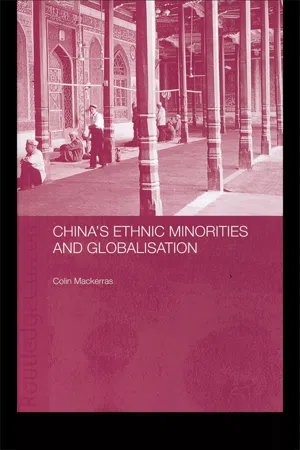
China's Ethnic Minorities and Globalisation
About this book
China's fifty-five officially recognised ethnic minorities form about 8% of the Chinese population, with over 100 million people, and occupy over 60% of China's territory. They are very diverse, and the degree of modernisation among them varies greatly. This book examines the current state of China's ethnic minorities at a time when ethnic affairs and globalisation are key forces affecting the contemporary world. It considers the fields of policy, economy, society and international relations, including the impact of globalisation and outside influences.
Information
1 Introduction
Among issues with the greatest impact on the world as a whole at the turn of the twenty-first century two of particular importance are ethnic relations and globalisation. The collapse of the Soviet Union at the end of 1991 produced a spectacular flow-on effect all over the world. Among many other factors, it saw a dramatic increase in ethnic wars and conflicts in many parts of the globe, while ethnic tensions intensified in a range of other countries.
Globalisation, or at least the less total form we might call internationalisation, has been important for a very long time. However, it gathered momentum greatly towards the end of the twentieth century. Its increasingly controversial nature became crystal clear at the World Trade Organisation (WTO) meeting in Seattle in November 1999, when demonstrators protesting against unchecked globalisation forced a postponement of a new trade round. The reasons for the protests will be taken up later in this chapter.
At the time China was in the late stages of active negotiations to join the WTO, having signed an agreement on entry with the United States earlier the same month. Negotiations had been lengthy and at times acrimonious. For China this success seemed a crowning achievement, since the United States was by far the most important and powerful of those countries with a say in whether China could join. There was considerable irony in the fact that China, which on many issues had once stood alongside ordinary people and against the power of governments, should now find itself aligned with powerful states against protestors. Quite a few hurdles stood in China’s way to WTO membership, but its efforts were eventually crowned with success in December 2001.
China is a country with fifty-five state-recognised minority nationalities, plus a majority nationality called the Han, the ethnic group whom we associate most closely with China and ‘the Chinese’. Although the 2000 census put the proportion of the minority population in China’s total at 8.41 per cent, the areas where they reside take up about 60 per cent of the territory of the People’s Republic of China (PRC) and many live near sensitive borders. For this and other reasons, China’s minorities are actually considerably more important for China than their population would suggest.
This book aims to describe developments among China’s minorities between the end of the 1980s and 2002. Several significant events took place in 1989, marking it out as very significant. A large-scale crisis rocked China, followed by the appointment of Jiang Zemin as General Secretary of the Chinese Communist Party (CCP) in June 1989. Later the same year crises erupted in Eastern Europe, leading to the overthrow of the great majority of ruling Marxist–Leninist parties there, and 2 years later the Soviet Union itself collapsed. The second date is when the typescript of this book was completed. It also saw the retirement of Jiang Zemin as CCP General Secretary, and his replacement by Hu Jintao.
The book aims to take up the minorities’ economies, their politics, their education, and their societies, including gender and population issues and in some cases religion. It also aims at preliminary explorations on how globalisation and its concomitant modernisation have affected China’s ethnic minorities during that time. In addition, the book considers the ramifications of secessionist activities at the turn of the century, and their implications for China as an integrated state. No account of globalisation can avoid international relations, and the book aims to cast further light on the way in which China’s minorities affect the international relations of the country as a whole. Finally, I am aiming through this book to contribute to theoretical discussions about the nature of globalisation in the contemporary world and its effects on ethnic groups, especially minorities.
Some background
What is a minority nationality?
Just who are we discussing when we talk of China’s ethnic minorities or minority nationalities? The answer is those fifty-five ethnic groups the Chinese state recognises as its ‘minority nationalities’. The Chinese state follows a definition of nationality laid down by Stalin in 1913 (1953: 307). It runs that a nationality (Chinese minzu) is ‘a historically constituted, stable community of people, formed on the basis of a common language, territory, economic life, and psychological make-up manifested in a common culture’. There are problems in applying any definition involved in anything so controversial as ethnic matters, including this one. The Chinese Muslims who are termed Hui do not have their own language nowadays and their territory is so dispersed throughout the country that it is very difficult to claim that they have a common territory. Hardly any Manchus still speak Manchu. And there are other anomolies.
However, the reality is that the Chinese state and its scholars have given a great deal of attention to ethnic identification based on this definition, especially in the 1950s. There was a substantial break owing to the Cultural Revolution of 1966– 1976, but the work of identification then began again. By 1979, the number of fifty-five had been reached. For various reasons, all other claims to being classified as a ‘nationality’ since then have been rejected.
By far the largest group who could be, but is not in fact, considered a ‘nationality’ is the Hakkas. These are a south Chinese people who, although culturally, linguistically and socially quite distinct in the late imperial period of Chinese history, nevertheless played a significant role in twentieth-century Chinese nationalism, especially in the early period. Among smaller groups, one people that stands out is the Mosuo, a matrilinear people still living near the Lugu Lake which straddles the Yunnan-Sichuan border in the southwest of China. For various reasons, mainly political, the state does not recognise either of these peoples as a ‘nationality’. It still considers the Hakkas as part of the majority Han, and the Mosuo as a branch of the Naxi, and is unlikely to change its mind. This is despite the fact that there is still some ethnic pride in both peoples, including those who are quite convinced that they are indeed separate peoples.
The Chinese state has published numerous official statistics based on its classifications. They cover a great many of the fields of relevance to this book. Moreover, Chinese scholars and officials have put out enormous amounts of information and insight, virtually all of it using the state-recognised classifications of the minority nationalities. Although the official figures can be subjected to criticism, they are on the whole the best available, and international bodies use them. Moreover, although some of the classifications are open to question, most are reasonably valid. Ethnic boundaries are rubbery at the best of times, and the fact remains that every Chinese has a ‘nationality’, which is included in a registration card using the official classifications. It is my overwhelming impression that the great majority of members of the minorities agree with, or at any rate accept, the classification in which they are placed. For these reasons, it is sensible and appropriate to adopt the Chinese state classifications for the purposes of this book.
This does not mean that they should never be questioned. In the West many scholars have challenged the Chinese state categories and terminology. One eminent scholar of the Hui, or Chinese Muslims, argues that ‘Marxist–Stalinist nationality theory’ has placed limitations on official Chinese portrayals of the Hui (Gladney 1991: ix–x), and he is not alone in offering criticisms of this kind (e.g. Tapp 1995: especially 195–9).
In the West there has been an enormous amount of thought and literature on questions relating to ethnic minorities terminology. The term ‘race’, which was once the most fashionable, has gone out of date because of its popularity with people now regarded as racists, such as nineteenth-century imperialists. A much more recent term than race is ‘ethnicity’, the first dictionary appearance of which was in the Oxford English Dictionary in 1972 (Eriksen 1993: 3). This term is preferable, since it lacks the judgemental overtones of ‘race’ and implies more cultural than biological concerns. Despite the relative novelty of the term, the corresponding adjective ‘ethnic’ has a much longer pedigree.
One authority has written that ‘the term ethnic group is now widely used both within and without academic discourse’ (Fenton 1999: 58). A definition of an ‘ethnic group’would appeal to ancestry, a shared history, and a common language and culture, possibly including religion. Schermerhorn (1970: 12) claims that ‘A necessary accompaniment is some consciousness of kind among members of the group’. This need places this definition on a much more subjective level than that of Stalin, who took no account at all of consciousness. The definition offered avoids the issue of whether ethnicity is primordial or socially derived, a debate over which much controversy has raged. On the other hand, Stalin’s definition, by calling a nationality ‘historically constituted’, suggests that it is socially based, an impression confirmed by the trend of Marxist thinking generally. One of the advantages of the term ‘ethnic group’ over ‘ethnic minority’ is that in some countries, such as Indonesia, there are no ethnic groups with populations making up the majority of the people, meaning that all groups belong to minorities. However, that is certainly not the case in China.
The aim of this section is to clarify precisely who is the subject of this book. The theory of ethnicity is an enormous topic and well outside my scope. But given these background comments, it seems to me legitimate to refer to the peoples of concern to this book as ‘ethnic groups’, ‘ethnic minorities’, ‘minority nationalities’ or simply ‘minorities’. I intend to use those terms more or less interchangeably, making it clear if there is a reason for avoiding one or the other.
The sources
There has been a considerable amount of work carried out over the last 20 years or so on China’s minorities in contemporary times, both in Chinese and European languages. Chinese works are too numerous to mention here, but many are cited in the notes and bibliography. Works in English are much more limited in number, although not necessarily in distinction. Some particularly deserving mention are Dru Gladney’s work on the Hui (1991), Stevan Harrell’s on the Yi,1 Louisa Schein’s on the Miao (2000), Ralph Litzinger’s on the Yao (2000), Katherine Kaup’s on the Zhuang (2000) and Tsering Shakya’s history of modern Tibet (1999).
Obviously it is appropriate that this book should base itself at least in part on what others have written. I note that one issue separating the present book from the great bulk of other work, either in Chinese or a European language, is that it attempts consideration of the minorities as a whole, rather than approaching one only. The advantage of this approach is that it allows for global coverage and draws attention to differences, comparisons and contrasts between and among ethnic groups. It allows for consideration of how the Chinese state and the minorities who live within its territory impact upon each other.
In addition to written sources, I have made use of numerous visits to minority areas, especially in the 1990s, and these have formed my main material for this book. Minority areas visited include Tibet in 1985, 1990, 1997 and 2002, Xinjiang in 1982, 1994 and 1999, Guizhou in 1990, western Sichuan in December 1996 and January 1997, the Yanbian Korean Autonomous Prefecture in 1986 and 1990, Inner Mongolia and Ningxia in 1990, Qinghai in 1995, and minority areas of Yunnan in 1996, 2000 and on other occasions. With but few exceptions, visits to these minority areas have involved going to see schools and other educational institutions, families, factories, farms, performances and art troupes, and monasteries, temples, mosques and/or other religious sites, among other places of interest. In all places I have tried to interview relevant people, finding out not only details of their lives and work but also their views about what matters to them, their role as members of an ethnic minority and their attitude towards life in contemporary China. The great majority of these interviews have been conducted in Chinese, but with a few in English or through interpreters familiar with minority languages such as Uygur and Tibetan.
History
Some background history of the period of focus in this book is necessary to make sense of developments among China’s ethnic minorities, and the mutual impact of globalisation on China and its minority nationalities. Since there is a considerable amount in other chapters about the history and conditions of individual minorities, it is Chinese background history that is of concern here.
After a period of radical revolution known as the Cultural Revolution (1966 –1976) and led by Mao Zedong (1893–1976), China entered a period of reform, in which the principal goal was economic development under the continued leadership of the CCP. The main architect of this policy was Deng Xiaoping (1904–1997), a towering figure in modern Chinese history who, though never the formal leader either of the Chinese government or CCP, in fact wielded gigantic power during the last quarter of the twentieth century, far more than any other single individual. The influence of Mao Zedong was so strongly eclipsed and the evaluation of his role so severely negated at that time that one eminent authority on Chinese politics has entitled his book on the age of Deng Xiaoping ‘burying Mao’ (Baum 1994).
The period of reform was introduced by the Third Plenary Session of the Eleventh CCP Central Committee, which lasted from 18 to 22 December 1978. What this full session of China’s top Party body did was to set the parameters of a new revolution based not on radical ideology but on a quest for modernisation, economic development, national strengthening and a drastic rise in the standard of living. More than any other it was at this meeting that Deng Xiaoping asserted himself and laid the groundwork for his future power.
Openness to the outside world was a primary aim of the reform policies. Overseas trade boomed and foreign expertise poured into the country. Chinese students went overseas in large numbers and, although many never returned, enough did so that their training and expertise made a difference to the economy and society. China changed from an isolated country to one that was highly susceptible and open to world influences. China’s joining the WTO in 2001 was a major spur to globalisation, but in fact the country had been subject to those good and bad trends we associate with globalisation somewhat before then.
This incipient globalisation had profound implications for China. Finding out about what was happening outside the country, people began to demand far more in the way of freedoms and outside knowledge and techniques. Western, especially American, influence became incomparably more widespread than had been the case under Mao Zedong. One result was a rapid decline in the impact of Marxism–Leninism among ordinary people, and a concomitant growth in that of Western liberalism.
During the 1980s there were several major student movements, the main ones being at the end of 1986 and in the middle of 1989. The first of these brought about the downfall of the CCP General Secretary Hu Yaobang, appointed to that position in the middle of 1981 and, after a break, the appointment of Zhao Ziyang to the position. The second developed a momentum so powerful on behalf of democracy that Deng Xiaoping came to believe that the CCP was about to be overthrown. He reacted by suppressing the student movement brutally through a military action on the night of 3–4 June, with substantial casualties among the students and others. Later the same month a CCP Central Committee Plenum dismissed CCP General Secretary Zhao Ziyang, replacing him with Jiang Zemin, who also became state president in March 1993.
The period following the suppression of the student demonstrations of 1989 was much more stable politically than most Western observers had expected. Jiang Zemin remained the CCP General Secretary until the Sixteenth CCP Congress towards the end of 2002. On the other hand, the plague of corruption, which had worsened significantly in the 1980s by comparison with the earlier period, continued to intensify its attack on China’s body politic. To be fair to him, Jiang Zemin appears to have done his best to counter this corruption, and authorities tracked down some extremely high-ranking corrupt officials. These even included former Guangxi Governor Cheng Kejie, executed on 14 September 2000. For a former provincial governor to be executed for corruption was completely unprecedented in the history of the PRC. Despite the efforts of authorities to stamp out corruption, they are most unlikely to solve the problem and are unlikely to do better than contain it.
The opening up, indeed globalisation, of China has brought tremendous changes to its society and culture. There is very much more freedom than there used to be. There has been a religious revival, which has affected virtually all parts of the country, especially the minority areas. On the other hand, the authorities did not hesitate to suppress religious activities they thought were a threat to the state, the most important example being the Falungong, a quasi-religious sect drawing on martial arts, meditation and healing. On 25 April 1999 this body suddenly and unexpectedly announced its presence in society with a large-scale demonstration outside the residences of the top leadership. The authorities took fright and banned the Falungong in July 1999. This did not prevent further demonstrations by the Falungong, with authorities arresting practitioners. In 2001 the Falungong leader Li Hongzhi, who had lived in the United States since 1992, was actually nominated for the Nobel Peace Prize but made no headway.
Mao Zedong’s regime laid considerably more weight on gender equality than Deng Xiaoping’s, with the slogan that ‘women hold up half the sky’. This was never reality under Mao, but observers generally saw a decline in the status of women in the period of reform. Certainly, the Fourth United Nations Conference on Women held in Beijing in September 1995 brought forward some very negative Western images of the fate of women under Deng, with emphasis laid on the abduction and sale of girls and the poor treatment of female orphans (see Mackerras 1999: 160–3). On the other hand, there was a brighter side to the story. The United Nations 1998 Human Development Report (cited ‘Monitor’ 1999: 12) ranked 174 countries according to such criteria as the number of women in parliament and the percentage of female administrators and professional and technical workers in the workforce. In general Asian countries fared very badly, but China came in the first in Asia and number 33 in the world. Women’s share of earned income was 38 per cent. This compared with 45 per cent in Sweden (the highest ranked country in the world for all criteria combined), 37 per cent in Thailand and 34 per cent in Japan.
Economically, China we...
Table of contents
- Cover page
- Title page
- Copyright page
- Preface
- Abbreviations
- 1: Introduction
- 2: Historical background, 1949–1989
- 3: Minorities politics, 1989–2002
- 4: The economies of the minorities
- 5: The realm of the mind, religion and education
- 6: Population, women and family
- 7: International relations
- 8: Conclusion
- Appendix: China’s ethnic minorities
- Notes
- References
Trusted by 375,005 students
Access to over 1.5 million titles for a fair monthly price.
Study more efficiently using our study tools.
Frequently asked questions
Yes, you can cancel anytime from the Subscription tab in your account settings on the Perlego website. Your subscription will stay active until the end of your current billing period. Learn how to cancel your subscription
No, books cannot be downloaded as external files, such as PDFs, for use outside of Perlego. However, you can download books within the Perlego app for offline reading on mobile or tablet. Learn how to download books offline
We are an online textbook subscription service, where you can get access to an entire online library for less than the price of a single book per month. With over 1.5 million books across 990+ topics, we’ve got you covered! Learn about our mission
Look out for the read-aloud symbol on your next book to see if you can listen to it. The read-aloud tool reads text aloud for you, highlighting the text as it is being read. You can pause it, speed it up and slow it down. Learn more about Read Aloud
Yes! You can use the Perlego app on both iOS and Android devices to read anytime, anywhere — even offline. Perfect for commutes or when you’re on the go.
Please note we cannot support devices running on iOS 13 and Android 7 or earlier. Learn more about using the app
Please note we cannot support devices running on iOS 13 and Android 7 or earlier. Learn more about using the app
Yes, you can access China's Ethnic Minorities and Globalisation by Colin Mackerras in PDF and/or ePUB format, as well as other popular books in Social Sciences & Ethnic Studies. We have over 1.5 million books available in our catalogue for you to explore.