- 224 pages
- English
- ePUB (mobile friendly)
- Available on iOS & Android
eBook - ePub
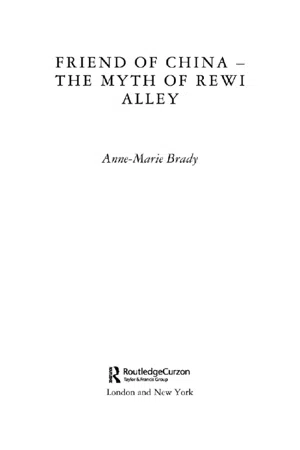
Friend of China - The Myth of Rewi Alley
About this book
This study is a radical and controversial analysis of the life and works of Rewi Alley utilizing both Chinese materials and previously unpublished materials from western sources. Rather than a biography as such, it is a revisionist history, re-examining what we know and understand about one of the most famous, or indeed infamous, foreigners in modern China: Rewi Alley, who arrived in China in 1927 from New Zealand and lived there for the rest of his life. Alley was regarded as a great humanitarian and internationalist. Later he became an outspoken 'foreign friend' of the Chinese regime and prolific propagandist on the new China. This book examines the myth and reality of his life, using them to explore the role of foreigners in China's diplomatic relations and their sensitive place in China after 1949, laying bare the important role of China's 'foreign friends' in Chinese foreign policy.
1
INTRODUCTION
. . . this Marco Polo in reverse, who does not carry off the secrets of Cathay, but helps the oldest society on earth to discover new powers.1
Rewi Alley was a man who became a myth in his own lifetime. Alley was by no means a passive witness to the mythologisation of his own life, indeed he was an active participant in the process. Although New Zealand-born, Alley played a prominent role in China from the 1930s, one which continues to the present day; from relief worker, envoy of Chinese foreign policy, role model for Chinese youth, to symbol of New Zealand–Chinese relations and idealised Sino-foreign relations. The persistence of the Alley myth has a lot to do with his most long-lasting and prominent role, that of ‘friend of China’. The foreign friends of the People’s Republic of China (PRC) have an important role in China’s distinctive foreign affairs system, which incorporates state-to-state diplomacy with so-called ‘people’s’ diplomacy, foreign propaganda and the management of the foreign presence in China.2 The friends are also symbolic of the highly politicised status of the foreigner in the PRC and the Chinese Communist Party’s (CCP) ongoing attempts to control Sino-foreign relations in the abstract and most literal sense. Alley’s sixty years in China (1927–1987) offer a microcosm of the changing position of foreigners in China from the late Republican period right up until the current phase of ‘reform and opening up’ begun in 1978. More than any other foreigner in this period, beginning in his earliest years in China, Alley had close involvement in some of the most burning issues of the times, close contact with the political figures who influenced change, as well as being an instrument of change himself.
Surprisingly, Rewi Alley’s political role in China and the means to which the myth about him was put has received little scholarly attention in the past. The myth of Rewi Alley has, however, been thoroughly documented by his admirers and hagiographers, and the following selection serves as an introduction to that myth:
He was a strangely out-of-place figure in that dark, sickly crowd, his sunburned face covered with dust beneath a fiery bush of upstanding hair. He was of only medium height, but he had tremendous rugged arms and legs. When he stood with those giant’s legs spread apart in a characteristic attitude, he seemed somehow rooted to the earth. But it was the man’s great head, with a profile like something carved from Stone Mountain, that struck me.
Edgar Snow, Saturday Evening Post, 19413
Alley had lived and worked in China for 60 years, affecting huge social change and influencing the thinking of many of the vast nation’s leaders, from Mao Tse-tung onwards. He drew on his early life as a Taranaki back-blocks farmer to shape the programmes and ideologies which were to change China. Always a pragmatist, he used a commonsense, do-it-yourself approach in his early efforts to help create a new order for China’s oppressed and exploited workers. Alley was dismayed by the plight of the Chinese workers when he arrived in Shanghai to take up an appointment as factory inspector in 1929.
Auckland Star, 19874
Originally, when he was young, he ran a farm in his motherland New Zealand and he worked really splendidly. At the time, a young lady was very fond of him. Before long, Rewi Alley went to China, the young lady still wrote to him and told him she still wanted to marry him, on condition that he must leave China and come back to New Zealand. Rewi Alley replied to her, ‘My work is in China. China needs me,’ and thus broke the engagement. During the war years, Premier Zhou Enlai was very concerned about [Alley’s] lifestyle and suggested he think about getting married. [Alley] disagreed, saying, ‘I dash about all the time and it is very dangerous. If I died wouldn’t it harm the other person?’
People’s Daily, 19885
About [1931] Alley became an official member of the Chinese Communist Party and linked forces with an American communist journalist named Agnes Smedley to become propagandists for the Reds.
New Zealand Herald, 19806
. . . more than any other individual . . . responsible for the development of Chinese industry.
New Zealand School Journal, 19467
Rewi Alley, the man mentioned in laudable terms by many writers of books on China: Perhaps we can sum him up by imagining a man of courage and vision and sympathy with the lot of the little people, writer, poet, philosopher, yet practical man all combined; a human dynamo – one of the world’s truly great people.
CORSO Report, 19478
Rewi contributed in an original way to the development of the New China. The Chinese Industrial Co-operatives, which he initiated and organised, provided the blue-print for the communes which now exist under the People’s Government. For many, however, Rewi Alley’s greatest contribution has been his literary achievements. His poems are very personal, close and deeply felt. He is second to none in the translation of Chinese literary works, especially Chinese T’ang poets. . . . His documentary and diary accounts are all first hand . . . these writings are generally good.
National Committee for the Commemoration of Rewi Alley’s
Seventy Fifth Birthday, NZ, 19729
To explain China to the world, to take part in conferences including the representatives of people struggling against foreign or local oppression throughout the world; to speak and waken people from the old way of thinking to an awareness of the new hopeful forces – these were his tasks, a continuation of what he had begun in Shanghai, continued in Gung Ho and in the Sandan school, and now could share with new comrades not only in China but on a worldwide basis.
Willis Airey, A Learner in China, 197010
I went back to my homeland of New Zealand in 1960 for the first time in twenty-three years. This was made possible by Premier Zhou Enlai. At an interview with a visiting New Zealand Labour Party delegation, he said in my presence, ‘Why don’t you get Alley a passport?’ They said, ‘Well, we are rather confused. We did not know about that. We did not know he doesn’t have one.’ Zhou said, ‘If you don’t get him a passport I’ll give him a Chinese one, right now.’ When they went back to New Zealand, I sent in my application for a passport, received it and went on a New Zealand lecture tour.
Rewi Alley, At 90: Memoirs of My China Years, 198711
He was one of those few and rare people on earth who move and live for others rather than for themselves. And at his contact, such was the power that emanated from this colossal faith of his in people, one somehow became better too, one began to understand what it is truly to live within the context of one’s own humanity, which is to care for others.
Han Suyin, New Argot, 197412
A tour group calls. Rewi is one of Beijing’s living monuments, and there are certain command functions he must perform. He talks for half an hour on China and the state of the nation as revealed by a first hand circuit from south to north just completed. At their departure, he is ahead of them. Swiftly, he ducks along the shelves gathering this and that item of pottery, and pictures given him on his travels. Then he is amongst them in the lobby, a centrifuge dispensing presents until a pink happiness pervades the entire group . . .
Geoff Chapple, Rewi Alley of China, 198013
(Italics added.)
(Italics added.)
The above series of quotes, culled from a representative sample of writings, are all myth, part of the Rewi Alley myth that flourished during the sixty years he lived and worked in China and continues to the present day. All of the images they present are falsehoods or, at best, present a greatly inflated view of Alley and his life. Edgar Snow promotes Alley to American readers as something akin to their heroic presidents profiled on Mount Rushmore; a New Zealand journalist claims Alley influenced the thinking of China’s leaders, including Mao Zedong; Alley’s former doctor repeats a myth created by Alley himself that he had never married due to a failed love affair and his commitment to the Chinese revolution; the New Zealand Herald tells us Alley is an official member of the Chinese Communist Party; the New Zealand School Journal cites Alley as the founder of China’s manufacturing sector; the Director of CORSO, formerly New Zealand’s leading charity, lauds Alley as ‘one of the world’s truly greatest people’; other admirers cite him as the inspiration for China’s People’s Communes; a revolutionary thinker from the very moment he arrived in Shanghai; indeed, so close to the Chinese leadership that he was eligible for instant Chinese citizenship; to Han Suyin, Alley is a Christ-like figure, through contact with him she alleges ‘one somehow became better too’; to New Zealand journalist Geoff Chapple, Alley is a ‘centrifuge’ dispensing presents and pink happiness.
The excerpts present Alley as an heroic figure, yet there is another aspect to his mythologisation that is mostly not available in written form, that is, the way in which Alley was villainised by those who were opposed to him or despised him. It is interesting that most of the hostile claims relate to Alley’s sexuality. In these mythic accounts Alley is portrayed as a womaniser who keeps a woman in every Chinese city he visits,14 a member of the Chinese Communist Party (here it is not meant favourably), a paederast who stayed on to write propaganda in Communist China after 1949 because he was supplied with young boys by the Chinese government; or, alternatively, as someone who was being blackmailed into writing for the Chinese government because of these sexual proclivities. As with the favourable versions of the Alley myth, all the above are also untrue.
In Rewi Alley’s long and eventful life, a web of often conflicting myths was constructed by Alley and others in order to present him as an iconic symbol, representative of vastly different ideas and objectives. Roland Barthes has written that the efficacy of myth in human life is that it
abolishes the complexity of human acts, it gives them the simplicity of essences, it does away with dialectics, with any going back beyond what is immediately visible, it organises a world which is without contradictions because it is without depth, a world wide open and wallowing in the evident, it establishes a blissful clarity: things appear to mean something by themselves.15
Myth-making smooths out the extraneous aspects of its subjects’ lives, since the lives of ordinary humans are too full of inconsistencies to be presented in all their complexity and conflict. Symbolic figures such as Alley have a role in every society. According to Moses Hadas, in authoritarian societies the list of individuals deemed worthy of veneration tends to be rather long, and consists of those persons who have upheld or maintained authoritarianism. In democratic societies, the number of heroes is reduced and their faults are not hidden. Social advances are attributed to society rather than individuals, hence the role of one particular individual is regarded as less significant.16 Unless there is an organised cult to perpetuate their memory, the eminent figures of one generation easily fall into oblivion. Hadas contends that it is the authorised image of the hero that is always more important than his actual personality. It is this image that will survive, to be revered and remembered, whether in popular tradition or as an organised cult.17
To say that Alley was mythologised does not take away from his actual achievements in China: in Shanghai as a factory inspector, in the Chinese Industrial Co-operatives and at the Shandan Bailie School in the 1940s, and in the 1980s, the strength of vision that saw him working to re-establish the co-operative movement and the Shandan Bailie School. To assess the value of his work as propagandist for the Chinese government is more difficult, and perhaps worthy of further study. None the less, most myths have some basis in reality, no matter how remote, and the Rewi Alley myth is no different.
So who was the real Alley? And can we ever know? This study aims to unravel the myth-making that has surrounded the life of Rewi Alley, examining how it was that a self-described ‘ordinary New Zealand plug’18 could become iconised in his own lifetime, a symbol of wide-ranging political objectives, in both his adopted and native countries. While biographical details are a feature, this work is not primarily a biography. There have been three book-length biographies on Alley, all written in Alley’s lifetime. They are Willis Airey’s A Learner in China, Geoff Chapple’s Rewi Alley of China and Alley’s own At 90: Memoirs of My China Years. All are useful in different ways, but deeply flawed. Airey’s book suffers from having been severely censored by Alley and his editor Shirley Barton (it was written during the Cultural Revolution). Chapple’s book is more honest, but his close relationship with Alley prevented him from revealing everythin...
Table of contents
- Cover Page
- Title Page
- Copyright Page
- Plates
- Acknowledgements
- 1 Introduction
- 2 A New Zealand Childhood
- 3 Shanghailander
- 4 The Humanitarian
- 5 Rewi’s School
- 6 The ‘Faustian Choice’
- 7 Friend of China
- 8 Peking’s Man
- 9 New Zealand’s Asset
- 10 Internationalist
- 11 Epilogue
- Appendix
- Notes
- Bibliography
Trusted by 375,005 students
Access to over 1.5 million titles for a fair monthly price.
Study more efficiently using our study tools.
Frequently asked questions
Yes, you can cancel anytime from the Subscription tab in your account settings on the Perlego website. Your subscription will stay active until the end of your current billing period. Learn how to cancel your subscription
No, books cannot be downloaded as external files, such as PDFs, for use outside of Perlego. However, you can download books within the Perlego app for offline reading on mobile or tablet. Learn how to download books offline
Perlego offers two plans: Essential and Complete
- Essential is ideal for learners and professionals who enjoy exploring a wide range of subjects. Access the Essential Library with 800,000+ trusted titles and best-sellers across business, personal growth, and the humanities. Includes unlimited reading time and Standard Read Aloud voice.
- Complete: Perfect for advanced learners and researchers needing full, unrestricted access. Unlock 1.5M+ books across hundreds of subjects, including academic and specialized titles. The Complete Plan also includes advanced features like Premium Read Aloud and Research Assistant.
We are an online textbook subscription service, where you can get access to an entire online library for less than the price of a single book per month. With over 1.5 million books across 990+ topics, we’ve got you covered! Learn about our mission
Look out for the read-aloud symbol on your next book to see if you can listen to it. The read-aloud tool reads text aloud for you, highlighting the text as it is being read. You can pause it, speed it up and slow it down. Learn more about Read Aloud
Yes! You can use the Perlego app on both iOS and Android devices to read anytime, anywhere — even offline. Perfect for commutes or when you’re on the go.
Please note we cannot support devices running on iOS 13 and Android 7 or earlier. Learn more about using the app
Please note we cannot support devices running on iOS 13 and Android 7 or earlier. Learn more about using the app
Yes, you can access Friend of China - The Myth of Rewi Alley by Anne-Marie Brady in PDF and/or ePUB format, as well as other popular books in History & Chinese History. We have over 1.5 million books available in our catalogue for you to explore.