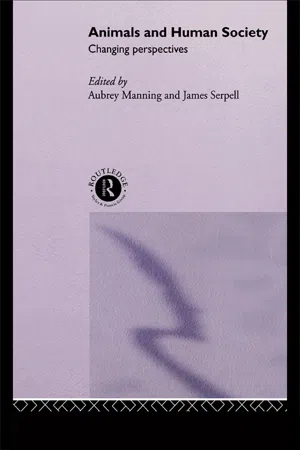
Modern society is beginning to re-examine its whole relationship with animals and the natural world. Until recently issues such as animal welfare and environmental protection were considered the domain of small, idealistic minorities. Now, these issues attract vast numbers of articulate supporters who collectively exercise considerable political muscle. Animals, both wild and domestic, form the primary focus of concern in this often acrimonious debate. Yet why do animals evoke such strong and contradictory emotions in people - and do our western attitudes have anything in common with those of other societies and cultures? Bringing together a range of contributions from distinguished experts in the field, Animals and Society explores the importance of animals in society from social, historical and cross-cultural perspectives.
- 240 pages
- English
- ePUB (mobile friendly)
- Available on iOS & Android
eBook - ePub
About this book
Information
1
FROM TRUST TO DOMINATION
An alternative history of human-animal relations
Tim Ingold
Just as humans have a history of their relations with animals, so also animals have a history of their relations with humans. Only humans, however, construct narratives of this history. Such narratives range from what we might regard as myths of totemic origin to supposedly ‘scientific’ accounts of the origins of domestication. And however we might choose to distinguish between myth and science, they have in common that they tell us as much about how the narrators view their own humanity as they do about their attitudes and relations to non-human animals. I aim to show that the story we tell in the West about the human exploitation and eventual domestication of animals is part of a more encompassing story about how humans have risen above, and have sought to bring under control, a world of nature that includes their own animality.
In this story, a special role is created for that category of human beings who have yet to achieve such emancipation from the natural world: known in the past as wild men or savages, they are now more politely designated as hunters and gatherers. I shall be looking at how hunter-gatherers have come to be stereotypically portrayed, in western anthropological accounts, as surviving exemplars of the ‘natural’ condition of mankind, and more particularly at how this is reflected in the depiction of hunters’ relations toward their animal prey. I shall then go on to contrast this depiction with the understandings that people who actually live by hunting and gathering have of their relations with the environmental resources on which they depend: again, since our concern is specifically with relations towards animals, I shall concentrate on hunting rather than gathering whilst recognizing, of course, that it is not a simple matter to determine where the former ends and the latter begins ( Ingold 1986a: Ch. 4)
Taking the hunter-gatherer understandings as a baseline, I shall attempt to construct an alternative account of the transformation in human-animal relations that in western discourse comes under the rubric of ‘domestication’, otherwise known as ‘the origins of food production’. My concern, in particular, will be to contrast human-animal relations under a regime of hunting with those under a regime of pastoralism. And a leading premiss of my account will be that the domain in which human persons are involved as social beings with one another cannot be rigidly set apart from the domain of their involvement with non-human components of the environment. Hence, any qualitative transformation in environmental relations is likely to be manifested similarly both in the relationships that humans extend towards animals and in those that obtain among themselves in society.
HUMANITY, NATURE AND HUNTER-GATHERERS
Let me begin, then, with the portrayal of the savage hunter-gatherer in western literature.1 There are countless instances, especially in the writings of nineteenth-century anthropologists, of pronouncements to the effect that hunter-gatherers ‘live like animals’ or ‘live little better than animals’. Remarks of this kind carry force only in the context of a belief that the proper destiny of human beings is to overcome the condition of animality to which the life of all other creatures is confined. Darwin, for example, found nothing shocking, and much to marvel at, in the lives of non-human animals, yet his reaction on encountering the native human inhabitants of Tierra del Fuego, during his round-the-world voyage in the Beagle, was one of utter disgust. ‘Viewing such men,’ he confided to his journal, ‘one can hardly make oneself believe that they are fellow-creatures and inhabitants of the same world’ (Darwin 1860:216). It was not just that their technical inferiority left them completely at the mercy of their miserable environment; they also had no control over their own impulses and desires, being by nature fickle, excitable and violent. ‘I could not have believed,’ Darwin wrote, ‘how wide was the difference between savage and civilised man; it is greater than between a wild and domesticated animal, inasmuch as in man there is a greater power of improvement’ (1860:208, see Plate 1.1).
Now Darwin, like many of his contemporaries and followers, was in no doubt that these human hunter-gatherers were innately inferior to modern Europeans. This is a view that no longer commands acceptance today. If you wanted to compare, say, the innate capacities of humans and chimpanzees, it would make no difference whatever whether your human subjects were— say—Australian Aboriginal hunter-gatherers or British university professors. Nevertheless, the belief persists in many quarters that even though, biologically, hunter-gatherers are fully human, their way of life makes them comparable to other animals in a way that people in pastoral, agricultural or urban societies are not. As recently as 1957, the American archaeologist Robert Braidwood wrote that ‘a man who spends his whole life following animals just to kill them to eat, or moving from one berry patch to another, is really living just like an animal himself (1957:122). Indeed, this idea of hunters and gatherers, as living in a pristine world of nature rather than an artificial, man-made environment, is virtually given by definition. To see why this should be so, we need to return to that very dichotomy which Darwin used as the measure of the distance from savagery to civilization, namely that between the wild and the domestic.
Hunting and gathering, of course, are terms that denote particular kinds of activity. How, then, are these activities to be defined? The conventional answer is that hunters and gatherers exploit ‘wild’ or non-domesticated resources, whereas farmers and herdsmen, by contrast, exploit domesticated ones (e.g. Ellen 1982:128). The precise meaning of domestication has remained a topic of scholarly debate for well over a century, and I shall return in a moment to examine some of the suppositions that underlie this debate. Suffice it to say at this point that every one of the competing definitions introduces some notion of human control over the growth and reproduction of animals and plants. Wild animals, therefore, are animals out of control. Hunter-gatherers, it seems, are no more able to achieve mastery over their environmental resources than they are to master their own internal dispositions. Like other animal predators, hunters are engaged in the continual pursuit of fugitive prey, locked in a struggle for existence which—on account of the poverty of their technology—is not yet won. Indeed the ubiquity, in western archaeo-zoological literature, of the metaphors of pursuit and capture is extremely striking: hunters forever pursue, but it is capture that represents the decisive moment in the onset of domestication ( cf. Ducos 1989:28). Feral animals, in turn, are likened to convicts on the loose. Notice how the relation between predator and prey is presented as an essentially antagonistic one, pitting the endurance and cunning of the hunter against the capacities for escape and evasion of his quarry, each continually augmented by the other through the ratchet mechanism of natural selection. The encounter, when it comes, is forcible and violent.
Then again, hunters and gatherers are conventionally defined as collectors rather than producers of their food. The history of this dichotomy is an intriguing one. Long ago, Marx and Engels argued that production was the essential criterion that set mankind apart from other animals. Men, they said, ‘begin to distinguish themselves from animals as soon as they begin to produce their means of subsistence’ (Marx and Engels 1977:42). Animals, by contrast, were supposed to collect whatever nature has to offer. But later on, the archaeologist V.Gordon Childe (1942) was to adopt exactly the same dichotomy, between food production and food collection, not to distinguish humans from animals, but to distinguish human agriculturalists and pastoralists from hunter-gatherers (or ‘foragers’) whether human or nonhuman. These terms have since become part of the stock-in-trade of pre-historians, who still speak of hunter-gatherers as food collectors, and of the domestication of plants and animals as marking the inception of food production. Indeed, this is just one of many examples of the way in which criteria originally introduced to specify the distinction between animals and humans have tended to slide on to the quite different distinction between domesticators and non- domesticators, so placing non-domesticating humans on the side of the animals (for other examples, see Ingold 1986a: 11, 236).
Behind these oppositions between the wild and the domestic, and between collection and production, there lies a much more fundamental metaphysical dualism—one that seems peculiar to the discourse which, as a convenient shorthand, we can call ‘western’, to the extent of being its defining feature. This is the separation of two mutually exclusive domains of being to which we attach the labels ‘humanity’ and ‘nature’. All animals, according to the principle of this separation, belong wholly in the world of nature, such that the differences between species are differences within nature. Humans, however, are the sole exception: they are different because the essence of their humanity transcends nature; and by the same token, that part of them that remains within nature presents itself as an undifferentiated amalgam of animal characteristics ( Ingold 1990a: 210). Thus human beings, uniquely among animals, live a split-level existence, half in nature and half out: they are conceived as biological and cultural beings, organisms with bodies and persons with minds. Now as Raymond Williams has pointed out,
to speak of man ‘intervening’ in natural processes is to suppose that he might find it possible not to do so, or decide not to do so. Nature has to be thought of…as separate from man, before any question of intervention or command, and the method and ethics of either, can arise.
(1972:154)
It follows that when we speak of production and domestication as interventions in nature, as we are inclined to do, humanity’s transcendence of the natural world is already presupposed.
Consider, for example, the meaning of production, classically defined by Engels as ‘the transforming reaction of man on nature’ (1934:34). In order to produce, humans have to achieve such command or mastery over nature as to be able to impress their own premeditated designs upon the face of the earth: ‘The further removed men are from animals…the more their effect on nature assumes the character of premeditated, planned action directed towards definite preconceived ends’ ( Engels 1934:178).
In other words, to the extent that the human condition transcends nature, so nature herself comes to stand as raw material to human projects of construction. In their realization, these projects establish a division, within the material world, between the natural and the artificial, the pristine and the man-made, nature in the raw and nature transformed. Hunters and gatherers, as the human inhabitants of a still pristine environment, cannot produce, for in the very act of production the world is irreversibly altered from its natural state. The virgin forest, for example, becomes a neatly ordered patchwork of cultivated fields, naturally occurring raw materials are turned into tools and artefacts, and plants and animals are bred to forms that better serve human purposes. The field, the plough and the ox, though they all belong to the physical world, have been engineered to designs that in every case had their origins in the minds of men, in human acts of envisioning.
Since our present concern is with the history of human-animal relations, or rather with a particular narration of that history, I want to stress the way ‘domestication’ figures in this account as a feat of engineering, as though the ox were man-made, an artificial construction put together like the plough. (The possibility of actually engineering animals is, of course, one that has opened up only very recently.) Darwin, to his credit, was at pains to stress that the power of humans to intervene in natural processes is in reality rather limited: above all, humans cannot create novel variants, but can only select retroactively from those that arise spontaneously. ‘It is an error,’ Darwin wrote, ‘to speak of man “tampering with nature” and causing variability’ (1875:2). Nevertheless, and despite Darwin’s careful distinction between intentional and unintentional selection, the belief has persisted that the husbandry of animals and the cultivation of crops, to qualify at all as forms of productive activity, must necessarily entail the deliberate, planned modification of the species involved. Thus it was assumed that to husband animals or plants was, in essence, to breed them, so that both husbandry and breeding came to be lumped indiscriminately under the concept of domestication. Instances where one appeared without the other, such as the ‘domesticated wild barley’ cultivated by early Neolithic villagers in Southwest Asia ( Jarman 1972), and the reindeer of northern Eurasian pastoralists which fall within the range of variation of the ‘wild’ form ( Ingold 1980: Ch. 2), were dismissed as anomalies or as unstable, transitional states of ‘semi-domestication’.
Such anomalies arise since making things, not growing things, had been taken as the paradigm for production. According to this paradigm, production is conceived as a ‘shaping up’, through the operations of construction or reconfiguration, of raw materials already brought forth in nature. In other words, nature provides the substance, human reason the form; production lies in the inscription of form upon substance.2 It is this paradigm, as we have seen, that specifies the artefact as an object of nature transformed through the imposition of external, conceptual design. For pastoralists and farmers, who cannot exactly construct their animals and plants, the closest thing to making is breeding. And so it is in those modifications to the morphology and behaviour of animals brought about by ‘controlled breeding’ ( Bökönyi 1969:219; 1989:22)—or more technically by ‘artificial selection’—that the essence of their domestication has been supposed to lie. And just as the distinction between the artefact and the naturally given object (such as a living organism) depends on the notion that the ‘building plan’ by which the artefact is constructed is extrinsic rather than intrinsic to the material (see Monod 1972:21), so likewise artificial selection can only be distinguished from natural selection on the premiss that the former is guided by a ‘preconceived end’, an ideal preserved in the collective representations of a human community, suspended above the inter- and intra-generational variability of the material world. As Durkheim wrote of concepts in general, the blueprint for selection stands ‘as it were, outside of time and change’ (1976:433), situated on the ethereal platform from which the human mind launches its selective interventions into the natural world.
The separation of humanity and nature which is implicit in the definition of domestication as a process of artificial selection reappears in a competing definition which emphasizes its social (or cultural) rather than its biological aspect.3 ‘Domestication,’ Ducos writes, ‘can be said to exist when living animals are integrated as objects into the socio-economic organisation of the human group’ (1978:54; 1989; see also Ingold 1986a: 113, 168, 233). They become a form of property which can be owned, inherited and exchanged. Property, however, is conceived here as a relation between persons (subjects) in respect of things (objects), or more generally, as a social appropriation of nature. Human beings, as social persons, can own; animals, as natural objects, are only ownable. Thus the concept of appropriation, just as the concept of intervention, sets humanity, the world of persons, on a pedestal above the natural world of things. As I have remarked elsewhere, in connection with the concept of land tenure, ‘one cannot appropriate that within which one’s being is wholly contained’ ( Ingold, 1986a: 135). It follows that hunters and gatherers, characterized in western discourse as exemplars of man in the state of nature, ‘at or near the absolute zero of cultural development’ (ibid.), can no more own their resources than they can intervene in their reproductive processes. The advent of domestication, in both senses, had to await the breakthrough that liberated humanity from the shackles of nature, a breakthrough that was marked equally by the emergence of institutions of law and government, serving to shackle human nature to a social order.
Implied here is the evolutionary premiss that the level of being that sets mankind above the animal kingdom has to be achieved, in the course of an ascent from savagery to civilization,...
Table of contents
- COVER PAGE
- TITLE PAGE
- COPYRIGHT PAGE
- LIST OF PLATES
- NOTES ON CONTRIBUTORS
- INTRODUCTION
- 1: FROM TRUST TO DOMINATION
- 2: THE UNNATURAL WORLD
- 3: ANIMALS IN THE ANCIENT WORLD
- 4: ANIMALS IN MEDIEVAL PERCEPTIONS
- 5: CRUELTY AND KINDNESS TO THE ‘BRUTE CREATION’
- 6: ANIMALS IN NINETEENTH-CENTURY BRITAIN
- 7: PETS AND THE DEVELOPMENT OF POSITIVE ATTITUDES TO ANIMALS
- 8: MANAGING EMOTIONS IN AN ANIMAL SHELTER*
- 9: ATTITUDES, KNOWLEDGE AND BEHAVIOUR TOWARD WILDLIFE AMONG THE INDUSTRIAL SUPERPOWERS
- 10: BRIDGE-BUILDING AT LAST
Trusted by 375,005 students
Access to over 1.5 million titles for a fair monthly price.
Study more efficiently using our study tools.
Frequently asked questions
Yes, you can cancel anytime from the Subscription tab in your account settings on the Perlego website. Your subscription will stay active until the end of your current billing period. Learn how to cancel your subscription
No, books cannot be downloaded as external files, such as PDFs, for use outside of Perlego. However, you can download books within the Perlego app for offline reading on mobile or tablet. Learn how to download books offline
Perlego offers two plans: Essential and Complete
- Essential is ideal for learners and professionals who enjoy exploring a wide range of subjects. Access the Essential Library with 800,000+ trusted titles and best-sellers across business, personal growth, and the humanities. Includes unlimited reading time and Standard Read Aloud voice.
- Complete: Perfect for advanced learners and researchers needing full, unrestricted access. Unlock 1.5M+ books across hundreds of subjects, including academic and specialized titles. The Complete Plan also includes advanced features like Premium Read Aloud and Research Assistant.
We are an online textbook subscription service, where you can get access to an entire online library for less than the price of a single book per month. With over 1.5 million books across 990+ topics, we’ve got you covered! Learn about our mission
Look out for the read-aloud symbol on your next book to see if you can listen to it. The read-aloud tool reads text aloud for you, highlighting the text as it is being read. You can pause it, speed it up and slow it down. Learn more about Read Aloud
Yes! You can use the Perlego app on both iOS and Android devices to read anytime, anywhere — even offline. Perfect for commutes or when you’re on the go.
Please note we cannot support devices running on iOS 13 and Android 7 or earlier. Learn more about using the app
Please note we cannot support devices running on iOS 13 and Android 7 or earlier. Learn more about using the app
Yes, you can access Animals and Human Society by Aubrey Manning,James Serpell in PDF and/or ePUB format, as well as other popular books in Social Sciences & Archaeology. We have over 1.5 million books available in our catalogue for you to explore.