Developmental and clinical researchers have only just discovered the phenomenon of adolescent romance as a topic of serious scientific inquiry. This discovery may be related to the overwhelming evidence that adult romantic relationships are failing at alarming rates. Dramatic increases in the rates of divorce, out of wedlock childbirth, and relationship violence lead to questions about the developmental precursors of romantic love and commitment. What's wrong with love and can it be fixed?
This book brings together a diverse group of experts from various disciplines to address a serious gap in the understanding of adolescent development. Part I focuses on romantic relations and sexual behavior from the perspective of normative adolescent development. Part II centers on high-risk adolescents and Part III explores the practical implications of current theory and research for clinicians, educators, and health administrators. Together the chapters in this integrative and clinically useful book lay a foundation for understanding how adolescents successfully navigate the tumultuous waters of young love.
eBook - ePub
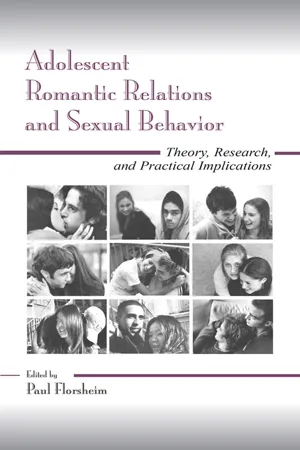
Adolescent Romantic Relations and Sexual Behavior
Theory, Research, and Practical Implications
- 432 pages
- English
- ePUB (mobile friendly)
- Available on iOS & Android
eBook - ePub
Adolescent Romantic Relations and Sexual Behavior
Theory, Research, and Practical Implications
About this book
Information
Publisher
Psychology PressYear
2003Print ISBN
9780415645690
9780805838305
Edition
1eBook ISBN
9781135648633
I
Normative Perspectives on Romantic Relations and Sexual Behavior Among Adolescents
1
The Role of Romantic Relationships in Adolescent Development
Most of us would characterize our adolescent romantic relationships as shortlived and superficial. In some respects, this description is correct. Most adolescent relationships only last a few weeks or months; it is unlikely that these relationships have the depth and complexity that characterize long-term committed relationships.
At the same time, the characterization of these relationships as short and superficial is incomplete. These relationships are central in adolescents’ lives. They are a major topic of conversation among adolescents (Eder, 1993;Thompson, 1994). Real or fantasized relationships are the most common cause of strong positive and strong negative emotions—more so than friendships, relationships with parents, or school (Wilson-Shockley, 1995). Moreover, adolescents are not the only ones who see these relationships as significant. The formation of romantic relationships is often thought to be one of the important developmental tasks of adolescence (Sullivan, 1953), and these relationships have significant implications for health and adjustment (Bouchey & Furman, in press).
Not only are adolescent romantic relationships significant in their own right, but the thesis of this chapter is that they play an important role in shaping the general course of development during adolescence. In particular, adolescents face a series of tasks that include (a) the development of an identity, (b) the transformation of family relationships, (c) the development of close relationships with peers, (d) the development of sexuality, and (e) scholastic achievement and career planning. In the sections that follow, we describe how romantic relationships may play a role in each of these key developmental tasks.
Three caveats are warranted. First, the research primarily has been conducted with heterosexual adolescents in Western cultures, and we know little about gay, lesbian, and bisexual relationships or romantic relationships in other cultures. Second, even the existing literature on Western heterosexual romantic relationships is limited. The question of what impact they have on development has received almost no attention. Thus, our comments are often speculative and will need to be tested empirically. Finally, the effects of romantic relationships vary from individual to individual. As will be seen repeatedly, the specific impact they have is likely to depend heavily on the nature of the particular experiences.
Romantic Relationships and Identity Development
According to Erikson (1968), the key developmental task of adolescence is the development of identity. During early adolescence, there is a proliferation of self-representations that vary as a function of the social context (Harter, 1999). That is, early adolescents develop a sense of themselves with their mothers, fathers, friends, romantic partners, and others. Sometimes their different selves may contradict one another, but such contradictions are usually not acknowledged. In middle adolescence, they begin to recognize such seeming contradictions in their conceptions of themselves, and may be conflicted or confused. By late adolescence, many of them are able to integrate the seeming contradictions into a coherent picture.
Romantic experiences may play a role in the development of a sense of self or identity in two ways. First, adolescents develop distinct perceptions of themselves in the romantic arena. They do not simply have a concept of themselves with peers, but have different self-schemas of themselves with the general peer group, with close friends, and in romantic relationships (Connolly & Konarski, 1994; Gecas, 1972; Harter, 1988). Romantic self-concept is related to whether one has a romantic relationship and to the quality of that relationship (Connolly & Konarski, 1994; Kuttler, La Greca, & Prinstein, 1999), suggesting that romantic experiences may affect one’s sense of self in the romantic domain. Thus, adolescents who have had positive experiences may think of themselves as attractive partners, whereas those who have had adverse romantic experiences may have little confidence in their ability to be appealing partners or have successful relationships.
Second, romantic experiences and romantic self-concept may also affect one’s global self-esteem. This effect is poignantly expressed in one of our teen’s reflections about her romantic experiences, including those with an abusive partner: “Hum, what have I gained? (6 sec. pause). I feel I haven’t gained like a lot, but I feel like I lost a lot. I lost my self-respect. I don’t respect myself. It’s like I feel like I have no self-esteem, no self-control, no nothing.” Consistent with her comments, romantic self-concept has been empirically found to be substantially related to self-worth (e.g., r’s = .40 to .55; Harter, 1988, 1999). Romantic self-concept is also related to one’s self-concept in other domains, particularly physical appearance and peer acceptance (Harter, 1988).
Although global self-esteem and perceived competence in various domains are fundamental aspects of self-representations, the concept of identity entails more than these. In the process of developing an identity, adolescents acquire moral and religious values, develop a political ideology, tentatively select and prepare for a career, and adopt a set of social roles, including gender roles (Waterman, 1985). Romantic relationships may facilitate the development of these facets of identity. For example, Erikson (1968) thought that adolescent love was an “attempt to arrive at a definition of one’s identity by projecting one’s diffused self-image on another and seeing it thus reflected and gradually clarified” (p. 132). On the other hand, sometimes romantic relationships may hinder the identity development process. For example, parenthood—a potential consequence of romantic involvement—is thought to have a detrimental effect on adolescents’ normative exploration of identity because of the constant demands and responsibilities it entails (Coley & Chase-Lansdale, 1998). Unfortunately, we can only speculate about how romantic relationships may facilitate or hinder identity development, as we have little empirical data about the role they may play. We know that peers and friends influence adolescents’ attitudes and behaviors (Kandel, 1978), but as yet the specific influence of romantic relationships or romantic partners simply has not been examined.
One particularly promising domain to study is gender-role identity. According to the gender intensification hypothesis, early adolescence is a period in which gender-related expectations become increasingly differentiated (Hill & Lynch, 1983). Girls are expected to adhere to feminine stereotypes of behavior, whereas boys are expected to adhere to masculine stereotypes. It is commonly thought that the emergence of dating may be one of the most powerful factors contributing to the intensification of conventional gender roles. Romantic partners, as well as other peers, may reinforce or punish different gender-related behaviors or roles; certainly adolescents are likely to act in ways that they think might make them more attractive to members of the other sex. Of course, different romantic partners are likely to have different expectations regarding gender roles, and one’s own experiences in romantic relationships would be expected to affect one’s concepts of gender roles (Feiring, 2000).
The Transformation of Family Relationships
During adolescence, relationships with parents and other family members undergo significant changes. From middle childhood through adolescence, rates of parental support and interaction decrease (Csikszentmihalyi & Larson, 1984; Furman & Buhrmester, 1992; Larson & Richards, 1991; Laurson & Williams, 1997). Rates of conflict also decrease over the course of adolescence, although the intensity of the affect in the conflict appears to peak in middle adolescence (Laurson, Coy, & Collins, 1998).
These changes, however, do not usually reflect a detachment from parents, but instead a renegotiation and transformation of parent–child relationships. Most adolescents are able to become appropriately autonomous without severing the bonds with parents (Hill & Holmbeck, 1986). Similarly, most parents are gradually able to accept their children’s individuality in the context of maintaining emotional ties (Youniss & Smollar, 1985). Thus, the process of transforming the relationship is a mutual one.
This process is not always a smooth one, however. Parents and adolescents have different expectations for each other (Collins, 1990, 1995). Such discrepancies in expectations periodically lead to conflicts, which in turn can lead to a realignment of expectations and eventually changes in the nature of the relationship.
Romantic relationships may play a role in these transformations of family relationships in several ways. At the most basic level, adolescents spend less time with family members and more time with the other sex or in romantic relationships as they grow older (Blyth, Hill, & Thiel, 1982; Darling, Dowdy, Van Horn, & Caldwell, 1999; Laursen & Williams, 1997; Richards, Crowe, Larson, & Swarr, 1998; Zimmer-Gembeck, 1999). Those who have romantic relationships spend less time with family members than those who are not currently involved with someone (Laursen & Williams, 1997).
Romantic relationships are also a common source of conflict and tension in the family (Laursen, 1995; Smetana, 1989). Adolescents and parents may disagree about curfews, choices of peers, and whether one may go to a party or social activity. Dating and romantic relationships are topics in which parents and adolescents have different expectations, and both are invested in exercising jurisdiction. Parents may want jurisdiction because of the risks associated with dating and sexual behavior, whereas adolescents want control over such personal issues. Thus, these topics are likely to lead to perturbations in the relationship, trigger discussion and re-examination of expectations, and contribute to the normative transformation of the decision making in these relationships. In other instances, however, it is not the romantic experiences that lead to normative changes in family relationships, but instead, conflicts with family members may lead some adolescents to seek out romantic relationships to escape family problems.
Empirical research is consistent with the idea that family conflicts and romantic relationships are linked. Students who are dating report more frequent and intense conflicts than non-daters (Dowdy & Kliewer, 1999). Those adolescents who are involved with a romantic partner at a young age also have higher rates of alcohol and drug use as well as lower levels of academic achievement (Aro & Taipale, 1987; Grinder, 1966). It appears that adolescents with interpersonal difficulties or familial problems may seek out romantic relationships earlier (Aro & Taipale, 1987; Pawlby, Mills, & Quinton, 1997), but it also seems possible that such early romantic relationships could lead to family discord or personal difficulties as well.
Even when dating is not a major source of conflict, parents may have ambivalent feelings about their children’s romantic relationships (Bonini & Zani, cited in Zani, 1993). For example, mothers report being both joyful that their daughters are happy, and yet sometimes jealous and aware of the loss of an exclusive tie. Similarly, the satisfaction of seeing their sons mature can be counterbalanced by the realization that they are growing up and eventually leaving the household. Some fathers report being accepting of a romantic relationship, but concerned that their children may be torn between loyalty to a partner and to the family. A serious relationship can be seen as an intrusion or threat to the family. As yet, we do not know how such ambivalent feelings may impact family relationships, but it seems that they may very well lead to some rethinking or restructuring of the relationships between the parents and adolescents.
Although conflict and ambivalent feelings about romantic relationships may occur commonly, these should not be overstated. In popular stereotypes, adolescence is thought of as period of great strife between parents and peers, but in fact, peer and parental influences are typically synergistic (Hartup, 1983). We believe that the same synergism may be characteristic of romantic relationships and family relationships. For example, perceptions of parents’ attitudes about “going steady” are associated with the likelihood of the adolescents actually having an exclusive relationship (Poffenberger, 1964). Although it is likely that this association stems partially from parents’ control over their adolescents’ dating behavior, it is also possible that adolescents’ desires and romantic experiences will affect how their parents think about romantic relationships and what they will allow their offspring to do.
The links between supportive behavior in relationships with romantic partners and parents are complicated. As adolescents grow older, they are more likely to turn to a boyfriend or girlfriend for support (Buhrmester & Furman, 1987; Furman & Buhrmester, 1992; Youniss & Smollar, 1985). Moreover, they are less likely to seek support from their parents (Buhrmester & Furman, 1987; Furman & Buhrmester, 1992). The early phases of the transition from a parent as the primary attachment figure to a romantic partner may begin in adolescence, particularly in late adolescence (Furman & Wehner, 1994). Specifically, adolescents may begin to turn to their partners or peers for a safe haven, although their parents are likely to remain as their primary secure base (Hazan & Zeifman, 1994).
Interestingly, however, the amount of support in the two types of relationships at any particular age is positively correlated (Connolly & Johnson, 1996; Furman, 1999; Furman, Simon, Shaffer, & Bouchey, in press). Perhaps the ability to be supportive in one relationship carries over to the other relationship. Having a supportive romantic relationship (vs. just any romantic relationship) may also have a positive effect on one’s general emotional state, which in turn may foster positive interactions in the home. Thus, although romantic relationships can be a source of strain on relationships with parents, they may have some positive effects on these relationships in other instances.
The Development of Close Relationships with Peers
Concomitant with the changes in the family throughout adolescence are significant changes in peer relationships. On average,...
Table of contents
- Cover
- Half Title
- Title Page
- Copyright
- Contents
- Introduction: Paul Florsheim
- Contributors
- Part I: Normative Perspectives on Romantic Relations and Sexual Behavior Among Adolescents
- Part II: Perspectives on Romantic and Sexual Behavior Among High-Risk Adolescents
- Part III: Commentary and Summary
- Author Index
- Subject Index
Trusted by 375,005 students
Access to over 1.5 million titles for a fair monthly price.
Study more efficiently using our study tools.
Frequently asked questions
Yes, you can cancel anytime from the Subscription tab in your account settings on the Perlego website. Your subscription will stay active until the end of your current billing period. Learn how to cancel your subscription
No, books cannot be downloaded as external files, such as PDFs, for use outside of Perlego. However, you can download books within the Perlego app for offline reading on mobile or tablet. Learn how to download books offline
We are an online textbook subscription service, where you can get access to an entire online library for less than the price of a single book per month. With over 1.5 million books across 990+ topics, we’ve got you covered! Learn about our mission
Look out for the read-aloud symbol on your next book to see if you can listen to it. The read-aloud tool reads text aloud for you, highlighting the text as it is being read. You can pause it, speed it up and slow it down. Learn more about Read Aloud
Yes! You can use the Perlego app on both iOS and Android devices to read anytime, anywhere — even offline. Perfect for commutes or when you’re on the go.
Please note we cannot support devices running on iOS 13 and Android 7 or earlier. Learn more about using the app
Please note we cannot support devices running on iOS 13 and Android 7 or earlier. Learn more about using the app
Yes, you can access Adolescent Romantic Relations and Sexual Behavior by Paul Florsheim in PDF and/or ePUB format, as well as other popular books in Psychology & Developmental Psychology. We have over 1.5 million books available in our catalogue for you to explore.