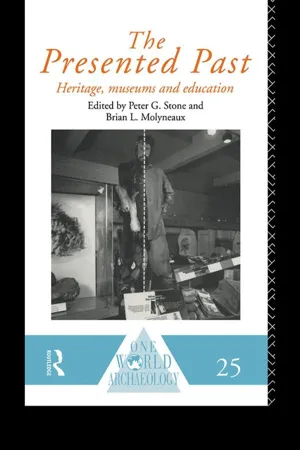
The Presented Past is concerned with the differences between the comparatively static, well-understood way in which the past is presented in schools, museums and at historic sites compared to the approaches currently being explored in contemporary archaeology. It challenges the all-too-frequent representation of the past as something finished, understood and objective, rather than something that is `constructed' and therefore open to co-existing interpretations and constant re-interpretation.
Central to the book is the belief that the presentation of the past in school curricula and in museum and site interpretations will benefit from a greater use of non-documentary sources derived from archaeological study and oral histories. The book suggests that a view of the past incorporating a larger body of evidence and a wider variety of understanding will help to invigorate the way history is taught. The Presented Past will be of interest to teachers, archaeologists, cultural resource managers, in fact anyone who is concerned with how the past is presented.
- 552 pages
- English
- ePUB (mobile friendly)
- Available on iOS & Android
eBook - ePub
About this book
Information
1 Reaping the whirlwind:
the Reader’s Digest Illustrated History of South Africa and changing popular perceptions of history1
LESLIE WITZ & CAROLYN HAMILTON
Introduction
In 1988 Reader’s Digest pulled off what is probably the publishing coup of the decade in South Africa. Responding to the storm of popular opposition to traditional South African history that blew up in the 1980s, it produced a book that took up the challenge: The Illustrated History of South Africa: the real story. It sold over 85,000 copies within six months of publication and Reader’s Digest has battled to keep up ‘with the demand for the book (Sunday Times, 28 May 1989). It is a remarkable achievement for a history text, and one that retails in the upper-price bracket at that. In this chapter we focus on the Illustrated History so as to explore some of the issues raised by the public hunger for alternatives to apartheid historiography. We trace the circumstances which created the market for the Illustrated History, and address the question of why this particular popular text is more successful than other similar ventures (see, for example, Cameron & Spies 1989; History Workshop 1989; and Preston 1989). Finally, we question whether or not the account provided by the Illustrated History is indeed the ‘real story’. In this context we discuss another consequence of the ongoing and heated contest over the past in South Africa: a changing popular perception of the nature of history itself and an associated shift of paradigm away from history as the story of the past towards history as an investigation of the past in the present.
South African historiography and the popular consciousness of history
With its roots in settler writings of the late nineteenth and early twentieth centuries, South African historiography was long dominated by the story of the triumph of white settlers over barbarous blacks (see, for example, Theal 1964 (1892–1919); and Walker 1928) and powerful assertions of Afrikaner nationalism (see, for example, du Toit 1897). Perhaps the most efficient conduit for the transmission of these ideas, particularly after the National Party came to power in 1948, was in the schools, where a special place was accorded to Afrikaner nationalist historiography: ‘The syllabus emphasized that authority was not to be questioned, whites were superior, blacks inferior, Afrikaners have a special relationship with God, South Africa rightfully belongs to the Afrikaner’ (Du Preez, quoted in Giliomee 1987, p. 3). One of the aims of the school syllabus was to inscribe apartheid and a culture of authoritarianism into student consciousness. These ideas informed both the content of what was taught and the pedagogical method used. Although changes in the history syllabus were instituted in response to limited political reforms in the early 1980s, its fundamental ideas were retained. As Van den Berg & Buckland point out, the latest syllabus, instituted in 1984, continues to reflect ‘an essentially “white” perspective…. History from 1910 to 1970 remains very largely the saga of “white” political parties and their struggle for power.’ No attempt is made to study the history of major African chiefdoms of the nineteenth century, while ‘the great struggle for the land is simply relegated to statements such as “the incorporation of the independent chiefdoms”’ (Van den Berg & Buckland, quoted in Giliomee 1987, p. 3).
This history syllabus is taught in schools by using an officially prescribed textbook. It is important to realize that not only do the school textbooks present a white-biased view of the past but they also do so in a manner that proclaims the text to be an unchallengeable real story of the past. Textbooks like C.J.Joubert’s History for Std 10, published by the Nationalist-owned company, Perskor, and used by most schools in South Africa, are ‘mostly descriptive rather than analytical, presenting history as a fixed body of unproblematic knowledge with little mention of original sources or the work of historians’ (Walker 1990, pp. 304–5). Pupils are afforded scant space to challenge the book and debate the ‘facts’ which it presents.
This approach is carried into the classroom, where most pupils are required to recite and learn the facts verbatim. Crucial pedagogical devices, such as asking questions and the generation of debate, are not considered to be good practice in a generally authoritarian schoolroom. The constant monitoring of teachers and students by education officials also inhibits the introduction of innovative content and method from other sources in the classroom. Moreover, students write an external school-leaving examination based on the syllabus and are reluctant to use alternative educational materials which may be available. All these problems are further exacerbated by the lack of financial resources. Although continuing to dominate in the classrooms well into the 1980s, the apartheid version of the past was, from its inception, challenged in the public consciousness. An important form that this took was the production and dissemination of dissenting histories in certain schools, popular memory, anti-apartheid political organizations, and some of the universities.
Alternative history content was introduced into schools set up by the African National Congress during the 1954 ‘Bantu education boycott’ (Lodge 1983). Similarly, in the Cape, in the 1950s and the 1960s, members of the Non-European Unity Movement taught, alongside the more conventional school history, radical history at a few coloured schools. Historian Bill Nasson, who attended one of these schools, recalled how the teacher told the class: ‘We are here to make sure that you aren’t contaminated by the Herrenvolk poison contained in your textbook’ (Nasson 1990, p. 189). What was emphasized instead was the history of the indigenous population of South Africa with specific emphasis on capitalist penetration, worker and peasant resistance and the collaboration of petty-bourgeois elements (Nasson 1990, p. 196).2
Members of the Unity Movement in the Cape were also producing radical texts, such as Majeke’s The Role of Missionaries in Conquest and Mnguni’s Three Hundred Years, which formed the basis of teaching in some schools. Both these books, published in 1952, were a direct challenge to official apartheid history. In that year there were celebrations in Cape Town commemorating the arrival of Jan van Riebeeck some 300 years earlier. Blacks in Cape Town boycotted the celebrations, as they were seen as an attempt ‘to inflict a ruler’s brand of history on the oppressed’ (Nasson 1990, p. 205). In their histories, Mnguni and Majeke tried to show that the 300 years since Van Riebeeck’s arrival were not an era of great glory but a time of ‘struggle between the oppressors and the oppressed’ (Nasson 1990, p. 205).
Apartheid history was also subjected to further challenges outside the schools. Some of the most resilient of these were preserved in the form of oral memories handed down across generations and recorded by early black writers like Sol Plaatje (1957), S.M.Molema (1920) and Magema Fuze (1979). Others existed only in the form of powerful oral narratives, but were largely suppressed through the assertion of the scientific accuracy of Western research over indigenous forms of the popular production of knowledge.
A more systematic and directed challenge came from a small range of Communist Party and early African nationalist history texts (see, for example, Mbeki 1964; Roux 1964; Simons & Simons 1969). These counter-histories were outlawed by draconian censorship and so-called security laws, particularly in the 1960s, but managed to continue in covert circulation.
Since the 1920s oral historians had also set about debunking the core myths on which the segregationist ideology was based. These scholars focused on the history of interaction between whites and blacks (see, for example, de Kiewiet 1941 and Macmillan 1929). In the relatively few instances where their work was produced in popular form it was aimed largely at a white middle-class audience (see, for example, Morris 1969).
It was only in the 1970s, and in particular following the 1976 schools uprising, that the history of black South Africans in their own right was investigated. This period saw a black intellectual efflorescence, strongly influenced by the ideology of Black Consciousness. A highly idealized view of the past dominated this writing. Its basic elements were an emphasis on the essential unity of the black experience and on what Sole has called ‘a rediscovery of African non-exploitative relationships’ (Sole 1983, p. 39). Steve Biko, the leading figure in the Black Consciousness movement, called upon blacks to rewrite their history and ‘produce…the heroes that formed the core of our resistance to the white invaders…stress has to be laid on the successful nation-building attempts of men such as Shaka, Moshoeshoe and Hintsa’ (Biko 1978, p. 95).
This period also saw the final retreat of colonialism on the rest of the African continent which stimulated an interest in African studies. This was rapidly infused with the materialist concerns of a new generation of left, largely expatriate South African scholars. The new radical historians investigated the processes of the emergence of capitalism and its impact on indigenous societies. They were also concerned to explore the responses of Africans to these developments. The alternative view of the past which they nurtured drew heavily on oral histories, and the culture and experiences of ordinary people for the development of a ‘view from below’.3
The revisionist historians were not merely concerned with publishing academic treatises. They also wanted their work to have a political impact. A number of the academics concerned had been involved in trade-union education in the 1970s, using history as a basis for discussions on strategizing for the present. This involvement led them to the conclusion that the new radical history needed to be published in a suitable form for workers. The dual concerns of writing materialist South African history and producing it in accessible form coalesced in the establishment, at the University of the Witwatersrand, of the History Workshop in 1977. In its early years the History Workshop’s popular forums and publications were ‘aimed at a specifically working class audience, and class struggle was their central focus’ (Callinicos 1990).
In sharp contrast to the marketing success of the Illustrated History, these endeavours, also produced in the politically heightened conditions of the 1980s, generally failed to capture widespread popular interest. Only two of the Workshop publications, Gold and Workers and New Nation, New History, managed to sell in significant numbers, although well short of the remarkable sales figures of the Illustrated History. Three reasons for their lack of appeal suggest themselves. The first is their failure to offer a synthesized overview of an alternative South African history. With the possible exception of Gold and Workers, which uses the early work of the revisionists to examine class relations in the initial stages of South Africa’s industrialization, the texts produced by the History Workshop tended to focus on specific topics such as the 1921 Bulhoek massacre and the history of liquor. Even New Nation, New History appeared as a compendium of different topics on distinct themes. The audiences lacked the necessary framework and context in which to situate the various slices of history which were provided. Second, these publications struggled to find appropriate formats and dissemination points. Distribution outside formal networks functioned effectively to ghettoize many of these works. The major exception was New Nation, New History, which was widely distributed through the New Nation newspaper. Finally, the focus on classes and class analysis, which was at the heart of revisionist scholarship, failed to tap in successfully to many popular perceptions of oppression in South Africa. In the 1980s racial oppression remained the central focus of anti-apartheid struggles, despite their strong anti-capitalist rhetoric. While the ideas of the revisionist historians were rapidly becoming hegemonic within the academies, they enjoyed a more limited success amongst ordinary people.
By the mid-1980s countrywide school boycotts and political protest had reached a crescendo. Between 1985 and 1986, student protests involved over 900 s...
Table of contents
- Cover Page
- Title Page
- Copyright Page
- List of Contributors
- Foreword
- Preface
- Introduction: The Represented Past
- Introduction: A Framework for Discussion
- 1. Reaping the Whirlwind: The Reader’s Digest Illustrated History of South Africa and Changing Popular Perceptions of History
- 2. Archaeology and Education In Botswana
- 3. Presenting Archaeology to the Public In the USA
- 4. Public Education and Archaeology In Florida, USA: An Overview and Case Study
- 5. Archaeology and the Public In Lebanon: Developments Since 1986
- 6. Education As a Means of Protection of the Archaeological Heritage In the Districts of Buenos Aires Province, Argentina
- 7. Rescuing Ordinary People’s Culture: Museums, Material Culture and Education In Brazil
- 8. The Role of Archaeology In Marginalized Areas of Social Conflict: Research In the Middle Magdalena Region, Colombia
- 9. The Museum Comes to School In Colombia: Teaching Packages As a Method of Learning
- 10. The Colegio Nueva Granada Archaeological Museum, Colombia: A Proposal for the Development of Educational Museums In schools
- 11. Creative Workshops: A Teaching Method In Colombian Museums
- 12. ‘The Fascinating World of Stonehenge’: An Exhibition and Its Aftermath
- 13. The Re-Display of the Alexander Keiller Museum, Avebury, and the National Curriculum In England
- 14. Privacy and Community Through Medieval Material Culture
- 15. What Is the Public’s Perception of Museum Visiting In Poland?
- 16. Museums and Their Messages: The Display of the Pre- And Early Colonial Past In the Museums of South Africa) Botswana and Zimbabwe
- 17. Museums and Sites: Cultures of the Past Within Education—Zimbabwe, Some Ten Years On
- 18. The Nigerian Teacher and Museum Culture
- 19. Indian Museums and the Public
- 20. A Case for Archaeology Informal School Curricula In India
- 21. Education and Heritage: An Example of New Work In the Schools of Benin
- 22. Archaeology In the Schools and Museums of Cameroon
- 23. Prehistory, Archaeology and Education In Zimbabwe
- 24. Archaeology and Education In Kenya the Present and the Future
- 25. Listening to the Teachers: Warnings About the Use of Archaeological Agendas In Classrooms In the United States
- 26. Archaeo-Fiction With Upper Primary-School Children 1988–1989
- 27. The Teaching of the Past Informal School Curricula In England
- 28. Ethnic Rrepresentation In Colombian Textbooks
- 29. Choosing Ancestors: The Primary Education Syllabuses In Buenos Aires, Argentina, Between 1975 and 1990
- 30. Blacks, Indians and the State In Colombia
- 31. Traditional American Indian Education As a Palliative to Western Education
- 32. The Benefits of Multicultural Education for American Indian Schools: An Anthropological Perspective
- 33. The Transfer of American Indian and Other Minority Community College Students
- 34. Archaeology, Prehistory and the Native Learning Resources Project: Alberta, Canada
- 35. One View of Native Education In the Northwest Territories, Canada
Trusted by 375,005 students
Access to over 1.5 million titles for a fair monthly price.
Study more efficiently using our study tools.
Frequently asked questions
Yes, you can cancel anytime from the Subscription tab in your account settings on the Perlego website. Your subscription will stay active until the end of your current billing period. Learn how to cancel your subscription
No, books cannot be downloaded as external files, such as PDFs, for use outside of Perlego. However, you can download books within the Perlego app for offline reading on mobile or tablet. Learn how to download books offline
Perlego offers two plans: Essential and Complete
- Essential is ideal for learners and professionals who enjoy exploring a wide range of subjects. Access the Essential Library with 800,000+ trusted titles and best-sellers across business, personal growth, and the humanities. Includes unlimited reading time and Standard Read Aloud voice.
- Complete: Perfect for advanced learners and researchers needing full, unrestricted access. Unlock 1.5M+ books across hundreds of subjects, including academic and specialized titles. The Complete Plan also includes advanced features like Premium Read Aloud and Research Assistant.
We are an online textbook subscription service, where you can get access to an entire online library for less than the price of a single book per month. With over 1.5 million books across 990+ topics, we’ve got you covered! Learn about our mission
Look out for the read-aloud symbol on your next book to see if you can listen to it. The read-aloud tool reads text aloud for you, highlighting the text as it is being read. You can pause it, speed it up and slow it down. Learn more about Read Aloud
Yes! You can use the Perlego app on both iOS and Android devices to read anytime, anywhere — even offline. Perfect for commutes or when you’re on the go.
Please note we cannot support devices running on iOS 13 and Android 7 or earlier. Learn more about using the app
Please note we cannot support devices running on iOS 13 and Android 7 or earlier. Learn more about using the app
Yes, you can access The Presented Past by B. L. Molyneaux,P. G. Stone in PDF and/or ePUB format, as well as other popular books in Sciences sociales & Archéologie. We have over 1.5 million books available in our catalogue for you to explore.