`For forty years I have defended the same principle: freedom in everything, in religion, in philosophy, in literature, in industry, in politics - and by freedom I mean the triumph of the individual.'
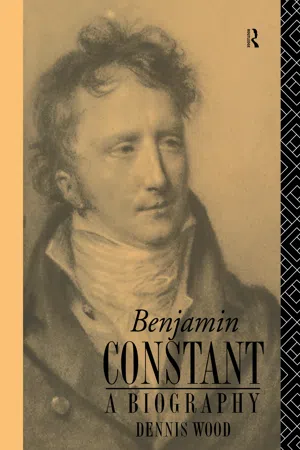
Constant thus summarized his beliefs at the end of his life. A political theorist and a passionate defender of individual liberty, he was also the author of one of the greatest French novels of psychological insight, Adolphe. In a major new biography Dennis Wood traces the development of Constant as a writer centrally preoccupied with the problematics of freedom, not only in the fields of politics and religious belief but also in his own troubled relationship with several women.
- 352 pages
- English
- ePUB (mobile friendly)
- Available on iOS & Android
eBook - ePub
About this book
Information
1
‘THE GRIEF THAT DOES NOT SPEAK’: CONSTANT AND HIS FATHER (1767–1783)
| Give sorrow words: the grief that does not speak Whispers the o’er-fraught heart, and bids it break. (Macbeth, IV. iii) |
It was a calamitous beginning. Scarcely was Benjamin Constant born, on 25 October 1767, a frail baby who was not expected to live, than the attention and anxieties of his family were directed away from him to his 25-year-old mother, Henriette, neé de Chandieu. There may have been complications at the birth; we do not know. What is certain is that Benjamin Constant’s mother died on the sixteenth day after his birth, that is on 10 November 1767, no doubt after unimaginable suffering.1 Benjamin immediately became the focus of a quarrel between his two grandmothers as to who should have charge of him. The argument was won by Henriette’s mother, Françoise-Marie-Charlotte, neé de Montrond (1722–77), but the tensions which already existed between the Constant and Chandieu families were aggravated: as Constant grew older they were indeed to become chronic.2 Benjamin was baptized on 11 November at the Calvinist church of Saint-François in Lausanne, and the following day Henriette de Constant was buried in the Saint-François cemetery. Shortly before the funeral, her husband Juste, desperate at the loss of the woman he had married only the previous year, was stricken with a seizure: he was unable to move, he could not get his breath, his pulse apparently stopped, and he was only saved by the intervention of a doctor.3 A second tragedy was thus narrowly averted. Colonel Juste de Constant lived on to return to Holland and the Swiss regiment of which he was commanding officer there. Meanwhile his son was no doubt left in the care of a nurse or nanny about whom we know nothing, whom Benjamin Constant never mentions and who concerned herself with the mundane task of keeping him alive. From time to time during these early months he would suddenly find himself in the midst of a constellation of grandmothers and aunts who would briefly take him in their arms, and then leave him to return to their daily social round.
Benjamin Constant almost never speaks about the first five years of his life, and it is not difficult to see why. During those years he wanted for nothing material. As an infant prodigy he was doted on and spoiled, his every utterance was applauded, and he soon learned how to captivate an audience of female relatives. Nevertheless his later life seems to tell a different and sadder story about the pattern of his childhood experience. Let us begin with the first catastrophe of his existence, the loss of his mother. There is no way of knowing how such a separation can affect so young a baby, and child psychologists maintain a prudent silence on the subject. All the evidence tends to suggest that the effects of what happened to Constant could have been mitigated, as common sense would suggest, by the establishment of a continuous and loving bond with a substitute for the mother, for example a nurse. Whether this happened in Constant’s case we do not know. Constant’s father Juste was a highly impulsive and quarrelsome man and, for all we know, may have changed his son’s nurses as he would later change his tutors—often. The long-term effects of such treatment have been exhaustively documented in our own century, notably by such clinical specialists as Michael Rutter and the late John Bowlby, and several of their conclusions remind us unmistakably of Benjamin Constant.4
But before considering them, there is another crucial factor to consider in respect of Henriette de Constant’s death: the reaction to it of her husband. We saw a moment ago the extraordinary effect of grief on Juste de Constant, a seizure which brought him close to death. And we can add to this the knowledge of the couple’s happiness during the sixteen months of their marriage (22 July 1766 to 10 November 1767), a fact about which Gustave Rudler was sceptical when he wrote his magisterial 1909 study La Jeunesse de Benjamin Constant, but which the correspondence surrounding Henriette’s death seems to confirm. Losing her left Juste de Constant in total disarray, the more remarkable for his being in normal circumstances a stern and exceptionally strong-willed personality. He had, for a while, no idea what to do with himself or his son. Then his composure returned, he made arrangements for Benjamin’s immediate future and left to rejoin his regiment in Holland. Thereafter Juste returned periodically to Lausanne, and we can easily imagine the bewilderment of his young son whose pattern of life his return disrupted and who would become attached to him on each visit only to undergo another inevitable separation.
Yet perhaps more important even than repeated separation was Juste’s attitude towards Benjamin. Portraits of Benjamin Constant from early childhood to middle age reveal a striking facial resemblance to Henriette, whose sandy hair he also inherited.5 Each sight of his son would renew Juste’s sense of loss, a grief it was not in his character to display, but which it would be only too natural for Benjamin to glimpse now and then. The mystery of death, and especially that of one’s own mother, is, of course, incomprehensible to a very young child, and it must certainly have troubled one as precocious and intelligent as Benjamin Constant. A look or a cross word from his father, the gossip of a servant, perhaps, would be enough to suggest to him that he had some part in the mystery. Not knowing anything about the physical details of birth, Benjamin felt nonetheless some responsibility for what occurred after his own. Jean-Jacques Rousseau offers us a case for comparison, as we can see in this well-known passage from the Confessions (1782):
I was born weak and sickly. I cost my mother her life, and my birth was the first of my misfortunes. I have never been able to understand how my father had borne her loss, but I do know that he was inconsolable for ever afterwards. He believed he could see her in me, while never being able to forget that I had taken her away from him. He never put his arms around me without my feeling in the force of his embrace a bitter sense of loss: this rendered it still more tender. Whenever he said, ‘Jean-Jacques, let’s talk about your mother’, I would reply, ‘So we’re going to cry again, are we, father?’ I only had to say that for his tears to begin to flow. ‘Bring her back to me’, he would sob, ‘console me for losing her. Fill the empty space in my heart. Would I love you as much as this if you were only my son?’ Forty years after losing her he died in the arms of his second wife with the name of the first on his lips, and the memory of her face deep in his heart.6
As we would expect of Rousseau, all the complexity of motive and feeling is brought out in this intensely moving passage: Isaac Rousseau’s reproaches, his heightened sense of his son’s vulnerability, above all the constant reminder of his dead wife in his son’s very looks. Painful as it was, this was an essentially healthy reaction towards Jean-Jacques on his father’s part. There was no bottling up of grief, and although Rousseau was clearly upset by the situation and powerless to prevent its recurrence, he was left in no doubt about either his father’s quite involuntary feelings of blame and resentment or about the abiding reality of his love for him. It is my belief that in this, as perhaps in other ways, Constant was emotionally less fortunate than Rousseau. Such a scene as the one just described in the Confessions had no counterpart in Constant’s experiences. For reasons which he must have tried long and hard to fathom, Constant only knew a father who was critical, ironic, lacking in warmth, above all who seemed permanently unable to come out into the open with what he had on his mind.
John Bowlby has written eloquently about the possible effects of such a failure of communication:
Without understanding and sympathy there is a danger that the child’s thoughts and feelings will become locked away, as though in a secret cupboard, and there will live on to haunt him. Then, whenever some adverse event or threat of it penetrates to that secret cupboard, with or without his realising it, he becomes anxious and distressed and prone to develop symptoms, the reasons for which neither he nor his family may understand.7
This lack of directness on Juste de Constant’s part was allied to an emotional restraint which must have seemed very much like rejection to a little boy who saw his father so infrequently. A child has no understanding of a person’s character and its history beyond what it sees. Benjamin Constant could not know at this age that genetically the Constant family was afflicted with a certain oddity in behaviour, compensated for—if compensation it can be called—by considerable intellectual vigour.8 All Benjamin could see in his father was an apparent indifference—which he would later rationalize as being timidity—which chilled him to the quick and destroyed all hope of trust or intimacy between them. The obvious conclusion, in a child’s mind, was: ‘What have I done to displease him?’ and there was an immensely disturbing answer ready to hand: that he was responsible for his mother’s death. John Bowlby describes such a situation and its consequences:
How prone children are spontaneously to blame themselves for a loss is difficult to know. What, however, is certain is that a child makes a ready scapegoat and it is very easy for a distraught widow or widower to lay the blame on him. In some cases, perhaps, a parent does this but once in a sudden brief outburst; in other cases it may be done in a far more systematic and persistent way. In either case it is likely that the child so blamed will take the matter to heart and thereafter be prone to self-reproach and depression. Such influences seem likely to be responsible for a large majority of cases in which a bereaved child develops a morbid sense of guilt; they have undoubtedly been given far too little weight in traditional theorizing.
Nevertheless, there are certain circumstances surrounding a parent’s death which can lead rather easily to a child reaching the conclusion that he is himself to blame, at least in part. Examples are when a child who has been suffering from an infectious illness has infected his parent, and when a child has been in a predicament and his parent, attempting rescue, has lost his life. In such cases only open discussion between the child and his surviving parent, or an appropriate substitute, will enable him to see the event and his share in it in a proper perspective.9
‘Open discussion’: the contrast with Rousseau and his father is instructive. That passage of the Confessions about a bereaved husband’s anger, sorrow and resentment must have been alarming and depressing for Constant when he eventually came to read it. There was no such communication with Juste de Constant. There was love of a kind, of course, in Juste, as Constant later knew, but a love which, very early, became ambitiousness on Benjamin’s behalf and a desire to rush him into an ‘adult’ world of intellectual achievement. No tears, no tender feelings, no mothering: Benjamin was under pressure to become a bel esprit, an intellectual and a salon wit—and the sooner the better. What damage Juste did to his son by this and other manifestations of a crass disregard for ordinary common sense we shall see later in this book. But we are still at the beginning of the story and that harm was, by the age of 5, already beginning to show itself in Benjamin Constant.
Evidence about Constant’s early childhood is extremely scant and fills only a dozen pages out of the seven hundred which make up volume I of the comprehensive Chronologie de la vie et de l’œuvre de Benjamin Constant, edited by Dominique Verrey in collaboration with Etienne Hofmann, covering the years 1767–1805.10 It was not until 1810 or 1811 that Constant himself began setting down his early experiences in a systematic and non-fictional form, though there may have been earlier unrecorded attempts. This precious but unfinished account of the years 1767–87 was given the title Le Cahier rouge in 1907 by its first editor after the red cover of the notebook, but Constant’s title was Ma Vie—My Life—as can be seen from the first page. On 2 February 1812 Juste de Constant died, and subsequently Benjamin seems to have revised the text of Ma Vie, to what extent is unknown. At all events it was neither completed nor published by him and the narrative ends in November 1787, just before Constant’s reunion with his friend Isabelle de Charrière. Where Rousseau’s Confessions sustain an unbroken flow of events and commentary, stretching back before his birth and reaching the moment when Rousseau sets pen to paper, Ma Vie in its early sections is marked by curious gaps and silences. As Constant’s account moves away from childhood towards late adolescence the writing leaves behind the initial form of brief entries year by year as in a chronicle and begins to resemble a continuous story. When he began writing, Constant may not have intended so detailed a record, with the dialogue, description and reflection that we see in the later sections of Ma Vie, and this might explain the lopsided nature of the whole. One might suppose that after a jerky and uncertain beginning, Constant with practice got into his stride and by the time he reached the mid–1780s was writing with confidence. But is this really the case? I suspect not. Nor was it the case, I believe, that Constant considered accounts of childhood experiences to be lacking in interest: Rousseau had shown they could make absorbing reading. I would suggest rather that a return to the details of his childhood would have been a return to an infernal region, to a time of unrelieved emotional suffering for Constant that he could hardly bear to recall. And the evidence of the text seems to bear this out. Ma Vie begins thus:
I was born on 25 October 1767 in Lausanne, Switzerland, the son of Henriette de Chandieu, who was from a formerly French family which had taken refuge in the Pays de Vaud for religious reasons, and Juste Constant de Rebecque, a colonel in a Swiss regiment in the service of Holland. My mother died as a result of giving birth, a week [or eight days] after I was born.
[1772] The first tutor of whom I have a reasonably clear recollection was a German named Stroelin, who used to beat me, then smother me with his embraces so that I wouldn’t complain to my father. I always kept my promise to him not to, but what was going on was found out in spite of my silence, and he was dismissed. He had had the ingenious notion of getting me to invent Greek in order to teach it to me, that is to suggest that the two of us create our own language which only we could understand. I became...
Table of contents
- CONTENTS
- PLATES
- PREFACE
- BRIEF CHRONOLOGY
- A NOTE ON BENJAMIN CONSTANT’S FAMILY
- INTRODUCTION
- 1 ‘THE GRIEF THAT DOES NOT SPEAK’: CONSTANT AND HIS FATHER (1767–1783)
- 2 ‘THE CHARMS OF FRIENDSHIP’ (1783–1785)
- 3 ISABELLE DE CHARRIERE (1785–1787)
- 4 ESCAPE (1787–1788)
- 5 THE BRUNSWICK YEARS (1788–1794)
- 6 GERMAINE DE STAEL (1794–1800)
- 7 ‘THE INTERMITTENCES OF THE HEART’ (1800–1806)
- 8 ‘ITALIAM, ITALIAM’ (1806–1812)
- 9 THE END OF AN EMPIRE (1812–1816)
- 10 ADOLPHE (1816–1819)
- 11 APOTHEOSIS (1819–1830)
- EPILOGUE
- LIST OF ABBREVIATIONS USED IN THE NOTES
- NOTES
- INDEX
Trusted by 375,005 students
Access to over 1.5 million titles for a fair monthly price.
Study more efficiently using our study tools.
Frequently asked questions
Yes, you can cancel anytime from the Subscription tab in your account settings on the Perlego website. Your subscription will stay active until the end of your current billing period. Learn how to cancel your subscription
No, books cannot be downloaded as external files, such as PDFs, for use outside of Perlego. However, you can download books within the Perlego app for offline reading on mobile or tablet. Learn how to download books offline
We are an online textbook subscription service, where you can get access to an entire online library for less than the price of a single book per month. With over 1.5 million books across 990+ topics, we’ve got you covered! Learn about our mission
Look out for the read-aloud symbol on your next book to see if you can listen to it. The read-aloud tool reads text aloud for you, highlighting the text as it is being read. You can pause it, speed it up and slow it down. Learn more about Read Aloud
Yes! You can use the Perlego app on both iOS and Android devices to read anytime, anywhere — even offline. Perfect for commutes or when you’re on the go.
Please note we cannot support devices running on iOS 13 and Android 7 or earlier. Learn more about using the app
Please note we cannot support devices running on iOS 13 and Android 7 or earlier. Learn more about using the app
Yes, you can access Benjamin Constant by Dennis Wood in PDF and/or ePUB format, as well as other popular books in Literature & Literary Criticism. We have over 1.5 million books available in our catalogue for you to explore.