- 240 pages
- English
- ePUB (mobile friendly)
- Available on iOS & Android
eBook - ePub
About this book
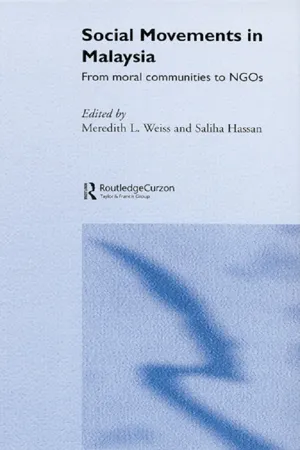
This book considers the proliferation in Malaysia over the past two decades of non-governmental organisations (NGOs) associated with various social movements, both to provide basic information about the NGOs and social movements, and to discuss their role in the development of civil society generally in particular their contribution to the reform movement, which has been gathering strength since 1998. The book discusses the nature and development of the movements, and shows that those movements concerned with human rights and women's issues have made significant contributions to the reform movement and been irrevocably changed by their involvement in it.
Information
1 Malaysian NGOs
History, legal framework and
characteristics
Meredith L. Weiss
Introduction
Though it is only relatively recently that the terminology of non-governmental organisations (NGOs) has been adopted in Malaysia and that issue-based advocacy groups have gained prominence, various sorts of civil society organisations have long played a role in the country. Contemporary Malaysian NGOs have their roots in a range of organisations, including Chinese secret societies, Indian nationalist associations and Malay-Muslim progress organisations. Moreover, the laws governing NGO activities date back to the colonial era, though they have been refined since then. The longevity of these strictures is testament to the ongoing tensions between state and civil society in Malaysia and the desire of both the colonial and independent state to control societal organisations. Today’s advocacy-oriented NGOs are heterogeneous in structure, membership and ideology. Still developing as a political and social force, many of these NGOs remain constrained not only by the restrictive political environment, but also by personalistic structures, a shortage of funds, difficulties in rousing an often disengaged mass public, and ethnic and religious divisions. Regardless, Malaysian NGOs have made important contributions to fostering a democratically inclined and socially aware citizenry, bringing key issues to public prominence and nurturing a significant core group within civil society able to rally mass opinion at crucial junctures in support of political, social and economic reforms.
Little has been written about NGOs and civil society in Malaysia, even amidst the burgeoning interest in these topics in neighbouring countries. The government does not encourage such research by either local or foreign scholars and NGOs themselves have limited resources for critical analysis of their own or other groups’ efforts. Most of the studies that have been done are either relatively superficial overviews of particular movements, funding agencies’ evaluations of the groups they sponsor, or a handful of more empirical than analytical works on specific sectors such as environmental activism. A few more critical works are available, though each still covering only certain sectors. These include Khong Kim Hoong (1988–9) on the reasons for the development of Malaysian public interest groups, their characteristics, and their relationship with the government; Sheila Nair (1995 and 1999) on the nature of hegemony and resistance through new social movements, particularly the environmental, human rights and Islamic movements; Saliha Hassan (1998) on relations between the state and political NGOs; and Tan Boon Lean and Bishan Singh (1994), which presents an analytical framework, an overview of state–NGO relations, and case studies of recent rape law reform and anti-logging campaigns.
More country-specific studies would be helpful both as practical evaluations of what NGOs have accomplished and how they could be more effective as well as for theory building and comparative research. Context is particularly significant since much of the existing literature on NGOs, civil society and related topics just does not really apply to Malaysia. The restrictive legal environment and semi-authoritarian regime make studies of new social movements (NSMs) and NGOs premised on a liberal democratic setting not all that relevant. Also, the Malaysian state has itself taken the lead in rural development, provision of social services and the like, rather than leaving a vacuum for developmental (and politically engaged) NGOs to fill, so much of the literature on the roles of NGOs as partners in development is also not really applicable.1
The analysis here will focus only upon advocacy-oriented or political NGOs. While both advocacy-oriented groups and voluntary welfare organisations are often lumped under the rubric of ‘NGO’, the former are more politically relevant and contentious in contemporary Malaysia. Saliha Hassan (1998: 17–18) offers a useful definition: ‘political NGOs are those that engage in public debates and dissemination of information relating to civil liberties, democratic rights, good governance, accountability of the government to the people, people oriented leadership – all of which relate to the central issue of democratic participation’. These NGOs centre around the question of good governance and present themselves as ‘the conscience of the state’ and as channels for the democratic participation of citizens in the polity, but are ‘eager to distance themselves from the ethnic pre-occupation of the Malaysian political parties’.
Historical antecedents
While advocacy-oriented NGOs are a relatively new phenomenon, having developed in Malaysia only in the past two decades, these groups build on a long tradition of societal organisations. The primary historical antecedents to contemporary Malaysian NGOs are Chinese associations, especially secret societies; reformist Indian associations; and Malay nationalist and/or Islamic organisations prior to independence. While lacking the same issue basis of advocacy NGOs, these early organisations are significant for having prompted the development of the legal codes that still govern and constrain NGOs, for presaging the composition of NGOs generally along ethnic lines, and for moving beyond welfare and cultural functions to more critical political perspectives and activities.
Chinese organisations
A wide range of Chinese organisations developed in colonial Malaya, including:
•secret or Triad societies;
•clan organisations – mutual benefit societies representing a particular county, clan or dialect group;
•commercial and industrial organisations – associations for dispute mediation and the community’s economic development, including chambers of commerce, commercial societies, unions and professional organisations;
•cultural organisations – book and newspaper reading societies, associations for the development of arts and language, university and school alumni associations and entertainment organisations;
•anti-Japanese organisations; and
•hundreds of privately established, privately funded Chinese schools (see Hicks 1996: 76–90).
Leadership within the Malayan Chinese community was drawn mostly from successful merchant-entrepreneurs involved with the mining, plantation agriculture, small-scale manufacturing, and retail and distribution sectors. Eventually in the pre-war years, clan and regional associations grew and consolidated into larger groupings. Starting around the turn of the century, these associations were gradually politicised, particularly in response to nationalist and revolutionary political upheavals in China prior to the establishment of the People’s Republic of China in 1949, with both the Kuomintang and the Communists rallying support in Malaysia (Tan 1983: 115–53; Heng 1996: 34). Indeed, though ‘essentially social and community welfare agencies’ (Tan 1983: 113), many Chinese societies, especially secret societies, ‘bordered on the political even if this political aspect was vague and not so explicitly and systematically laid out’ (Lee 1985: 131).2
It was the secret societies that were seen as most violent and dangerous, inciting the colonial government more closely to regulate associational life. Chinese secret societies existed both in China (especially the political Triad Brotherhood, active since the seventeenth century) and among Chinese communities elsewhere. Brought overseas by early Chinese immigrants, hundreds of secret societies persist to this day in Singapore and Malaysia, despite successive governments’ surveillance and suppression. A local Chinese secret society is ‘a group composed of and operated by people of Chinese origin in the Straits Settlements and/or Singapore and Peninsular Malaysia, and which has a set of well-defined norms, secret rituals, and an oath that are intended subjectively to bind the members not to reveal the group’s affairs’ (Mak 1981: 8). The groups may have included members of only one or several dialect groups, and some even included non-ethnic Chinese members. Some societies had eligibility criteria related to place of residence or type of employment (Blythe 1969: 1). The societies operated on a range of fronts – political, social-welfare and criminal – and developed a mystique based on secrecy and ceremony, as well as fear of the violent methods used by the groups. Secret societies claimed enormous influence and membership; as of 1888, eleven secret societies in Singapore were reported to have 62,376 members, while Penang had five secret societies with 92,581 members (Hicks 1996: 91).3 No central organisation controlled relations among all the various secret societies, so economic and other rivalries, manifested in murders, assaults, extortion and the like, did occur at times.
Secret societies offered ethnic Chinese a comfortable community of people with similar customs and language, as well as protection, authority and ordering rituals in a foreign, unfamiliar land. More specifically, Chinese secret societies were fostered and sustained by inadequacies in the legal protection system, with improvements in legal protection effecting a decline in the activity of Chinese secret societies. In other words, the strength of secret societies’ conflict-reduction mechanisms may be what kept them alive (Mak 1981: 17–19, 21). Colonial police control was inadequate given language barriers hampering investigations, the protection each secret society afforded its members, and the groups’ resentment of outside interference. Colonial authorities attempted both to reach a modus vivendi with leaders of the societies to get them to control their own members and to reach agreement by arbitration or conciliation. Upon transfer of the Straits Settlements to the control of the Colonial Office in 1867, the government also designed legislation to augment the powers of the Governor and other authorities in case of a disturbance. In particular, after a vicious secret society riot in Penang in 1867, in December 1869 the colonial government enacted a law requiring the registration of all societies of ten or more members (except Freemasons). Any registered society with illegal objects or likely to be a threat to the public peace was liable to be called upon to provide details of members, ceremonies and rules, and accounts, with fines and compensation charged to societies participating in riots. Though intended as a temporary measure, this law became permanent in 1872 (Blythe 1969: 2–5).
Despite the government’s increased powers, disturbances continued within the Chinese community, whether linked with secret society action or in response to those very restrictions. Secret societies were considered too strong to ban outright, but given the bloody civil wars between Chinese factions, after 1874 ‘it was made plain in each of the States which came under British influence that secret societies were prohibited, and though the natural result of this policy was that the societies continued to exist clandestinely’, it paved the way for strong action by the authorities against organisers or officials of such societies (Blythe 1969: 6). In the Straits Settlements, a new Societies Ordinance, predecessor to the contemporary Societies Act, came into force on 1 January 1890 and remained the basic law in effect until the Japanese occupation. This law also required all societies of ten or more persons to register. Any group could be denied registration or forced to dissolve in the interest of public safety and order, and participation in unlawful societies was punishable with fines and imprisonment. The law also specifically outlawed societies using a Triad ritual and criminalised possession of Triad documents or paraphernalia. In addition, a Banishment Ordinance allowed any person other than a British subject to be banished at any time in the interests of the public peace and welfare. Similar legislation was successively adopted throughout the Malay states, concluding with Johor in 1916. In addition, the British extended the Chinese Protectorate system – first introduced in Singapore in 1872 to advise the government on Chinese affairs and facilitate communication between the Chinese and the government – throughout Malaya, providing ‘a poor man’s tribunal to which all Chinese had access’. Regardless, secret societies remained, however unlawful, supplemented or replaced by gangs in some areas and, in the early twentieth century, by societies reflecting political movements in China (Blythe 1969: 5–7).
Though hundreds of secret society members were executed under Japanese rule during the Second World War, others fled to join resistance groups in the jungle (mostly linked with the Malayan Communist Party, MCP) and some became informers to the Japanese, secret societies still persisted (Blythe 1969: 8). When the British returned, societies of all kinds proliferated throughout Malaya. For five months, the colonial officials did not implement the Societies and Banishment Ordinances; during this time, Triad societies flourished until they posed a challenge to the government, especially in Penang. Gradually, the colonial authorities clamped down on Triad societies with the Societies Ordinance, though allowing all other associations so long as they applied for registration. The government’s use of special emergency powers to crack down on communists and known or suspected secret society members weakened the secret societies somewhat.
The police used their powers of detention ‘to ensure that the advent of independence in 1957 did not lead to increased society activity on the pretext that once the British had left the societies would provide protection for the Chinese community against a Malay-majority government’. Indeed, secret society personnel were active in the formation and campaigns of political parties, while the Singapore government was unsuccessfully pressed to consent to a potentially very politically powerful umbrella organisation open to Triad members (Blythe 1969: 9–10). Despite the defeat of the communist revolt and the withdrawal of emergency regulations, powers of arrest and detention, with double penalties for known secret society members, remained, having been incorporated into the permanent law in the interest of internal security. Secret societies have since declined in significance, though contemporary gangsters may use the same symbolism and, even beyond independence, Triad societies served their members ‘as a source of unemployment relief, in providing welfare services and mediating in disputes’ (Comber 1961: X–XI).
Indian societies
Indian migrants also formed organisations in colonial Malaysia, again along ethnic lines and paralleling to some extent movements in the home country. In particular, Indian associations in Malaya were closely linked with the contemporaneous independence movement in India. The urban–rural dichotomy among Indians in Malaya, particularly in the pre-war period, generally followed caste, linguistic, economic and educational divisions, without any homogeneous view of cultural identity or sense of belonging, complicating mass associations. Moreover, a western-educated, professional minority has maintained prominence as the elite of the community in terms of income and access to power since the 1920s. While caste formed the base of many Indian associations in peninsular Malaya in the 1920s, in line with the reform movement in India, others in the pre-war period were concerned with reforming and correcting abuses of the caste system, implying reform in Hinduism, as well (Tham 1971: 105–9; Rajoo 1985:149–54).
Most Indian associations are religious organisations, followed by youth organisations, social organisations, and guilds. While early Malayan Indian organisations simply provided formal organisational structures and fostered esprit de corps, these organisations began to take on a more political character over time (Tham 1971: 107–9).4 Indians were also among the first to establish modern, western-style trade unions in Malaya. Since many Indians were employed by large European estates and government departments, pre-war Indian organisations’ activities were often identified with improving conditions of work for the community. While the quest for independence in India spurred concern for the plight of Indian workers in Malaysia, radical journalists also played a significant role in politicising Indian workers, both through their writing and through direct mobilisation (INSAN 1989: 51).
The multiplicity of Indian organisations all working separately, tending to stress in-group identity and highlight differences across sub-communities (not least the Muslim Indian community’s tendency to associate itself with Muslim Malays rather than with Hindu Indians), precluded real unity (Rajoo 1985: 155). The first political body claiming to represent all Indians was the Central Indian Association of Malaya (CIAM), formed only after a long struggle, including a 1937 visit by Nehru to Malaya, during which he reportedly chided middle-class Indians for their indifference to the community and called for communal unity. CIAM activists– still mainly western-educated intellectuals– were influenced by and identified with the Indian Nationalist Movement in India and were supported by the Indian government. Though a few made statements regardi...
Table of contents
- Cover
- Half Title
- Full Title
- Copyright
- Contents
- Preface
- List of contributors
- Introduction: from moral communities to NGOs
- 1 Malaysian NGOs: history, legal framework and characteristics
- 2 The women's movement in peninsular Malaysia, 190–99: a historical analysis
- 3 Complex configurations: the Women's Agenda for Change and the Women's Candidacy Initiative
- 4 Islamic non-governmental organisations
- 5 The environmental movement in Malaysia
- 6 The Malaysian human rights movement
- 7 Non-governmental organisations in Sarawak
- 8 The peace movement and Malaysian foreign and domestic policy
- Notes
- References
- Index
Trusted by 375,005 students
Access to over 1.5 million titles for a fair monthly price.
Study more efficiently using our study tools.
Frequently asked questions
Yes, you can cancel anytime from the Subscription tab in your account settings on the Perlego website. Your subscription will stay active until the end of your current billing period. Learn how to cancel your subscription
No, books cannot be downloaded as external files, such as PDFs, for use outside of Perlego. However, you can download books within the Perlego app for offline reading on mobile or tablet. Learn how to download books offline
Perlego offers two plans: Essential and Complete
- Essential is ideal for learners and professionals who enjoy exploring a wide range of subjects. Access the Essential Library with 800,000+ trusted titles and best-sellers across business, personal growth, and the humanities. Includes unlimited reading time and Standard Read Aloud voice.
- Complete: Perfect for advanced learners and researchers needing full, unrestricted access. Unlock 1.5M+ books across hundreds of subjects, including academic and specialized titles. The Complete Plan also includes advanced features like Premium Read Aloud and Research Assistant.
We are an online textbook subscription service, where you can get access to an entire online library for less than the price of a single book per month. With over 1.5 million books across 990+ topics, we’ve got you covered! Learn about our mission
Look out for the read-aloud symbol on your next book to see if you can listen to it. The read-aloud tool reads text aloud for you, highlighting the text as it is being read. You can pause it, speed it up and slow it down. Learn more about Read Aloud
Yes! You can use the Perlego app on both iOS and Android devices to read anytime, anywhere — even offline. Perfect for commutes or when you’re on the go.
Please note we cannot support devices running on iOS 13 and Android 7 or earlier. Learn more about using the app
Please note we cannot support devices running on iOS 13 and Android 7 or earlier. Learn more about using the app
Yes, you can access Social Movements in Malaysia by Saliha Hassan,Meredith Weiss in PDF and/or ePUB format, as well as other popular books in Politics & International Relations & Politics. We have over 1.5 million books available in our catalogue for you to explore.