This important new study argues that an historical analysis of the labour-management policies of the Korean family conglomerates, or chaebol, is essential for a complete understanding of the dynamics of South Korean industrial relations. Focusing on the labour-management strategies of the Hyundai Business Group, the book offers a new perspective on the Asian 'tiger' economy.
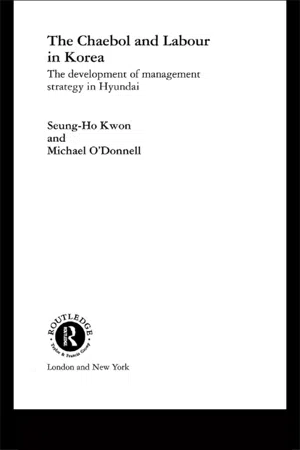
eBook - ePub
The Cheabol and Labour in Korea
The Development of Management Strategy in Hyundai
- 240 pages
- English
- ePUB (mobile friendly)
- Available on iOS & Android
eBook - ePub
The Cheabol and Labour in Korea
The Development of Management Strategy in Hyundai
About this book
Part I
The political economy of South Korea
1 The state, the chaebol and independent trade unions
Introduction
This chapter reviews the history of Korea's political economy and focuses upon relations between the state, employers and trade unions from the late nineteenthcentury. Hyundai's labour-management strategies were formulated within this broader context from the 1940s onwards. In the late nineteenth century, a wage-labouring class and an organised labour movement emerged during Korea's transition from a feudal to a capitalist society. In the first half of the twentieth century, this trade union movement was largely subordinated to the state during the period of Japanese colonial rule (1910–45), the post-Second World War division of the Korean Peninsular (1945) and the Korean War (1950–3). A key characteristic of South Korea's political economy for much of the post-Second World War period emerged during this period; the subordination of workers and trade unions to the combined interests of a repressive military state and the chaebol.
During the 1960s and 1970s the interests of workers and trade unions continued to be subordinated under the Park military government's authoritariancorporatist approach to industrial relations. This involved the repression of labour unrest, incorporation of a state sponsored trade union federation and reliance on the chaebol to rapidly industrialise the economy. The state's emphasis on rapid economic development facilitated the transformation of small- and medium-sized chaebol businesses in the 1960s into large industrial conglomerates by the 1980s.
Despite a state–chaebol alliance hostile to organised labour, large-scale resistance to authoritarian labour controls emerged in the 1970s. In the mid-1980s, a combination of pro-democracy and trade union activists initiated nation-wide protests and industrial strikes in pursuance of more democratic forms of political governance and the recognition of an independent trade union movement. The success of the pro-democracy movement led to the demise of authoritarian military rule and the election of a more democratic government resulting in the state playing a less interventionist and repressive role in workplace industrial relations. Hyundai was not exempt from the effects of Korea's highly volatile political economy. The company experienced considerable industrial action in the late 1980s as production workers expressed their opposition to several decades of low wages, strict supervision and work intensification. This chapter traces the development of Hyundai and other chaebol from the liberation of Korea from Japanese colonial rule, the relationshipbetween an authoritarian state and the chaebol, its chosen agency for economic development, and the re-emergence of an independent trade union movement from the mid-1980s.
The demise of feudalism, Japanese colonialism and organised labour
Before its colonisation by Japan in 1910, what now constitutes Korea was the feudal kingdom of Chosun, controlled by the Yi Dynasty from the fourteenth century according to a rigid Confucian code of personal and social behaviour. Chosun's feudal system was maintained by a hierarchical, authoritarian structure,rigidly stratified from top to bottom into the Yangban (ruling class), the Jungin or Seoin (middle class), the Sangmin (peasant farmers and craftsmen) and the Cheonmin (underprivileged class). Feudal Korea had an agricultural economic base; landlords leased their agricultural land to tenant farmers for a fixed share of production and handicrafts were made in Sangmin and Cheonmin family workshops. The first indications of a developing wage-labour class can be traced to the late eighteenth century when this feudal structure began to break down as new, less labour-intensive farming methods were adopted. These methods resulted in an increasing concentration of land among larger landowners,tenant farmers and businessmen, and triggered an exodus of subsistence peasant farmers to emerging economic sectors, such as mining, over several decades. The effects of natural disasters on agricultural lands, as well as the levying of exorbitant taxes by the ruling elite, further contributed to the exodus of the peasantry from the land in the late nineteenth century (An Byeonggik 1981a: 20–1, Cho Dongyeon 1979: 98–101, Park Moonok 1985: 77–148, Sin Taegon 1978: 181)
The development of a wage-labour class was accelerated by the Japanese opening up of Korea in 1896 and its military annexation in 1910. Imperial Japan used Korea to supplement a growing shortfall in primary products needed for the newly industrialising Japanese economy. The large-scale occupation of Korean public and private lands by the Japanese under the Sanmijeungsan Gyeahoeg programme (The Plan to Increase Rice Production) resulted in a mass exodus of Sangmin and Cheonmin from agriculture. At the same time, the Korean economy was being industrialised by the Japanese, with mining, transport and maritime industries among the first to be developed. These newly established industries absorbed a substantial number of the growing ranks of landless peasants. By 1928, daily-wage workers living in the cities comprised 57.5 per cent (653,552) of all wage-workers, with constructionworkers comprising 37.2 per cent (422,543) of the total workforce. In order to support Japanese munitions industries in the 1930s, Korean manufacturing expanded rapidly and by 1940 this sector employed a workforce of some 295,000 (An Byeonggik 1981b: 29–32, Baek Wukin 1987: 122, Cho Youngbeom 1983: 25–6, Yang Sanghyeon 1986: 219–20).
Low wages, hazardous working conditions and anti-Japanese sentiments contributed over time to the formation of Korean trade unions. The first modern trade union, the Seongjin Stevedores’ Union, was formed in 1898, and others soon followed. Spontaneous strikes organised by these emerging trade unions1 were often broken by the state and employers sending in police to break up mass protest meetings of workers. Nevertheless, in the 1920s, trade unions increased in number and industrial strength as nationalists and socialists combined to form a national organisation (Kim Yunwhan 1982: 41–3, National Stevedore's Union 1979: 15–24).
Under the Japanese colonial economy, Korean workers experienced considerablewage discrimination, long work hours and hazardous working conditions.
During this period just 1 per cent of Korean workers enjoyed an eight-hour day, while 46.9 per cent worked more than twelve hours a day. The worst working conditions were in mining, where accidents increased from 1,210 in 1924 to 8,571 in 1938. Such conditions were a major contributor to the growth of anti-Japanese sentiment among both nationalist and socialist organisations (Cho Younggeon 1984: 20–8, Chung Jinseong, 1984: 50–70, Kang Dongjin 1983: 98–121).
During this period just 1 per cent of Korean workers enjoyed an eight-hour day, while 46.9 per cent worked more than twelve hours a day. The worst working conditions were in mining, where accidents increased from 1,210 in 1924 to 8,571 in 1938. Such conditions were a major contributor to the growth of anti-Japanese sentiment among both nationalist and socialist organisations (Cho Younggeon 1984: 20–8, Chung Jinseong, 1984: 50–70, Kang Dongjin 1983: 98–121).
In the aftermath of the Russian Revolution in 1917, nationalists and socialists found common cause in opposing the colonial authorities’ exploitation of labour. As a result, union membership increased and trade unions established both national and industry-based organisations, such as the Chosun Labour Fraternal Association in 1920, the Chosun Labour Confederation in 1922 and the Chosun Labour and Farmer Confederation in 1924. The development growth in trade unionism gave rise to an increasing number of protests against low wages, poor working conditions and racial discrimination in favour of Japanese workers. By 1930 some 1,608 strikes involving 18,972 workers occurred, up from 81 strikes involving 4,599 workers in 1920 (Kim Kyungil 1992: 82–259, 309, Kim Yunwhan 1982: 111–17, Yoon Yeodug 1991: 80–112). Table 1.1 shows the growth in trade unions and in trade union membership in Korea in the 1920s.
The growth in trade union organisation proved short-lived and trade union membership declined during the 1930s. Despite its increasingly activist role, the trade union movement was often ineffective against the repressive force Source: Revised from Kim Kyungil 1992: 83. exerted by the Japanese colonial state to crush labour unrest in its munitions factories established in Korea during the Second World War. In response, Korean trade unions concentrated on more covert and underground forms of resistance to Japanese occupation. Nevertheless, differences between nationalistsand revolutionary socialists eventually split the trade union movement, despite efforts to maintain an alliance against Imperial Japanese rule. While the nationalists advocated the resolution of industrial conflict within the industrial framework of the colonial state, socialists insisted on mobilising Koreans to overthrow Japanese colonial capitalism. To fuel these divisions, the Japanese ensured that nationalist affiliated trade unions received a range of benefits while the more militant leftist trade unions were suppressed. These leftist unions struggled to survive during the 1930s, a period in which the trade union movement overall declined (Kim Kyungil 1992: 261–305, Kwon and Leggett 1995, Yoon Yeodug 1991: 121–31).
Table1.1Number of trade unions and unionists, selected years 1920–35
The liberation of Korea in 1945 coincided with the start of the Cold War which ultimately resulted in the division of the Korean peninsular by two ideologically opposed forces; the United States and the Union of Soviet Socialist Republics (USSR). The economy of North Korea was structured along communist lines with political backing from the USSR, while South Korea adopted a capitalist model, initially under the rule of the American Military Government. The dominant business groupings in South Korea, comprising former Japanese collaborators, landlords and capitalists, were given political hegemony by the American Military Government as a countervailing force to communist North Korea. In 1948, Rhy Seungman, who represented these interest groups, was elected President of the First Republic of Korea (Yang Jaein 1983: 205–19). The Rhy government sought to strengthen its grip on political power through a combination of anti-communist propaganda, the passing of legislation such as the New National Security Act (1958), that aimed to suppress communist influence in South Korea, and by repressive control of the mass media.2 In practice, though, the Act was often misused and became a potent weapon for legally suppressing all forms of left-wing activism, including the actions of trade unionists (Kang Mankil 1985: 182–3).
Liberated Korea experienced a severe economic recession as a result of the forcible repatriation of Japanese capital, entrepreneurs and engineering expertise.3 This recession was further aggravated by the division of the Korean Peninsular. What remained of Japanese industrialisation was mostly destroyed during the Korean War of 1950–53. Rather than attempting to solve these structural problems in the Korean economy, the American Military Governmentlargely administered emergency aid programmes such as the Government Administration Relief in Occupied Areas. Nevertheless, the American Military Government did attempt to encourage a capitalist economic system as a bulwark against North Korea through the privatisation of Japanese resources; from 1945 to 1948 some 20 per cent of Japanese capital in South Korea was sold to the American Military Government's supporters (Kim Kiwon 1989:
209, Park Chanil 1981: 67–95).
209, Park Chanil 1981: 67–95).
The first economic imperative for the Rhy government was to boost private capital accumulation and productive investment. This was achieved initially by the distribution of the Japanese legacy of factories and land to supporters of the government on exceptionally favourable terms.4 Other sources of economic development were various aid programmes provided by agencies of the United States and the United Nations, such as Civil Relief in Korea and the United Nations Korean Reconstruction Agency. Although aid programmes provided relief from starvation, they also facilitated the economic subordination of Korea to the United States and the destruction of its agricultural sector (Finance Ministry 1967: 36, Hamilton 1984: 30–1, Jones and Sakong 1980: 46, Kim Daewhan 1981: 211, Ogle 1990: 42).
A developmentalist state and the chaebol
Significantly, the administration of these foreign aid programmes by the Rhy government enabled the chaebol to accumulate sufficient capital to diversify their businesses. They concentrated on two major industrial sectors, consumer products (especially flour milling, sugar processing, textiles and ceramics) and construction, in which they established themselves as leading business enterprises after the Korean War.5 Samsung and Hyundai, two of the largest chaebol today, were typical of these emerging business enterprises. Samsung started its first business with the Jaeil Sugar Company in 1953 and expanded into spinning, banking and retailing industries in the late 1950s. Hyundai largely owed its initial growth to construction contracts awarded by the Rhy government and the American military (Bank of Korea 1965, Hamilton 1984: 40, Kim Byungdae 1981: 138–40).
The growth of the chaebol was also facilitated by the establishment of cartels, such as the Flour Mill Manufacturers’, Sugar Manufacturers’ and the Spinning Manufacturers’ Associations and the Five Major Construction Contractors’ Association. Raw materials for production were distributed through these associations, who also determined market prices. The largest government projects were awarded to the Five Major Construction Contractors’ Association, which included Hyundai, in exchange for political donations. Therefore, during the 1940s and 1950s, the formation of the chaebol was facilitated by the corrupt re-distribution of Japanese factories and foreign aid by the Rhy and American military governments in exchange for political contributions in order to create a bulwark against the communist North. This corrupt relationshipwas a major issue leading up to the revolution of 1960 (Han 1975, Kim Kyongdong 1977: 476).
In 1960, the rigging of elections for Rhy Seungman's fourth term led to street demonstrations throughout the country, referred to as the ‘Four Nineteen Revolution’ of 19 April. New elections following this popular uprising resulted in the election of the Chang Myeon government in 1960.6 Although elected to office to reconstruct democracy, the Chang government was ousted by a military coup in May 1961 by General Park Chunghee. Claiming to act in the interest of economic development and national defence, the Park government suppressed all legal and political institutions and arrested politicians and business leaders it believed to be guilty of corruption. The anti-democratic political practices of this government gave rise to increasing resistance from opposition political groups and students. In response the government became increasingly repressive and authoritarian and relied on rapid industrialisation of the Korean economy to maintain its legitimacy (Lee Jungjae 1994: 57–129, Park Moonok 1985: 314).
Rapid industrialisation
The Park Chunghee military government faced ongoing opposition because of the manner in which it assumed power. The Park regime responded to such opposition by enacting the Emergency Martial Law and the Moral Committee for the Freedom of the Press Act to suppress resistance. The Park government also undertook various cultural and moral campaigns such as the Saemaul Undong (New Village Movement) in 1971 to mobilise public support for its political and economic policies. In the 1970s, the Park regime introduced the Constitution for Revitalizing Reform (1972), revised the National Security Act (1971) and the Martial Law Act (1972). In addition, censorship of the press prevented the broadcasting of opposition to the government's authority. Given the Park Chunghee military government's focus on censorship and the suppression of all opposition, its economic policy of encouraging rapid industrialisationwas critical to cementing its political legitimacy. This strategy made use of foreign capital and the availability in Korea of an abundance of low-paid and unskilled labour (Kang Mankil 1985: 187–9, Mun Kyungsoo and Chung Jangyeon 1991: 38–50).
The chaebol were the main private sector agencies used to implement the Park government's export-led industrialisation policies. The development of close economic ties with the government enabled the chaebol to transform from small and medium-sized businesses in the late 1940s into large-scale conglomeratesby the 1970s. Labour unrest in chaebol workplaces was repressed by the state and only unions that supported the government's emphasis on economicdevelopment were legally recognised. To achieve its economic strategy of export-led industrialisation, the Park military government introduced four Five Year Economic Development Plans (1962–6, 1967–71, 1972–6, 1977–81) under the control of the Economic Planning Board, founded in 1967. Various export promotion policies and incentives were introduced, such as tax exemptions, a payment guarantee policy, and restrictions on trade union access to foreign-owned firms, in an effort to attract foreign capital (Cho Seunghyeok 1984: 65, Economic Planning Board 1962, 1966, Republic of Korea Government 1962).
During the First Five Year Economic Development Plan (1962–6), over 36 per cent of total investment was devoted to infrastructure. Labour intensive light industries, such as textiles and footwear, were emphasised, sustained by cheap, low...
Table of contents
- Cover Page
- Title Page
- Copyright Page
- Figures
- Tables
- Preface
- Acknowledgements
- Abbreviations
- Introduction
- Part I: The political economy of South Korea
- Part II: Family business and expansion: 1940–1960s
- Part III: Business diversity and concentration: 1970s–early 1980s
- Part IV: Crisis and transition: early 1980s–1990s
- Part V: Conclusion: the chaebol and labour in Korea
- Notes
- Bibliography
Trusted by 375,005 students
Access to over 1.5 million titles for a fair monthly price.
Study more efficiently using our study tools.
Information
Publisher
RoutledgeEdition
1Year
2003Topic
Social SciencesPrint ISBN
9780415221696
Subtopic
Ethnic StudieseBook ISBN
9781134597482
Index
Social SciencesFrequently asked questions
Yes, you can cancel anytime from the Subscription tab in your account settings on the Perlego website. Your subscription will stay active until the end of your current billing period. Learn how to cancel your subscription
No, books cannot be downloaded as external files, such as PDFs, for use outside of Perlego. However, you can download books within the Perlego app for offline reading on mobile or tablet. Learn how to download books offline
Perlego offers two plans: Essential and Complete
- Essential is ideal for learners and professionals who enjoy exploring a wide range of subjects. Access the Essential Library with 800,000+ trusted titles and best-sellers across business, personal growth, and the humanities. Includes unlimited reading time and Standard Read Aloud voice.
- Complete: Perfect for advanced learners and researchers needing full, unrestricted access. Unlock 1.5M+ books across hundreds of subjects, including academic and specialized titles. The Complete Plan also includes advanced features like Premium Read Aloud and Research Assistant.
We are an online textbook subscription service, where you can get access to an entire online library for less than the price of a single book per month. With over 1.5 million books across 990+ topics, we’ve got you covered! Learn about our mission
Look out for the read-aloud symbol on your next book to see if you can listen to it. The read-aloud tool reads text aloud for you, highlighting the text as it is being read. You can pause it, speed it up and slow it down. Learn more about Read Aloud
Yes! You can use the Perlego app on both iOS and Android devices to read anytime, anywhere — even offline. Perfect for commutes or when you’re on the go.
Please note we cannot support devices running on iOS 13 and Android 7 or earlier. Learn more about using the app
Please note we cannot support devices running on iOS 13 and Android 7 or earlier. Learn more about using the app
Yes, you can access The Cheabol and Labour in Korea by Seung Ho Kwon,Michael O'Donnell in PDF and/or ePUB format, as well as other popular books in Social Sciences & Ethnic Studies. We have over 1.5 million books available in our catalogue for you to explore.