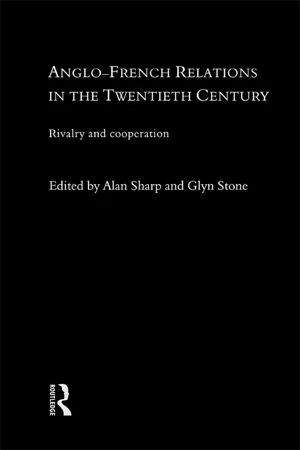
Anglo-French Relations in the Twentieth Century is a collection of studies on the key episodes of the difficult and often discordant Anglo-French exchange over the past century. The authors critically re-evaluate: * the role of Spain in Anglo-French relations up to 1918
* the missed opportunity of the 1920s with the failure of France and Britain to find sufficient common ground and co-operation
* the short-lived Anglo-French alliance and the Second World War
* the degree of Anglo-French Imperial co-operation
* the Suez Crisis
* British and French policies on European Integration.
eBook - ePub
Anglo-French Relations in the Twentieth Century
Rivalry and Cooperation
- 368 pages
- English
- ePUB (mobile friendly)
- Available on iOS & Android
eBook - ePub
Anglo-French Relations in the Twentieth Century
Rivalry and Cooperation
About this book
1 The elusive balance British foreign policy and the French entente before the First World War
Thomas Otte
Reviewing the recent course of British foreign policy, the head of the Foreign Office’s Western Department noted of the Anglo-French entente in 1907 that it ‘was the outcome of the honest and ardent desire…to compose, as far as possible, the many differences which had been a source of perpetual friction between them’.1 His French counterpart described the conclusion of the agreement in his eponymous memoirs as ‘un grand tournant de la politique mondiale’.2 Such contemporary testaments are, perhaps, not the most reliable guides for efforts to assess the historical significance of the Anglo-French entente. Historical interpretations range from inspired and far-sighted statesmanship to an act of weak-kneed ‘Edwardian appeasement’. 3 What they have in common with Eyre Crowe’s and Maurice Paléologue’s eulogies is the assumption of the novelty of Anglo-French cooperation.
The entente agreement of 1904 was no diplomatic revolution. All too often, commentators seem to have succumbed to the romantic vision conjured up by Winston Churchill of ‘the historic antagonism to France, the memories of Blenheim, of Minden and of Waterloo’.4 Despite the prolonged periods of conflict especially in the eigh-teenth century, there was no continuous line of Anglo-French antagonism from Agincourt, Malplaquet and Trafalgar to Fashoda. In the aftermath of the Napoleonic wars ‘liberal’ France was often found to be a more concurrent partner in European affairs than the three eastern monarchies. Under Lord Aberdeen’s premiership both governments strove to establish and maintain ‘a cordial, good understanding’, or in Jarnac’s magic rendering ‘une entente cordiale’.5
Despite such instances of close cross-Channel cooperation, the nature of Anglo-French relations in the nineteenth century was more complex. France was as much a troublesome competitor overseas as she was an important factor in European politics, without which no viable continental equilibrium was thought feasible.6 It was with France that Britain concluded the first free-trade treaty in 1860, thereby laying the foundations for her network of late-nineteenth-century free-trading arrangements with various continental countries. 7 Occasional trade disputes notwithstanding, Britain’s commercial ties with France were on the whole close.8
Similar elements of continuity can also be detected in the ambivalent attitude of Britain’s foreign policy-making élite towards France. Common (Anglo-Saxon, Protestant) suspicion of France and her political and cultural traditions of monarchic absolutism, Catholic ob-scurantism and revolutionary and Bonapartist demagoguery did not preclude willingness to cooperate. Warm sympathy towards things French, on the other hand, though perhaps confined to only a few, did not imply the absence of suspicion and mistrust.9 The most obvious example was perhaps John Morley, whose numerous insightful literary and historical essays bear witness to his affinity with French culture;10 yet who, as a Cabinet minister, was critical of the French entente and who ultimately resigned from the Government in 1914 in protest against the decision to enter the war against Germany.11
Public attitudes in both countries, though less sophisticated, were equally ambivalent. In Britain, images of General Kitchener’s ‘triumph’ at Fashoda in 1898 were far from dormant when the entente with France was concluded. Not so long ago, ‘vive les Boers’ was frequently heard on the boulevards of Paris and the French public had revelled in anti-British caricatures of dubious taste.12 Successive British ambassadors at Paris had complained of ‘the scoundrelly press of Paris’,13 whose doings had left the French public ‘educated in hostility of England’.14 The great sea-change, insofar as public opinion was concerned, came under King Edward VII. Although ‘very pleased’ about its conclusion,15 he was not, contrary to persistent popular mythology, the architect of the entente. He was, however, instrumental in winning over the public of both countries.16
I
It is not without irony that the entente with France was the unintended outcome of the retirement of British diplomacy after 1900. With Lord Salisbury eased out of the Foreign Office in that year and Lord Lansdowne firmly installed as his successor, anti-isolationist sentiments had gained the ascendancy in the Cabinet.17 Although a majority of ministers were convinced of the need for a continental alignment of some kind, an arrangement with France was not what the new Foreign Secretary had in mind. His one ‘preconceived idea’ on taking office was to ‘use every effort to maintain, and if we can to strengthen the good relations which at present exist [with Germany]’.18
In view of the chequered record of Anglo-French relations over the past two decades and of the parlous state of relations with Russia, it was not a surprising conclusion to arrive at. Ever since the collapse of the dual management of Egyptian affairs in the wake of the 1881– 2 crisis, the question of the future of the country on the Nile had been a festering sore in the relations between Britain and France. Prime Minister Jules Ferry’s colonial flirtation with Chancellor Otto von Bismarck in the early 1880s had done little to encourage British belief in French reliability;19 and had, in fact, left behind a legacy of suspicion which was still well alive after the conclusion of the entente.20 The efforts undertaken in the 1890s to arrive at an African settlement with France seemed only to have served to delay the stand-off at the headwaters of the Nile rather than to avoid it altogether.21 In the ‘Eastern Question’ and its various sub-issues French policy appeared to British diplomats at best capri-cious, and therefore unreliable; at worst, exceedingly subservient to Russian wishes, and thus suspicious.22 The near clash with France over Siam in July 1894, though no doubt largely brought about by Lord Rosebery’s miscalculation, and Edward Grey’s sabre-rattling over Uganda in the following year, only served to underline the fault-lines in Anglo-French relations.23 French competition for political and commercial influence over southern and central China merely completed this impressive catalogue of global clashes of interest and rivalries.24 Certainly, circumstances were not propitious for Gabriel Hanotaux’s desire to ‘arriver a une bonne entente avec 1’Angleterre’.25 A military conflict with France and her ally Russia was therefore thought of as a distinct possibility.26
At the same time, there were few manifest clashes of interest with Germany; and if there were lingering ‘memories of Blenheim, of Minden and of Waterloo’,27 then those very same battles stood also for Anglo-German comradeship-in-arms. Imperial Germany therefore seemed to be a natural choice as partner in a continental alignment. Still, whatever the precise nature of Lansdowne’s ‘preconceived idea’, he was warned by the Ambassador at Berlin against ‘making any concessions [to Germany] for which we do not receive a completely adequate consideration’.28 Frank Lascelles‘ warning was pertinent. Ultimately Lansdowne’s plans never came to fruition because of German diplomatic manoeuvres.29 Moreover, the Wilhelmstrasse’s persistent efforts to foster conflict between Britain and the Franco-Russian alliance, and to exploit existing difficulties made Germany the linchpin of the European system.30 Reflecting in later years on his efforts to arrive at an understanding with the German Government, Lansdowne had to concede that he found he ‘couldn’t trust them’.31
The alliance with Japan of January 1902 solved Lansdowne’s most pressing far-eastern problems which had made an arrangement with Germany seem so desirable.32 The Japanese alliance safeguarded Britain’s regional interests around the China seas without incurring any European obligations. Indeed, it highlighted Britain’s aloofness from continental affairs rather than marking the end of ‘splendid isolation’.
With the German navy still in its chrysalis stage the Admiralty was confident of being able to deal with any emerging threat. The Japanese alliance was to contain Russia in China. Indeed, the far-eastern problem now appeared to be quiescent. But this seemed to leave India even more vulnerable to a Russian land invasion.33 To many, Lansdowne included, an understanding with Russia on Persia and Afghanistan was now highly desirable.34 An improvement in Anglo-French relations was seen largely in terms of its utility in bringing about the desired accommodation with France’s ally Russia.35 A proposal by Paul Cambon, the French Ambassador at London, in March 1901, and then again in July of the same year, for a bargain involving the relinquishing of some of France’s special and ill-defined fishing rights off Newfoundland under the Treaty of Utrecht of 1713 in return for some territory in the Gambia was therefore broadly welcomed. On closer examination, however, and on Colonial Secretary Joseph Chamberlain’s advice, the idea was rejected as the removal of a minor, albeit perpetual, source of irritation in Anglo-French relations seemed hardly worth the sacrifice of African territory.36 Indeed, for the time being, Cambon’s negotiating position was rendered mo...
Table of contents
- Cover Page
- Title Page
- Copyright Page
- Contributors
- Introduction
- 1: The elusive balance British foreign policy and the French entente before the First World War
- 2: The Conservative party and the Anglo-French entente, 1905–1914
- 3: The poor relation Spain in Anglo-French relations, 1898–1914
- 4: Britain and France at war, 1914–1918
- 5: Britain, France and the Russian Civil War, 1918–1920
- 6: Lloyd George, Clemenceau and the elusive Anglo-French guarantee treaty, 1919 ‘A disastrous episode’?
- 7: Anglo-French relations from Versailles to Locarno, 1919–1925 The quest for security
- 8: Britain, France and the League of Nations in the 1920s
- 9: The search for disarmament Anglo-French relations, 1929–1934
- 10: From entente to alliance Anglo-French relations, 1935–1939
- 11: France’s economic and financial crisis The view from the Foreign Office, the Treasury and the Bank of England, 1936–1939
- 12: Entente broken and renewed Britain and France, 1940–1945
- 13: The most important of the Western nations France’s place in Britain’s post-war foreign policy, 1945–1949
- 14: The failure of the new entente cordiale, 1947–1950
- 15: Anthony Eden, the Foreign Office and Anglo-French Relations, 1951–1954
- 16: From Dien Bien Phu to Evian Anglo-French imperial relations, 1954–1962
- 17: The Cold War, European Community and Anglo-French relations, 1958– 1998
Trusted by 375,005 students
Access to over 1.5 million titles for a fair monthly price.
Study more efficiently using our study tools.
Frequently asked questions
Yes, you can cancel anytime from the Subscription tab in your account settings on the Perlego website. Your subscription will stay active until the end of your current billing period. Learn how to cancel your subscription
No, books cannot be downloaded as external files, such as PDFs, for use outside of Perlego. However, you can download books within the Perlego app for offline reading on mobile or tablet. Learn how to download books offline
Perlego offers two plans: Essential and Complete
- Essential is ideal for learners and professionals who enjoy exploring a wide range of subjects. Access the Essential Library with 800,000+ trusted titles and best-sellers across business, personal growth, and the humanities. Includes unlimited reading time and Standard Read Aloud voice.
- Complete: Perfect for advanced learners and researchers needing full, unrestricted access. Unlock 1.5M+ books across hundreds of subjects, including academic and specialized titles. The Complete Plan also includes advanced features like Premium Read Aloud and Research Assistant.
We are an online textbook subscription service, where you can get access to an entire online library for less than the price of a single book per month. With over 1.5 million books across 990+ topics, we’ve got you covered! Learn about our mission
Look out for the read-aloud symbol on your next book to see if you can listen to it. The read-aloud tool reads text aloud for you, highlighting the text as it is being read. You can pause it, speed it up and slow it down. Learn more about Read Aloud
Yes! You can use the Perlego app on both iOS and Android devices to read anytime, anywhere — even offline. Perfect for commutes or when you’re on the go.
Please note we cannot support devices running on iOS 13 and Android 7 or earlier. Learn more about using the app
Please note we cannot support devices running on iOS 13 and Android 7 or earlier. Learn more about using the app
Yes, you can access Anglo-French Relations in the Twentieth Century by Alan Sharp,Glyn Stone,Professor Glyn A Stone in PDF and/or ePUB format, as well as other popular books in History & World History. We have over 1.5 million books available in our catalogue for you to explore.