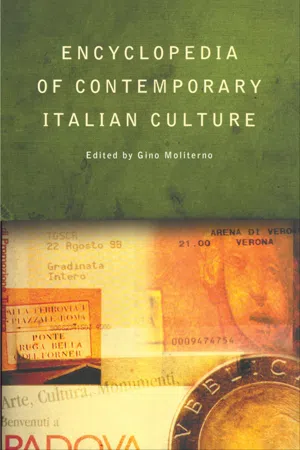
This rigorously compiled A-Z volume offers rich, readable coverage of the diverse forms of post-1945 Italian culture. With over 900 entries by international contributors, this volume is genuinely interdisciplinary in character, treating traditional political, economic, and legal concerns, with a particular emphasis on neglected areas of popular culture. Entries range from short definitions, histories or biographies to longer overviews covering themes, movements, institutions and personalities, from advertising to fascism, and Pirelli to Zeffirelli.
The Encyclopedia aims to inform and inspire both teachers and students in the following fields:
*Italian language and literature
*Arts, Humanities and Social Sciences
*European Studies
*Media and Cultural Studies
*Business and Management
*Art and Design
It is extensively cross-referenced, has a thematic contents list and suggestions for further reading.
- 704 pages
- English
- ePUB (mobile friendly)
- Available on iOS & Android
eBook - ePub
Encyclopedia of Contemporary Italian Culture
About this book
P
P2
P2 (Propaganda 2) was a secret Masonic lodge, established under the aegis of the larger of Italy’s two Masonic families, the Grand Orient of Palazzo Giustiniani. It was dissolved by Parliament as a criminal association in 1981.
P2’s real history begins in 1970 when a Tuscan businessman, Licio Gelli, was granted responsibility for the lodge and power to initiate new members privately. Gelli’s suspiciously recent conversion to Freemasonry (he was initiated in 1965) and his political obscurity suggest that his role, designed by others, was to infiltrate the organization and convert an influential segment of the P2 into a clandestine centre of anticommunist influence. His wartime experiences, which included service to Fascists, Germans and Americans, had given him entry into both moderate and extreme conservative circles in Italy and abroad, and his links with leading members of the Italian secret services enabled him to obtain the dossiers they had compiled on 300,000 Italians in the 1960s. Gelli was able to turn such resources to good effect in recruiting for the P2. The list of 511 members which was made public in 1981 included ministers and MPs, magistrates and judges, senior officers in the armed forces and security services, and high-ranking state officials. Other powerful affiliates included Angelo Rizzoli, then owner of the Corriere delta sera, and two bankers who were to meet violent deaths, Michele Sindona and Roberto Calvi. The revelation that even leading politicians were ready to join a secret association suspected of plotting against the state forced the resignation of the Christian Democrat government in 1981 and its replacement by the first postwar government to be led by a member of another party (Giovanni Spadolini from the PRI).
What purpose did the P2 serve? Its structure, based exclusively on direct links between Gelli and affiliates whose involvement was not widely known to other members and who met only in small groups, certainly militated against any clear collective goal. Some accounts portray it as little more than an underground salotto, organized by Gelli to make participants aware that their fear of the advance of communism, and sympathy for some kind of authoritarian response, was shared by people in other influential positions. Others, including several Italian courts, have identified it as an active agent in the rightwing conspiracies of the 1970s, detecting its hand in the neo-fascist strategy of tension (see strategia deHa tensione) and in a deliberate decision to allow Moro, supposedly soft on communism, to be murdered by the Red Brigades. Senior P2 members, notably from the armed forces, were fond of illegality, but it remains unclear whether their actions had a common origin in P2 strategy.
Further reading
Cecchi, A. (1985) Storia della P2 (History of the P2), Rome: Editori Riuniti.
Cornwell, R. (1983) God’s Banker, London: Victor Gollancz (the career of Robert Calvi and his links with the P2).
Ferraresi, F. (1996) Threats to Democracy: The Radical Right in Italy After the War, Princeton, NJ: Princeton University Press (the political environment of the P2).
DAVID MOSS
Paci, Enzo
b. 19 December 1911, Ancona; d. 21 July 1976, Milan
Philosopher
Paci studied with Antonio Banfi at Milan and was heavily influenced by the phenomenology of Husserl and by historical materialism. His synthesis of the unlikely pair, phenomenology and Marxism, led him to formulate a philosophy of history which privileged events over entities and made the processes inherent in relatedness more important than substance itself. With a rapid succession of works and through the phenomenological orientation of the journal Aut aut, which he founded in 1951, Paci inspired the return to Husserl that animated Italian philosophy of the 1960s. His influence is due, at least in part, to his wide range of interests which included poetry, music, science and architecture.
Further reading
Dallmayr, F. (1973) ‘Phenomenology and Marxism: A Salute to Enzo Paci’, in G.Psathas (ed.), Phenomenological Sociology, New York and London: John Wiley and Sons, 305–56.
THOMAS KELSO
Padre Pio
b. 25 May 1887, Pietrelcina, Benevento; d. 23 September 1968, San Giovanni Rotondo, Foggia
Franciscan friar
One of the greatest foci of modern Italian popular piety and the principal cause of a religious revival in southern Italy in the postwar period, Pio entered the Franciscan order in 1905 and was ordained in 1910. In 1918 he first manifested signs of the stigmata (the wounds which Christ suffered on the Cross) and as a result his monastery at San Giovanni Rotondo, Puglia, became a centre of pilgrimage for the next sixty years. In spite of mystical leanings, Padre Pio showed great concern for the living and for working conditions of the local people, and in 1956 he opened a major hospital. For a long time the Church’s general attitude towards the Padre Pio phenomenon was one of scepticism and distance, but in December 1998 his miraculous works were confirmed and in May 1999 he was officially beatified.
Further reading
McKevitt, C. (1991) ‘San Giovanni Rotondo and the Cult of Padre Pio’, in J.Eade and M.J.Sallnow (eds), Contesting the Sacred, London: Routledge.
JOHN POLLARD
Pagliarani, Elio
b. 25 May 1927, Viserba, Forlí
Poet
After completing his degree in Political Science in 1951, Pagliarani taught in several high schools in Milan and worked on the editorial staff of the socialist newspaper Avanti! (Forward!). He also contributed to literary journals such as Nuovi argomenti, il verri, Quindici and, finally, Periodo ipotetico which he also founded. His poems appear in the neoavantgarde anthology I novissimi (1961), and he belonged to the Gruppo 63, a group of poets and intellectuals who sketched the theoretical background for neoavantgarde poetry itself. His poetry, prosaic and chronicle-like, is often filled with the imagery and characters of an urban landscape. His verses, especially the later ones, are characterized by a strong innovative and experimental tension which aims at undermining the structures of language and discourse.
Further reading
Pagliarani, E. (1985) (La ragazza Carla—Lezione di fisica e Fecaloro—Dalla ballata di Rudi) (Poems for Recitation: The Girl Carla—The Physics Lesson and Fecaloro—From Rudi’s Ballad), ed. A. Briganti, Rome: Bulzoni (a representative collection of Pagliarani’s poetry).
ENRICO CESARETTI
Pajetta, Giancarlo
b. 24 June 1911, Turin; d. 13 September 1990, Rome
Politician
One of the most popular and prestigious leaders of the PCI (Italian Communist Party), Giancarlo Pajetta was first jailed for subversive activities at the age of sixteen. During the Resistance, as a leader of the CLNAI (National Liberation Committee), he was responsible for agreements in which the Allies and the caretaker Italian government recognized the CLNAI as their representative in the North, in return for a guarantee to relinquish authority after Liberation. While Pajetta claimed that it had been impossible to achieve more, the socialists considered this price for support of the partisan struggle too high. A member of parliament from 1945 onwards, as well as editor of L’Unità and Rinascita for long periods, Pajetta was known for his corrosive wit and fiercely combative spirit. Within the party, he played a key role in organizational affairs and foreign policy development.
CLAIRE KENNEDY
Paladino, Mimmo (Domenico)
b. 18 December 1948, Paduli, Benevento
Artist
Paladino was part of the Italian transavantgarde and the return to the use of figurative elements in painting in the 1970s and 1980s. His interest in drawing is shown by the compositional nature of his works which, like those of other artists identified with the transavantgarde, make use of a wide range of sources, including ancient art and mythology. Paladino’s work is somewhat more mysterious, however; it alludes to the past, to states of life and death and to the unknowable, without attempting to impose fixed meanings. On the Edge of Evening (1983) is composed of human and animal shapes built up to suggest a dreamlike state where matter is in flux. Paladino has held numerous exhibitions since 1976, moving beyond painting to mixed media, print-making and sculpture.
Further reading
Bonito Oliva, A. and Rosenthal, N. (1993) Mimmo Paladino, Milan, Fabbri Editori (exhibition catalogue with some colour illustrations).
MAX STAPLES
Palazzeschi, Aldo
b. 2 February 1885, Florence; d. 18 August 1974, Rome
Poet and novelist
As one of the founding members of the Italian avantgarde, Palazzeschi (the pseudonym of Giurlani Aldo) not only revolutionized Italian literature earlier in the twentieth century with his antiliterary work but, through his writing’s ironic and self-reflexive parody, also offered an early example of postmodern sensitivity in Italian culture.
Having trained briefly as an actor before starting his career as a writer, Palazzeschi published his first book of poetry, I cavalli bianchi (White Horses) in 1905. In this as well as in other early books, Palazzeschi parodies and attacks the leading poetic schools of the time by transforming D’Annunzio’s Nietzschean celebration of the poet’s Dionysian powers and the ‘tubercular’ resignation of decadentismo (the decadent school) into what one critic has called ‘l’occasione per l’irriverenza, la malizia, la metamorfosi in manichini dei personaggi tipici di tali luoghi e spazi’ (the occasion for irreverence, for malice and for the metamorphosis into puppets of the typical characters represented in such works) (Barbèri Squarotti, 1994:704 (my translation)). Having joined the futurists’ revolt against the status quo, Palazzeschi continued to attack the literary establishment with the narrative works Codice di Perelà (Perelà’s Codex) (1911) and La Piramide (The Pyramid) (1926), whose fantastic and sarcastic humour signal a pessimistic abandonment of the rhetorical and self-centred artistic representations of the previous Italian tradition. Prior to the Second World War, Palazzeschi also published his most successful novel, Le sorelle Materassi (The Materassi Sisters), which was made into film in 1943 and adapted for Italian public television in the 1960s. On the surface level, the novel narrates the emotional and financial swindling of two sisters by a nephew with whom they have fallen in love. However, it is also meant as the occasion for a scathing indictment of the Florentine bourgeoisie and its provincial morality.
Following a period of inactivity that coincided with the Second World War, Palazzeschi returned to writing in the late 1940s and early 1950s with the novels I fratelli Cuccoli (The Cuccoli Brothers) (1948) and Roma (1953), books that do not maintain the biting originality and cohesive attacks on the system of his previous works. More interesting are the short stories collected in Bestie del Novecento (TwentiethCentury Beasts) (1951), where the elaboration of a modern bestiary provides the occasion for an attack on the vices of his contemporaries. After another lengthy interruption, the 1960s saw a renewed flurry of activity on Palazzeschi’s part. Of significance are the poems collected in Cuor mio (My Heart) (1968), which display novel linguistic experimentation side by side with the usual polemics against the intellectual establishment. Palazzeschi was more-over the author of numerous autobiographical works, chief among them Tre imperi…mancati (Three Empires…Lost), in which Fascism’s imperial policy is divested of its false rhetoric of power and heroic virtue, and exposed as the source of all the suffering and civic unhappiness that followed.
Further reading
Barbèri Squarotti, G. (1994) ‘Palazzeschi’, in G. Barbèri Squarotti (ed.), Storia della civiltà letteraria italiana (History of Italian Literary Culture) Turin: UTET.
Tamburri, A. (1990) Of Saltimbanchi and Incendiari: Aldo Palazzeschi and Avant-Gardism in Italy, London: Associated University Press.
VALERIO FERME
Pannella, Marco (Giacinto)
b. 2 May 1930, Teramo
Politician and civil rights campaigner
For more than twenty years, Marco Pannella acted as conscience of the Italian Left, a professional outsider who was in fact part of the establishment, the joker in the political pack and in practice the leader of the anti-clerical non-Marxist liberal left. He was among the founders of the Radical Party as a pressure group in 1955, and its de facto leader when it became a parliamentary party in 1974. Pannella and the Radicals fought in favour of divorce, legal abortion, conscientious objection to conscription and decriminalization of illegal drugs. In the 1980s they fought for increased famine relief and aid to the developing world. The main weapons used were civil disobedience, hunger strikes and referenda. In 1994 he left the left-wing Progressive Alliance and gave ambiguous support to Silvio Berlusconi (bearing out Teodori’s characterization of Pannella as ‘schizophrenic’). He was a deputy in the Italian Parliament from 1976–92 and the European Parliament from 1979, either as a Radical or standing under the banner of the ‘Club Pannella’ or ‘Riformatori’.
Further reading
Tedori, M. (1996) Marco Pannella. Un eretico liberale nella crisi della Repubblica (Marco Pannella: A Liberal Heretic in the Crisis of the Republic), Venice: Marsilio.
JAMES WALSTON
Panorama
Launched in October 1962 by publisher Arnoldo Mondadori in association with the American Time—Life group, Panorama was originally a generic monthly presenting cultural and entertainment features with little or no space dedicated to politics. Poor sales soon led the Time-Life group to abandon the project. The magazine was taken over by Arnoldo’s son Giorgio, who transformed it into a weekly newsmagazine modelled on the American Newsweek; by 1968 it was selling over 100,000 copies per issue. In a climate of accelerating political and social change, the magazine came to focus ever more on news and current affairs, significantly adopting the subtitle ‘I fatti separati dalle opinioni’ (the facts separated from opinions). As the 1970s progressed, Panorama became more politically active, denouncing terrorism and government corruption, uncovering scandals and supporting progressive liberal campaigns in favour of divorce and abortion.
Given its new direction, the magazine soon became locked into fierce competition with its rival newsmagazine, L’Espresso (by 1980 both magazines were selling close to 300,000 copies each). A series of financial takeovers in the late 1980s brought Panorama under the control of television and media magnate Silvio Berlusconi. During the 1990s the magazine became ever more closely identified with his political line, in the later 1990s waging an open campaign against both the Ulivo centre-left governments and Berlusconi’s nem...
Table of contents
- Cover Page
- Title Page
- Copyright Page
- Editorial Team
- List of Contributors
- Introduction
- Acknowledgements
- How to Use this Book
- Thematic Entry List
- A
- B
- C
- D
- E
- F
- G
- H
- I
- J
- K
- L
- M
- N
- O
- P
- Q
- R
- S
- T
- U
- V
- W
- Z
Trusted by 375,005 students
Access to over 1.5 million titles for a fair monthly price.
Study more efficiently using our study tools.
Frequently asked questions
Yes, you can cancel anytime from the Subscription tab in your account settings on the Perlego website. Your subscription will stay active until the end of your current billing period. Learn how to cancel your subscription
No, books cannot be downloaded as external files, such as PDFs, for use outside of Perlego. However, you can download books within the Perlego app for offline reading on mobile or tablet. Learn how to download books offline
Perlego offers two plans: Essential and Complete
- Essential is ideal for learners and professionals who enjoy exploring a wide range of subjects. Access the Essential Library with 800,000+ trusted titles and best-sellers across business, personal growth, and the humanities. Includes unlimited reading time and Standard Read Aloud voice.
- Complete: Perfect for advanced learners and researchers needing full, unrestricted access. Unlock 1.5M+ books across hundreds of subjects, including academic and specialized titles. The Complete Plan also includes advanced features like Premium Read Aloud and Research Assistant.
We are an online textbook subscription service, where you can get access to an entire online library for less than the price of a single book per month. With over 1.5 million books across 990+ topics, we’ve got you covered! Learn about our mission
Look out for the read-aloud symbol on your next book to see if you can listen to it. The read-aloud tool reads text aloud for you, highlighting the text as it is being read. You can pause it, speed it up and slow it down. Learn more about Read Aloud
Yes! You can use the Perlego app on both iOS and Android devices to read anytime, anywhere — even offline. Perfect for commutes or when you’re on the go.
Please note we cannot support devices running on iOS 13 and Android 7 or earlier. Learn more about using the app
Please note we cannot support devices running on iOS 13 and Android 7 or earlier. Learn more about using the app
Yes, you can access Encyclopedia of Contemporary Italian Culture by Gino Moliterno in PDF and/or ePUB format, as well as other popular books in History & World History. We have over 1.5 million books available in our catalogue for you to explore.