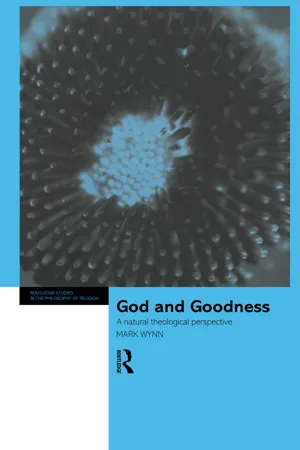
First Published in 2004. God and Goodness takes the experience of value as a starting point for natural theology. Mark Wynn argues that theism offers our best understanding of the goodness of the world, especially its beauty and openness to the development of richer and more complex material forms.
We also see that the world's goodness calls for a moral response: commitment to the goodness of the world represents a natural extension of the trust to which we aspire in our dealings with human beings.
Wynn argues that the goodness of the world provides a glimpse into what we should mean by 'God'. Here, he seeks to recover the mediaeval sense that the goodness of the world offers an image of the goodness of God, not simply in relation to the world, but in itself. This book will be an invaluable read for those interested in natural theology and philosophy of religion.
- 240 pages
- English
- ePUB (mobile friendly)
- Available on iOS & Android
eBook - ePub
About this book
Information
Part I
The goodness of the world as its reason for existence
1 Providence and beauty
The argument from design
The central thesis of this book is that the world exists because it is good that it should exist. In this first part of the book I shall argue that various phenomena, including natural beauty, life and consciousness, are well explained in terms of this thesis, and not well explained otherwise. This discussion will constitute a defence of the argument from design in relation to these phenomena. In Chapters 1 and 2, I shall defend three versions of the argument from design. But before proceeding to set out these arguments I shall offer a brief overview of the history of the design argument, in order to locate the sort of approach I am defending within a larger intellectual context.
The point I wish to emphasise here is that some forms of the design argument may have proved self-subverting: to the extent that it has concentrated on quasi-mathematical, evaluatively neutral features of the world (for example, its apparently mechanical regularity over space and time), the design argument may paradoxically have contributed to the demise of religious belief, by undermining our appreciation of the world, and thereby encouraging a secular, merely utilitarian interpretation of its significance.1 By contrast the arguments I develop in this section will be clearly grounded in an evaluative engagement with the world. This approach will also aim to meet the charge that the argument from design (and other forms of natural theology) are religiously irrelevant because they can be understood, and even endorsed, by someone who professes to find their conclusions a matter of indifference. In the case of the arguments I discuss, there will be an internal connection between seeing the soundness of the argument and holding a set of evaluations which are congenial to religious belief in the fullest sense.
Design arguments are as old as western philosophy.2 They are found in the works of the Presocratics, and defended in the writings of Plato.3 For instance, in The Laws, Plato suggests that the existence and beneficence of the gods may be inferred from the regular movement of the heavenly bodies. Aristotle has also been taken as a source for the argument from design. Of course, the God of the Metaphysics is not a providential deity. But Aristotle does maintain that nature is ordered teleologically, and that God provides the ultimate explanation of this fact; and his thinking on this point was to exercise a profound influence on the writings of later, Christian authors. In Aquinas for example we find a clear association between the thought that individual things, including inanimate things, act for a purpose and the thought that these things are guided by an intelligence. Thus he writes that:
Goal-directed behaviour is observed in all bodies obeying natural laws, even when they lack awareness. Their behaviour hardly ever varies and practically always turns out well, showing that they truly tend to their goals and do not merely hit them by accident. But nothing lacking awareness can tend to a goal except it be directed by someone with awareness and understanding.4
This is of course Aquinas’s ‘Fifth Way’. Interestingly, the passage cites two sorts of consideration in support of the idea of design: the fact that things act regularly and the fact that their behaviour is for the best. These same considerations are evident in The Laws, where Plato proposes that the regularity of the world, and especially the movements of the heavenly bodies, are a mark of the gods’ benevolence.
In the seventeenth century in the wake of the new, mechanistic physics of Newton and others, the design argument entered a new phase. Whereas the ancients had tended to consider the universe by analogy with an organism, it now became common to think of it as machine-like, so providing the argument with a new analogical foundation.5 After all, in the case of our own activity, it seems clear enough that mechanisms result not by chance but from the purposeful exercise of intelligence; and by extension, we might suppose that the mechanically ordered universe derives from a transcendent, non-mundane intelligence. Thus in Hume’s Dialogues, Cleanthes urges his interlocutors to compare the universe to ‘one great machine’ and to marvel at the ‘curious adapting of means to ends, throughout all nature’.6 The same sort of appeal to a mechanical analogy is evident famously in William Paley’s proposal that the world resembles a watch.7 It is important to note that despite this change in its scientific basis, the argument retains its basic structure. Thus in these remarks of Hume there is an appeal once more to regularity and teleology. And in Paley’s writings, too, we find reference both to the regular movement of the heavenly bodies, and to the intricate structure, apparently teleological, of individual organisms.
In the view of many commentators, Hume’s arguments in the first Enquiry and above all in the Dialogues have decisively refuted this form of the design argument.8 Through the character of Philo, Hume argues variously that the analogy between the universe and the products of human agency is weak (like any comparison between the parts of a thing and the thing as a whole, where the parts comprise an insignificant portion of the whole); that even if this analogy should work, there are other, competing analogies which are at least as persuasive (perhaps the universe is more akin to an animal or vegetable?); that this sort of argument is misconceived in principle (above all because we have no experience of the origins of worlds, and therefore no experiential basis for the idea that worlds like ours are more likely than not to derive from design); that the analogy is anyway of no use to theology, since it invites an anthropomorphic conception of the deity (indeed, Hume suggests, if we persist with the analogy we ought to postulate a number of such deities, since human artefacts are generally made in collaboration); and that the argument lacks any explanatory force because it postulates a further set of facts as much in need of explanation as those which it purports to explain (since the order of the divine mind must be isomorphic with the order of the world, in so far as the first involves a representation or design plan of the second).9 Hume also explores the thought that a merely random exploration of possibilities will hit upon an orderly outcome given sufficient time, so removing any need for the design hypothesis.10 And he suggests that while the world with all its imperfections may be compatible with belief in beneficent design, it can hardly provide a secure basis for that conviction.11
Later commentators have argued that even if the design argument is able to resist Hume’s criticisms, the work of Darwin and his successors has definitively put an end to whatever plausibility it may have had. Darwin’s theory, together with subsequent elaborations, threatens the argument at a number of levels. By proposing that a number of species have become extinct, it appears to undermine decisively the idea that in general creatures have been contrived so they can flourish in their respective environments. Moreover, the theory maintains, of course, that new species emerge over time, and that maladapted variations on existing types are eliminated, on account of their inability to compete effectively for scarce resources. Such a view implies that the neat fit between creatures and their environments which we observe in the present may reflect not the working out of a beneficent purpose, but the extermination of weaker, less competitive forms of life, and the survival of their fitter counterparts. Moreover, given the development of genetic theory, it now seems that the generation of new creaturely types is in large part a random process.
So from the perspective of evolutionary theory, we may wish to say that the adaptedness of creatures to their environments, which so impressed Paley and others, is best understood not as a matter of contrivance, but in terms of a random exploration of possibilities, coupled with a selection mechanism which ensures the elimination of any emergent heritable characteristic which damages the survival prospects of the individual.12 Of course, this picture of the world as a scene of strife, where various creatures are pitted against one another in a struggle for survival, has posed a further challenge by suggesting not only that we do not need the notion of divine agency to account for the phenomena of adaptation, but also that the world itself is not a fitting product of design.
Not surprisingly, modern discussion of the argument from design has concentrated on the question of whether it can be plausibly reconstructed in a post-Humean, post-Darwinian form. Some scholars point towards alleged lacunae in the Darwinian account, but more commonly it is argued that there are certain general facts about the world which are suggestive of design, but necessarily elude Darwinian kinds of explanation, since they are presupposed in the processes described by Darwin. Thus it has been said that Darwinian kinds of mechanism cannot account for the overarching framework of natural law which undergirds the process of evolution. This broadening of the design argument’s focus is evident in the writings of, for instance, Tennant, Hambourger, Swinburne and Walker.13 As we have seen, this interest in the regularity of the world has clear antecedents in earlier versions of the argument.
As Kant anticipated, developments in science have continued to prompt new formulations of the argument.14 Most notably, a range of new design arguments have been formulated in response to the proposal of cosmologists that there is a delicate relationship between the character of the cosmos as a whole and its suitability for the development of life.15 It seems for instance that life would not have emerged in a universe with a rather different expansion rate or rather different ratio of hydrogen to helium in its early moments, to name just two examples from many. There are two widely canvassed explanations of this ‘fine tuning’ of the universe to the possibility of life. Some commentators suggest that we should postulate many universes. In that case, even if the conditions required for life are unlikely to be found in any one universe, it may be that they are likely to obtain at some point within such an ensemble of universes. Our presence in this special, life-permitting kind of universe should not call for further explanation, of course: it is unsurprising if our universe proves to be consistent with human life.16 On the other side, it is said that this sort of ‘explanation’ is unacceptable, above all because it violates, in spectacular fashion, Ockham’s Razor, and that we should therefore seek to explain the phenomena of fine tuning in terms of design.17 This is an issue to which I shall return in Chapter 2, where I offer a defence of the fine-tuning version of the design argument.
These are some of the issues which have arisen over the course of some two and a half millennia of debate concerning the claim that the existence of the world is best explained in terms of the goodness of its existing. In the course of my discussion, I shall offer responses to a number of these criticisms of the design argument. But fundamentally, my object is to develop earlier versions of the argument, and especially the tendency of a great deal of recent discussion, by setting out a form of the argument which is clearly grounded in an evaluatively rich appreciation of the world. Hence it is not regularity understood abstractly or a quasi-mechanical conception of the world which will provide the basis of the arguments I consider, but rather the sense that the world is a locus of value.18 Again, the reasons for preferring this perspective are not so much philosophical as religious: if the design argument is to be religiously relevant, it should not appeal simply to the disengaged intellect, and only as an afterthought, once the argument has run its course, seek to give its conclusions some evaluative or religious significance. Rather, the argument should have an evaluative commitment built into its premises. If we do not begin from a perception of the goodness of the world, then in corresponding degree we are likely to be left with an impoverished conception of the God who is said to be its source.
So following this rule of giving primacy to arguments which rest upon an evaluatively charged appreciation of the world, I shall now present an argument which takes as its premise our tendency to regard the world as an object of aesthetic appreciation. Most believers, it seems to me, are more likely to be impressed by the beauty of nature, when considering whether the world answers to a providential purpose, than by mere regularity or order. If philosophers have as a rule eschewed arguments of this kind, it is perhaps because they suspect that any such argument is bound to collapse into sentimentality or vagueness, in so far as beauty cannot be specified with the same quantitative exactitude as regularity. I leave the reader to judge whether the following argument does indeed fall into difficulties of this kind.
More exactly, I shall set out and at certain points refine an argument from the beauty of the world which is presented by F.R.Tennant in his Philosophical Theology (published in 1930).19 A re-consideration of Tennant’s argument is timely, I believe, in view of recent developments in sociobiology, which appear to offer both support and criticism of his approach, and in view of the growing tendency in our own times to suppose that nature (understood in an evaluatively rich sense) bears some sort of sacred significance. This latter development is evident for instance in certain strands of the environmental movement and in the growing interest in the religions of indigenous peoples.
Tennant’s argument
Before moving to the details of Tennant’s argument, we should note what he has to say about the ontological status of natural beauty. Tennant maintains that his approach does not require any commitment to the ‘objectivity’ of beauty. Thus he writes:
If we minimise phenomenal Nature’s gift by denying that her beauty is intrinsic, as is form or colour, we must allow to ontal Nature an intrinsic contribution such that minds can make beauty as well as nomic order out of it.20
Here Tennant grants that aesthetic properties may be of the mind’s making (and may be so even if we suppose that colours, for example, are intrinsic to nature). But his argument is undisturbed by this idea, he thinks, for we can still ask: why should nature be so constituted that it is receptive to an aesthetic interpretation? I am inclined to agree with Tennant on this question in part. As we shall see, his case for explaining natural beauty depends on an empirical observation concerning the abundance of beauty in nature and its relative paucity in the world of human construction. In other words, he is interested in why beauty should be found frequently in one sphere and not in the other; and this question loses none of its force if we are told that beauty is mind-dependent, assuming that its minddependence holds equally in both spheres. However, if beauty does turn out to be a mental projection of some sort (albeit one to which nature is receptive), then Tennant’s argument will be vulnerable to other kinds of criticism, which grant that beauty is to be explained, but doubt whether Tennant’s explanation is the right one. Let us look at these criticisms briefly.
Perhaps it will be objected: if beauty is understood as a mental projection of some kind, then the designer who features in Tennant’s argument need not have very extensive powers; after all, even we human beings have the power to shape the affective tone of our responses to the world in quite profound ways (by means of drugs and neurosurgery, for example). But here Tennant may reasonably reply that if the world is uniformly regular in the way we commonly suppose, then the activity of any designer will not be localised in the way that our activity is; rather, it must be woven seamlessly into the natural order of which brains form a part. Accordingly, there is no reason to suppose that the designer ‘merely’ affects the workings of the mind.21
However, there are other ways of developing the projectivist challenge which are more damaging to Tennant’s case, and may call into question the need to postulate a designer in the first place. For example, we might introduce an ‘error theory’ to explain away our aesthetic responses to nature. Similarly, John Mackie has argued that our moral experience is to be explained away, in so far as it purports to disclose a realm of objective values. On Mackie’s proposal, the apparent objectivity of moral values is merely a convenient myth, one to which we subscribe for the sake of social order. He writes:
We need morality to regulate interpersonal relations, to control some of the ways in whi...
Table of contents
- Cover
- Halftitle
- Title
- Copyright
- Dedication
- Contents
- Preface
- Acknowledgements
- Introduction
- Part I The goodness of the world as its reason for existence
- Part II Disvalues and the goodness of the world
- Part III Moral commitment to the goodness of the world
- Part IV The goodness of the world and the concept of God
- Notes
- Bibliography
- Index
Trusted by 375,005 students
Access to over 1.5 million titles for a fair monthly price.
Study more efficiently using our study tools.
Frequently asked questions
Yes, you can cancel anytime from the Subscription tab in your account settings on the Perlego website. Your subscription will stay active until the end of your current billing period. Learn how to cancel your subscription
No, books cannot be downloaded as external files, such as PDFs, for use outside of Perlego. However, you can download books within the Perlego app for offline reading on mobile or tablet. Learn how to download books offline
Perlego offers two plans: Essential and Complete
- Essential is ideal for learners and professionals who enjoy exploring a wide range of subjects. Access the Essential Library with 800,000+ trusted titles and best-sellers across business, personal growth, and the humanities. Includes unlimited reading time and Standard Read Aloud voice.
- Complete: Perfect for advanced learners and researchers needing full, unrestricted access. Unlock 1.5M+ books across hundreds of subjects, including academic and specialized titles. The Complete Plan also includes advanced features like Premium Read Aloud and Research Assistant.
We are an online textbook subscription service, where you can get access to an entire online library for less than the price of a single book per month. With over 1.5 million books across 990+ topics, we’ve got you covered! Learn about our mission
Look out for the read-aloud symbol on your next book to see if you can listen to it. The read-aloud tool reads text aloud for you, highlighting the text as it is being read. You can pause it, speed it up and slow it down. Learn more about Read Aloud
Yes! You can use the Perlego app on both iOS and Android devices to read anytime, anywhere — even offline. Perfect for commutes or when you’re on the go.
Please note we cannot support devices running on iOS 13 and Android 7 or earlier. Learn more about using the app
Please note we cannot support devices running on iOS 13 and Android 7 or earlier. Learn more about using the app
Yes, you can access God and Goodness by Mark Wynn in PDF and/or ePUB format, as well as other popular books in Theology & Religion & Religion. We have over 1.5 million books available in our catalogue for you to explore.