- 224 pages
- English
- ePUB (mobile friendly)
- Available on iOS & Android
eBook - ePub
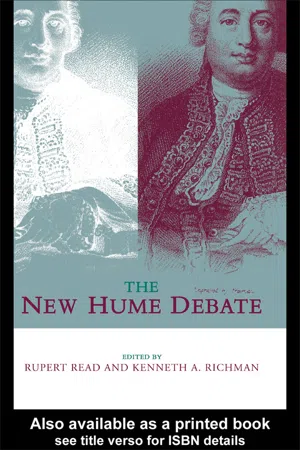
The New Hume Debate
About this book
For decades scholars thought they knew Hume's position on the existence of causes and objects he was a sceptic. However, this received view has been thrown into question by the `new' readings of Hume as a sceptical realist. For philosophers, students of philosophy and others interested in theories of causation and their history, The New Hume Debate is the first book to fully document the most influential contemporary readings of Hume's work. Throughout, the volume brings the debate beyond textual issues in Hume to contemporary philosophical issues concerning causation and knowledge of the external world and issues in the history of philosophy, offering the reader a model for scholarly debate. This revised paperback edition includes three new chapters by Janet Broughton, Peter Kail and Peter Millican. Contributors: Kenneth A. Richman, Barry Stroud, Galen Strawson, Kenneth P. Winkler, John P. Wright, Simon Blackburn, Edward Craig, Martin Bell, Daniel Flage, Anne Jaap Jacobson, Rupert Read, Janet Broughton, Peter Millican, Peter Kail.
Information
1 Introduction
Kenneth A.Richman
Does Hume believe that there are causes in the world that have the power to bring about their effects? Does he believe that these causes are objects in the world? Does he believe that there are any objects in the world at all? What does Hume think about the fact that some people (but not all of us) feel compelled to ask questions about causes and objects? These questions have been discussed for some time, but over the last few years, with the introduction of new readings of Hume as a sceptical realist about causal powers and external objects, the discussion has moved to new levels of sophistication, subtlety and care in the interpretation of Hume’s texts and their historical context. The sceptical realist interpretations claim that Hume believed we can know that causal powers and objects exist in the world, although we may not be able to know any more about them than that they exist. The purpose of this anthology is to document some of the early moves in this new stage of the discussion, to further the discussion even more, and to suggest some ways in which it might fruitfully be continued in the future. In this introduction, I will sketch how I see the issues raised in the debate over sceptical realist readings of Hume fitting into various facets of Hume’s overall account of belief. I will also offer some introductory remarks on the essays that make up the rest of this volume.
Proponents of the ‘New’ interpretations of Hume’s philosophical writings share the view that Hume was a realist of some sort about causal powers and external objects. That is, defenders of the New Hume hold that Hume’s analysis of our everyday beliefs has as one of its conclusions that the beliefs in the existence of external, independent objects and causes objectively so-called meet at least minimal epistemic standards for assent. The New Hume debate is between those who read Hume as a strict epistemic sceptic on these matters and those who support the New Hume interpretation.
The ‘New Humeans’, as I shall call them, include, among others, Janet Broughton, Galen Strawson and John Wright. New Humeans generally attribute to Hume what they call a ‘sceptical realist’ view of causes (and certain other entities, such as external objects). A sceptical realist about some entity is realist about the entity’s existence, but agnostic about the nature or character of that thing because it is epistemically inaccessible to us in some non-trivial way. Janet Broughton offers a clear example of the New Hume position in ‘Hume’s Ideas about Necessary Connection’. She argues that Hume held the following theses:
…we can form the bare thought just of there being some feature of objects that underlies the constant conjunctions of their observable qualities.
and
We cannot know anything more about the causal powers of objects than what we know in having the bare thought described [above] and observing constant conjunctions.
(Broughton 1987:235)
Broughton’s interpretation is much like Galen Strawson’s in The Secret Connexion, where he writes that Hume ‘takes it for granted…that Causation does exist in reality, although we are entirely ignorant of its ultimate nature’ (Strawson 1989:219). John Wright argues for a similar position in The Sceptical Realism of David Hume when he writes:
It seems to me undeniable that one misses the central aim of Hume’s sceptical philosophy unless one recognises that he consistently maintained the point of view that there are real powers and forces in nature which are not directly accessible to our senses.
(Wright 1983:129)
The more traditional readings vary in the varieties of scepticism they attribute to Hume. So, for instance, Richard Popkin claims that Hume takes a kind of Pyrrhonian scepticism, one which recognizes that we must acquiesce to the beliefs that our nature compels us to hold, but also recognizes that these beliefs are without epistemological foundation. According to Popkin, Hume considers a self-conscious reliance on the beliefs of nature to be the most practicable way to exhibit true scepticism (Popkin 1980:130). Don Garrett offers an account of Hume’s scepticism which recognizes that Hume’s scepticism about reason must also be applied to itself. ‘That is’, writes Garrett, ‘if human reason judges itself to be imperfect, then reason itself tells us that we must discount to some extent the very skepticism to which it leads us’ (Garrett 1997:236). The ‘old’ Hume readings also vary in how they describe the contents of the beliefs whose status is under consideration in the debate, and in their ways of understanding how the beliefs in causal powers and external objects are related.
As the chapters that follow show, the New Hume interpretations also have a certain degree of diversity. However, Kenneth Winkler has observed that the New Hume interpretations all differ from more traditional interpretations of Hume in their shared view of the role that Hume’s theory of ideas plays in his overall system. By the theory of ideas he means (primarily) Hume’s claims that we can have no idea that is not derived from a previous impression and that our beliefs are limited by the range of our impressions and ideas:
The scope of the theory seems to be universal, and its force unforgiving: it seems to say that any alleged thought or conception lacking an appropriate pedigree is unintelligible or meaningless. But defenders of the New Hume dispute this reading…
(Winkler, p. 59 below)
According to Winkler, defenders of the New Hume interpretation either understand Hume’s theory of ideas to be limited in scope (that is, to apply to less than the entire range of our beliefs, ideas and terms) or to be limited in force (that is, to say of ideas or terms that are not derived from previous impressions something less strong than that they are meaningless and hence useless), or both.
There are other ways to describe the disagreement inherent in the debate. In fact, the debate sits squarely in the midst of a nest of issues central to Hume’s system. In what follows, I want to sketch the relationship between the New Hume debate and the following topics: (1) Hume’s empiricism and his account of relative ideas, (2) the relationship between philosophy and ‘common life’ in Hume’s work, (3) the character of Hume’s naturalism, (4) the notion of proof and the status of Hume’s ‘mitigated’ scepticism, and (5) Hume’s response to occasionalism and other voluntarist accounts of natural laws. The New Hume debate can help us to unravel some of these issues; for others, the debate helps us to understand how significant and complex the issues really are. Understanding how the New Hume debate is tied into all of these will, I hope, help us to see the importance of the debate to Hume scholarship as a whole.
1 Hume’s empiricism and his account of relative ideas
A puzzle in the interpretation of Hume, perhaps the main puzzle, is the fact that Hume appears to do the following: (a) endorse beliefs in objects and causes, (b) hold that we should not endorse beliefs that do not have appropriate grounding in our impressions (as described in the theory of ideas), and (c) hold that the beliefs in objects and causes do not have appropriate grounding in our impressions. Defenders of the old reading of Hume reject or qualify (a), arguing either that Hume does not endorse these beliefs, or that he endorses them in a way that does not commit him to the truth of the beliefs. As we have seen, Popkin defends an interpretation of the latter sort. According to Popkin, Hume endorses an entirely sceptical allegiance to our beliefs.
New Humeans accept (a), and either reject or modify (b) or (c). For example, in his book The Mind of God and the Works of Man, Edward Craig defends the New Hume interpretation by rejecting (b), arguing instead that Hume entertains the theory of ideas only in order to reject it. He takes it as a ‘general truth that he [Hume] has in fact little real interest in the theory of ideas and impressions’ (Craig 1987:120). Wright and Strawson, on the other hand, argue that although the beliefs in causes and objects do not meet the standards of the theory of ideas under its most strict interpretation, there is a broader understanding of the theory of ideas according to which these beliefs are acceptable to Hume. They can, therefore, be understood as accepting (a) and (b) and rejecting (c).
Hume’s early statement of the theory of ideas states: That all our simple ideas in their first appearance are deriv’d from simple impressions, which are correspondent to them, and which they exactly represent’ (T4). Disagreements concerning the import of this passage arise in light of Hume’s later statements in which he suggests that there may be a distinction between what we can suppose and what we can conceive. For instance, at the end of Treatise Book I, Part II, Hume writes: ‘…we may well suppose in general, but ‘tis impossible for us distinctly to conceive, objects to be in their nature any thing but exactly the same with perceptions’ (T218; see also T68). Under the strict reading of the theory of ideas, an idea only has meaning if it is derived from an impression previously conceived by the mind. So, according to this strict reading, the supposition of an object different in nature from our ideas cannot be the basis for a belief in such objects because this supposition is either empty, non-existent, or is in fact a confused conception with some content other than what we initially take it to have.
The New Humeans generally take Hume’s distinction between conceiving and supposing as a distinction between two ways in which ideas can satisfy the requirements of Hume’s theory of ideas. Those ideas that we can conceive will have more robust meaning than those that are merely suppositions. However, according to this reading, ideas that we suppose but do not conceive can also be meaningful to us. The suppositions of interest to the New Hume debate often come in the form of relative ideas, ideas of things that stand in certain relations to the objects of our experience but that we cannot experience directly. (Daniel Flage offers an in-depth discussion of relative ideas in Chapter 9 of this volume.)
Hume sometimes suggests that a true causal power must be intelligible. Most take this to mean that if we know a causal power, we know its essence fully. Because causal powers are often referred to by Hume as necessary connections, knowing a causal power, on this model, means knowing what it is with which the cause is necessarily connected. Hume claims (for instance in Section IV of the Enquiry Concerning Human Understanding) that we cannot obtain evidence simply by examining a cause by itself for any claims about what its effect would be. Some defenders of the New Hume interpretation argue that the complete understanding suggested by Hume’s use of terms like ‘intelligible’ is treated by Hume as an ideal for knowledge of a thing, but not as necessary for knowledge of a thing’s existence. This New Hume treatment of intelligibility is thus parallel to the New Hume treatment of conceivability as an ideal for acquaintance with an idea.
2 The relationship between philosophy and ‘common life’ in Hume’s work
The beliefs under investigation here are beliefs central to our ‘common life’ ways of thinking. By common life (a term used not only by Hume, but also occasionally by others, including Locke and Berkeley), Hume means our everyday experiences not subverted or made self-conscious by philosophy. Thus common life is (at least) closely allied with the life of the ‘vulgar’. The beliefs of common life are the beliefs that common (vulgar) people share, and that philosophers share with the vulgar when they are not concerned with philosophy. These beliefs include the belief that the objects we experience continue to exist when not perceived. As the philosophical examination of these beliefs can have the effect of undermining them, we can understand the New Hume debate as involving a disagreement about the relationship between philosophy and common life in Hume’s account of belief.
Defenders of the New Hume argue that sceptical realism was Hume’s philosophical position. Strawson puts this point quite simply on page 1 of The Secret Connexion:
I hope to show that Hume takes the existence of something like natural necessity or causal power for granted not only in common life but also as a philosopher. If we are to accept the beliefs in objects and causes, this must mean either that common life in some way trumps philosophy, or that philosophy and common life somehow work together, with philosophy not completely subverting but rather correcting or merely weakening the common life beliefs.
(Strawson 1989:1)1
We might articulate this view of the New Hume debate as a disagreement on how best to interpret Hume’s famous imperative from Section I of the Enquiry Concerning Human Understanding: ‘Be a philosopher; but, amidst all your philosophy, be still a man’ (E9). Hume sometimes tells us that what he believes as a philosopher is different from his position as an agent in ‘common life’. For instance, he writes about his own inference from cause to effect that, ‘As an agent, I am quite satisfied in the point; but as a philosopher…I want to learn the foundation of this inference’ (E38). Where Hume the man may be willing to believe, Hume the philosopher remains sceptical. The New Hume debate can be thus described as a disagreement concerning the outcome of the internal struggle between Hume’s two tendencies. The New Humeans claim that Hume the man is able to stake out some ground in the philosopher’s territory, indeed, that the conflict is not as complete and devastating as the old Humeans think.
3 The character of Hume’s naturalism
We might also characterize the New Hume debate in terms of the relationship between Hume’s critical project of analysing our beliefs and his project of describing how it is that we come to have the beliefs we do. The first critical project is what we might call his ‘empiricist’ or ‘philosophical’ project. In this project, Hume seeks to test our beliefs for philosophical rigour and justification of a philosophical (or epistemic) sort by searching among our previous impressions for the origin of the ideas involved in each belief. This project is intertwined in the texts with what we might call Hume’s ‘naturalist’ project, in which he explores how it is that we come to form various beliefs even apart from the issue of whether they meet his strictest standards of philosophical rigour. One might defend the New Hume position by invoking the conclusions of Hume’s naturalism. After all, Hume seems to be recommending the beliefs in question when he makes statements such as ‘If I must be a fool…my follies shall at least be natural and agreeable’ (T270), and when he calls scepticism a ‘malady’ (T218).2
If we come to the conclusion that Hume’s attitude towards these beliefs is determined by his naturalism, we must yet determine what attitudes are supported by this aspect of Hume’s work. If the conclusions of Hume’s naturalist project are found to have normative import, according to which the beliefs to which we are naturally inclined are better in some way than other beliefs, then Hume can be said to endorse the beliefs in objects and causes. However, even if Hume can be said to endorse these beliefs, we might still ask whether the sort of endorsement offered is epistemic (that is, whether Hume sees himself as suggesting that these beliefs might be true, or might either be knowledge or lead us to knowledge), the type of endorsement that would support the New Humeans’ claims. However, if the type of normative endorsement involved in Hume’s naturalism is not epistemic but based rather on healthy functioning, survival value or social convention, then Hume’s naturalist conclusions cannot be used to support any claims about what Hume believed was actually true. Thus the type of normativity at work in Hume’s naturalist project, and the role that this normativity plays, bear greatly on the New Hume debate.
Hume describes the Treatise as ‘An ATTEMPT to introduce the experimental Method of Reasoning into MORAL SUBJECTS’ (T title page). This description is often cited to support the common understanding of Hume as attempting ‘to be the Newton of the moral sciences’ (Passmore 1952:43). On this understanding, Hume’s naturalist project is meant to describe and explain the workings of our minds in the same way that Newton described and explained the workings of the physical world. In ‘Hume’s Defense of Causal Inference’, John Lenz writes: ‘Such explanation was possible, Hume thought, because the actions of the mind are as fully determined as the motions of material bodies…’ (Lenz 1968:170). If the subject of Hume’s naturalist investigation is fully determined in this way, then certain types of normativity (those that allow blame for straying from the norm) are not available for defending the New Hume position or any other.
Like Lenz, Gary Hatfield also interprets Hume’s nat...
Table of contents
- Cover Page
- Title Page
- Copyright Page
- Notes on contributors
- Preface
- Acknowledgements and permissions
- Reference notes
- 1 Introduction
- 2 ‘Gilding or staining’ the world with ‘sentiments’ and ‘phantasms’
- 3 David Hume: Objects and power
- 4 The New Hume*
- 5 Hume’s causal realism: recovering a traditional interpretation
- 6 Hume and thick connexions*
- 7 Hume on causality: projectivist and realist?
- 8 Sceptical doubts concerning Hume’s causal realism
- 9 Relative ideas re-viewed
- 10 From cognitive science to a post-Cartesian text: what did Hume really say?
- 11 In closing: The new antagonists of ‘the New Hume’: on the relevance of Goodman and Wittgenstein to the New Hume debate
- Bibliography
Trusted by 375,005 students
Access to over 1.5 million titles for a fair monthly price.
Study more efficiently using our study tools.
Frequently asked questions
Yes, you can cancel anytime from the Subscription tab in your account settings on the Perlego website. Your subscription will stay active until the end of your current billing period. Learn how to cancel your subscription
No, books cannot be downloaded as external files, such as PDFs, for use outside of Perlego. However, you can download books within the Perlego app for offline reading on mobile or tablet. Learn how to download books offline
Perlego offers two plans: Essential and Complete
- Essential is ideal for learners and professionals who enjoy exploring a wide range of subjects. Access the Essential Library with 800,000+ trusted titles and best-sellers across business, personal growth, and the humanities. Includes unlimited reading time and Standard Read Aloud voice.
- Complete: Perfect for advanced learners and researchers needing full, unrestricted access. Unlock 1.5M+ books across hundreds of subjects, including academic and specialized titles. The Complete Plan also includes advanced features like Premium Read Aloud and Research Assistant.
We are an online textbook subscription service, where you can get access to an entire online library for less than the price of a single book per month. With over 1.5 million books across 990+ topics, we’ve got you covered! Learn about our mission
Look out for the read-aloud symbol on your next book to see if you can listen to it. The read-aloud tool reads text aloud for you, highlighting the text as it is being read. You can pause it, speed it up and slow it down. Learn more about Read Aloud
Yes! You can use the Perlego app on both iOS and Android devices to read anytime, anywhere — even offline. Perfect for commutes or when you’re on the go.
Please note we cannot support devices running on iOS 13 and Android 7 or earlier. Learn more about using the app
Please note we cannot support devices running on iOS 13 and Android 7 or earlier. Learn more about using the app
Yes, you can access The New Hume Debate by Rupert Read, Kenneth Richman, Rupert Read,Kenneth Richman in PDF and/or ePUB format, as well as other popular books in Philosophy & Philosophy History & Theory. We have over 1.5 million books available in our catalogue for you to explore.