- 292 pages
- English
- ePUB (mobile friendly)
- Available on iOS & Android
eBook - ePub
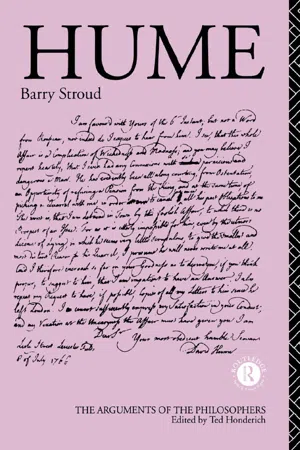
Hume-Arg Philosophers
About this book
The purpose of this series is to provide a contemporary assessment and history of the entire course of philosophical thought. Each book constitutes a detailed, critical introduction to the work of a philosopher of major influence and significance. This volume seeks to provide a comprehensive interpretation of Hume's philosophy and to expound and discuss his central problems against the background of that general interpretation.
Information
Topic
PhilosophySubtopic
Philosophy History & TheoryNotes
For full bibliographical details please see the bibliography.
I The Study of Human Nature
1 Hume (1). All page numbers appearing alone in parentheses in the text refer to this book.
2 Hume (3). All page numbers preceded by an ‘E’ in parentheses in the text refer to this book.
3 See, for example, the first sentence of the first Enquiry, which begins: ‘Moral philosophy, or the science of human nature…’ (E, p. 5). It is clear that the ‘or’ serves to introduce what the OED calls a ‘mere synonym’.
4 Jeremy Bentham apparently was unimpressed by Hume’s implicit claim to greatness, and he made use of the same parallel to support the same claim on his own behalf. He wrote: ‘What Bacon was to the physical world, Helvetius was to the moral. The moral world has therefore had its Bacon; but its Newton is yet to come.’ Quoted in Halévy (1), p. 19.
5 See his ‘Dedication’ at the beginning of Reid (1) and the autobiographical remarks in Reid (2), p. 172.
6 See the letter Hume wrote to a physician in March or April 1734, when he was almost twenty-three, describing his life since he left the university (Hume (7), vol. 1, pp. 12–18).
7 The importance of Hutcheson for the origin and development of Hume’s view has been stressed in the masterly work of Norman Kemp Smith. See Kemp Smith (2), esp. chapters 1–3, 7, 14.
8 For example, compare Hume (p. 458) with Hutcheson (1), p. 120, or Hume (E, p. 293) with Hutcheson (1), p. 123.
9 Kemp Smith was the first to suggest that Hume’s work on morals was composed first, and that the point of view taken there was then generalized to other parts of human psychology. So Books I and II of the Treatise, which were published before Book III, were actually written later. See Kemp Smith (2), esp. pp. 12–20. I suggest some further evidence for this conjecture in Chapter VIII, pp. 186–7.
10 See, for example, Descartes (1), vol. 1, p. 116. In referring to Descartes’ views here and in what follows I do not mean to suggest that Hume in his philosophizing had Descartes explicitly in mind. It is only the general type of view which is forcefully expressed in Descartes that is in question.
11 Hume’s position on, for example, our beliefs about the future is often represented as the view that those beliefs are not reasonable, or are unjustified, because they arise simply from ‘custom’ or ‘habit’. This unsupportable interpretation fails to distinguish the negative and the positive phases of Hume’s investigation. Although Hume nowhere explicitly argues that an inference from ‘this belief is caused in such-andsuch a way’ to ‘this belief is not reasonable’ is not a good one, from the fact that he never makes such an inference perhaps we can conclude that he would endorse that assessment of it. For some recent demonstrations of the invalidity of similar inferences see, for example, Davidson (1) and Pears (7).
II The Theory of Ideas
1 See, for example, pp. 3, 5, 6, where Hume either asserts, or says something that implies, that ideas of colours, or of particular shades of a colour, are simple ideas.
2 Hume actually asserts a one-one correlation between simple ideas and simple impressions, but all he actually relies on in his subsequent argument about the origin of simple ideas is the presence of an impression for each idea. If the correlation also held in the other direction it would follow that every simple impression is followed by a simple idea, and hence that the mind never perceives a simple quality that it does not retain at least for a little while ‘in thought’. I can see no good reason for Hume to insist on this controversial point. He wants to explain the origin of all the ideas that actually arise in human minds. The fact that some impressions do not give rise to any ideas would not undermine that explanation.
3 See Berkeley (1), esp. the First Dialogue.
4 A full discussion of this view and the philosophical interests and inclinations that seem to lead inevitably to it would take up much more than a big book on its own. Although it is certainly a fundamental belief for Hume, and one that has far-reaching consequences for the whole of his philosophy, most of my discussion will provisionally concede its intelligibility and truth, or else will try to determine the extent to which his treatment of particular issues can survive without it. Any other course would lead to a book on perception and the peculiarities of philosophizing about it, and not one especially about Hume.
5 This of course makes the outrageously unacceptable assumption, which Hume relies on throughout, that our impressions can somehow ‘remain’ in the mind after they have been ‘had’, so that we can then notice their similarities with their ‘corresponding’ ideas. He seems to be engaging here and elsewhere in the fiction that all (or a sizeable number) of our past perceptions can be ‘present’ to us, or at least that they remain available for inspection. But on the theory of ideas, strictly speaking, we can make no sense of this alleged possibility.
6 A natural reply on Hume’s behalf is to say that the detective has a more forceful and lively perception on the second occasion only because he notices something different, or because he believes, for example, that the victim was right-handed, that right-handed people usually put pokers back on the right-hand side of fireplaces, and so on. But even if that is so, it remains true that the second occasion was in fact one of thinking and not perceiving, and that the perception then present to the mind was more forceful and lively than the earlier one. A perception that is more forceful and lively than its counterpart only because of the presence of some additional causal factor is, after all, more forceful and lively than that counterpart.
7 The point of the example is only to support the first of these two alternatives. It is not put forward to ‘refute’ Hume’s way of making the distinction, but only to show that talk of ‘force and liveliness’ cannot be taken very literally. Hume concedes as much, at least when he tries to use the same terms to explain the nature of belief. See, for example, p. 629.
8 I return briefly to Hume’s difficulties in explaining different ‘attitudes’ involving the same perception in Chapter IV, pp. 74–6.
9 Hume cannot accept the plausible suggestion that the man fills in the missing shade by noticing certain features common to all previously perceived members of the spectrum and also noticing a certain respect or degree in which they all differ. That implies that the perceptions of the particular shades are complex, since they would have distinguishable features, whereas it is the very fact that the particular perceptions are supposed to be simple that gives rise to the problem. Someone’s getting a complex idea without having had a corresponding impression poses no threat to Hume’s principle about the origin of ideas.
10 This is a further instance of the difficulties Hume gets into in trying to distinguish different mental ‘acts’ or ‘attitudes’ solely on the basis of differences among their ‘objects’. See above, pp. 74–6 and pp. 225–39.
11 Hume thinks the ‘great’ Berkeley has made ‘one of the greatest and most valuable discoveries that has been made of late years in the republic of letters’, and he tries only to ‘confirm it by some arguments, which I hope will put it beyond all doubt and controversy’ (see page).
III Causality and the Inference from the Observed to the Unobserved: The Negative Phase
1 Even in the so-called ‘definitions’ of ‘cause’ at the end of Section VII, ‘Of the Idea of Necessary Connexion’ (E, pp. 76–7) no mention is made of contiguity.
2 This argument (p. 76) is extremely puzzling, and Hume does not seem entirely happy with it himself. It uses a certain ‘establish’d maxim’ to derive from the assumption that there is one cause that is simultaneous with its effect the consequence that all causes are simultaneous with their effects. That in turn is held to imply ‘no less than the destruction of that succession of causes, which we observe in the world; and indeed, the utter annihilation of time’. So no cause can be simultaneous with its effect, but must exist or occur prior to it. The difficulty is that the ‘maxim’ used to derive this strong conclusion is: ‘an object, which exists for any time in its full perfection without producing another, is not its sole cause; but is assisted by some other principle, which pushes it from its state of inactivity, and makes it exert that energy, of which it was secretly possest’. And that implies directly that no cause can exist ‘in its full perfection’ at any time before its effect exists, which contradicts the desired conclusion.
3 The difficulties raised in the previous two pages will be familiar to all students of recent philosophy from the writings of Quine. See especially the classic Quine (1). The fact that Quine’s objections to positivism carry over so easily to Hume’s theory of ideas perhaps shows how little progress had been made on the nature of ‘demonstrative’ knowledge since Hume. It would be just as misplaced to say that the present objection to Hume’s argument rests only on arbitrarily or unreasonably strict requirements for an adequate explanation of ‘same idea’ as it was to say of Quine in ‘Two Dogmas’ that he simply imposed arbitrarily or unreasonably strict standards of adequacy on any explanation of synonymy.
4 Hume speaks only of ‘objects’ as causes and effects, or sometimes of an object’s ‘beginning to exist’ as an effect. In what follows I will usually speak of events as the terms of the causal relation. In doing so I depart from the letter of Hume’s doctrine, but it remains to be seen whether any important view of his is denied or damaged by the change.
5 Hume says his detour in the search for the source of the idea of necessary connection will consist in trying to answer the two questions: (i) why we believe that everything that begins to exist must have a cause, and (ii) how and why we come to believe, of some particular cause, that it will have such-and-such particular effects (see page). But having shown that the appeal to ‘reasoning from ideas alone’ will not answer (i), and therefore that experience must be appealed to, he does not go on to try directly to answer the question of how experience brings about that general belief. Rather, he finds ‘it will be more convenient to sink this question in the following, Why we conclude, that such particular causes must necessarily have such particular effects, and why we form an inference from one to another? …’ Twill, perhaps, be found in the end, that the same answer will serve for both questions’ (see page). The long explanation of our belief in particular causes and effects can then be used to account for the general belief as well.
6 He concentrates on cases in which the correlation is perfect—every A has been followed by a B. But of course most of our experiential reasoning is not like that; it proceeds on less than perfect correlations. Hume agrees, and in the sections ‘Of the probability of chances’ and ‘Of the probability of causes’ he discusses the origins of our beliefs when they are based on ‘the chances’ or when our experience is ‘mixed’. But if he shows that our inferences to the unobserved are not reasonable or justified when based on exceptionless correlations, then he will have shown that they are not reasonable or justified in the ‘mixed’ cases either. For the sake of brevity I, like Hume, will concentrate on cases in which the correlation is perfect.
7 I use ‘PE’ to stand for a statement of this form about past experience, ‘PI’ for a description of a present impression, and ‘FE’ for a statement about a future experience or, since the predicted event need not be experienced, for a future event. I thereby put the problem in terms of the past and the future, for the usual dramatic effect, although that does not express Hume’s concern in its full generality. What is in question is any inference at all from the observed to the unobserved, so even beliefs about unobserved events in the past or the present will arise in this way.
8 It would be absurd to suggest that in inferring from the past to the future one is committed to something as clearly false, or even incoherent, as ‘the future is exactly like the past in every respect’, ‘every sort of thing that has happened once will happen again’, or ‘every generalization that has been observed to hold so far will continue to hold in the future’. For the purposes of considering its role in Hume’s argument, we need have only a relatively weak and restricted version of the principle in mind. It must say something about the relation between the observed and the unobserved, but it need not be any stronger than, e.g. ‘with respect to being followed by Bs, unobserved As will continue to resemble observed As (at least for a short time into the future)’.
9 In suggesting that an inference’s being ‘founded’ on a certain supposition must be understood ‘epistemically’ and not in purely logical terms, I appear to differ with, among others, D.C.Stove, who has given the most recent and most elaborately defended interpretation of Hume’s sceptical argument. For Stove:
Sometimes when we sa...
Table of contents
- Cover Page
- Title Page
- Copyright Page
- Preface
- I The Study of Human Nature
- II The Theory of Ideas
- III Causality and the Inference from the Observed to the Unobserved: The Negative Phase
- IV Belief and the Idea of Necessary Connection: The Positive Phase
- V The Continued and Distinct Existence of Bodies
- VI The Idea of Personal Identity
- VII Action, Reason and Passion
- VIII Reason, Passion and Morality
- IX Morality and Society
- X Problems and Prospects of Humean Naturalism
- Notes
- Bibliography
Trusted by 375,005 students
Access to over 1.5 million titles for a fair monthly price.
Study more efficiently using our study tools.
Frequently asked questions
Yes, you can cancel anytime from the Subscription tab in your account settings on the Perlego website. Your subscription will stay active until the end of your current billing period. Learn how to cancel your subscription
No, books cannot be downloaded as external files, such as PDFs, for use outside of Perlego. However, you can download books within the Perlego app for offline reading on mobile or tablet. Learn how to download books offline
Perlego offers two plans: Essential and Complete
- Essential is ideal for learners and professionals who enjoy exploring a wide range of subjects. Access the Essential Library with 800,000+ trusted titles and best-sellers across business, personal growth, and the humanities. Includes unlimited reading time and Standard Read Aloud voice.
- Complete: Perfect for advanced learners and researchers needing full, unrestricted access. Unlock 1.5M+ books across hundreds of subjects, including academic and specialized titles. The Complete Plan also includes advanced features like Premium Read Aloud and Research Assistant.
We are an online textbook subscription service, where you can get access to an entire online library for less than the price of a single book per month. With over 1.5 million books across 990+ topics, we’ve got you covered! Learn about our mission
Look out for the read-aloud symbol on your next book to see if you can listen to it. The read-aloud tool reads text aloud for you, highlighting the text as it is being read. You can pause it, speed it up and slow it down. Learn more about Read Aloud
Yes! You can use the Perlego app on both iOS and Android devices to read anytime, anywhere — even offline. Perfect for commutes or when you’re on the go.
Please note we cannot support devices running on iOS 13 and Android 7 or earlier. Learn more about using the app
Please note we cannot support devices running on iOS 13 and Android 7 or earlier. Learn more about using the app
Yes, you can access Hume-Arg Philosophers by Barry Stroud in PDF and/or ePUB format, as well as other popular books in Philosophy & Philosophy History & Theory. We have over 1.5 million books available in our catalogue for you to explore.