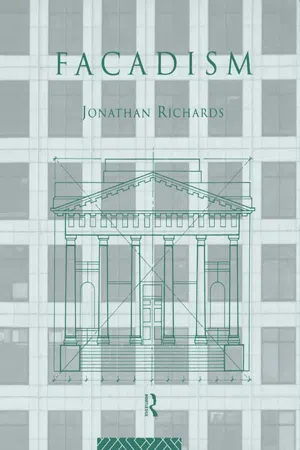
Facadism - the preservation of historic facades, the creation of facsimiles in front of new buildings and the decorative exercises of postmodernism - is accused of destroying architectural innovation, of divorcing the interior and exterior of buildings and of reducing townscapes to theatre sets. Its defenders describe facadism as the way urban tradition and progress walk hand in hand.
Facadism presents a critical analysis of a concept central to the way in which the city is being remodelled. Assessing architectural and townscape philosophies and their aesthetics, the principles of urban conservation, the process of heritage planning and the market forces of urban development, the book builds a complete picture of the causes and effects of facadism in the Twentieth Century.
- 208 pages
- English
- ePUB (mobile friendly)
- Available on iOS & Android
eBook - ePub
Facadism
About this book
1
INTRODUCTION
My interest in the concept of facadism has its roots in the historic city of Bristol, where I worked as an urban planner during the 1970s and 1980s. The early part of this period brought drastic changes to the inner city, which saddened me. It was a time of mass destruction of areas of characteristic inner city townscape as a result of rampant commercialism, which in turn spawned a grotesque array of poor-quality modernist buildings, alien townscapes and spaces devoid of meaning, beauty or interest. Thankfully, the orgy of destruction came to a shuddering halt as the result of a mid-1970s property crash, which gave the historic built environment a reprieve and allowed time for people to take stock of what had happened to the centre of Bristol. Many felt a sense of outrage, and popular opinion provided a fertile land for the growth of new ideas about urban change. Suddenly, the urban conservation movement, which had been flexing its muscles during the 1960s, found a platform on which to base an effective and meaningful influence over the process of urban change.
During the late 1970s and throughout the 1980s, I became increasingly intrigued by the numerous cases around the inner city where old buildings had been completely felled—apart from the facades, which were held in place by elaborate scaffolding structures. These fragile-looking skins of brick or stone rose precariousy out of the ruins as monuments to the traditions of the past, survivors of comprehensively planned mass destruction. The bizarre and desolate scenes conjured up images of post-nuclear holocaust landscapes or displays from the world of avant-garde Punk art. In time, some of the facades became incorporated into new developments, with varying degrees of success. New infill terraced buildings behind a retained frontage were easily disguised, but a number of odd hybrids of old and new fabric appeared in more prominent situations. Other facades remained supported in place awaiting development, often for long periods, as the townscapes around them changed, creating equally strange scenes. Also at this time, the practice of building facsimile historic facades in front of new buildings was gathering pace in parts of the city.
Throughout Britain during the 1970s and 1980s, the trends in Bristol were being reflected in other historic cities. The approaches to redevelopment involving the preservation of historic facades or the creation of facsimiles in front of new buildings were greeted with controversy and labelled ‘facadism’, which has since been the subject of an emotive debate. Much disparaging comment about facadism has been generated from a wide range of interests involved in urban processes, including architects, town planners, historians and conservationists. For example, it has been claimed that facadism prevents new architectural styles from evolving and reduces buildings to ‘mere elevations or self parodies’.1 It has been condemned for causing the divorce between the interior and exterior of buildings and creating townscapes which are little more than stage sets. It is condemned by architectural purists as being immoral or distasteful. In the USA the practice of preserving facades as part of redevelopment schemes has been described in derogatory terms as façodomy by both the Modernist design community and conservation purists. However, justification has also been offered for facadism on the grounds that it is a valid method of urban conservation which enables the retention of familiar historic streetscapes or formal set pieces of urban design. At the same time, it also allows the provision of up-to-date accommodation with all its comforts and conveniences. Somewhat later than in Britain, the controversy about facadism has also surfaced in America, with similar arguments to those in the UK being rehearsed.
In 1986, when studying for my Bachelor of Town Planning degree, I was provided with an ideal opportunity to begin exploring the subject of facadism in depth. The material for this book builds on my initial research of that period, and work already carried out by others, although it must be said that I have unearthed relatively little written material.
Facadism is a concept which raises many significant implications for the built environment and its inhabitants. These implications provide the raison dêetre for this book. It is important that concepts such as facadism are fully debated, explored, analysed and understood because they significantly embrace our lives and impact upon the quality of our day-to-day experiences. The association between the quality of human life and the built environment is evidenced throughout the history of civilisation by people's Utopian idealist strivings to provide ordered, dignified, beautiful and convenient settings for life's activities. The attractiveness and success of urban environments is influenced by many factors, such as the character, appearance and aesthetic qualities of particular townscapes, the accessibility of places to the community at large and standards of interior accommodation. Although Utopian urban areas may not be achievable, to be able to create the highest possible quality of environment the full implications of different approaches to urban development must be appreciated. I hope that this book contributes to such an appreciation.
It has been my intention here to broaden the perspective of the facadism debate both in terms of what is considered to constitute facadism and also in relation to the impact of facadism as an approach to urban remodelling. The debate has so far tended to focus rather too narrowly on the practices of preserving historic facades, or creating facsimiles, in front of contemporary buildings. There are other forms of development as well as facade preservation and replication which can, in essence, be regarded as manifestations of facadism, because they display similar characteristics or raise similarissues.
Consequently, in this book I have considered, for instance, the time-honoured tradition of refacing buildings and the decorative exercises of postmodernism as part of the concept of facadism.
When we refer to facadism, what do we mean? Are we concerned with a conservation principle within which the preservation of street elevations is paramount or with an architectural philosophy wherein buildings are designed primarily with regard to their facades? Are we referring to a townscape concept which seeks to provide urban identity? Are we dealing with a marketing technique of heritage planning which aims to satisfy contemporary demands within the built environment?2 Indeed, is facadism concerned with all of these matters to a degree? Certainly, facadism is an elusive concept which proves difficult to define, and one of my aims in this book is to explore ideas which bring the meaning of the term into sharper focus.
It is generally assumed that facadism is normally manifest in relation to historic buildings or townscapes. However, postmodern facadism, which the architect John Outram refers to as ‘iconic’ and ‘pictorial’ and as ‘architecture recollected, not architecture itself’,3 is likely to appear on any street.
Architectural purists from any era would condemn facadism as a distasteful or dishonest approach to creating buildings. Others would argue that facadism is a time-honoured tradition practised by many of the world's great architects. I have examined facadism in the light of a range of architectural perspectives extending between these two extremes, under a threefold structure covering pre-modern, Modern and post-modern perspectives.
Facadism is also considered in relation to townscape philosophy and the threedimensional visual impact of facadism on built urban form, and its inherent visual character and qualities are discussed.
Every development decision creates a balance sheet of social and financial costs and benefits involving many different interests. The effects of some forms of facadism can be seen as highly significant in terms of these costs and benefits. If we are to understand fully the consequences of concepts such as facadism as part of the complex process of urban change it is important to address such costs and benefits and their impact on various interests. Consequently, the book provides an overview of a number of relevant social and economic issues.
Facadism is also assessed in relation to the process of urban conservation. Here, the validity of facadism as an approach to remodelling historic urban environments and how true a concept it is to the spirit or essence of conservation are considered. Urban conservation is itself a somewhat elusive subject, but several basic themes are identified which help to define its essence. Having arrived at a conception of what urban conservation is, or should be, facadism is examined in the light of the main themes.
Finally, facadism is considered from a managerial perspective and explanations are provided of how and why facadism becomes a chosen development approach. The aim here is to contribute to a greater understanding of the nature of facadism as a course of action and its part in the achievement of urban remodelling objectives. The discussionin this chapter embraces the roles, attitudes and opinions of central government, local planning authorities, developers, architects, clients and amenity pressure groups within the complex negotiating processes that surround development decisions. There is also some analysis of the impact of particular outcomes on urban planning policy intentions.
It is, in my view, essential to an understanding of the concept of facadism to explore the subject more widely than simply assessing the end product of a highly complex decision-making process. Substantive issues such as facadism are not purely technical matters isolated from the complexities of the contemporary land development process and the political environment within which it operates. Courses of action within this process are subject to, and affected by, power struggles, negotiations and other interactions between a range of interests and the interplay of physical, social and economic factors. Therefore, in arriving at explanations of particular outcomes, I have examined the process that leads to the end product and have taken account of the values and aspirations of the various interests involved and the impact of relevant physical, social and economic factors.
Three different case studies provide the empirical analysis of particular outcomes. The explanations provided by these case studies clearly do not result in any universal truths about facadism. My aim is simply to highlight issues which may also be applied in other cases and thereby contribute to a greater understanding of the nature of facadism and its impact on the process of urban remodelling, particularly in the context of historic built environments.
The research methodology has involved a bottom-up approach to analysing the outcomes in the case studies displaying different characteristics wherein an action perspective, rather than a policy-centred or top-down appraisal, has been central to the analysis. Facadism may or may not emerge as a result of explicit or implicit policy strategies. Therefore, in my view, it is more appropriate to an understanding of the true nature of the concept of facadism to take particular outcomes, rather than policies, as the starting point of the analysis, and to examine the relevant influences that lead to those outcomes. The explanations arrived at provide an opportunity for reflection on the extent to which a course of action has related to policy objectives.
The analysis of the cases examined involved, where possible, open-ended discussions4 with key actors in the decision-making processes and access to relevant documentation. Inevitably, personnel changes within organisations and an inability to trace individuals has meant that all matters could not be verified through discussion. Nevertheless, sufficient information has been compiled to enable adaquate explanations of the outcomes in each case to be reached.
A considerable amount of material in this book relates to Bristol, and I make no apologies for this. My detailed knowledge of the city and the relevant factors has enabled me to write with authority on many of the issues discussed. Bristol also possesses a number of good examples with which I ha...
Table of contents
- Front Cover
- Half Title
- Title Page
- Copyright
- Dedication
- CONTENTS
- List of illustrations
- Acknowledgements
- 1 INTRODUCTION
- 2 WHAT IS FACADISM?
- 3 ARCHITECTURAL PERSPECTIVES
- 4 TOWNSCAPE PERSPECTIVES
- 5 SOCIAL AND ECONOMIC PERSPECTIVES
- 6 FACADISM AND URBAN CONSERVATION
- 7 WHY FACADISM?
- Notes and references
- Select bibliography
- Index
Trusted by 375,005 students
Access to over 1.5 million titles for a fair monthly price.
Study more efficiently using our study tools.
Frequently asked questions
Yes, you can cancel anytime from the Subscription tab in your account settings on the Perlego website. Your subscription will stay active until the end of your current billing period. Learn how to cancel your subscription
No, books cannot be downloaded as external files, such as PDFs, for use outside of Perlego. However, you can download books within the Perlego app for offline reading on mobile or tablet. Learn how to download books offline
Perlego offers two plans: Essential and Complete
- Essential is ideal for learners and professionals who enjoy exploring a wide range of subjects. Access the Essential Library with 800,000+ trusted titles and best-sellers across business, personal growth, and the humanities. Includes unlimited reading time and Standard Read Aloud voice.
- Complete: Perfect for advanced learners and researchers needing full, unrestricted access. Unlock 1.5M+ books across hundreds of subjects, including academic and specialized titles. The Complete Plan also includes advanced features like Premium Read Aloud and Research Assistant.
We are an online textbook subscription service, where you can get access to an entire online library for less than the price of a single book per month. With over 1.5 million books across 990+ topics, we’ve got you covered! Learn about our mission
Look out for the read-aloud symbol on your next book to see if you can listen to it. The read-aloud tool reads text aloud for you, highlighting the text as it is being read. You can pause it, speed it up and slow it down. Learn more about Read Aloud
Yes! You can use the Perlego app on both iOS and Android devices to read anytime, anywhere — even offline. Perfect for commutes or when you’re on the go.
Please note we cannot support devices running on iOS 13 and Android 7 or earlier. Learn more about using the app
Please note we cannot support devices running on iOS 13 and Android 7 or earlier. Learn more about using the app
Yes, you can access Facadism by Jonathan Richards in PDF and/or ePUB format, as well as other popular books in Physical Sciences & Geography. We have over 1.5 million books available in our catalogue for you to explore.