- 224 pages
- English
- ePUB (mobile friendly)
- Available on iOS & Android
eBook - ePub
About this book
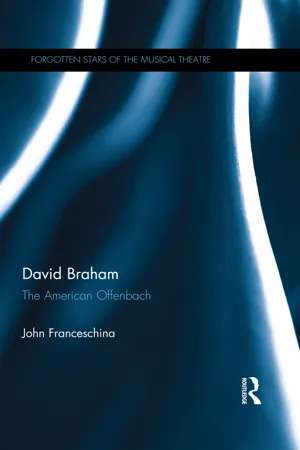
David Braham (1834-1905) was the musical director for the famous vaudeville team of Harrigan and Hart, writing music for many of their comic songs, including The Mulligan Guards, Paddie Duffy's Cart, and many more. His long career as a theatrical composer in New York helped establish a new style of Broadway musical. He came from a family well-entrenched in the music and theater worlds, and his story touches upon nearly all aspects of the history of American musical theater of this era.
Trusted by 375,005 students
Access to over 1.5 million titles for a fair monthly price.
Study more efficiently using our study tools.
Information
Subtopic
Biographies de musiqueChapter 1
Overture: “My Brother’s Violin”
The summer following the opening of Reilly and the Four Hundred, the greatest success to emerge from the collaboration between composer David Braham and his son-in-law Edward Harrigan, the authors were scheduled to be interviewed by the New York Herald at Braham’s town house at 75 West 131st Street in Harlem. Inside the house, to the accompaniment of a banjo and a piano, three of Braham’s eight children were singing “Maggie Murphy’s Home,” the runaway hit from the score, while Braham sat on the front stoop, waiting for his son-in-law and the interviewer to arrive, nodding his head in time to the music and merrily smoking a cigar. The black and red tennis cap he always wore made him look more like a character out of a 1920s musical comedy than a major figure in the American musical theater. The Spirit of the Times (August 19, 1882) had dubbed him “the American Offenbach,” claiming he could make all of New York City “keep time” to his music.
The comparison of Braham to the famous composer of French musical comedies was more than simple hyperbolic publicity. Both composers began their careers writing music for satirical burlesques; both arranged and orchestrated all of the songs and incidental music in their productions; both employed popular dance styles in their musical comedy scores; both traded on existing musical forms from both the popular and classical traditions; both wrote for specific performers, designing their musical ideas to hide the limitations of the one and exploit the potential of another; and, because of their phenomenal popularity, both became the archetype (consciously or otherwise) for the musical theater they created. Associations with Mozart (with whom Braham shared an unusual fecundity of musical ideas and a facility for orchestration) and with Sir Arthur Sullivan (because Harrigan and Braham were considered America’s answer to Gilbert and Sullivan during the HMS Pinafore craze in 1879) came and went, but David Braham would ever be linked with Offenbach. Though he never publicly mentioned the connection, the subtle and witty inclusion of phrases from one or another of Offenbach’s melodies in his overtures and incidental music suggests that, at the very least, Braham was not adverse to the tag.
Harrigan and the interviewer finally arrived and were ushered into the house, swept away immediately by the waves of music emanating from the old upright piano in the parlor. David’s wife, Annie, rushed in from the kitchen to greet her husband’s guests, and the four adults began a lively conversation, unconsciously shouting over the voices of the children singing—another musical comedy scene.
Braham lead the way to his “office,” where his desk was crowded with sheet music and Harrigan’s play manuscripts, and the walls were covered with music manuscript paper half-littered with notes and scratches. That’s the way he arranged music, he explained. He would compose a line of the violin part, then do the same line for flute, clarinet, cornet, and all the other instruments. Sometimes he would not even write down the notes. He would simply play the part on his violin, and his son, George, would copy it down: quick and efficient. The interviewer appeared surprised and impressed. Harrigan, used to his father-in-law’s working habits, was not, thinking that if Braham could read his son-in-law’s handwriting—something few other people could decipher—Braham could certainly orchestrate music on the wall!
The men found themselves seated in comfortable chairs, worn with wear, but cozy nonetheless. Suddenly the children stopped singing, and the house was still. The office was filled with a quiet expectation like the kind experienced in the theater after the opening number when the audience is waiting for the plot to get under way. And so the story begins.
David Braham was born in February 1834 in the parish of St. George’s, Middlesex, then a prosperous middle-class neighborhood in the East End of London. His father, Joseph John Braham, was born in Rochester, Kent, in 1801 and had gone to London in his teens to apprentice in the watch making profession under Thomas Cook, in whose business the elder Braham would remain for the rest of his professional career. His future and trade secure, Joseph turned to domestic matters and swiftly charmed and married Elizabeth Ann Mary Atkinson, a dressmaker. Typical of the artisans of the period, the couple took residence adjacent to Cook’s shop at 565 Grosvenor Place, at the intersection of Commercial Road.
In the early 1820s, at about the time of the Brahams’ marriage, St. George’s had become a haven for merchants and traders at the height of their prosperity. The area around Wellclose Square, with its manicured gardens and well-appointed houses and carriages, was the most fashionable place to live, and not only because that was where the Danish ambassador held court. Centrally located, across from the parish church, Wellclose Square was the place where the rich could flaunt the merchandise carefully crafted for them by the tradesmen of Commercial Road, the thoroughfare that separated St. George’s from nearby Whitechapel and its predominantly Jewish neighborhoods. Based on what is believed to have been the genesis of the Braham name, Joseph Braham’s choice of locales was anything but accidental. According to Braham family tradition, members of an Orthodox German Jewish family named Abraham migrated to England in the mid-eighteenth century, dropping the initial “A” of the name in the spirit of assimilation. A letter to the New York Herald dated June 13, 1923, and bearing the headline “Dave Braham a Jew” attempted to reinforce the story. Without providing any corroborative evidence, the author, John J. MacIntyre of Port Richmond, argued: “[It] may interest readers of your attractive letter columns to learn that David Braham, composer of the music of the famous Harrigan and Hart songs, was a Jew. His real name was Abraham. By dropping the ‘A’ he made ‘Braham.’” Although it is doubtful that Joseph held on to many of the Orthodox beliefs of his ancestors, he was profoundly ecumenical in his ethical and commercial philosophies and raised his children to be tolerant and appreciative of ethnic differences—traits that would eventually come to fruition in his son David’s work in New York City.
David’s exposure to ecumenism was not limited to his father’s lectures at home but extended well into his grammar-school education. Many of the schools operating in Middlesex during the second quarter of the nineteenth century were experimental, non-denominational schools, aiming to solve the “religious question” by avoiding sectarianism and promoting liberalism. The British Union School established by Joseph Fletcher in 1816 on Farmer Street, Shadwell, was one such school. Designed to serve the areas of Wapping, St. George’s, Middlesex, Limehouse, Shadwell, and Radcliff, the school registered 550 boys and girls of various religious beliefs on its rolls by 1819. By 1845, nearly half the population under sixteen years of age attended schools preaching varying degrees of liberalism.
But it was not the ethics of a grammar-school education that spurred the interest of the young Braham boy, nor the obligatory lessons in reading, writing, and doing sums. What David enjoyed most was what many other children viewed as a waste of time: clapping and singing, an elementary musical education. So proficient had David become at reading notes and marking rhythms that he began creating his own melodies, and by the time he was a teenager, he announced that his ambition was to become a professional harpist. It is unknown whether young David engaged in formal training beyond the simple performance skills he acquired at school, but certainly he was adept enough on the harp to entertain the monied merchants of Wellclose Square, and to be invited to perform at the country estates of their friends.
It was on the way to the first of these “engagements” in the English countryside that David Braham experienced a career (if not life)-changing event. About to board a crowded coach hastening to his destination, Braham was informed by the driver that he was permitted to ride in the vehicle but his cumbersome instrument was not. Momentarily daunted by the loss of the engagement, David remembered that, as a lad, he often used to pick out tunes on his older brother Joseph’s fiddle. Greater was Braham’s ambition to be a musician than specifically to be a harpist, and he switched to the much more practical (and portable) violin for the remainder of his life.
By the time he was eighteen, David Braham had acquired an almost virtuosic mastery of the violin; still, he had no ambition to tour as a professional artist, preferring the more popular venues of the music hall, theater, and salon to the concert hall. Perhaps he felt he lacked the “formal” training necessary for the concert stage. Perhaps his own musical tastes drew him more to parlor songs and theater music than to symphonies and concertos; theater memorabilia dating back to the days of the Royalty and Brunswick Theatres located at Wellclose Square in the 1820s still could be found in the households of St. George’s as late as 1845. Ever since the celebrated English vocalist and composer John Braham (who bore no relation to David except in family name) debuted as Cupid at the Royalty in 1787, the community was bitten by the theater bug, and David Braham may have been among its happy victims. Perhaps he preferred the role of accompanist rather than soloist. Perhaps he was warned by his father about the difficulties of earning a living as a serious musician. Whatever the reason, Braham chose to live the life of a part-time performer, like many of the tradesmen and merchants in St. George’s, and devote his daylight hours to practicing a trade.
According to the 1851 British Census, David Braham’s “trade” was that of a “Brass turner,” fashioning, among other things, the brass tubing for trombones, cornets, and horns in conjunction with the firm of Rudall, Rose, Carte and Co., the oldest manufacturers of brass instrument in Britain and winners of a prize medal at the 1851 Great Exhibition in London. The years between 1851 and 1854 passed quickly and enjoyably for David Braham, making instruments during the day, making music at night. But the happy surroundings of St. George’s had begun to change, and David began to itch for a new environment. The prospect of work on the docks of London brought throngs of unskilled laborers into the community. By the 1840s, the low rate of pay and the impermanence of employment brought great poverty to the district, a misery intensified by the outbreak of cholera in 1849. Brother Joseph’s infant son John narrowly escaped becoming a victim to the first epidemic, but many other children were not as fortunate.
In 1854, Braham’s mother became another victim of the cholera epidemic that ravaged St. George’s through 1855. Faced with the loss of his favorite parent and the diminishing possibilities of a working-class lifestyle, David began to consider immigrating to America. Joseph had departed for New York City a few years earlier, hoping to find a better life, and David determined the time was right for him to do the same. In April 1856, violin in hand, David Braham boarded the Empire State at Liverpool and set sail for the New World, where he arrived on April 28.
New York in 1856 was everything that David Braham had hoped for. Not only was it the musical and theatrical center of America where a musician of talent could earn an honest living, it also was a place of endless variety, a cultural melting pot able to stir young Braham’s musical imagination. On May 5, the French Ravel troupe was performing the acrobatic spectacle Mazulm at Niblo’s Garden; on May 7, Henrietta Behrend made her debut in Italian opera in Norma at the Academy of Music; on May 12, the Franklin Museum opened at 127 Grand Street, with living statuary (twenty-seven of Mme. Warton’s models, billed as the “finest artistic living females”); May 16 ushered in Er muss auf’s Land; oder, der Ball im Methodisten-Hause at the Stadt Theater; on May 20, a Family of Mountaineer Singers (Béarnais) appeared at the Tabernacle for three performances; on May 24, Dion Boucicault and Agnes Robertson appeared in Boucicault’s new play, Violet; or, The Life of an Actress at Burton’s Chambers St. Theatre; and on May 26, English soprano Louisa Pyne could be heard concertizing at Niblo’s Saloon.
Braham’s work as a musician in the theater orchestras and bands of London was merely a prelude to the nights of subbing in various orchestra pits throughout the city until he could acquire some permanent position. His self-effacing, pleasantly cooperative nature, combined with his meticulous sight-reading skills and near-virtuosic ability on the violin, made him a great favorite with musicians, conductors, and patrons—a reputation that would follow him for nearly fifty years. Playing in pit orchestras also had a profound effect on Braham’s future as a composer and arranger. He knew about brass instruments from having constructed them back home in England. Now he became more aware of performers’ needs: how to minimize mistakes (or “clams,” as bad notes are often termed by pit musicians) and maximize orchestral color in ensembles of varying sizes. Moreover, the different styles of music that were now available to him stirred his creative imagination. Braham’s early compositions in England had been merely imitative childhood exercises; he needed the musical melting pot of the big city to stimulate him to create a sound that was his alone.
In the summer of 1857, sporting his characteristic mustache, the redheaded, bespectacled David Braham accepted a position as violinist in the orchestra accompanying Matt Peel’s Campbell’s Minstrels, a company of blackface “Ethiopian delineators” preparing for an East Coast tour to begin in late August. Included in the company were the “Irish Minstrel” Matt Peel; end man George Washington (“Pony”) Moore; comic dancer Mert Sexton; English jig dancer Tommy Peel; guitarist, vocalist, and pantomimist A. M. Hernandez; violinist and orchestra leader John B. Donniker; banjoist Frank B. Converse; and harpist and tenor Raffaele Abecco. It was a serendipitous opportunity for Braham because the tour promised him a decent wage at the very time New York City was experiencing a major financial crisis—the “Panic of 1857”—caused by the failure of the New York branch of the Ohio Life Insurance and Trust Company. Throughout the fall, banks failed, businesses closed, attendance at theaters and concerts dropped significantly, and thousands of New Yorkers ended up unemployed and homeless.
When the panic struck, Campbell’s Minstrels were in New Haven, Connecticut, playing to large crowds. From New Haven they traveled to Albany, New York, and on to Cleveland, Ohio, where the New York Clipper (October 3, 1857) reported consistently crowded houses at the Melodeon Hall, where they performed on September 23 and 24. Mert Sexton’s peculiar style of dancing was singled out as being particularly effective in Cleveland, from which the minstrels headed south for New Orleans by way of Cincinnati. The company found New Orleans audiences especially amenable to its brand of jokes, songs, dances, and satirical sketches, and remained in Louisiana until the New Year. During this leg of the tour, Braham’s musicianship won him the respect of John Donniker, the company’s celebrated minstrel fiddler, and the friendship of tambourinist “Pony” Moore (“Mr. Tambo”), who would later, at the helm of the English “Moore and Burgess Minstrels,” popularize several of Braham and Harrigan’s songs in London.
In January 1858 Campbell’s Minstrels began working their way up North with stops in Memphis, Tennessee, and Savannah, Georgia, where the New York Clipper (February 13, 1858) reported excellent business. From Savannah, the minstrels moved to Augusta, Georgia, where their popularity apparently caused a lack of attendance at a performance by a more serious company led by a “Mr. Marchant.” The situation prompted this news item in the Evening Dispatch (February 5, 1858):
In consequence of the Campbell Minstrels, there was no audience at [Mr....
Table of contents
- Cover
- Half Title
- Title Page
- Copyright Page
- Dedication
- Table of Contents
- Acknowledgments
- Series Introduction: “Sic transit gloria spectaculi”: Some Famous but Forgotten Figures of the Musical Theatre
- Chapter One Overture: “My Brother’s Violin”
- Chapter Two Act One: “Leader of the Orchestra”
- Chapter Three Olio: “W. H. Lingard”
- Chapter Four Act Two: “Variety Virtuosos”
- Chapter Five Act Three: “Josh Hart and the Theatre Comique”
- Chapter Six Intermezzo: “Olios at the Eagle”
- Chapter Seven Act Four: “Harrigan, Hart, and Braham”
- Chapter Eight Entr’Acte: “The New Comique”
- Chapter Nine Act Five: “Triumphs at the Park”
- Chapter Ten Act Six: “Harrigan’s Theatre”
- Chapter Eleven Grand Finale: “I Have Had My Share of It”
- Appendix A Songs by David Braham
- Appendix B Songs by the Braham Family
- Appendix C The Repertoire during Braham’s Employment at the Grand Opera House
- Appendix D The Repertoire during Braham’s Employment at Wallack’s Theatre
- Index
Frequently asked questions
Yes, you can cancel anytime from the Subscription tab in your account settings on the Perlego website. Your subscription will stay active until the end of your current billing period. Learn how to cancel your subscription
No, books cannot be downloaded as external files, such as PDFs, for use outside of Perlego. However, you can download books within the Perlego app for offline reading on mobile or tablet. Learn how to download books offline
Perlego offers two plans: Essential and Complete
- Essential is ideal for learners and professionals who enjoy exploring a wide range of subjects. Access the Essential Library with 800,000+ trusted titles and best-sellers across business, personal growth, and the humanities. Includes unlimited reading time and Standard Read Aloud voice.
- Complete: Perfect for advanced learners and researchers needing full, unrestricted access. Unlock 1.5M+ books across hundreds of subjects, including academic and specialized titles. The Complete Plan also includes advanced features like Premium Read Aloud and Research Assistant.
We are an online textbook subscription service, where you can get access to an entire online library for less than the price of a single book per month. With over 1.5 million books across 990+ topics, we’ve got you covered! Learn about our mission
Look out for the read-aloud symbol on your next book to see if you can listen to it. The read-aloud tool reads text aloud for you, highlighting the text as it is being read. You can pause it, speed it up and slow it down. Learn more about Read Aloud
Yes! You can use the Perlego app on both iOS and Android devices to read anytime, anywhere — even offline. Perfect for commutes or when you’re on the go.
Please note we cannot support devices running on iOS 13 and Android 7 or earlier. Learn more about using the app
Please note we cannot support devices running on iOS 13 and Android 7 or earlier. Learn more about using the app
Yes, you can access David Braham by John Franceschina in PDF and/or ePUB format, as well as other popular books in Médias et arts de la scène & Biographies de musique. We have over 1.5 million books available in our catalogue for you to explore.