eBook - ePub
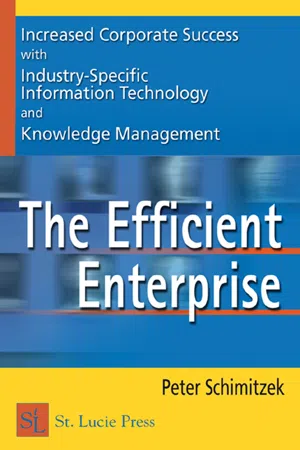
The Efficient Enterprise
Increased Corporate Success with Industry-Specific Information Technology and Knowledge Management
- 440 pages
- English
- ePUB (mobile friendly)
- Available on iOS & Android
eBook - ePub
The Efficient Enterprise
Increased Corporate Success with Industry-Specific Information Technology and Knowledge Management
About this book
In modern business, the availability of up-to-date and secure information is critical to a company's competitive edge and marketing drive. Unfortunately, traditional business studies and classical economics are unable to provide the necessary analysis of such contemporary issues as information technology and knowledge management.
The Efficie
1: SYSTEMATIC VISUALIZATION OF ECONOMY
In today's information society, the quality of information technology determines the effectiveness of corporate management. “Visualization,” or the accurate portrayal of an entire enterprise, is an essential requirement of information systems, as is the efficient implementation of all decisions derived from it. Industry-specific and company-specific software must be able to map business processes at individual companies with the highest possible level of integration. As specialized tools for information processing, industry-specific Enterprise Resource Planning (ERP) software systems have a common responsibility in gaining a competitive edge for enterprises.

Chapter 2 places much emphasis on software engineering technology (exemplified by the CSB-System). An efficient method of software engineering directly helps secure competitive advantages and independence for vendors of industry-specific software systems.
A scientifically secure and holistic model of explanation of economic development must be able to clarify the economic history of the past as well as today's information and knowledge society.
With a theoretical system of visualization, the basic approach toward explication for our world economy must be derivable as a “real system.” This model should not contain any ideological sources or any boundary conditions. Business sciences should gravitate toward natural sciences, and especially toward the efforts of physicists, who seek a model for a “unified theory” as a holistic approach to account for our physical existence. Business sciences are required to far surpass their current function as practical science, and should be politically motivated to seize the task of finding an economic development model that also includes the information and knowledge of society in its theories of factor and commodity market development. Approaches for the development of an information technology theory can be inferred from the economic development theory serving as a description of our real-world system, which can be combined to form the model for a visualization system (as an integrated corporate-specific information system). The task of modeling, in this case, initially consists of finding the smallest visualization units of an information system, which can be defined as visualization elements. To establish a computer-based integration system from these elements, one must define the “integration elements” and their multifaceted linkage to information technology.
1.1 ENTERPRISES IN THE INFORMATION AGE
In light of the purpose and objectives of economics, it is important that successful entrepreneurs be regarded as driving factors for any national economy. The commodities (products and services) introduced by entrepreneurs into the market generally experience higher appraisal than generic goods or, at least for a time, are not really challenged by the generic goods. Entrepreneurs, therefore, enjoy significant corporate success. In addition to positively affecting the national economy, they can also be distinguished by the fact that they create additional innovative potential throughout the company, often resulting in even more highly marketable commodities. In line with corporate objectives, the organization and market position are expanded.
Organizing and implementing goal-oriented activities among organizational units (business and market participants) with the least business interruption is the ultimate task of integrated information technology for corporate management.
Information technology has thus become a strategic weapon for corporate management. State-of-the-art technology in software engineering will have a crucial impact on traditional business practices as well.
1.2 INFORMATION TECHNOLOGY AND ECONOMICS
Modern and cutting-edge information technology significantly affects economic sciences. Traditional business studies were developed in the industrial age, when production and the coordination of production processes for the manufacture of goods were at the center of scientific research. The transition from the industrial age to the information society has moved communication and information technology to the forefront of social change. The practical application of economic activity occurs within the framework of the possibilities provided by information technology. This situation makes it necessary to develop a flexible software solution for integrated corporate management with sufficient options for customization. The question is, however, which scientific foundation, practical insights, or theoretical criteria should serve as the groundwork for industry-specific software for corporate management?
1.3 THEORETICAL BASIS OF MANAGEMENT
One can generally doubt that traditional business studies provide a universal basis to develop valid schemes for all economic entities. Along the same lines, the now long tradition of specialization in business studies proves that one cannot derive cross-industry standardized software for corporate management. Thus, a generally valid and scientifically viable classification of an enterprise (via standardized industry-specific ERP software) applicable to information systems can be built only on the basis of universal factors of economics.
1.3.1 Factors of Performance Potential
The production of goods arises from the targeted combination of current demand factors in the market. According to Erich Gutenberg, corporate performance potential is divided into the following elementary factors of business:
- ■ Labor (provided by private households)
- ■ Operating resources (provided by businesses)
- ■ Materials (provided by business)
- ■ Planning factor (organized and generated within the specific corporate economy)
The performance potential of economic entities becomes effective through the combination of these elementary factors, especially planning. Computer science significantly improves planning abilities when combining the elementary factors. Because it results from technological progress, Gutenberg does not identify computer science as an independent factor, but as a part of planning. The improvement of information flow and information structures now possible in the information age has had a longlasting effect on corporate performance. This effect may be referred to as the “integration factor.” Hence, the consequential positive effects on the entire enterprise must be attributed to integrated information technology. The combining of factors resulting in corporate performance occurs within corporate segments referred to as “functional areas.” These functional areas focus on the combination of factors as determined by the specific corporate industry.
1.3.2 “Integration” as Factor Performance
Integration of the functional areas and functions in an enterprise is an essential requirement for the successful organization of internal and external economic processes that support goal-oriented activity.
Only with this integration can multifaceted procedures be standardized (as repeatable cycles) via the “transmission effect” of application software and thus be truly reproducible. Through the software's multiplying effect, integration acts as an independent dimension of process design within all functional and operative areas of a business. From this it follows that integration is an independent factor. The hardware required for the use of software is, or course, apportioned to the operating resource factor.
The integration effect in information technology across all functional areas presumes that the functional areas have been defined according to generalized criteria. It is important to point out that although different industries are distinguished by various combinations of business factors, each should still be visualized in one overall functional scheme.
To actually state this requirement is both possible and necessary to create an industry-independent model of standard software for corporate management. Therefore, in addition to the above elementary business factors including planning, a further factor is needed: “Integration.”
1.3.3 An Outline of Functional Areas
Neither general nor specific business studies provide a conclusive classification of the functional business areas that would satisfy the organizational requirements of cross-industry standard software for corporate management. Thus, it is necessary to restructure the functional areas in the CSB-System, as follows:
- Management and Controlling
- Performance and Time Management
- Goods and Product Management
- Accounting and Finance
1.3.3.1 Management and Controlling
The effect of planning on the combination of elementary business factors in functional areas should naturally be allocated to the area of corporate management. The term management and controlling implies the following functions for the industry-specific standard software suite of CSB-System:
- ■ Human Resource and Knowledge Management (HRKM)
- ■ Management Information System (MIS)
- ■ Area Information System (AIS)
- ■ Quality Control System (QCS)
Management functions are distinguished by the fact that they are used in a cross-functional manner, enabling planning functions in the entire system of the company.
1.3.3.2 Performance and Time Management
The functional area of time management focuses on the economic element “time”: the standardization of software results in the following outline of functions:
- ■ Human resources (labor)
- ■ Operating resources (assets and aggregates)
1.3.3.3 Goods and Product Management
Here, material is at the center of this business factor. The management of this factor occurs via the following functions in the corporate management system:
- ■ Procurement
- ■ Inventory
- ■ Production
- ■ Sales
The term product management is synonymous with goods management, i.e., the administration of goods and services.
1.3.3.4 Accounting and Finance
Corporate success manifests itself through the performance potential of a combination of innovative factors that make the company effective in the market. These effects in single enterprises are visualized in accounting and finance. The financial and accounting transactions associated with this factor are divided into the following standard programs:
- ■ Payroll
- ■ Asset Accounting
- ■ Financial Accounting
- ■ Cost Center Accounting
These programs are used t...
Table of contents
- COVER PAGE
- THE EFFICIENT ENTERPRISE
- TITLE PAGE
- COPYRIGHT PAGE
- PREFACE—AN ENTREPRENEUR
- ABOUT THE AUTHOR
- 1: SYSTEMATIC VISUALIZATION OF ECONOMY
- 2: IT BUSINESS ORGANIZATION AND CONTROL SYSTEM
- 3: INTEGRATED INDUSTRY-SPECIFIC INFORMATION TECHNOLOGY FOR CORPORATE MANAGEMENT
- GROWTH THROUGH EFFECTIVE CORPORATE MANAGEMENT
- RECOMMENDED LITERATURE
- ENDNOTES
- CSB-SYSTEM APPLICATIONS MENU
Trusted by 375,005 students
Access to over 1.5 million titles for a fair monthly price.
Study more efficiently using our study tools.
Frequently asked questions
Yes, you can cancel anytime from the Subscription tab in your account settings on the Perlego website. Your subscription will stay active until the end of your current billing period. Learn how to cancel your subscription
No, books cannot be downloaded as external files, such as PDFs, for use outside of Perlego. However, you can download books within the Perlego app for offline reading on mobile or tablet. Learn how to download books offline
Perlego offers two plans: Essential and Complete
- Essential is ideal for learners and professionals who enjoy exploring a wide range of subjects. Access the Essential Library with 800,000+ trusted titles and best-sellers across business, personal growth, and the humanities. Includes unlimited reading time and Standard Read Aloud voice.
- Complete: Perfect for advanced learners and researchers needing full, unrestricted access. Unlock 1.5M+ books across hundreds of subjects, including academic and specialized titles. The Complete Plan also includes advanced features like Premium Read Aloud and Research Assistant.
We are an online textbook subscription service, where you can get access to an entire online library for less than the price of a single book per month. With over 1.5 million books across 990+ topics, we’ve got you covered! Learn about our mission
Look out for the read-aloud symbol on your next book to see if you can listen to it. The read-aloud tool reads text aloud for you, highlighting the text as it is being read. You can pause it, speed it up and slow it down. Learn more about Read Aloud
Yes! You can use the Perlego app on both iOS and Android devices to read anytime, anywhere — even offline. Perfect for commutes or when you’re on the go.
Please note we cannot support devices running on iOS 13 and Android 7 or earlier. Learn more about using the app
Please note we cannot support devices running on iOS 13 and Android 7 or earlier. Learn more about using the app
Yes, you can access The Efficient Enterprise by Peter Schimitzek in PDF and/or ePUB format, as well as other popular books in Business & Information Management. We have over 1.5 million books available in our catalogue for you to explore.