- 304 pages
- English
- ePUB (mobile friendly)
- Available on iOS & Android
eBook - ePub
About this book
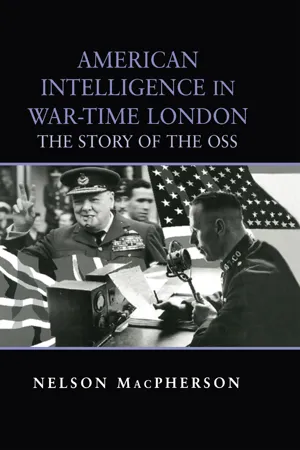
Based on OSS records only recently released to US National Archives, and on evidence from British archival sources, this is a thoroughly researched study of the Office of Strategic Services in London. The OSS was a critical liaison and operational outpost for American intelligence during World War II.
1
The British Intelligence Community: Setting the Tone for OSS
Many OSS members believed unquestioningly in Britain’s intelligence preeminence, and this article of faith has long permeated OSS historiography. The Americans routinely attributed their successful indoctrination into the black arts of intelligence to their special relationship with British spy masters whose professional lineage stretched in an unbroken line from Elizabethan times.1 Their British counterparts no doubt encouraged such a myth; but while British experience indeed proved critical for the development of modern American intelligence, its worth was all the more impressive given the British services’ eccentric antecedents, their impoverishment, their uneven record, and their often hard-pressed operational fortunes. The highly personalized and stubbornly entrenched system of intelligence administration that emerged in wartime was also significant, since this resolutely unchanging arrangement served to mould the dominant structures and rivalries of the tightly knit Anglo-American intelligence bureaucracies. The British example thereby ensured that OSS evolved even more in the likeness of the British intelligence community than has been commonly understood.
Although various court officials had performed intelligence functions for their sovereigns throughout British history, the creation of a professional intelligence establishment within the machinery of executive government was a strictly modern phenomenon. Not until the post-Waterloo period were efforts made within the War Office to formalize intelligence gathering in support of military operations. The Royal Navy followed suit in the mid-1880s, while domestic surveillance developed under the Special Branch during that same period.2 An institutionalized Secret Service finally began to evolve in the late nineteenth century through the collaboration of the Foreign Office and the War Office in utilizing secret service funds to deploy a limited network of agents on the continent and in imperial troublespots.3 The clandestine efforts of this ad hoc system were, however, given an unexpected jolt by the efforts of pulp fiction writers determined to dramatize Britain’s strategic vulnerability. Capitalizing on the growing British fear of invasion by continental powers between 1900 and 1909, authors such as William Le Queux, E. Phillips Oppenheim, and Erskine Childers popularized tales of German invasion plans, the vanguard of which (according to Le Queux in particular) embodied hordes of Teutonic spies. These villains were stymied in the books by a fictional British Secret Service wholly of their authors’ imaginations.4 Harmless in themselves, these yarns began to take hold in the minds of the public and establishment alike, and fanned by the press, escalated into a wholesale spy mania. Where there are suspected spies, there is a cry for counter-measures. Since the organs of the War Office and the Admiralty were not up to the task, there was strong lobbying from within these departments to create the means to verify and confound the knavish tricks of the continental secret services. A sub-committee on foreign espionage of the Committee of Imperial Defence, swayed as much by the fictional spy scenarios as anything else, eventually concurred with that view in 1909. Their report led directly to the establishment of Britain’s first Secret Service Bureau in that same year, modified in 1910 to consist of a War Office home counter-espionage department, and a foreign espionage department under control of the Admiralty.5 Upon the outbreak of the First World War, the Home Section became an element of the newly formed Directorate of Military Intelligence within the War Office in 1916, and was styled as MI5. The Foreign Section also joined the War Office at that time as MI1(c), but control and funding of the department passed to the Foreign Office by the end of the conflict. The exclusive inter-service responsibility of the Foreign Section for espionage, known by then as either the Secret Service, the Special (or Secret) Intelligence Service (SIS), or by its nominal War Office military intelligence cover title of MI6, was only formalized in 1921. The service accordingly reported its information without interpretation to the Foreign Office, was supervised by the Foreign Office, and its espionage system was not to prejudice by association, or supplant, the FO’s political reporting.6
The emphasis with the return to peace was obviously on bureaucratic control. Less attention was paid to the actual execution of such control in terms of establishing operational priorities, and in deploying the limited resources of SIS, especially regarding direction from the armed services. This shortcoming would only be exacerbated throughout the period preceding the Second World War. The lack of funding was a prime reason for this, a problem shared with the defence establishment in general. The SIS budget was reduced from £240,000 in 1919 to £90,000 in 1922, and SIS stressed in 1935 that the lack of finances had, for example, forced the complete abandonment of operations ‘in several countries’ from which information could have been gathered on Italy relevant to the Abyssinian crisis. This state of affairs persisted, with only a small temporary budget increase in the spring of 1938, and led to the armed services complaining about the poor, often non-existent, state of SIS information on German intentions and rearmament.7 It is thus easy to understand why the Official Historians of British intelligence entitled the section of their work dealing with the wartime period from its out-break in September 1939 to the winter of 1941 ‘In the Dark’. The British Secret Service was no all-seeing eye, no invincible collection of cunning experts practicing their craft in the ruthless spirit of raison d’état. Two decades of relative neglect and lack of direction were offset only by a late realization of the need to mobilize intelligence for potential war in the manner of the armed services. The same process of personnel expansion and enhanced operational control in a transition from peacetime structures to those of war had to be made by the SIS.8
One of the most pressing requirements with the onset of war was to develop an effective means of executive control and direction over intelligence. Some progress had been made on this front through the establishment within the Chiefs of Staff organization of a Joint Intelligence Sub-Committee in 1936. It was intended that the JIC would aid the service heads and assist the Joint (i.e., tri-service) Planning Staff by acting as a channel for the dissemination of relevant intelligence in support of higher planning. Actual practice was another matter because the JIC consisted merely of service intelligence deputies who showed little initiative in providing appreciations, and who were seldom consulted by the JPS. There was, curiously, no SIS representation. It became clear by June 1939 that closer integration was required of the service intelligence departments, and that Foreign Office political input would have to be incorporated into the JIC as well. The Sub-Committee from then onwards consisted of the service intelligence chiefs or their deputies, and a Counsellor from the FO who also served in the capacity of unofficial chairman. Still without SIS participation, the JIC was now formally expected to assess and co-ordinate intelligence for the Chiefs of Staff in order to effect the most sound basis for Government policy, and to contribute toward improving the ‘efficient working of the intelligence organization of the country as a whole’.9 This essentially amounted to a mandate to produce operational intelligence appreciations for the War Cabinet and COS, and it was a nominal first for British intelligence. While the JIC was best suited to compare and assess the widest range of information, it still must be noted that the JIC only centralized strategic assessments, not the management of the intelligence system as a whole. Even this innovation was problematic until the creation of a Joint Intelligence Staff in May 1941 to ease the committee’s debilitating workload by drafting basic appreciations for JIC consideration and approval. By also serving as a ‘corporate memory’ for the British intelligence system, the JIS established a firm foundation for the systematic influence of intelligence on British strategy. This in itself was a laudable accomplishment, but it nevertheless failed to resolve the thorny issue of how best to coordinate the component clandestine services within the intelligence system. It was as yet unclear how the competing interests of the various departments—Foreign Office, War Office, Admiralty—could be equably balanced, and it was assumed that intelligence was best left in the hands of the various departmental masters.10
One consequence of the ongoing fractured direction of intelligence operations was revealed through the convoluted, nearly arthritic, attempt to organize clandestine sabotage before the German onslaught of May 1940. A French General of the Secretariat General de la DéfenseNationale contacted the British Military Secretary to the War Cabinet, Major- General Hastings Ismay, on 26 January 1940 with a proposal for a combined sabotage programme against German railways and other lines of communication. Ismay in turn forwarded the scheme to the Director of Military Intelligence, Major-General F.G.Beaumont-Nesbitt, who in early February passed it on to Military Intelligence Research (MIR), that element of the General Staff designated to plan such activities.11 Their conclusions, communicated to Ismay by Beaumont-Nesbitt on 3 March, were that the French plan had merit if widely executed over some time with a thorough organization. This would obviously require a degree of inter-service and inter-Allied coordination that in the DMI’s view still left something to be desired. While MIR studied sabotage and guerrilla warfare, SIS was expected to execute any specific projects. SIS tended to do this with no reference to the military, which the DMI considered ‘fundamentally wrong’. The Foreign Office and the three service intelligence chiefs had met in the preceding weeks to fashion greater coordination, but more needed to be done. Beaumont-Nesbitt suggested that all sabotage projects be submitted to a special all-service committee under the control of, and answering to, the JIC. The JIC would then decide on further action, including delegating responsibility for execution to the military services or SIS. The DMI was convinced that even this ponderous set-up, dictated by the circumstances of intelligence organization, ‘would be an improvement on our present haphazard methods’. Coordination with the French would see their utilization of a similar mechanism, and both would then report to an ‘inter-Allied JIC’ for the execution of a combined programme.12
Ismay replied two days later that while the DMI’s proposals were ‘thorough’, a less formal but equally effective alternative would be to make the War Office responsible for all such projects, and that they could then devise ‘the necessary arrangements’ for the requisite harmonized effort. How exactly the War Office was supposed to obtain the cooperation of the other competing bodies and departments went unsaid. Subordinating such operations to the Army made sense, but only if the DMI had sufficient authority, which he did not.13
The DMI’s suggestion therefore found favour with the JIC, which agreed to the formation of an Inter-Services Project Board. Both Ismay and Sir Edward Bridges, the Secretary to the War Cabinet, emphasized JIC control of the board.14 The First Lord of the Admiralty, Winston Churchill, was not impressed by this development. He commented that the ISPB would ‘be only another piece of clogging machinery set up in the path of action’. Churchill ‘understood that these matters were primarily the care of Colonel Menzies who has representatives of the three [service] Intelligence Departments either in, or in close contact with his organization’, that being SIS.15 As Deputy to the preceding Chief of the Secret Service (CSS, or by traditional appellation, simply ‘C’), Menzies had succeeded to the leadership of SIS in November 1939, and the First Lord wanted the ISPB blueprint submitted by ‘C’ and the JIC for Cabinet approval.16 Churchill evidently soon relented, with the proviso that the suggested board be ‘under Lord Hankey [Minister without Portfolio], who with Colonel Menzies ought to be the channel through which all such projects pass. To have it as a separate piece of mechanism would be at once redundant and conflicting.’17 Hankey himself had not been given time for ‘a considered opinion’ on the matter, although he was inclined to feel ‘that the proposed board was on much too low a level and that coordination in these matters ought to be carried out on a very high level so that approval for projects could be given without the full War Cabinet being consulted’. He was nevertheless prepared to concur with Churchill.18
The JIC set out their formal proposition on the subject to the War Cabinet on 26 April. It emphasized the increasingly inter-departmental nature of sub rosa operations, particularly of those ‘irregular’ actions in support of the Government’s economic warfare strategy designed to blockade Germany into capitulation. The ISPB was therefore intended as ‘an advisory and consultative body’ made up of ‘comparatively junior officers’ (Lieutenant-Colonel grade) from SIS and the service departments, and to be distinct from the JIC in order to avoid the apparently disquieting spectre of ‘unnecessary formalities’.19 This document was considered and accepted by the Deputy Chiefs of Staff on 29 April 1940, just in time to be rendered largely irrelevant by the decisive German offensive that began on 10 May.20 The dispersion of intelligence functions and bodies, the limitations of the JIC, and the Secret Service’s detachment therefrom had obviously served as considerable stumbling blocks in the attempt to fashion a timely and effective means of directing sabotage activities. British intelligence direction on the eve of disaster was undeniably diffuse and impracticable.21
With a Shakespearean sense of timing, Churchill succeeded to the premiership on the day of the German assault as a result of the fall of Neville Chamberlain after the April debacle in Norway. Churchill came to the premiership with a long history of dealings with intelligence throughout his Cabinet service. As Secretary of War in 1920, he had even recommended that MI5 and SIS be combined as an economy measure. This proposal was not accepted, and Churchill himself reflected that the marriage of ‘distinct and very secretive organizations…cannot be brought about in a hurry having regard to the peculiar nature of the matters dealt with and the importance of not distu...
Table of contents
- Cover Page
- Title Page
- Copyright Page
- Acknowledgements
- Abbreviations
- Introduction
- 1 The British Intelligence Community: Setting the Tone for OSS
- 2 The Genesis of OSS/London, and the British Dimension
- 3 Servants of Overlord: So, Si, and the Invasion of Europe
- 4 Reductio Ad Absurdum: R&A/London’s Quest for Relevance
- 5 Falling Short of the Target: EOU, SIRA, and the Pitfalls of R&A
- 6 Inspired Improvisation: William Casey and the Penetration of Germany
- 7 Following the British Example: X-2 and Morale Operations
- 8 Full Circle: Anglo-American Intelligence and the Transition to Cold War
- Conclusion
- Bibliography
Trusted by 375,005 students
Access to over 1.5 million titles for a fair monthly price.
Study more efficiently using our study tools.
Frequently asked questions
Yes, you can cancel anytime from the Subscription tab in your account settings on the Perlego website. Your subscription will stay active until the end of your current billing period. Learn how to cancel your subscription
No, books cannot be downloaded as external files, such as PDFs, for use outside of Perlego. However, you can download books within the Perlego app for offline reading on mobile or tablet. Learn how to download books offline
Perlego offers two plans: Essential and Complete
- Essential is ideal for learners and professionals who enjoy exploring a wide range of subjects. Access the Essential Library with 800,000+ trusted titles and best-sellers across business, personal growth, and the humanities. Includes unlimited reading time and Standard Read Aloud voice.
- Complete: Perfect for advanced learners and researchers needing full, unrestricted access. Unlock 1.5M+ books across hundreds of subjects, including academic and specialized titles. The Complete Plan also includes advanced features like Premium Read Aloud and Research Assistant.
We are an online textbook subscription service, where you can get access to an entire online library for less than the price of a single book per month. With over 1.5 million books across 990+ topics, we’ve got you covered! Learn about our mission
Look out for the read-aloud symbol on your next book to see if you can listen to it. The read-aloud tool reads text aloud for you, highlighting the text as it is being read. You can pause it, speed it up and slow it down. Learn more about Read Aloud
Yes! You can use the Perlego app on both iOS and Android devices to read anytime, anywhere — even offline. Perfect for commutes or when you’re on the go.
Please note we cannot support devices running on iOS 13 and Android 7 or earlier. Learn more about using the app
Please note we cannot support devices running on iOS 13 and Android 7 or earlier. Learn more about using the app
Yes, you can access American Intelligence in War-time London by Nelson MacPherson in PDF and/or ePUB format, as well as other popular books in History & Military & Maritime History. We have over 1.5 million books available in our catalogue for you to explore.